

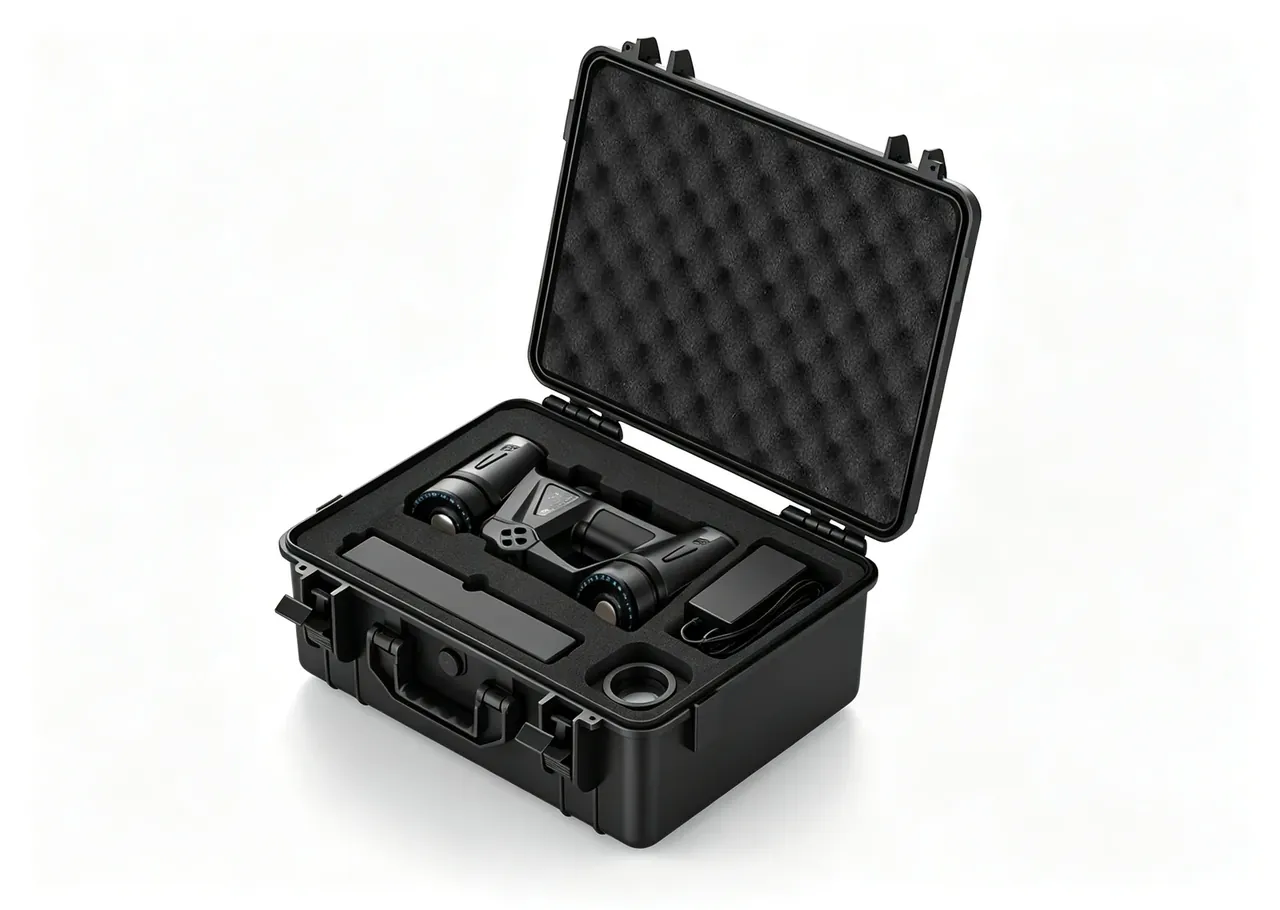
Quick answer: Case coastal use takes three rinses — 0.1 MPa for 30 s, 0.2 MPa for 60 s, 0.15 MPa for 40 s at 30 ℃ — plus 4 h of drying and residue under 50 mg/m².
Table of contents
- Why residue has to come off
- Three rinse stages
- Pressure 0.2 MPa and water at 30 ℃
- Springs, rivets and hinge gaps
- FAQ
1. Why residue has to come off
A case that spent 3 months on a coast, rinsed once before storage, showed red spots 1–2 mm across at the rivet heads on day 90. The order of those spots follows the amount of salt left behind.
Coastal mist carries 5% NaCl at pH 6.5–7.2, and evaporation leaves crystals of 5–20 μm on the shell. They do not dissolve in oil and do not blow away; only water lifts them again.
Salt in a gap keeps drawing moisture. At 65% relative humidity the grain sits under a film a few micrometres thick, chloride crosses the passivation layer, and the oxygen-starved gap bottom becomes a differential cell that eats the metal under the rivet head first.
The eye registers pits only above 0.2 mm. At 50 mg/m² the shell still looks clean, yet by the time a spot shows, corrosion has reached 20 μm into the substrate.
Field records are lopsided: rivet heads take 62% of the pits, latch springs 21%, hinge pins 12% and the relief valve plate 5%. Every one sits in a gap while the flat panels stay clean, and the corners held 1.2 mm of deposit against 0.1 mm on vertical walls. Rinse bottom-up so runoff never crosses a cleaned face.
2. Three rinse stages
The rinse splits into three stages, each with its own pressure, time and purpose. Compressing them into one pass pushes salt from the surface into the gaps.
| Stage | Action | Pressure | Time | Removes |
|---|---|---|---|---|
| Pre-rinse | Top-down flooding, gun 150 mm away | 0.1 MPa | 30 s | 80% of loose crystals |
| De-salting | 1% neutral detergent, soft brush in gaps | 0.2 MPa | 60 s | Salt crust inside gaps |
| Final rinse | Clean water, one direction, no return | 0.15 MPa | 40 s | Detergent and free chloride |
Stage one moves the coarse grains. Dry crystals grip hard, so hitting them at 0.2 MPa drives them into a spring cavity 0.8 mm wide where later stages cannot follow.
Stage two uses 30 ℃ water with 1% neutral detergent at pH 6.5–7.2. Alkaline cleaners attack the anodised layer on aluminium and acid accelerates pitting; 1% is already above the critical micelle concentration, so stronger mixes only leave a film.
Stage three is clean water only, pushed from one end to the other without scrubbing back. Three stages use about 6 L, 4 L more than a single pass, and drop residue from 300 mg/m² to below 50 mg/m².
The sequence runs 130 s a case, so one operator with one gun finishes 200 a day. Squeezing it into a 90 s high-pressure pass saves 40 s but lifts rework from 3% to 18%, which is why a timer at each stage beats judging by feel.
3. Pressure 0.2 MPa and water at 30 ℃
Case coastal use sets the gun at 0.2 MPa, or 2 bar at the nozzle. Held 150 mm from the shell that gives about 0.05 MPa of dynamic pressure — enough to lift salt from a gap, not enough to peel a gasket lip.
Above 0.6 MPa the job fails. The gasket lip seals at only 0.02 MPa, so a jet angled into the joint lifts it 0.3 mm and water walks into the case; below 0.1 MPa the crust does not move at all.
Water at 30 ℃ sits between speed and material limits. Salt dissolves about 40% faster than at 10 ℃, so 60 s carries away half again as much crystal, while 45 ℃ softens the foam adhesive and 70 ℃ for 24 h leaves 15% compression set in a gasket.
A 40° fan tip covers 80 mm and, at 0.3 m/s, gives each point 1.2 s of water. A 0° jet forces water into the breather hole of the relief valve and anything past 65° spreads the force until the salt stops moving.
Put the gauge at the gun, not the pump: a 10 m hose of 8 mm bore loses 0.03 MPa, so a pump reading of 0.23 MPa delivers 0.2 MPa at the nozzle. Reused water goes into stage three only below 500 μS/cm, or the final rinse lays a fresh layer of salt back on.
4. Springs, rivets and hinge gaps
Three places need individual work after case coastal use: the latch spring cavity, the underside of each rivet head and both ends of the hinge pin. Their gaps measure 0.8 mm, 0.3 mm and 0.4 mm — water reaches them, pressure does not.
Work the spring cavity with a 20 mm soft brush of 0.15 mm bristle, five strokes along the axis, then cycle the latch 3 times so salt leaves with the stroke.
Turn a φ5 mm cotton bud twice under each rivet head. A rivet is a blind fixing, water cannot reach the bottom, and the bud is the only thing that carries salt out.
Put 2 drops of clean water at each end of the hinge pin, cycle the hinge 5 times, then rinse. Never press the relief diaphragm: its 0.3 kPa opening pressure depends on moulded shape, and one push leaves it offset. Where latches come off without tools, remove them and rinse the bare joint at 20 s a point.
Drying takes 4 h and is the step most often skipped. A blind rivet head holds 0.02 mL and a hinge bush 0.05 mL; close the lid on either and the vapour shows as mist at the next opening. Two hours of 40 ℃ air, one dry wipe and 2 h of ventilation clears it, and chloride is read on a 100 mm × 100 mm wipe below 50 μS/cm.
Conclusion
The whole case coastal use rinse fits on one card: 0.1 MPa for 30 s, 0.2 MPa for 60 s, 0.15 MPa for 40 s, then 4 h of drying. Skip a step and residue climbs back toward 300 mg/m². Keep the jet under 0.6 MPa and the water under 45 ℃, because those two limits protect the gasket and the foam adhesive. Judge on chloride alone: below 50 mg/m², runoff under 50 μS/cm, and no rivet spots after 3 months. A crew that runs the card every 7 days spends 130 s a case and never buys hardware to replace rusted springs, which is the cheapest outcome available at the coast.
| Step | Setting | Pass criterion |
|---|---|---|
| Pre-rinse | 0.1 MPa, 30 s | No visible crystals |
| De-salt | 0.2 MPa, 30 ℃, 60 s | No white crust in gaps |
| Final rinse | 0.15 MPa, 40 s | Runoff ≤50 μS/cm |
| Drying | 40 ℃ 2 h plus 2 h air | No film inside gaps |
| Verdict | Chloride ≤50 mg/m² | No rivet spots for 3 months |
This article discusses container-side specifications and design implications only, and does not cover any handling, loading or use of the contents.
Related Reading
- Washing salt deposits off cases
- How case hardware behaves in salt spray
- Choosing latch hardware for cases
- Protecting cases in sea freight
Related Products
- 8 Series — Gun Cases; Military Equipment Cases; Camera Equipment Cases; Drone Cases; Watch Cases; Knife Cases; First Aid Cases; Electronics Equipment Cases
- WL8-2812 PP Gun Case — model WL8-2812
- All protective cases and toolboxes: 7 series, 158 models