

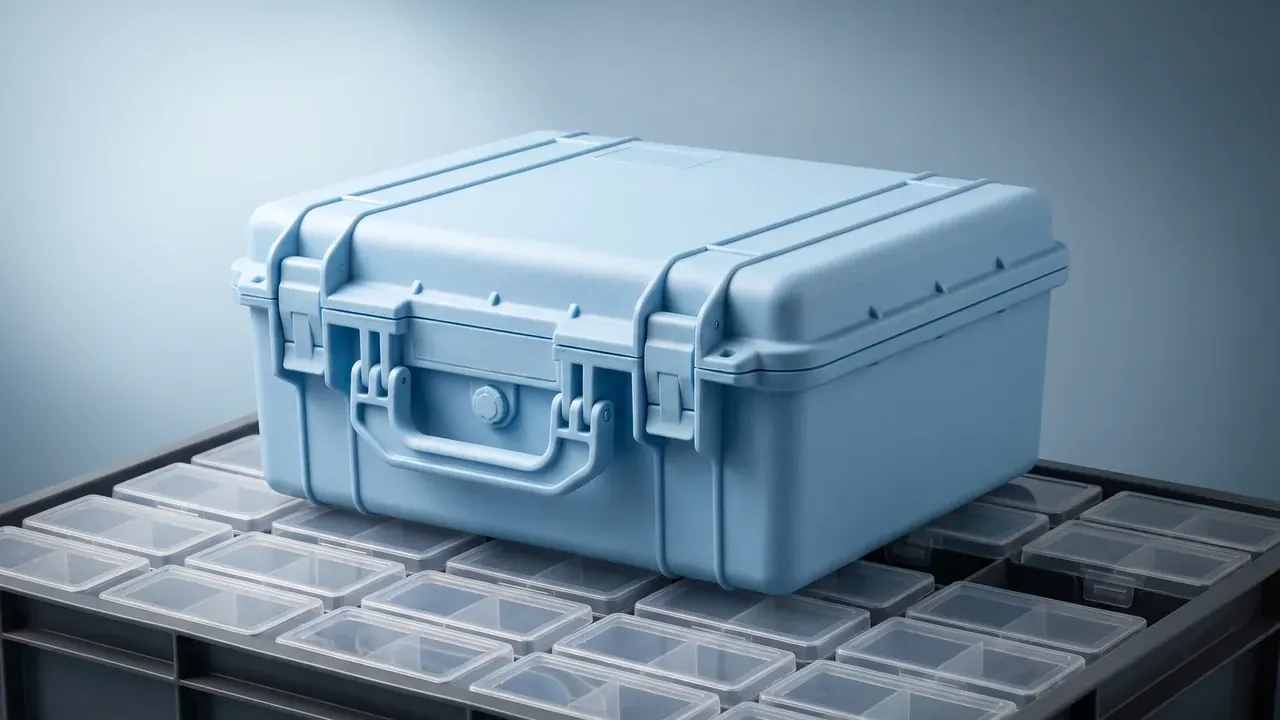
Quick answer: A roadside assistance tool case is marked for 50 m visibility before its insert is designed. At minus 20 C the latches and hinge decide failure.
Table of contents
- Twelve Items for a Roadside Call
- Three Brittle Points at Minus 20 C
- Reflective Marking at 50 m
- Four Seconds and Two Latches
- Three Bays for Sign, Jack and Tools
- FAQ
1. Twelve Items for a Roadside Call
A roadside assistance tool case has to be seen from 50 m at minus 20 C, so reflective marking comes before the insert. The list is the easy part: drop what a driver will not use or will misuse, then order the rest by the sequence of a call.
Twelve items is a number a driver can hold under pressure. More and the roadside assistance tool case becomes a rummage; fewer and one missing part turns one call into two. The torch decides whether the triangle can be placed after dark, and the gloves decide whether anyone kneels in snow to change a wheel.
| No. | Item | Bay |
|---|---|---|
| 1 | Warning triangle | Sign bay |
| 2 | Hi-vis vest | Lid, flat |
| 3 | Torch | Lid, clip |
| 4 | Cable ties | Tool cells |
| 5 | Jump leads | Tool bay |
| 6 | Tow rope | Tool bay |
| 7 | Tyre inflator | Tool slot |
| 8 | Scissor jack | Jack cradle |
| 9 | Wheel brace | Jack sleeve |
| 10 | First aid pouch | Lid pocket |
| 11 | Extinguisher | Tool clamp |
| 12 | Work gloves | Lid pouch |
2. Three Brittle Points at Minus 20 C
Isotactic polypropylene passes its glass transition near minus 10 C, where notched impact strength has already dropped 40 to 60%, and by minus 20 C the toughness left is a fraction of the room-temperature figure. Thicker walls do not answer that; finding the three thinnest, most loaded locations and changing material there does.
The latch tongue. The root is often 3 mm thick, the thinnest solid section in the case, and one side impact in the cold snaps it there. Material beats thickness: mould it in impact copolymer or POM instead of adding wall.
The hinge boss. Pin clearance is set at 0.2 to 0.5 mm for room temperature, yet PP expands at roughly 1.5 × 10⁻⁴ per C, so a 40 C drop eats most of it, the pin stiffens and forcing the lid cracks the boss.
The corner wall. Where the wall steps from 3.5 mm to 5 mm the moulding cools unevenly and leaves stress along the transition. Nothing shows for six months, then the first hard frost drives a crack down the rib line.
3. Reflective Marking at 50 m
Grade decides whether a roadside assistance tool case is seen, not area. At 60 km per hour a car covers 16.7 m per second, so 50 m is three seconds of warning for the driver behind.
Under ASTM D4956, Type III white sheeting returns about 250 cd/lx/m² at a 0.2 degree observation angle and -4 degree entrance angle; Type I returns roughly 75. Night headlamps turn that threefold gap into a lit object against a smudge, for less than the price of a coffee.
The adhesive is the second trap: low-temperature grades such as Class 4 carry an application floor around minus 7 C, and a strip applied outdoors below that lifts at the corners within a week. Strips therefore go on the roadside assistance tool case at the factory, and a field replacement is a whole lid panel.
Three positions cover the shell: a horizontal strip across the lid and one vertical strip on each side wall, all clear of latches, handle and lid seam. Anything that cannot sit flat peels from that edge first.
4. Four Seconds and Two Latches
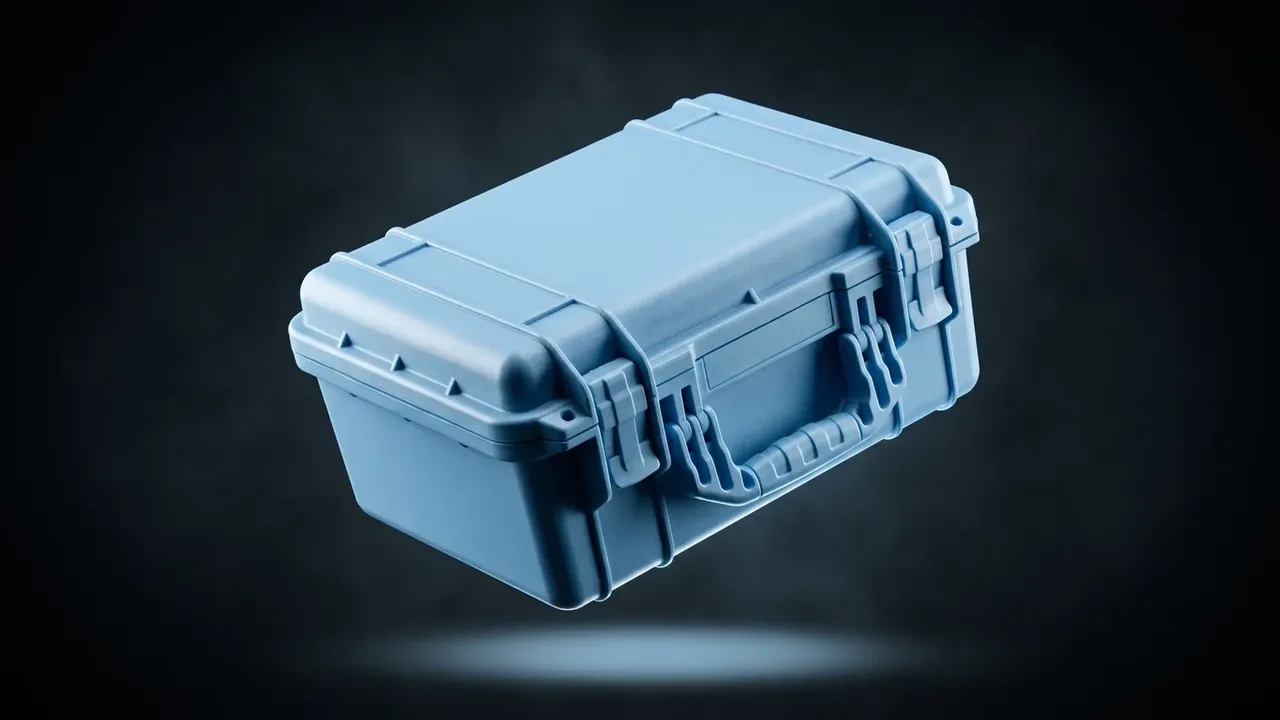
Define the four seconds before arguing about them: from the hand landing on the handle to the lid being liftable, torch still held. On that definition two independent latches fail, because one hand releases one latch at a time.
So the roadside assistance tool case has two routes. A single central latch is fast but cannot press the ends of the rim, the gasket lifts in the middle and rain gets in. Keeping two latches and adding a tie bar lets one finger pop both: about 2 seconds of release, four with the lift.
The tie bar costs three extra parts, one assembly step and one cold-weather failure node, which is why its pins are stainless rather than moulded. A plastic pin hardens with the roadside assistance tool case at minus 20 C and the linkage stops being a linkage.
Two latches also buy something quieter than speed: clamp force lands at both ends of the rim, the gasket compresses evenly, and splash resistance still holds after two winters in a boot.
5. Three Bays for Sign, Jack and Tools
The three bays follow weight and sequence, not size. The sign bay is a flat slot at 450 x 90 x 40 mm, since a folded triangle runs about 30 mm thick and must slide out without catching an edge; it sits at the top, so one bend at the tailgate reaches it.
The jack bay sits on the handle side, low and near the middle. A ten-kilo jack near the centre of gravity keeps the roadside assistance tool case from tipping on a single-hand lift, and a 5 mm pad under the bay stops the base from bruising the floor.
The tool bay on a roadside assistance tool case takes the remainder, split by dividers. Noise is the lesser reason; the real one is finding a part by touch in the dark.
Walls between bays run 2 mm or more and double as stiffeners, because a thin wall bows under the jack and lets the next bay's contents slide across.
Conclusion
Splitting 12 items across 3 bays and holding 4 seconds for the two most used ones gives a roadside assistance tool case its shape. Minus 20 C governs the material and 50 m governs the marking, and a compromise on either shows up on the first call.
This article deals only with the specification and design meaning on the container (case body) side, not with any handling, loading or use of the contents.
Related Reading
- Incoming inspection checklist
- Handle load and two-person lift
- Cartons and cases in packing
- Foam against dividers
JUNZHIJIA
Related Products
- 8 Series — Gun Cases; Military Equipment Cases; Camera Equipment Cases; Drone Cases; Watch Cases; Knife Cases; First Aid Cases; Electronics Equipment Cases
- WL8-2812 PP Gun Case — model WL8-2812
- All protective cases and toolboxes: 7 series, 158 models