

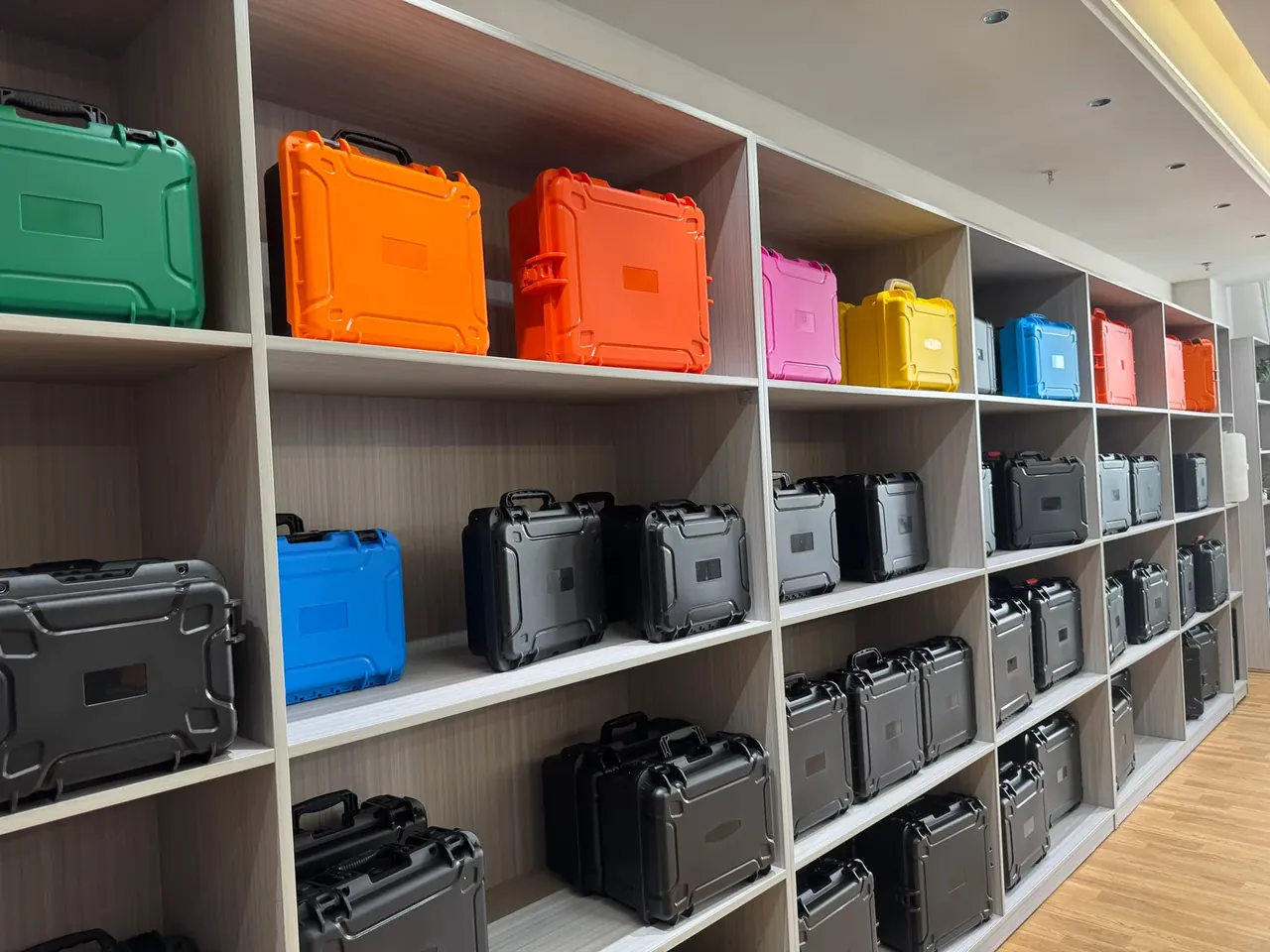
Quick answer: Salon Barber Tool Case bays run 6 to 9, with a 220 mm shear slot, a 90 mm dryer bay, a 12 kg handle and latches tested to 5000 cycles.
Table of contents
- Where Clipper and Shear Cavities Differ
- How Much Cooling Clearance a Dryer Bay Needs
- Laying Out Shallow Slots for Consumables
- Surface Treatment Against Wax and Perm Lotion
- Load Points for Hand Carry and Shoulder Carry
- Latch Selection for Constant Opening
- FAQ
1. Where Clipper and Shear Cavities Differ
A barber knows within one reach whether a case works: the blade either clears the lid or it does not. A clipper is a block with a blade head, a shear is a thin body with finger rings, and a Salon Barber Tool Case has to give them clearance in opposite directions.
Clippers eat depth; shears eat length. A standard clipper with its blade measures 150 to 180 mm by about 50 mm, so a bay 60 mm wide and 55 mm deep is enough, with a 5 mm step at the blade end and 5 mm of air beneath the body. Shears need a 220 mm slot, because a 6 inch flat shear plus rings and a tip guard adds 40 mm of footprint; below that the tip rubs the lid liner and the edge dulls in three months. Thinning shears get their own bay, since their teeth bend if anything presses them.
| Tool | Shape driver | Bay clearance | Draw action | Typical mistake |
|---|---|---|---|---|
| clipper | block with blade head, 150 to 180 mm | 60 mm wide, 55 mm deep | drops in blade down | bay floor touches the vents |
| flat shear | long and slim, 6 inch | 220 mm long, 25 mm wide | angled in, edge up | slot too short, tip hits the lid |
| thinning shear | thin teeth, easily bent | 220 mm long, 25 mm wide | own bay, foam under teeth | shares a bay, teeth bend |
2. How Much Cooling Clearance a Dryer Bay Needs
The dryer takes the most room and runs the hottest. Folded at the handle it measures 220 to 240 mm, the nozzle is 45 to 50 mm across, and the housing reaches 60 to 70 C just after switch-off. Give the bay 90 mm of width and 10 mm of air each side.
Drill the floor. Three holes of 6 mm, offset 30 mm from the cable exit, send heat down instead of through the lid gap. Never mould a tight bay: ABS deflects at 80 to 105 C under 1.82 MPa, so a 70 C housing resting on the wall softens a dent that catches the Salon Barber Tool Case dryer on every later use.
3. Laying Out Shallow Slots for Consumables
Consumables turn to chaos fastest. In a Salon Barber Tool Case, clips, bands, neck strips, oil, spray bottles and wipes differ so much that one big compartment blends them into a heap in two uses.
Hold the bay count at 6 to 9 with 3 or 4 shallow. Slot depth runs 15 to 20 mm, about 5 mm less than the item, so a fingertip pinches the edge; past 25 mm small parts fall out of reach. Keep ribs at 3 mm or thicker, since a thinner rib distorts as it shrinks and turns the slot trapezoidal.
| Consumable | Unit size | Slot depth | Position | Restock rhythm |
|---|---|---|---|---|
| clips and bands | small, stackable | 15 mm | lid-side slot | topped up weekly |
| neck strips | flat, 100 per pack | 20 mm | upright wall slot | whole pack swapped |
| clipper oil | 50 mL bottle | 20 mm | round pocket | replaced when low |
| spray bottle | 50 mm cylinder | 20 mm | round pocket with clip | replaced when empty |
4. Surface Treatment Against Wax and Perm Lotion
Salon chemicals are harsher than most Salon Barber Tool Case buyers expect. Wax carries mineral oil that migrates into ABS pores, perm lotion is alkaline and leaves a pale ring overnight, and setting spray lifts ordinary screen print in one pass.
ABS itself resists oil and alkali, so the weak point is the print. Specify alcohol-resistant ink and prove it at 50 rubs with a 75% alcohol cloth at 500 g; standard ink whitens at 15. The aluminum frame wraps the ABS lip so wax lands on metal and wipes clean, and acetone stays off a Salon Barber Tool Case entirely, fogging the surface in 30 seconds.
5. Load Points for Hand Carry and Shoulder Carry
A loaded box runs 8 to 10 kg, of which 1.8 to 2.4 kg is the shell. The handle is rated 12 kg, twenty percent spare, and that margin covers the swing of a one-handed lift where the load peaks at 1.5 times static.
The root must land on the frame. A handle fixed to the thin wall alone whitens around the screws after ten lifts, so fit a 2 mm plate at each end and rivet it to the frame at 40 mm centres. A shoulder ring sits 30 mm above the centre of gravity and 10 mm to the rear of the narrow face, which keeps a Salon Barber Tool Case off the hip without swinging.
| Carry mode | Load point | Hardware spec | Empty weight | Where it suits |
|---|---|---|---|---|
| one hand | handle root riveted to frame | handle rated 12 kg | 1.8 to 2.4 kg | between chairs in the salon |
| shoulder | ring on upper narrow edge | ring bore 25 mm | 1.8 to 2.4 kg | home visits and teaching |
| two hands | long edge, load through frame | no hardware | 1.8 to 2.4 kg | short moves when full |
6. Latch Selection for Constant Opening
A Salon Barber Tool Case opens dozens of times a day and passes ten thousand cycles a year. The 5000-cycle test is conservative and checkable: the spring still self-locks, the tongue shows no wear step, and the feel has not gone slack.
A push latch beats a draw latch indoors, because a draw latch needs two hands. Specify 0.8 mm stainless rather than 0.5 mm, which softens near 3000 cycles. Below 380 mm of width one latch is enough; a Salon Barber Tool Case at 400 mm needs one at each end plus a locating pin, with 2 mm tongues so a fall onto tile does not open them.
Conclusion
Working from the tool list backwards means laying tools out before drawing a grid: clippers take depth, shears take length, the dryer takes air, consumables take shallow depth. A Salon Barber Tool Case lasts because that grid was right at the start.
Related Reading
- Handheld tool cases with a tray
- Removable tray layouts in tool boxes
- Choosing and proving a latch
- How a consolidated tool kit is organised
This article covers the container (case) side of specifications and design intent only; it does not address any handling, loading or use of the contents.
JUNZHIJIA
Related Products
- 8 Series — Gun Cases; Military Equipment Cases; Camera Equipment Cases; Drone Cases; Watch Cases; Knife Cases; First Aid Cases; Electronics Equipment Cases
- WL8-2812 PP Gun Case — model WL8-2812
- All protective cases and toolboxes: 7 series, 158 models