

Quick answer: A sealed plastic carrying case holds water out through lip compression and latch preload, while the valve decides whether pressure can escape. A torch, a spring scale and a stopwatch will rank three samples on the factory floor.
Table of contents
- Two lips, not one gasket
- Give the pressure somewhere to go
- Latch preload, measured with a spring scale
- Handle load and opening seconds
- The line between seal margin and opening time
- FAQ
1. Two lips, not one gasket
A sealed plastic carrying case does not seal because the latches crush the lid shut, but because a lip is compressed and springs back into the gap. One lip has a single edge where water enters; two lips trap an air pocket, the outer blocking water and the inner blocking air, so both must fail.
| Seal type | Compression | Opening effort | Usual leak path | Opening frequency |
|---|---|---|---|---|
| Single lip | 25%–30% | Light | Rolled lip edge | A few times a month |
| Twin lip, air pocket | 22%–26% | Medium | Both lips failing | A few times a day |
| Twin lip, moulded corners | 18%–24% | Heavy | Thin spot at the corner | Ten times a day or more |
Field checks need no disassembly. Run a torch along the joint and look for light inside, then drag a 0.05 mm feeler gauge around it: wherever it enters, the lip is not compressed. Twin lips run 22–28 percent compression; below 20 percent a dished lid stops sealing, above 32 percent the lip loses rebound.
2. Give the pressure somewhere to go
A 40 L case trucked from sea level to 2,500 m carries roughly 0.3 bar across the lid, close to 1,200 N of force. Without a valve that force goes through the latches, and 40 kgf of pull is needed before the lid moves; with one, five seconds of pressing or unscrewing balances it.
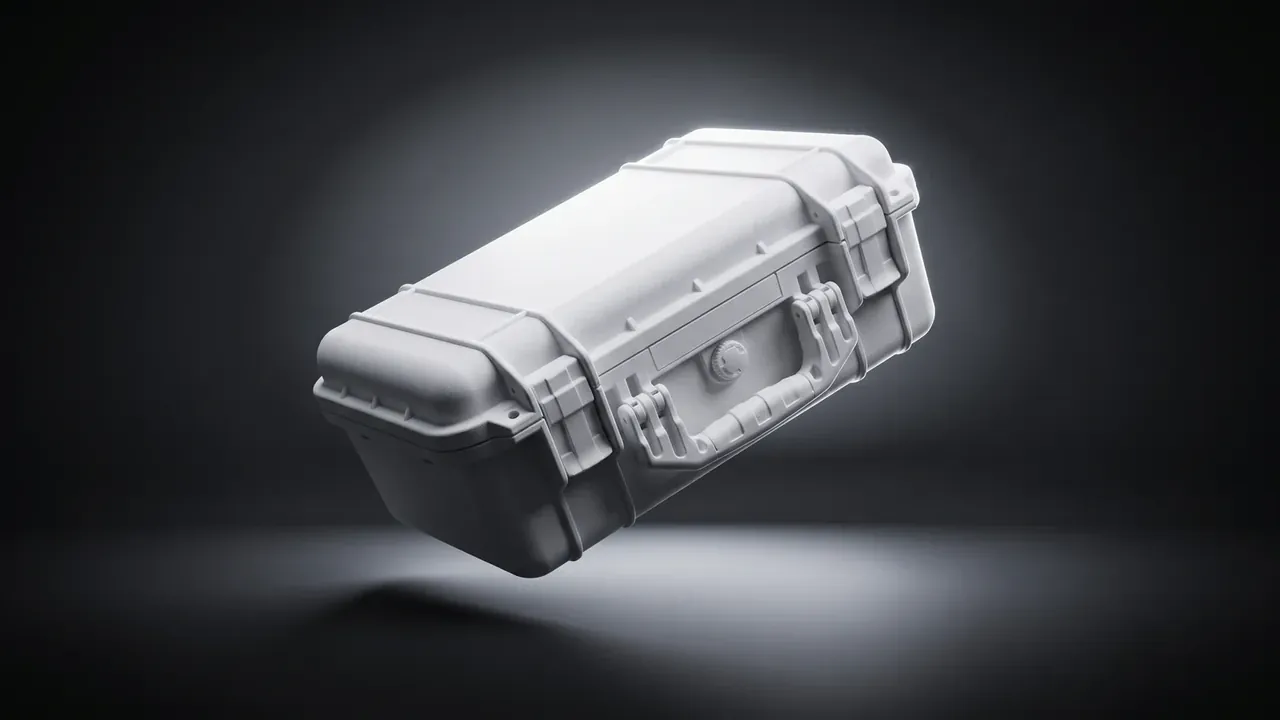
The hard part of a valve is water, not air. The membrane opens on outward flow and must close at 0.1 bar reversed. Sink the closed case to 30 cm for 30 minutes, dry it, then look for a watermark inside the valve.
3. Latch preload, measured with a spring scale
Preload, not clamping force, is what a latch contributes. The lid edge travel after closing is the preload, normally 1.5–2.0 mm; under 1.2 mm the gasket only touches, over 2.5 mm the latch ears whiten.
- Pull: hook a spring scale on the latch edge and pull straight, 60–90 N means the preload is right
- Measure: gauge the lid gap closed and open, the difference is the preload, 1.8 mm is common
- Listen: one dull click is correct, two sharp clicks mean the latch slipped mid-travel
- Order: close diagonally, front left then rear right, so four latches share the load
Decay deserves its own number: after 5,000 cycles the preload should lose under 0.3 mm, beyond which the hook is probably homopolymer.
4. Handle load and opening seconds
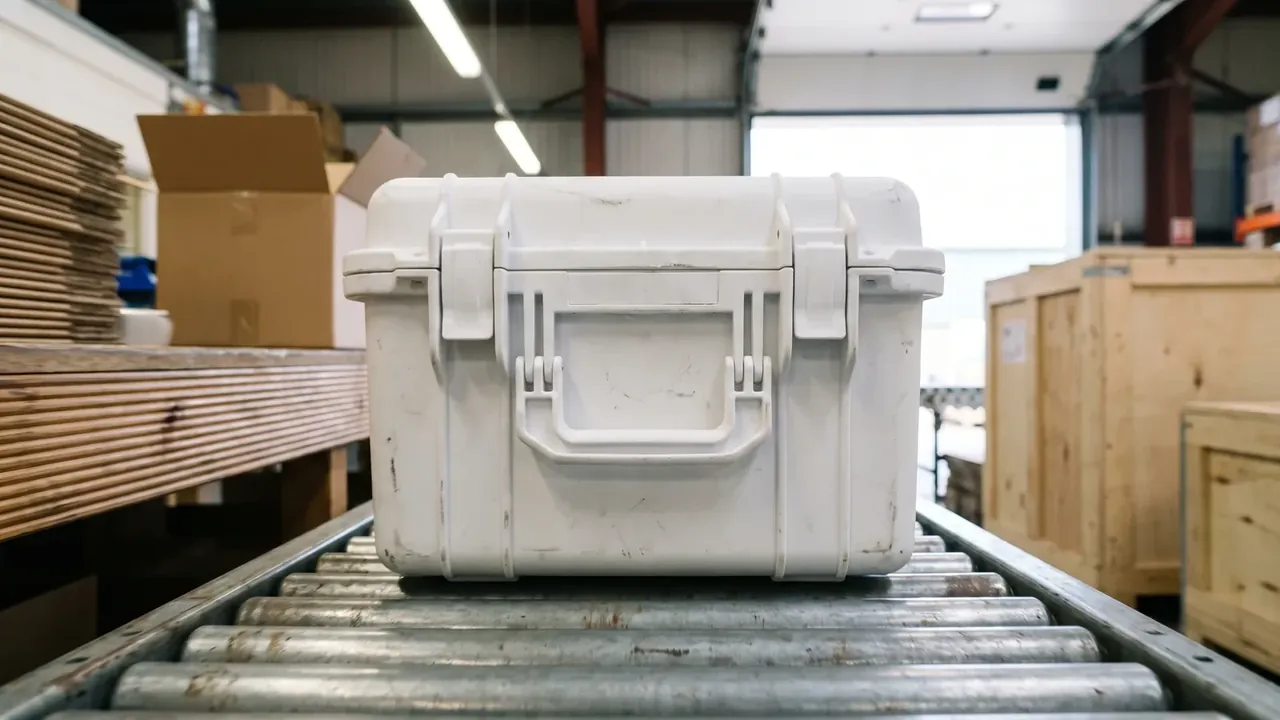
The handle is the only part under sustained load and the first to be treated as an accessory. Carrying 18 kg for 200 m without a whitened shell is the pass mark; 28 kg hung for 30 minutes should leave under 2 mm of set.
| Layout | Latches | Opening time | Static handle load | Seal margin |
|---|---|---|---|---|
| Single lip, two latches | 2 | 6 s | 22 kg | Low |
| Twin lip, four latches | 4 | 12 s | 28 kg | Medium |
| Twin lip, four latches, valve | 4 | 14 s | 28 kg | High |
Two latches take a practised hand 6 seconds, four take 12, a valve adds 2; at 20 openings a day that is 7,300 a year, and the layouts differ by 12 hours.
5. The line between seal margin and opening time
Seal and convenience pull against each other, and the only honest way to cut between them is opening frequency. Below five openings a day, put the margin first: twin lips, four latches, and the extra six seconds never matters. Between five and twenty, twin lips with two latches and a valve let pressure escape through the valve instead of latch force. Above twenty, a single lip with quick latches is practical, at the cost of a gasket every two years and no short immersion. Write three numbers on one sheet: carried weight, openings per day, and whether the case meets rain or brief immersion. Handle rating should follow carried weight times 1.5, because lifting adds acceleration a static figure ignores. Choosing a sealed plastic carrying case is a balance point between those numbers, not a hunt for the one case that wins everywhere.
Conclusion
A sealed plastic carrying case is judged at three measurable points: lip compression at the joint, 60–90 N of latch pull, and five seconds of valve equalisation.
A torch, a spring scale and a stopwatch settle three suppliers in two hours. Choose the sealed plastic carrying case by frequency first, seal level second, price last.
This article discusses only the container (case body) side of specifications and design intent, and does not cover any handling, loading or use of the contents.
Related Reading
- What to check on a factory showroom visit
- Rifle case selection: length, lining and sling
- Knife case choice: edge-to-slot distance
- Military box selection: stacking and lifting
Related Products
- 8 Series — Gun Cases; Military Equipment Cases; Camera Equipment Cases; Drone Cases; Watch Cases; Knife Cases; First Aid Cases; Electronics Equipment Cases
- WL8-2812 PP Gun Case — model WL8-2812
- All protective cases and toolboxes: 7 series, 158 models