

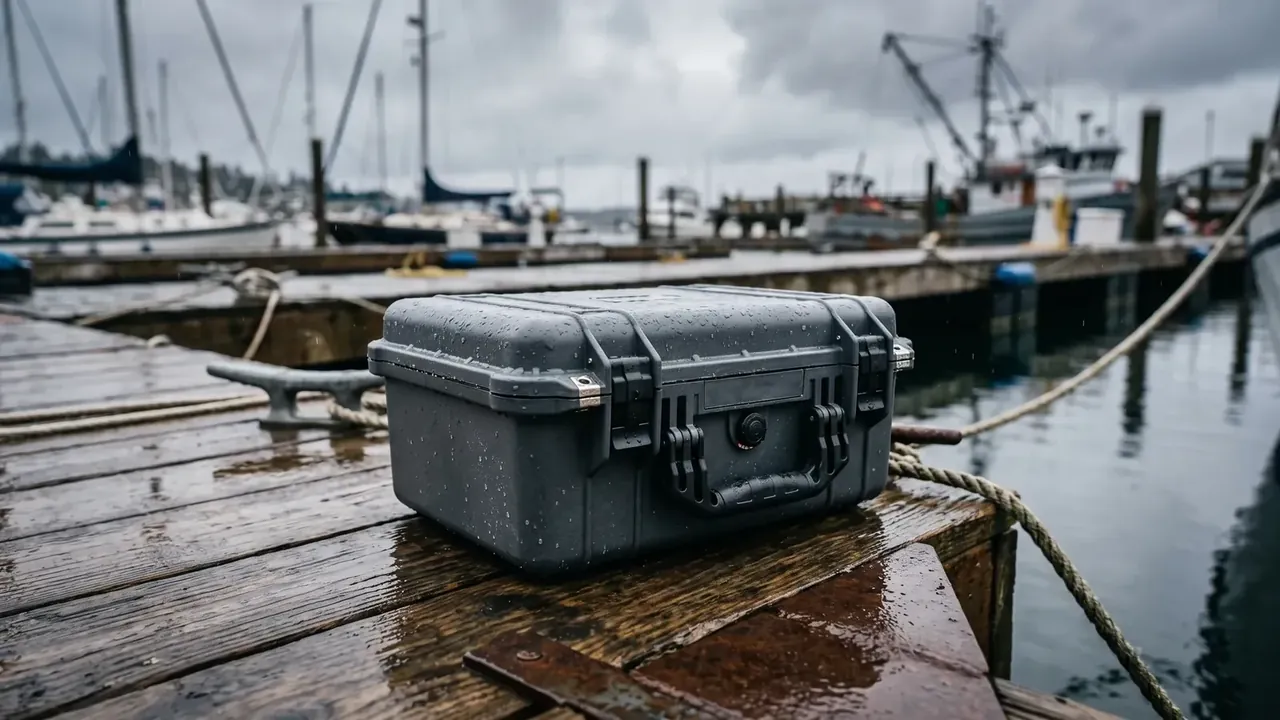
Quick answer: Split by mass, not outline: 62 kg needs three pockets, 12 mm EVA to locate and 25 mm egg crate in the lid. Judge by joint offset, not wall thickness.
Table of contents
- Splitting 62 kg of Robot Across Pockets
- Where the Centre of Gravity Sits at 900 mm
- 12 mm EVA and 25 mm Egg Crate
- Three Tie Points and 2 mm of Preload
- 0.3 mm of Joint Spring After a 1.2 m Drop
- FAQ
1. Splitting 62 kg of Robot Across Pockets
A 62 kg service robot arrives intact because of where its 900 mm arm puts the centre of gravity, not because of wall thickness.
Pocket by mass, never by silhouette. Chassis and battery are 39 kg, the torso 15 kg, both arms 8 kg: a threefold spread in floor pressure, so one shared bay lets the chassis insert bottom out while the arms rattle. A Service Robot Equipment Case cuts at the shoulder instead, with a 300 mm main bay, a 120 mm arm channel and a 150 mm accessory bay under one lid.
| Bay | Load | Depth | Floor insert |
|---|---|---|---|
| Main | 54 kg chassis and torso | 300 mm | 12 mm EVA on 30 mm base |
| Arm channel | 8 kg folded arms | 120 mm | 12 mm EVA slot |
| Accessory | 6 kg dock, cables | 150 mm | 12 mm EVA grid |
| Lid | no load | 25 mm | 25 mm egg crate |
2. Where the Centre of Gravity Sits at 900 mm
For a Service Robot Equipment Case, the number that matters is how far the mass sits from the shoulder. Extended, each arm's centre is 450 mm forward, so 4 kg per arm becomes 3.6 kg·m on the joint, and one longitudinal shock drives that into the channel wall until the slot splits.
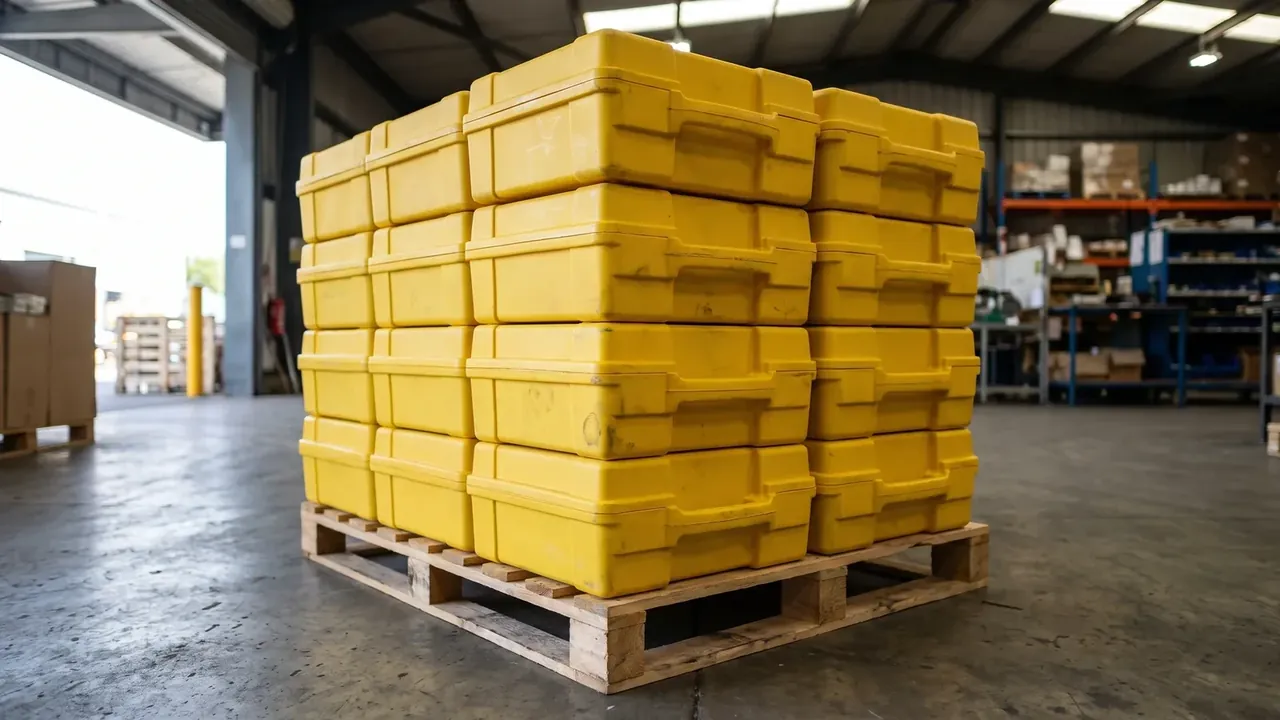
Folding trades moment for width: elbow at 90 degrees, wrist folded again, centre at 100 mm and moment at 0.4 kg·m, at 380 mm of arm group width. A Service Robot Equipment Case then keeps that gravity line inside the support polygon: 210 mm above the floor, 45 mm forward of centre, 275 mm from the edge of a 1080 × 640 mm floor. Below 80 mm of margin, a skewed shove in a van tips it.
3. 12 mm EVA and 25 mm Egg Crate
In a Service Robot Equipment Case, 12 mm EVA locates and 25 mm egg crate only bears on a surface. EVA is closed-cell at 60 kg/m³, cuts clean, keeps a slot wall through twenty load cycles and resists the lateral shear that would let 62 kg drift. Egg crate is open-cell polyurethane at 24 to 32 kg/m³, and its job is the top-face hit and the slap of a closing lid.
| Layer | Material | Thickness | Load | Working compression |
|---|---|---|---|---|
| Location | closed-cell EVA, 60 kg/m³ | 12 mm | lateral shear | 17 percent |
| Face | PU egg crate, 24 to 32 kg/m³ | 25 mm | top impact | 30 percent |
| Base | EVA sheet, 60 kg/m³ | 30 mm | floor | 10 percent |
Egg crate laid on the floor is flattened by 54 kg on trip one and protects nothing on trip two; EVA in the lid rubs white marks into the shell. A Service Robot Equipment Case sizes inner height at part height plus 39 mm, the extra 2 mm being preload, and a peak compresses 30 percent, 7.5 mm, enough to close the gap without bowing the shell.
4. Three Tie Points and 2 mm of Preload
Two blocks under the chassis pin the 39 kg at its lowest point and a 25 mm webbing strap crosses the channel mouth to hold the folded 8 kg. Three points form a triangle, so a side tilt loads all three together instead of leaving one to absorb everything.
Two millimetres is a drawing value, not a feel in a Service Robot Equipment Case: the insert is 2 mm thicker than the bay, 16.7 percent compression on 12 mm EVA, still elastic, so it returns when the lid opens. At 4 mm the robot needs 15 kg of pull to come out; at zero, 300 km of road leaves it 4 mm off position.
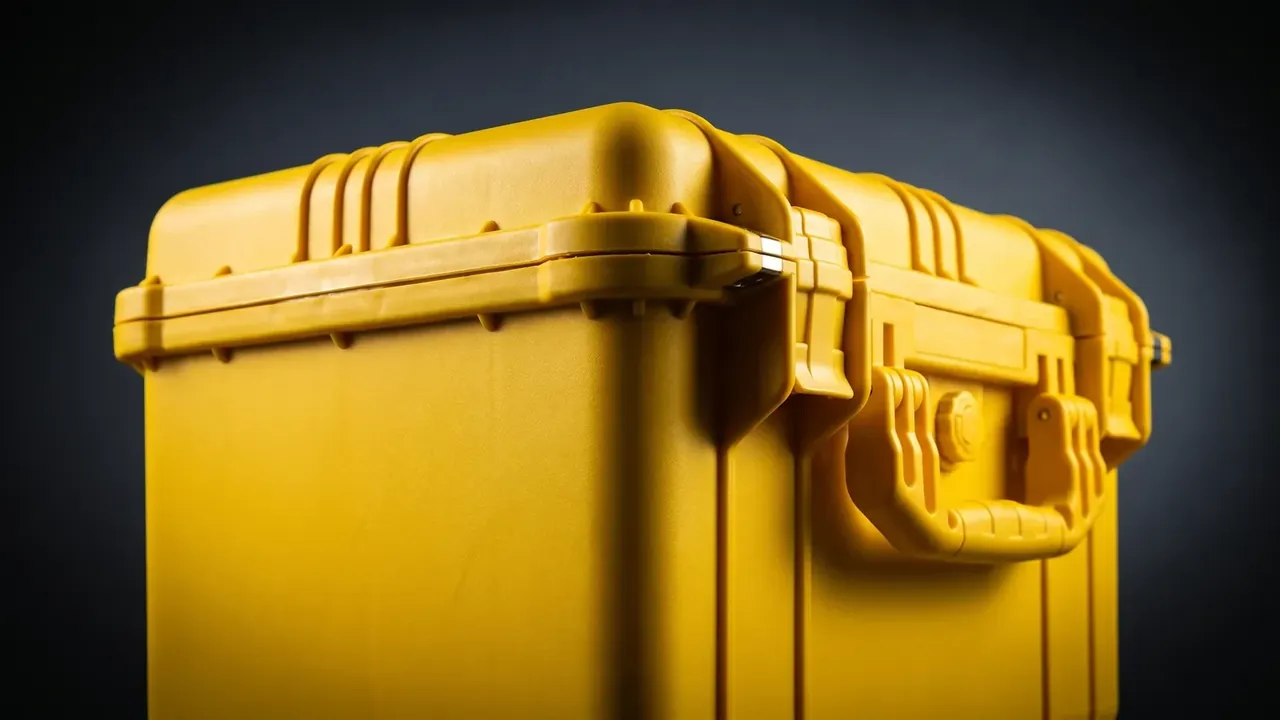
Even spacing puts 54 kg through the middle and lifts both ends. Two points 60 mm above the floor plus one over the arm mass hold movement under 1 mm through 30 minutes of shaking. A Service Robot Equipment Case relies on that geometry, not on latches, which share 40 N of preload.
5. 0.3 mm of Joint Spring After a 1.2 m Drop
For a Service Robot Equipment Case, 1.2 m is not the routine grade. GB/T 4857.5 scales drop height to gross mass and a 60 kg class package falls below 400 mm; robot builders push to 1.2 m to see what margin is left. One corner, three edges, two faces, six impacts.
Measure the joint, not the shell. Three dial-gauge readings, largest wins. Within 0.3 mm the reducer backlash moves less than 0.05 mm and calibration stays valid; past 0.5 mm, 1.5 mm of error appears at the end of a 900 mm reach and every pick point needs re-teaching.
| Drop | Insert compression | Joint offset | Action |
|---|---|---|---|
| 0.6 m | 5 mm | 0.1 mm | release |
| 0.9 m | 8 mm | 0.2 mm | release |
| 1.2 m | 11 mm | 0.3 mm | release, recheck backlash |
| 1.5 m | 14 mm | 0.6 mm | reject, change insert |
0.3 mm is settled, not instantaneous: the 1.8 mm peak recovers inside 30 seconds and stops moving after two hours, so a gauge read under load always lies. A 1.2 m drop spends 11 mm of compression, the 25 mm egg crate keeps 7.5 mm and 4 mm stays in reserve; under 3 mm, a second drop doubles the offset. That is the margin budget of a Service Robot Equipment Case: 86 kg over three points, 28 kg each.
Related Reading
- Usable cavity ratio and corner loss
- Inner height and foam thickness
- Gasket materials compared
- Large cases, wall thickness and lift points
JUNZHIJIA
Related Products
- 8 Series — Gun Cases; Military Equipment Cases; Camera Equipment Cases; Drone Cases; Watch Cases; Knife Cases; First Aid Cases; Electronics Equipment Cases
- WL8-2812 PP Gun Case — model WL8-2812
- All protective cases and toolboxes: 7 series, 158 models