

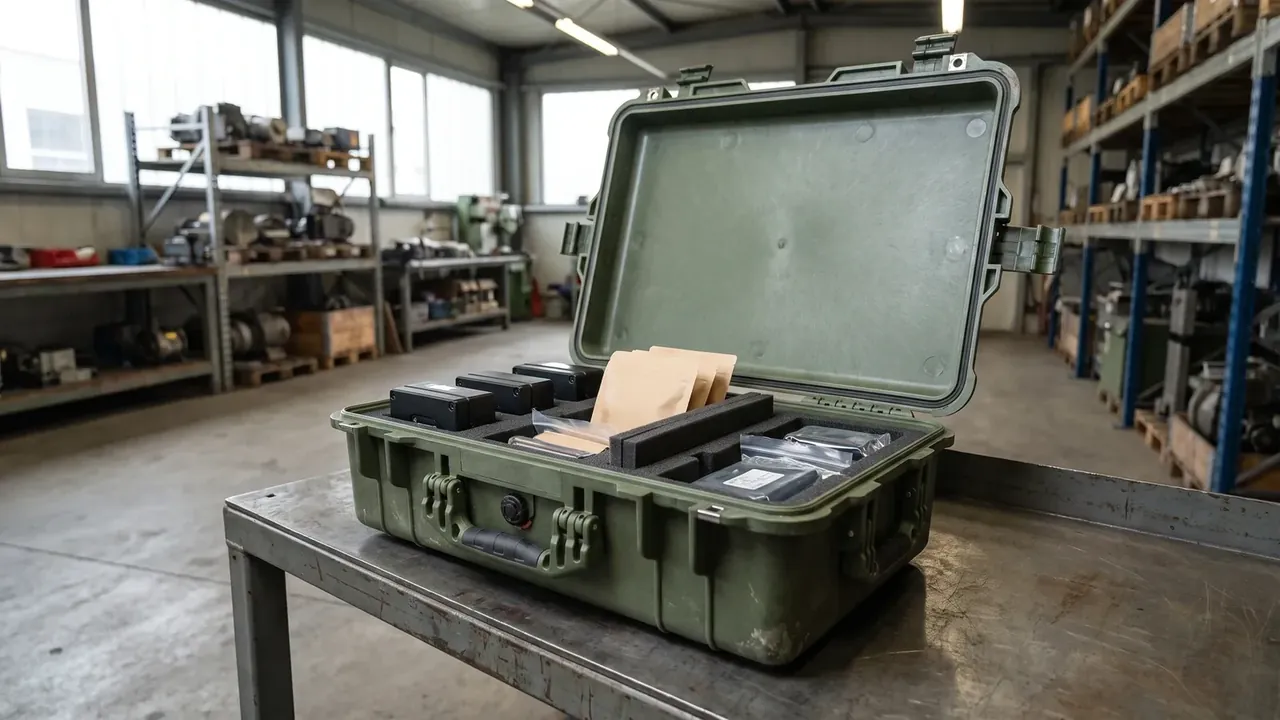
Quick answer: Case branding placement comes down to six spots: lid face 120 mm × 60 mm, beside the latches 40 mm × 20 mm, side wall 80 mm × 40 mm, end faces 60 mm × 30 mm, handle recess 50 mm × 15 mm, base 40 mm × 25 mm.
Table of contents
- Six Logo Positions at a Glance
- Latches and Side Walls: Draw the Margin First
- End Faces, Handle Recess and Base
- The Lid Face Wears Out First
- Combining Positions on One Insert
- FAQ
1. Six Logo Positions at a Glance
A 500 mm × 350 mm × 210 mm case offers six planes: the lid face, the pad beside the latch seats, the side walls, the end faces, the handle recess and the base. Four face outward; two hide under a palm or against the floor.
All six case branding placement options sit on just two moulding surfaces, the lid on the cover mould and the remaining five on the body core. That count, not the number of marks, sets the tooling bill.
| Position | Size | Read distance | Wear | Surface |
|---|---|---|---|---|
| Lid face | 120 × 60 mm | 3 m | 1.2 mm in 3 years | Cover mould |
| Beside latches | 40 × 20 mm | 0.8 m | None in 3 years | Body core |
| Side wall | 80 × 40 mm | 2 m | 1 scratch per 100 moves | Body core |
| End faces | 60 × 30 mm | 2.5 m | Medium to slow | Body core |
| Handle recess | 50 × 15 mm | 0.3 m | Palm friction, fast | Body core |
| Base | 40 × 25 mm | 0 m | Ground drag, fastest | Body core |
Draw the 3 mm margin first: the clearance from a logo edge to a radius, rib wall or latch seat. Plastic shrinks fastest at the rib root, so a thinner margin pulls strokes into a sawtooth.
Only the lid and side walls are flat. The other four carry a step or recess, which needs a 5 mm margin, or its shadow closes over the edge.
2. Latches and Side Walls: Draw the Margin First
The 40 mm × 20 mm block sits on a pad 1.5 mm below the wall, between the latch seat and the nearest rib, so the lettering never meets a pallet edge.
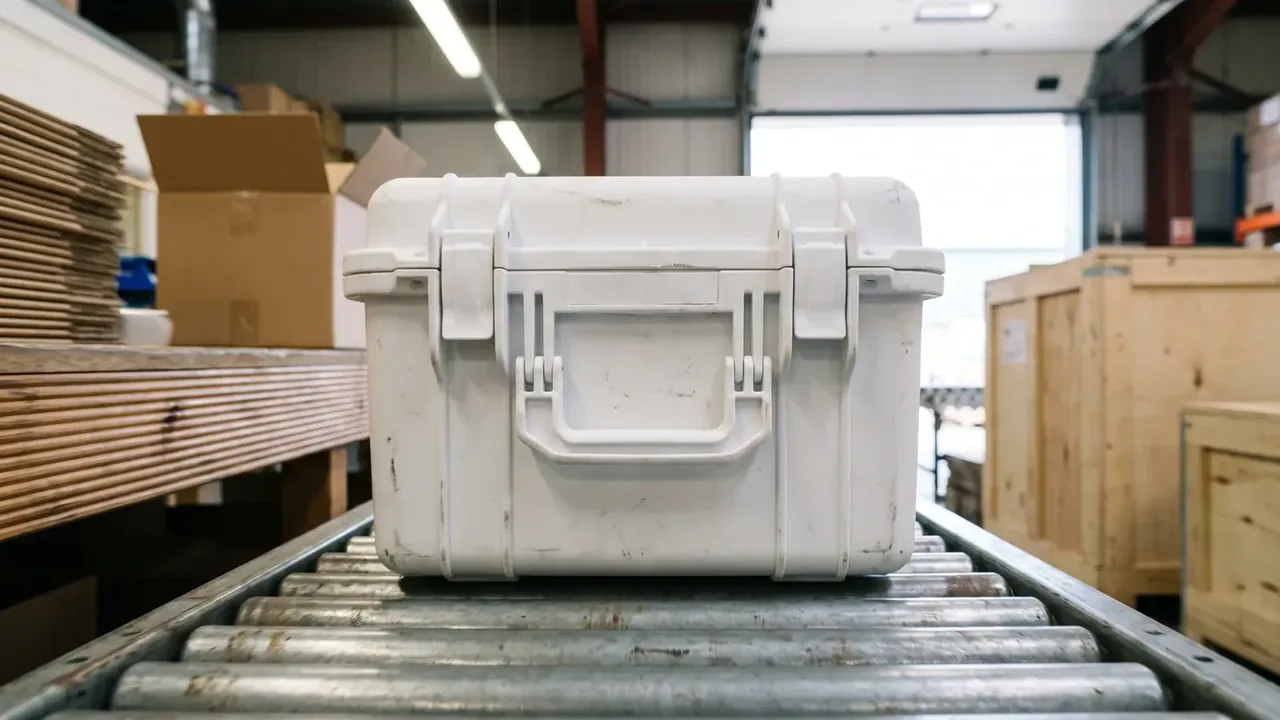
The latch swings outward, so keep 12 mm from the latch seat. A 40 mm length is what two ribs will take: longer crosses a rib, shorter leaves 8 mm of white on each side.
Field data backs it: cases shipped in 2022 and stored outdoors show no wear beside the latches after 36 months, while lid faces from the batch lost 0.15 mm at the edge.
The 80 mm × 40 mm side wall reads at about 2 m, enough to recognise a brand before scanning. On concrete it takes 1 to 2 scratches per 100 moves against 5 or more on the lid. Its weak point is the 0.2 mm parting line, which cuts the block in half unless it moves 12 mm and crowds the latch seat to 15 mm.
3. End Faces, Handle Recess and Base
Each end face gives 60 mm × 30 mm, the narrowest plane. On a 350 mm end, two R25 corners take 25 mm each and the handle seat takes the rest.
End faces matter when cases go onto a shelf end-out: readable at 2.5 m and the only option tied directly to shelf display. Warehouse buyers see them more often than the lid.
The handle recess allows 50 mm × 15 mm, one line of small type. A palm covers it, it appears only during the lift, and 40 lifts a day reach roughly 12,000 contacts in three years.
The base gives 40 mm × 25 mm and is never seen once packed. A batch code belongs 20 mm in from the edge, clear of the floor ribs, because dragging removes a layer within 1 m.
4. The Lid Face Wears Out First
The 120 mm × 60 mm lid block is the only one holding three lines of type plus a symbol. A 500 mm case projects 300 mm × 200 mm of lid; 6 rib channels and four corner radii leave 240 mm × 170 mm, so the block takes 17.6%.
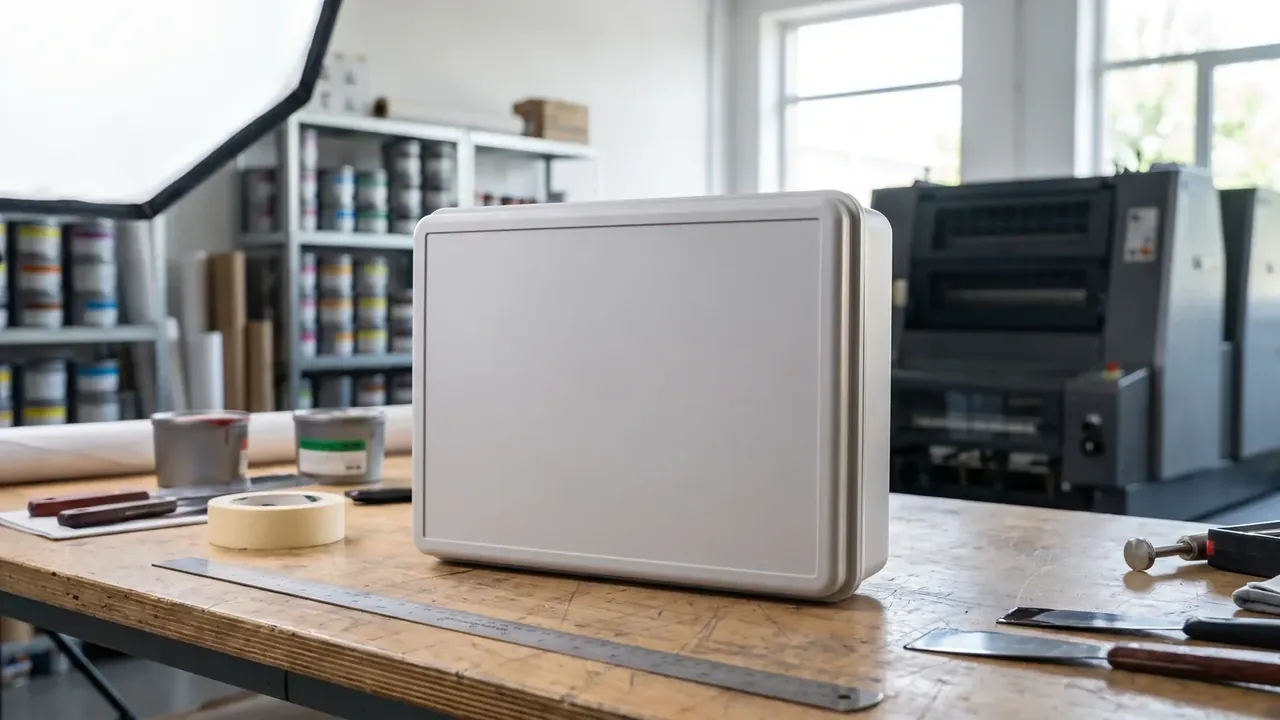
It also scuffs first, facing the base of the case stacked above and whatever grit comes with it: about 1.2 mm at the edge in three years.
At 8 mm cap height that loss removes 15% of the stroke width, and the thinnest 0.8 mm stroke breaks first. A 10 mm cap limits it to 12% without touching the mould.
| Years | Lid edge scuff | Legibility at 8 mm cap | Beside latches |
|---|---|---|---|
| 0 | 0 mm | Sharp at 3 m | No wear |
| 3 | 1.2 mm | 2 strokes broken | No wear |
| 5 | 2.0 mm | Reads as 6 mm | Slight sheen |
| 8 | 2.8 mm | Needs 1.5 m | Reads at 1.0 m |
The five-year row tells the story: the lid needs 1.5 m while the latch block still reads at 1.0 m, a position difference rather than a printing one.
Inside the block a 1:2 split works best: symbol 40 mm × 60 mm, type 80 mm × 60 mm, so the symbol loses its border first and the type stays legible.
5. Combining Positions on One Insert
Positions do not set tooling cost; surfaces do. Six positions on two surfaces need 2 inserts and 6 days of mould change; the lid alone needs 1 insert and 3 days.
The arithmetic reorders the decision. Because the body insert already carries five positions, adding a block on the side wall, end face or base costs almost nothing in tooling. What it costs is layout room: three blocks on a 350 mm end sit under 15 mm apart and blur at distance.
Restraint belongs on the lid. At 160 mm × 80 mm it crosses the first rib channel, the flat insert becomes a ribbed one, and the change grows from 3 to 5 days.
Channel logic settles the rest: lid plus end face for end-out racks, lid plus side wall for retail, a base block for traceability.
Conclusion
Case branding placement reduces to two numbers: how many moulding surfaces the marks land on, and how wide the scuff grows. The first sets mould-change days, the second sets how long a position stays legible. The 120 mm × 60 mm lid wins on visibility and loses 1.2 mm in three years, so it carries the primary mark; the 40 mm × 20 mm spot beside the latches survives and suits a quiet second.
Three actions close the job: box all six positions at a 3 mm margin, count the surfaces they fall on, then pick the combination per channel instead of printing all six.
| Position | Size | Surface | Extra tooling | Best use |
|---|---|---|---|---|
| Lid face | 120 × 60 mm | Cover mould | 1 insert, 3 days | Primary mark |
| Beside latches | 40 × 20 mm | Body core | Shared | Quiet second mark |
| Side wall | 80 × 40 mm | Body core | Shared | Retail display |
| End faces | 60 × 30 mm | Body core | Shared | Shelf end-out |
| Handle recess | 50 × 15 mm | Body core | Shared | Batch code |
| Base | 40 × 25 mm | Body core | Shared | Traceability |
This article discusses container-side specifications and design implications only, and does not cover any handling, loading or use of the contents.
Related Reading
- How much nameplate area a case really has
- Logo printing methods for protective cases
- Choosing a custom case with a logo
- Screen printing layout and colour registration
Related Products
- 8 Series — Gun Cases; Military Equipment Cases; Camera Equipment Cases; Drone Cases; Watch Cases; Knife Cases; First Aid Cases; Electronics Equipment Cases
- WL8-2812 PP Gun Case — model WL8-2812
- All protective cases and toolboxes: 7 series, 158 models