

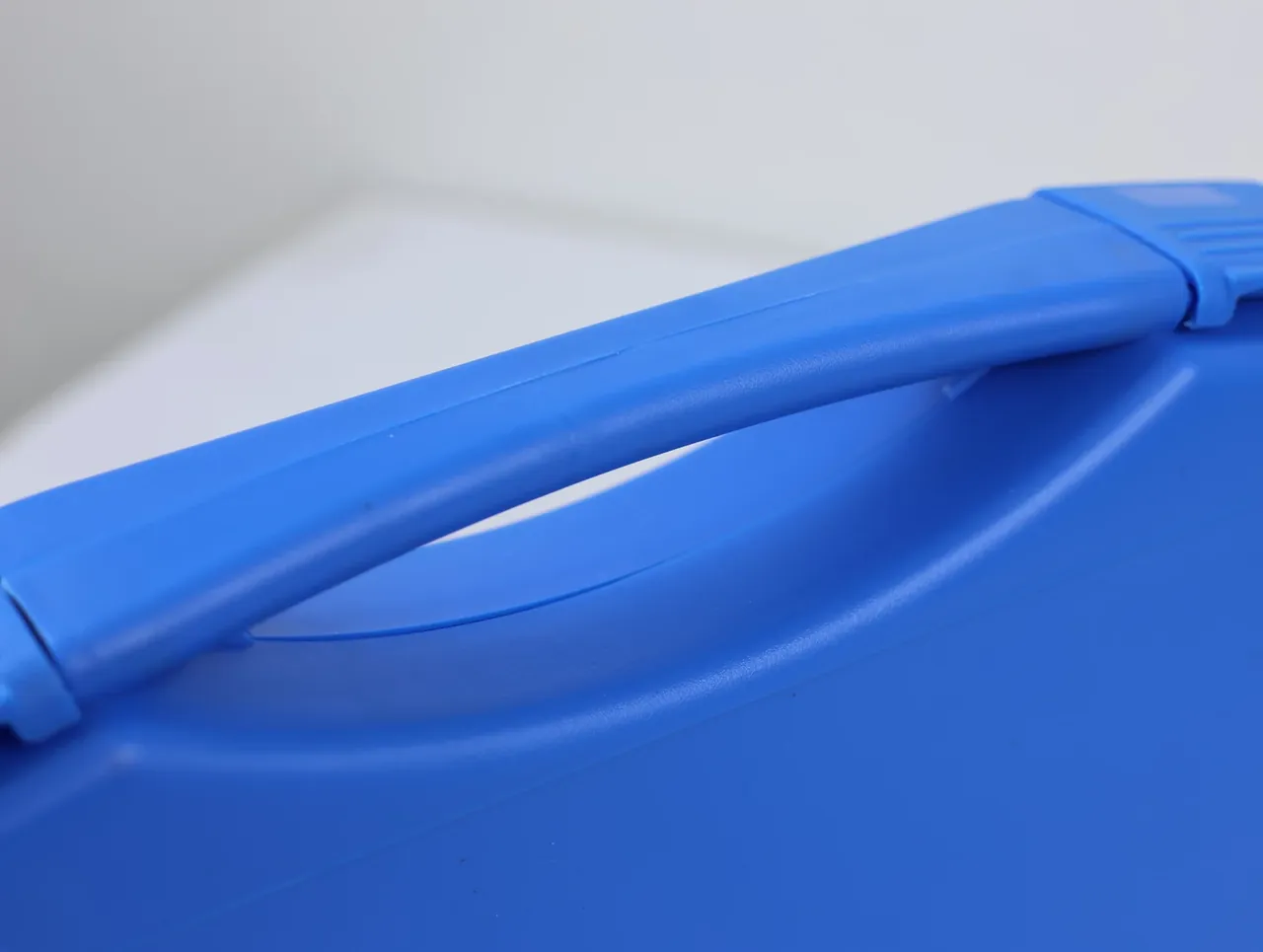
Quick answer: A Small Plastic Case is an injection-moulded box within 165 by 120 by 45 mm that one hand can hold: body, lid, living hinge, one to four latches. Walls run 0.8 to 1.6 mm, cavities 2 to 16, and IP54 depends on gasket squeeze.
Table of contents
- Size Band and the Palm-Hold Limit
- Cavity Count, Tonnage and Cycle Time
- Wall Thickness Bands and Sink Marks
- Hinge Life and Latch Styles
- Where Material Meets the Standards
- FAQ
1. Size Band and the Palm-Hold Limit
A Small Plastic Case is bounded by grip, not volume. The band stops at 165 by 120 by 45 mm; above that it becomes a carrying case.
Inside drops one wall per side: a 130 by 90 mm body at 1.2 mm leaves 127.6 by 87.6 mm. Past 45 mm deep a finger cannot reach the bottom.
An adult palm spans about 180 mm, so a body over 120 mm cannot be pinched and must ride flat.
| Outside (L x W x H) | Inside | Load ceiling | Cavities |
|---|---|---|---|
| 60 x 40 x 18 mm | 57.6 x 37.6 x 16 mm | 0.4 kg | 16 |
| 130 x 90 x 35 mm | 127.6 x 87.6 x 33 mm | 1.8 kg | 4 |
| 165 x 120 x 45 mm | 162.6 x 117.6 x 43 mm | 2.6 kg | 2 |
2. Cavity Count, Tonnage and Cycle Time
Tool cost climbs almost linearly with cavity count while the per-part share flattens after eight, because cycle time and tonnage step up together.
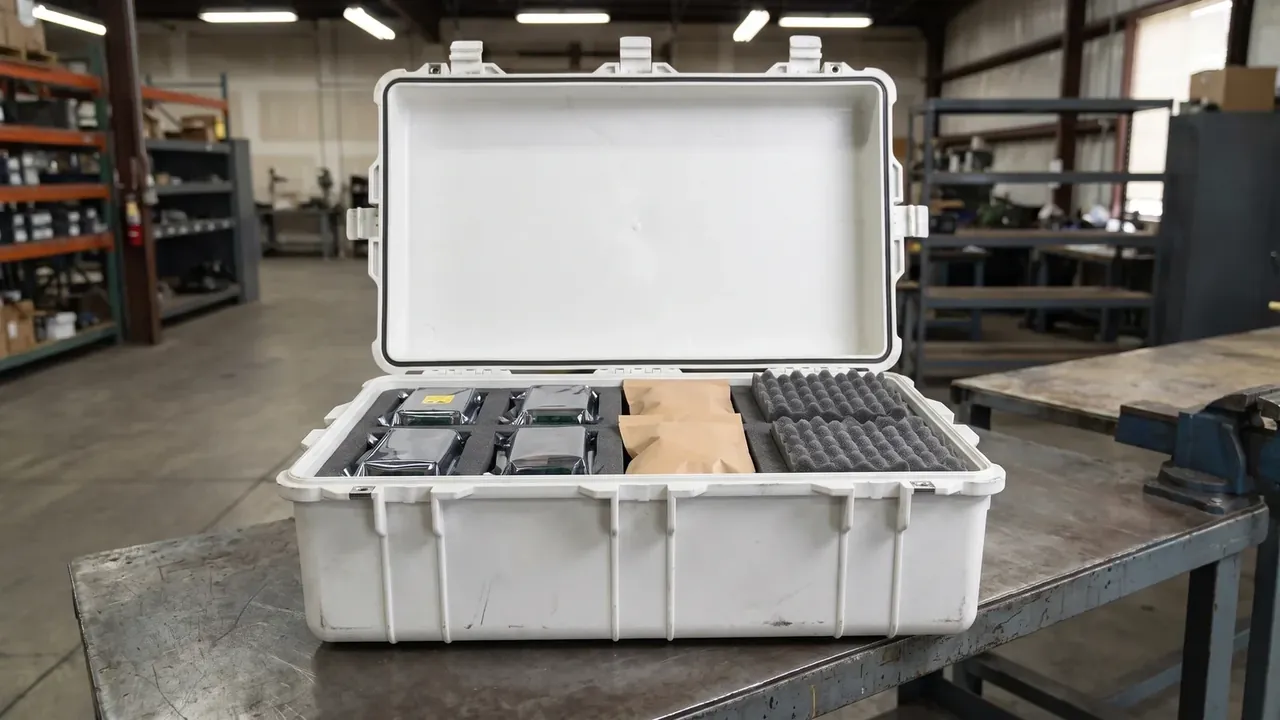
- Two cavities: 32,000 CNY tool, 90 t press, 18 s cycle.
- Four cavities: 46,000 CNY tool, 180 t press, 20 s cycle, 9.2 CNY per part at 5,000.
- Eight cavities: 78,000 CNY tool, 250 t press, 22 s cycle, pays above 20,000.
Clamp force is projected area times pressure: 117 cm2 per box, 468 cm2 for four cavities, 164 t at 350 bar, so a 180 t press leaves ten percent.
Cooling owns the cycle. A 1.2 mm wall cools in about 8 s at 22 C; with 3 s of open and close and 4 s of packing the cycle lands at 18 to 22 s. At 1.6 mm it stretches to 30 s.
3. Wall Thickness Bands and Sink Marks
Wall thickness in a Small Plastic Case is four numbers. Base and sides take 1.2 mm, the lid 1.0 mm, the hinge seat 1.6 mm before thinning into a 0.35 mm membrane, and a clear window 0.8 mm PS.
| Wall | Where | Past the limit |
|---|---|---|
| 0.8 mm | Clear window | Dents under a finger, edges whiten |
| 1.0 mm | Lid | Side bows 0.6 mm under load |
| 1.2 mm | Base and sides | Eight stacked empties splay outward |
| 1.6 mm | Hinge seat, corners | Too stiff, impact goes to the lid |
Past a 0.4 mm step, sink marks arrive: PP shrinks 1.5 to 2.0 percent and leaves a 0.1 mm hollow visible after painting. Rib roots run at 0.6 times the wall, corners take R0.5, and below R0.3 every drop cracks there.
4. Hinge Life and Latch Styles
The living hinge divides this class: one moulded part instead of two, with service life resting in a 0.35 mm membrane.
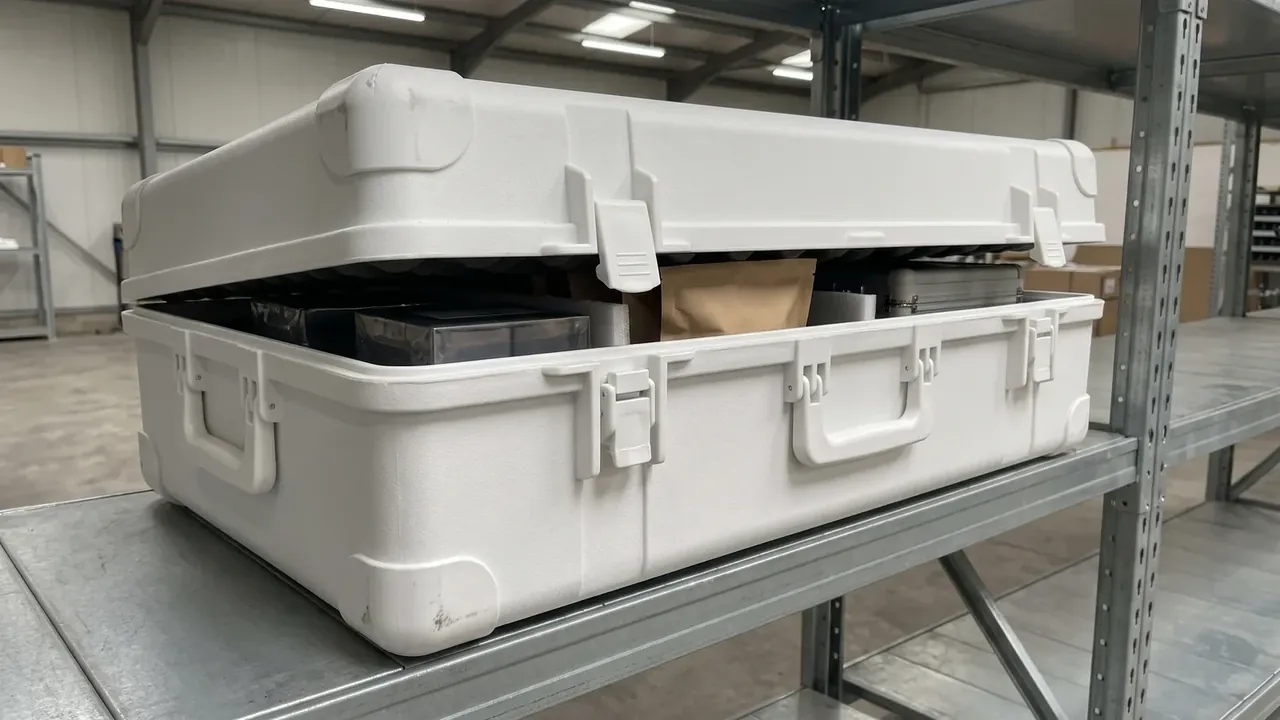
A 0.35 mm PP hinge survives 20,000 cycles and whitens after 10,000. Two-shot PP over TPE reaches 50,000 for about 40 percent more tool cost, a 0.8 mm stainless pin 100,000 for 0.15 CNY of labour. A kit opened 20 times a day lives on a living hinge; a rental pool opened 60 times needs a pin.
Latches open at 18 N single, 30 N double, 45 N for four, with 0.4 mm interference. Under 0.2 mm the lid works loose, over 0.6 mm it takes the heel of a hand.
PP turns brittle at minus 15 C and the tongue snaps flush, so winter circulation wants a 0.3 mm root radius or ABS.
5. Where Material Meets the Standards
Three standards apply.
- IEC 60529: IP5X stops a 1 mm probe via a 1.5 mm EPDM gasket squeezed 25 percent; IPX4 is a 10 minute spray at 0.07 litres per minute.
- MIL-STD-810H 516.8 Procedure IV: 26 drops, one per corner, edge and face, from 1.2 m, no crack or latch release.
- UL 94: HB burns under 40 mm per minute horizontally; V-0 self-extinguishes within 10 s.
- ISO 4892-3: 200 h of UV with a colour shift under 3.
On a Small Plastic Case, material decides which claim holds: PP at 0.90 density and 100 C deflection is the hinge default, PS passes 88 percent of light but holds only to 70 C, ABS doubles the impact strength.
| Material | Deflection | Shrinkage | Role on the part |
|---|---|---|---|
| PP | 100 C | 1.5 to 2.0 % | Body, living hinge |
| PS | 70 C | 0.4 to 0.6 % | Clear window |
| ABS | 88 C | 0.4 to 0.7 % | Corners, latch tongue |
Conclusion
The chain for a Small Plastic Case has four links: size fixes grip, wall thickness fixes stiffness, cavity count fixes cost, hinge and latch fix life. Settle 165 mm, 1.2 mm and 20,000 cycles before arguing about colour; what decides survival is the margin a Small Plastic Case keeps in drop and in opening.
This article discusses only the container (case body) side of specifications and design intent, and does not cover any handling, loading or use of the contents.
Related Reading
- Tooling and modification for small-batch case customisation
- How a tool box is specified and built
- Where a gear case gets its protection rating
- Body structure and load paths in a road case
Related Products
- 8 Series — Gun Cases; Military Equipment Cases; Camera Equipment Cases; Drone Cases; Watch Cases; Knife Cases; First Aid Cases; Electronics Equipment Cases
- WL8-2812 PP Gun Case — model WL8-2812
- All protective cases and toolboxes: 7 series, 158 models