

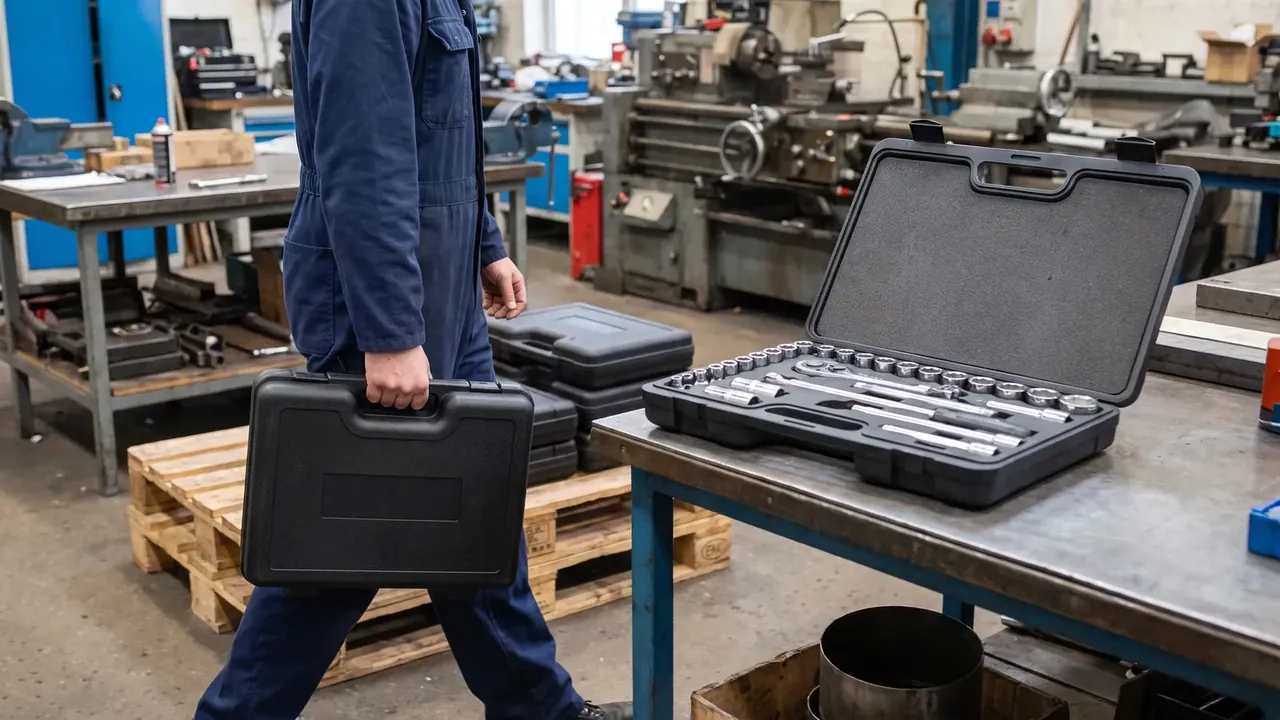
Quick answer: A socket wrench set case reads in five process layers: forming fixes wall and stiffness, the liner keeps sockets from migrating, hinge and latches carry the open-close count, the handle decides whether a full case lifts, marking and tolerance decide batch consistency. Compromise on one and the case fails where it is thinnest.
Table of contents
- How a Socket Wrench Set Case Body Is Formed
- Liner Layout and Socket Location
- Hinge and Latch Load Paths
- Handle and Load Rating
- Marking, Tolerance and Appearance
- FAQ
1. How a Socket Wrench Set Case Body Is Formed
A socket wrench set case body is made one of three ways, and the method sets wall, stiffness and order size.
| Process | Material | Wall | Cycle | Suits |
|---|---|---|---|---|
| Injection | Polypropylene | 2.8–3.2 mm | 55 s | Above 3,000 pcs |
| Blow | HDPE | 4–5 mm | 3 min | 500–5,000 pcs |
| Rotomould | PE powder | 6 mm | About 30 min | Under 500 pcs |
Injection runs near 800 tonnes; thin walls push stiffness into a rib grid, raising tool cost but buying repeatability. Blow moulding inflates a parison at 4 to 5 mm in about three minutes at a third of the tooling cost, yet corners run 0.8 mm thinner and crack there first. Rotomoulding spins powder at 280 °C for 12 minutes and cools for 15, reaching 6 mm with no parting-line stress.
2. Liner Layout and Socket Location
The liner holds dozens of steel parts. Too loose and sockets knock together in transit, dulling chrome; too tight and the technician fights the case.
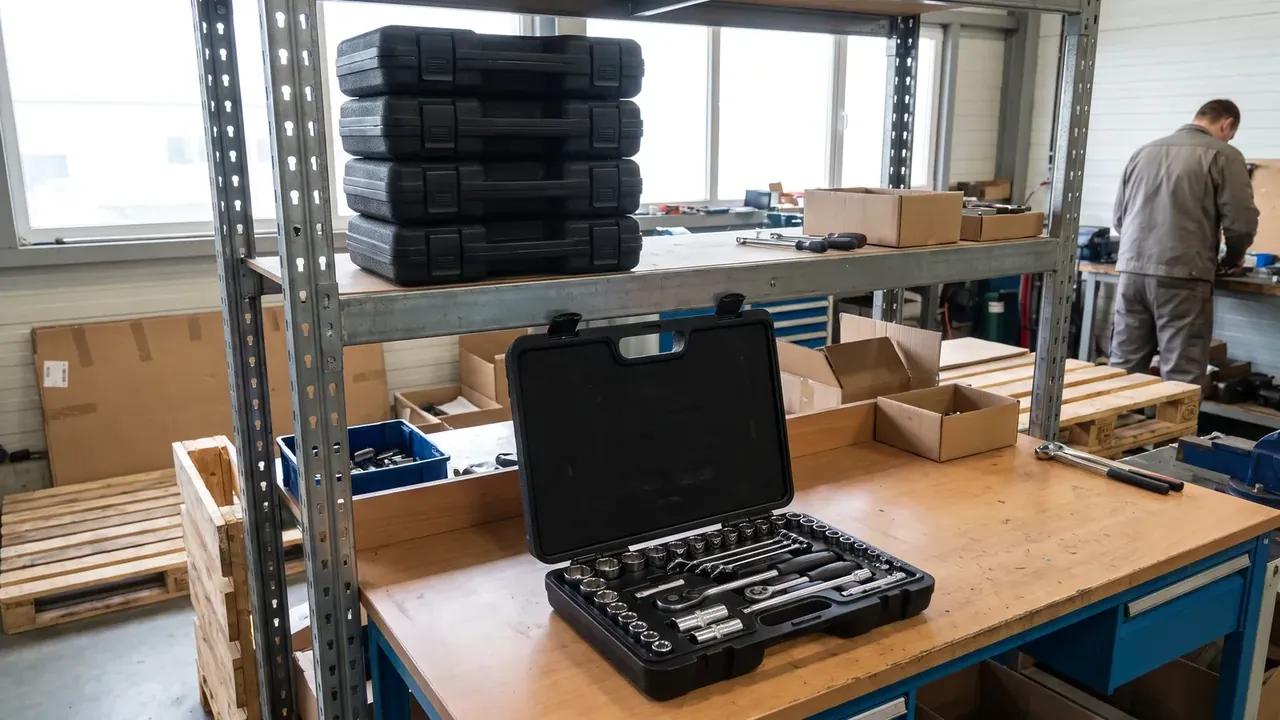
Die-cut EVA forms in one stroke at ±0.3 mm, cheap but fixed. CNC routing holds 0.05 mm and needs only a program change. Thermoforming presses sheet at 110 °C for 30 seconds for stepped cavities. Fit is set at the mouth: a 1.5 mm lead-in straightens a socket dropped in at an angle, a 2 mm relief stops swarf jacking it up, and ribs stay at least 4 mm wide.
3. Hinge and Latch Load Paths
A socket wrench set case opens far more than a tool box: a dozen times a day, four thousand a year, twelve thousand over three years. Hinge and latch are designed against that count, not sample feel.
Injection cases use a living hinge, a 0.8 mm web that whitens under cyclic stress and cracks near ten thousand cycles unless thickness is uniform. Blow and rotomoulded cases use a 4 mm steel pin with nylon bushings; once one wears through the pin grinds the body, so it is designed for 8,000 cycles.
Latches are specified by force: about 55 N to close, 40 N to open with gloves. Too stiff and workers pry with a screwdriver; too soft and the lid pops in a drop. A 1.2 m six-face drop with latches shut is the floor.
4. Handle and Load Rating
A loaded case passes 15 kg, and the handle takes that load. What matters is not empty feel but how far the body deflects when lifted full.
Injection cases mould the handle with an R5 root fillet; a tighter radius whitens after two lifts. Blow moulded cases often pin a separate handle through side bosses, stronger if the boss root thickens to 8 mm. Testing runs at twice the rating: 30 kg for 60 seconds, no cracking, 3 mm deflection at most.
5. Marking, Tolerance and Appearance
Before shipping, three things are checked against numbers: marking, tolerance, appearance.
| Check | Basis | Limit |
|---|---|---|
| Parting line step | Height difference | 0.2 mm max |
| Rim flatness | Diagonal measurement | 1.5 mm max |
| Colour difference | Against golden sample | ΔE 1.5 max |
| Print register | From datum edge | 1 mm max |
| Liner hole position | Against drawing | 0.3 mm max |
Screen printing is cheapest and must survive 50 alcohol rubs; in-mould labelling cannot peel but needs a new tool per revision; laser suits serial numbers and socket sizes beside the pockets. Rim flatness is most often skipped: 1.5 mm is the blow moulded ceiling, injection holds 0.8, rotomoulding needs 2. Cracks and broken latch seats fail the lot; flow marks and flash are judged at AQL 4.0.
Conclusion
The quality of a socket wrench set case is carried by five layers: forming, liner, hinge and latch, handle, marking with tolerance. Forming sets the wall, the liner keeps sockets in place, hinge and latch set the years, the handle whether a full case lifts, tolerance whether units look alike. Write those five limits into the drawing and a socket wrench set case becomes reproducible.
This article discusses only the container (case body) side of specifications and design intent, and does not cover any handling, loading or use of the contents.
Related Reading
- Socket Wrench Set Case pocket layout and specification series
- How a Socket Wrench Set Case is configured for professional repair
- Internal dividers in cases: what they do and how they are made
- Rotomoulded cases: forming principle and where they fit
Related Products
- 8 Series — Gun Cases; Military Equipment Cases; Camera Equipment Cases; Drone Cases; Watch Cases; Knife Cases; First Aid Cases; Electronics Equipment Cases
- WL8-2812 PP Gun Case — model WL8-2812
- All protective cases and toolboxes: 7 series, 158 models