

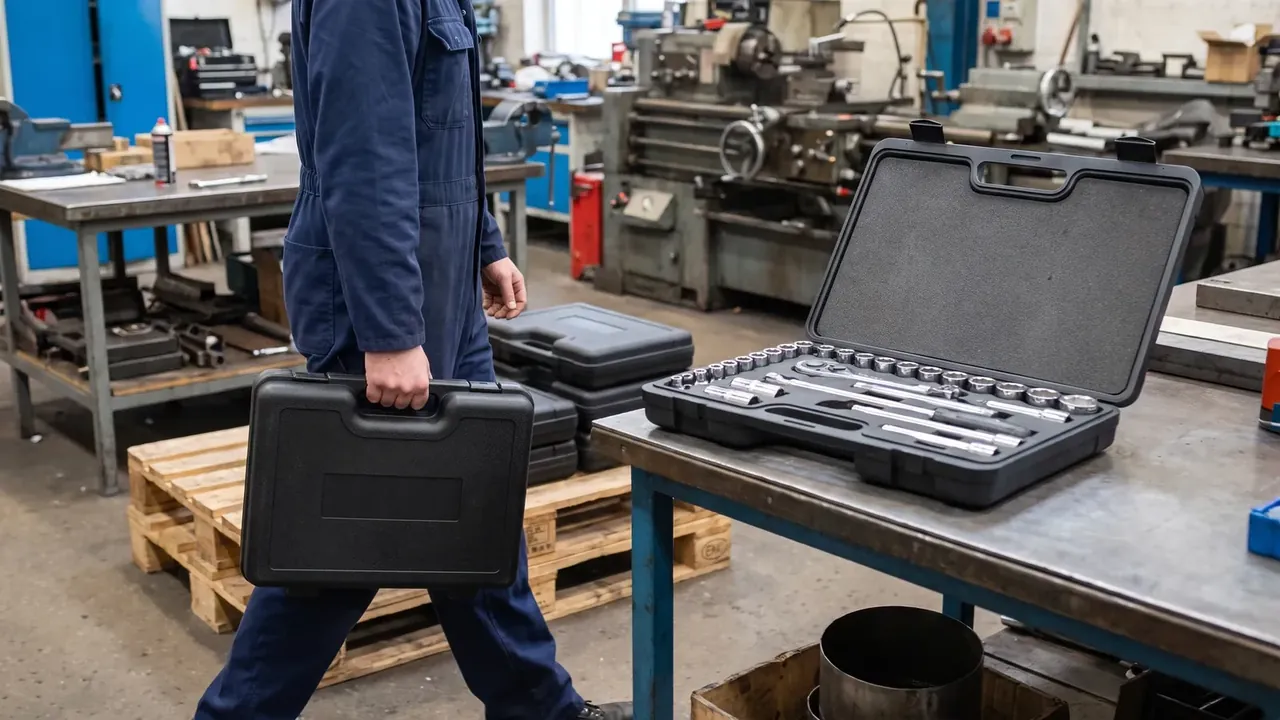
Quick answer: Upkeep on a socket wrench set case runs on three clocks: a pre-shift look at the latches and handle root, a monthly measurement of hinge clearance and liner seating, and a quarterly check of the weatherstrip. Every item carries a measured limit, and past that limit the part is swapped, never patched.
Table of contents
- What a socket wrench set case check covers
- Reseating and cleaning the pocket liner
- Measuring hinge and latch wear
- Reading cracks at the handle and walls
- Weatherstrip ageing and missing-piece limits
- FAQ
1. What a socket wrench set case check covers
Work a socket wrench set case on three clocks. Pre-shift, read the handle root, both latches and the lid joint. Monthly, open it and measure hinge clearance and liner seating. Quarterly, check the strip, the wall corners and the feet.
A four-digit stamp in the liner floor ties each row to a date, a value and an action; fine records nothing.
| Tier | Interval | Checked | Output |
|---|---|---|---|
| Pre-shift | Each shift | Handle root, latches, lid joint | Pass or hold |
| Monthly | 30 days | Hinge clearance, liner seating | Values recorded |
| Quarterly | 90 days | Strip compression, wall cracks | Review or replace |
2. Reseating and cleaning the pocket liner
The liner fails first, and from poor seating rather than wear. A liner shifted two millimetres thins the wall between neighbouring pockets. Press the rim of a socket wrench set case; soft clicks mean every clip is home.
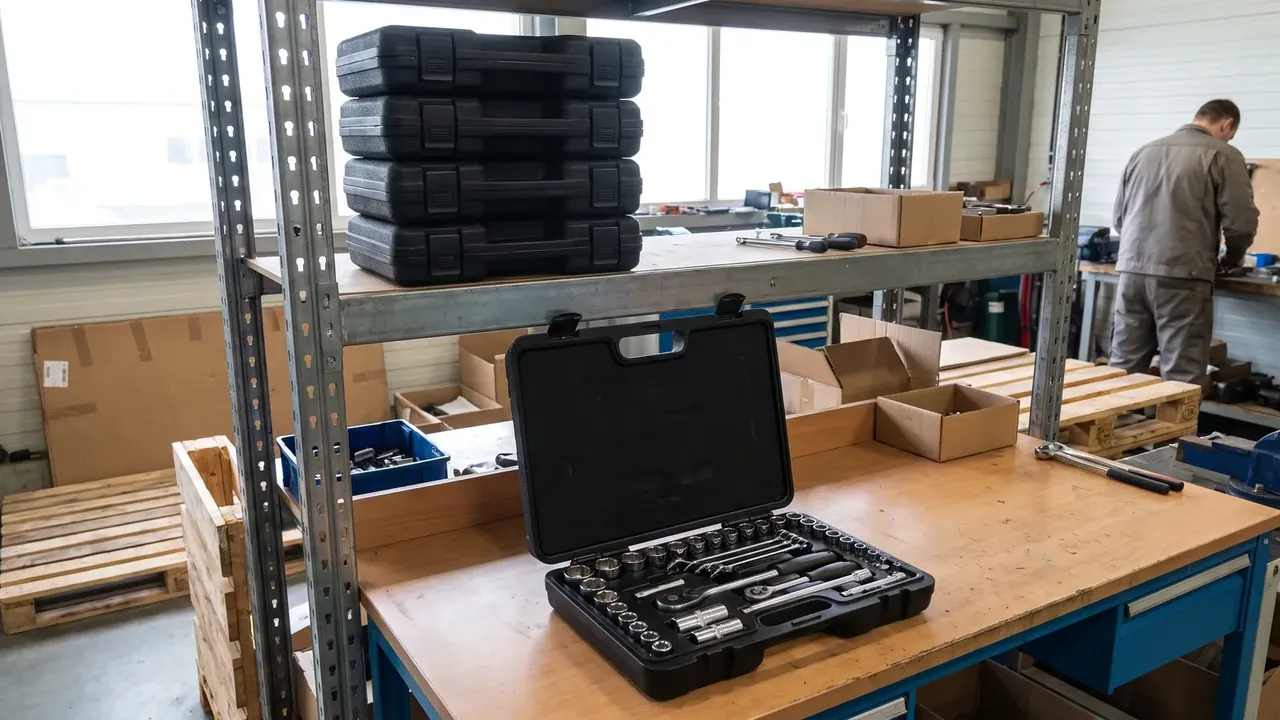
A corner left three to five millimetres high is forced down by the lid and splits within weeks. Clean with air below 0.3 MPa or neutral detergent near pH 7 under 40 C; acetone hardens it.
| Method | Use on | Dilution and heat | Drying |
|---|---|---|---|
| Soft brush plus low air | Debris, dust in seams | Air below 0.3 MPa | 10 minutes |
| Neutral detergent | Oil film, hand marks | 1:20 in water, under 40 C | Blot, 20 minutes |
3. Measuring hinge and latch wear
Hinge wear is a clearance figure. With the lid at 90 degrees, a new pin sits within 0.10 mm of its barrel; past 0.35 mm the hinge is due, and the rocking it allows swings strip compression at the lid joint.
Latches give holding force and throw. A new tongue pulls about 210 N; under 140 N a loaded case pops open. Design throw is 9 mm, and 1.5 mm of loss makes a half-engaged latch feel locked. Replace in pairs.
4. Reading cracks at the handle and walls
The handle carries the only sustained cyclic load on a socket wrench set case. At 14 kg, twenty lifts a day and seven thousand a year, cracks open at the fillet under the root and run a millimetre or two before a raking light finds them.
Under 5 mm off the fillet, mark it for fortnightly review. Five to eight, or any length crossing the fillet, stop. Past 8 mm, scrap. Wall cracks sit at the corners and beside each keeper; 0.5 mm offset is through.
5. Weatherstrip ageing and missing-piece limits
The strip is the only flexible part and ages fastest. Shore A rising from 55 to above 70 means plasticiser has migrated; 10 mm squeezed to 5 mm for 24 hours at 40 C, recovering under 7 mm, condemns it. Replace as a full loop.
Fill one empty pocket within two weeks. Past three gaps, or a gap in the three most-used sizes, the socket wrench set case leaves the bench. Two cracks in one section, a torn keeper or a worn-through foot ends it outright.
| Item | Keep in service | Watch | Replace now |
|---|---|---|---|
| Hinge pin clearance | Within 0.10 mm | 0.10 to 0.35 mm | Over 0.35 mm |
| Latch holding force | Above 210 N | 140 to 210 N | Below 140 N |
| Handle root crack | None | Under 5 mm, off the fillet | Over 5 mm or on it |
| Wall crack | None | Not through, under 3 mm | Through or offset over 0.5 mm |
| Strip hardness | Under 60 Shore A | 60 to 70 | Above 70 |
Conclusion
Upkeep on a socket wrench set case lines up three clocks, five part families and one decision table, where every line carries a measured value and a limit. Parts past the limit are changed in pairs, never patched, so a socket wrench set case fails on a schedule you can see rather than mid-carry.
This article discusses only the container (case body) side of specifications and design intent, and does not cover any handling, loading or use of the contents.
Related Reading
- Pocket layout and specification sequence
- Maintaining a metal tool chest
- Upkeep for a hard-shell suitcase
- Seating a foam insert
Related Products
- 8 Series — Gun Cases; Military Equipment Cases; Camera Equipment Cases; Drone Cases; Watch Cases; Knife Cases; First Aid Cases; Electronics Equipment Cases
- WL8-2812 PP Gun Case — model WL8-2812
- All protective cases and toolboxes: 7 series, 158 models