

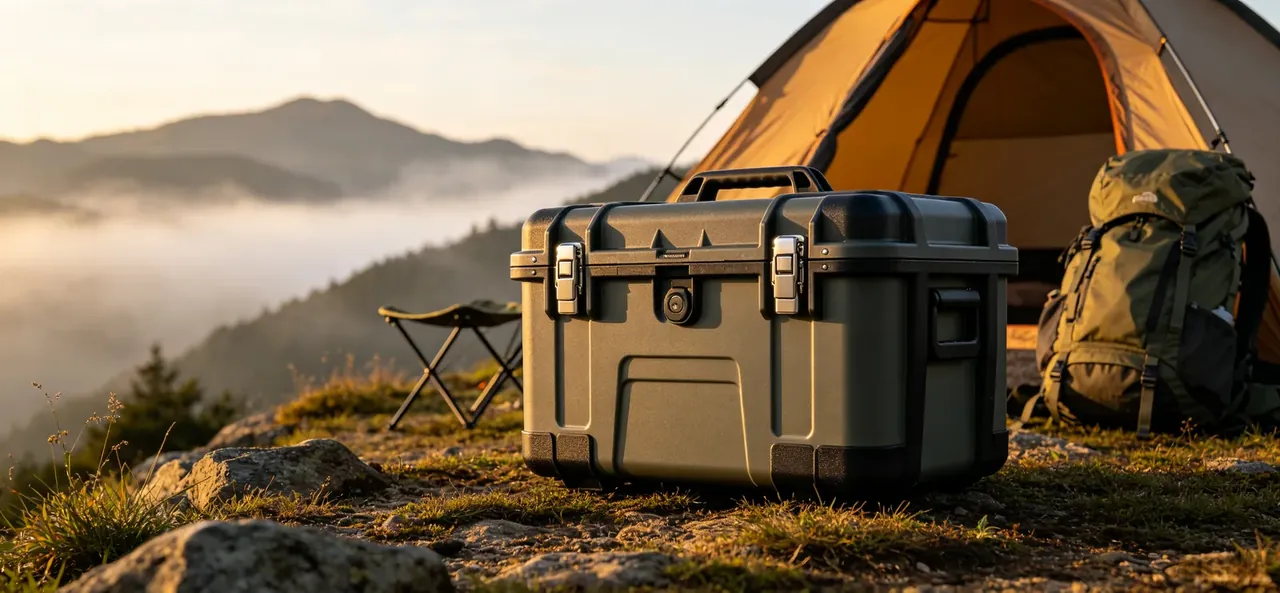
Quick answer: A solar om case only reaches a 15° roof with three numbers settled: 0.26 g downslope, 0.35 kN/m² load limit, and 30 kg split into two loads.
Table of contents
- Three numbers to settle before the case goes up
- A 25 mm seam and a 15° pitch: how the case travels
- The 0.26 g downslope share and four 8 mm rubber strips
- Splitting 22 kg into two: a 620 mm handle and 80 m
- FAQ
1. Three numbers to settle before the case goes up
The first limit on a roof is not mass but pressure per square metre. Trapezoidal steel sheet is commonly rated at 0.35 kN/m², and a 22 kg solar O&M case with a 0.36 m² footprint, plus 8 kg of tools, puts about 0.82 kN/m² on the panel. The case survives; the sheet dents first.
The second limit is pitch. At 15° the downslope component of gravity is 0.26 g, so a 22 kg solar om case pulls with the equivalent of 5.7 kg. Nobody holds that with an arm; the friction under the case and a tether to the rail do the work.
The third limit is the person: repeated single-person lifting tops out near 25 kg, and 30 kg moves on flat concrete but fails at 80 m on a 15° pitch.
| Roof type | Pitch, ° | Allowable load, kN/m² | Access condition |
|---|---|---|---|
| Standing-seam steel sheet | 15 | 0.35 | walk the crests, along purlins |
| Snap-lock steel sheet | 10 | 0.30 | spread load on a 1 m² pad |
| Concrete deck | 3 | 1.50 | place anywhere |
| Rail walkway | 15 | 0.35 | grating 600 mm wide |
2. A 25 mm seam and a 15° pitch: how the case travels
A standing seam stands 25 mm proud, so a solar om case does not slide on a flat plane; it rides a row of ribs. A fully flat base bears on two or three crests only and doubles the local pressure again. A 30 mm relief groove, or four longitudinal ribs, spreads the contact.
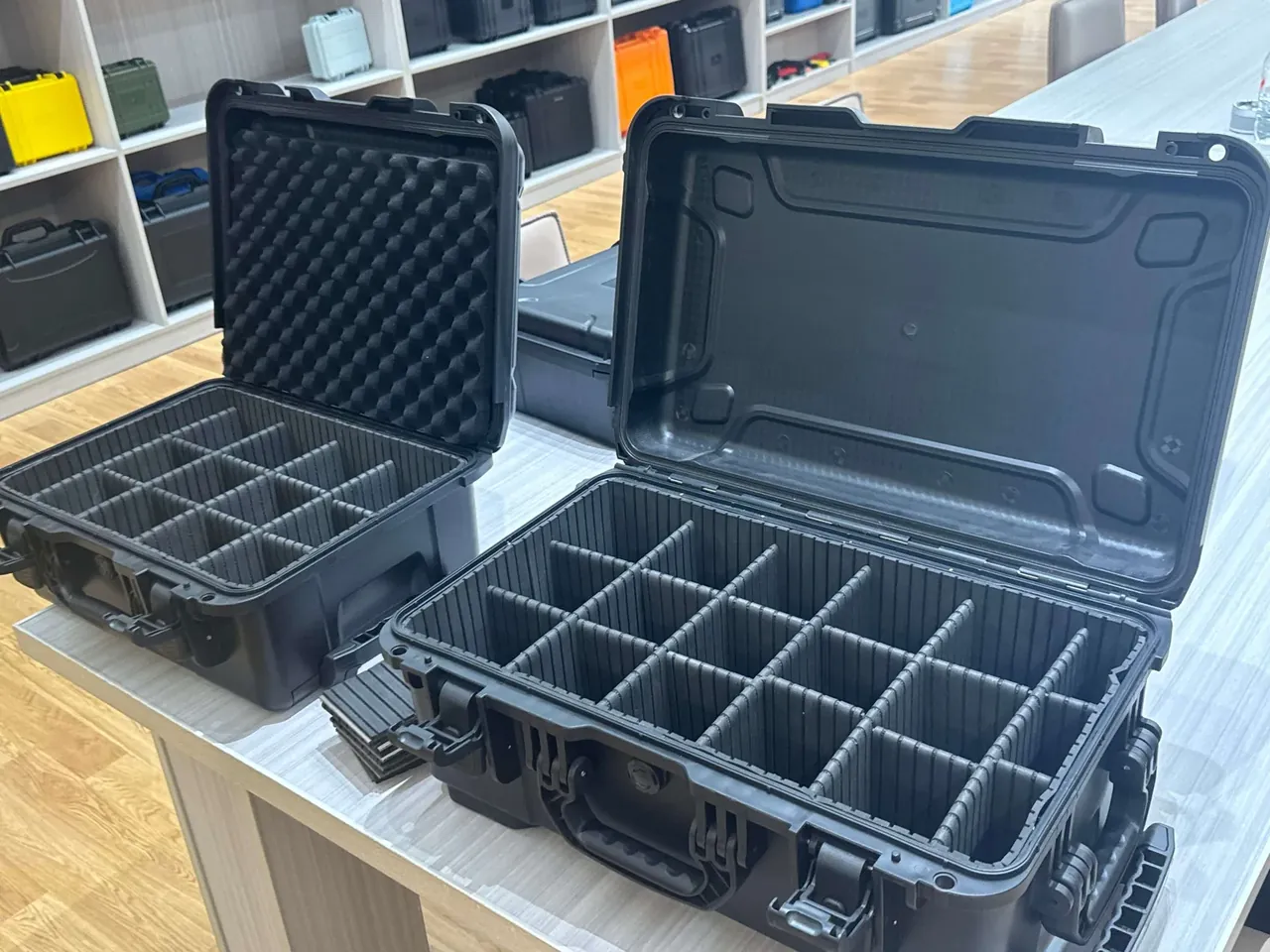
Opening the lid on a pitch is a separate problem. On 15° anything loose heads downhill, and an open case becomes a chute. Twelve dividers, one item each, mean the hand never rummages: take one, close the lid, nothing rolls.
Walkway width has to match. Arrays leave 600 mm between rows, and a 400 mm wide solar om case leaves 100 mm a side. That is enough to walk straight, not to turn, so the case goes down before the body does.
3. The 0.26 g downslope share and four 8 mm rubber strips
A bare solar om case base on dry sheet gives a static friction coefficient near 0.6, which against 0.26 g leaves a safety factor of 2.3. That looks adequate until dew, dust or a film of cutting oil drops it below 0.55, and one shower spends the whole margin.
Four 8 mm rubber strips change the sum. Run full length along the long sides at 25 mm wide, they replace plastic on steel with rubber on coating, lift friction to 0.85 and the factor to 3.3. Four, not two, because the base crowns in the middle and two strips only load the ends.
| Pitch, ° | Downslope share, g | Dry µ | Wet sheet µ | Treatment |
|---|---|---|---|---|
| 5 | 0.09 | 0.85 | 0.55 | place freely |
| 10 | 0.17 | 0.85 | 0.55 | add strips |
| 15 | 0.26 | 0.85 | 0.55 | strips plus tether |
| 25 | 0.42 | 0.85 | 0.55 | pass through only |
The 25° row is the boundary. Beyond it the strips lose, and a solar om case may only be carried past, never parked and opened. Pitch needs no instrument on site: if the front of the foot loads up and you lean forward to stand, it is past 15°.
4. Splitting 22 kg into two: a 620 mm handle and 80 m
Twenty-two kilograms of solar om case plus 8 kg of tools is 30 kg, five over the single-person limit. On flat ground those five kilos are a harder pull; on a 15° pitch they are the last two steps of a tired leg. Two 15 kg loads cost a second trip and keep every trip inside the envelope.
Eighty metres becomes four legs, with a rest point every 20 m on the grating, all four strips touching down. Each rest point doubles as a check on strip shift.
The 620 mm handle height matches a relaxed wrist. Below 550 mm the carrier bends and the case swings out on standing; above 700 mm the shoulder lifts and the grip changes every dozen metres, which is when a case is dropped.
| Carrying method | Load per person, kg | Time for 80 m, min | Use |
|---|---|---|---|
| One hand | 15 | 4 | straight runs to 15° |
| Two-person carry | 30 | 3 | walkways over 600 mm |
| Tethered drag | 30 | 6 | long sheet runs, two people |
Dragging is the last resort. Eighty metres of sheet takes 1 mm to 2 mm off the strips, and the roughened face grips harder on the return, so the case is replaced the same day.
Conclusion
A solar om case on a roof is governed by four numbers: 0.35 kN/m² of allowable load, a 15° pitch, a 0.26 g downslope share and a 25 kg single-person limit. Split 30 kg into two 15 kg loads, fit four 8 mm strips to reach 0.85 friction, set the handle at 620 mm, and 80 m becomes four controlled legs. Anti-slip is arithmetic, not caution.
This article discusses only the case body and its design implications, not the handling, loading or use of anything inside it.
Related Reading
- Configuring a PV module inspection case
- Weather and shock protection for inverter transit cases
- Choosing caster materials for cases
- Handle load ratings and ergonomics
Related Products
- 8 Series — Gun Cases; Military Equipment Cases; Camera Equipment Cases; Drone Cases; Watch Cases; Knife Cases; First Aid Cases; Electronics Equipment Cases
- WL8-2812 PP Gun Case — model WL8-2812
- All protective cases and toolboxes: 7 series, 158 models