

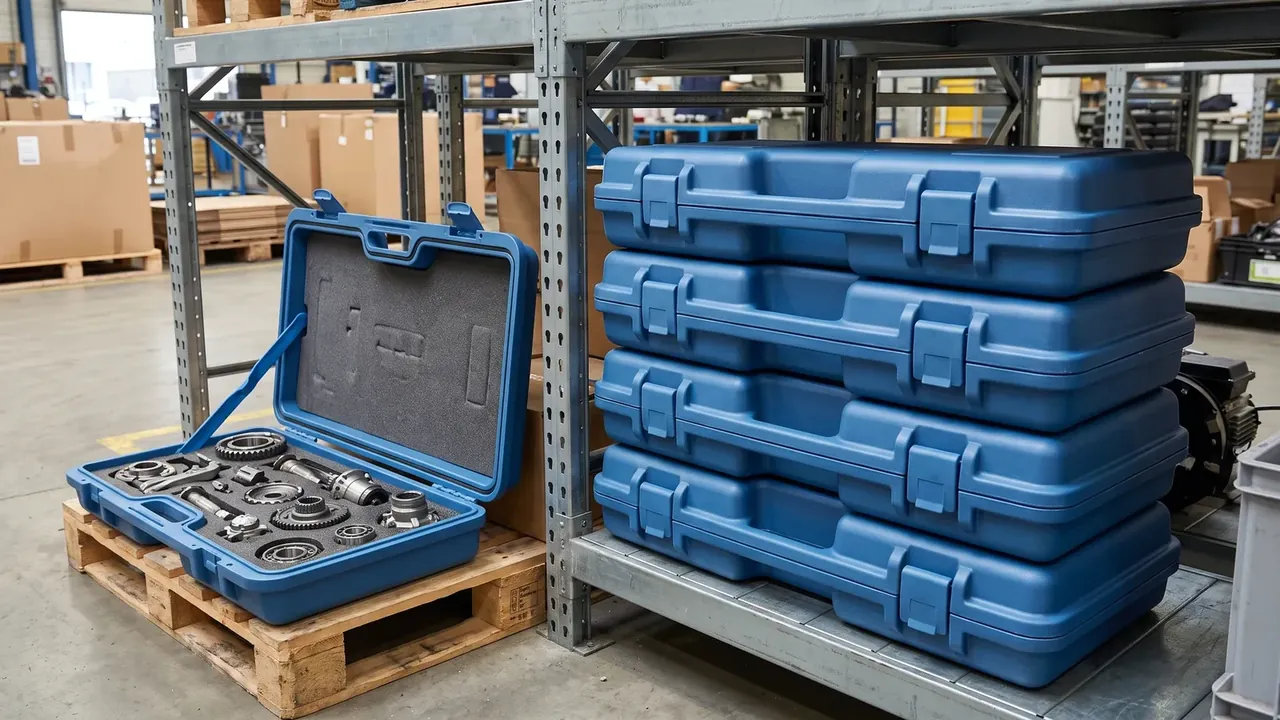
Quick answer: Source factory plastic tool box OEM ODM costing starts at the tool: a 1 mold 2 cavity set rated for 300,000 shots, running a 95 s cycle.
Table of contents
- Tooling milestones in source factory plastic tool box OEM ODM
- Cavity count and cycle time per shot
- Trial shots and first-article approval
- Where modification and colour change end
- Amortisation tiers by batch size
- FAQ
1. Tooling milestones in source factory plastic tool box OEM ODM
Nobody pays for a mould because they like steel. A 1 mold 2 cavity set spread over 300 pcs carries more tool cost per case than the moulding itself, while over 3000 pcs the same tool leaves a sliver. Settling that gap comes first in source factory plastic tool box OEM ODM work.
The milestones cannot be reordered: design review, flow analysis, P20 steel and cavity machining, T0 structural trial, T1 re-check, first-article approval.
| Tooling milestone | Deliverable | What it settles |
|---|---|---|
| Design review | Wall and draft list | 3.2 mm wall, 1.5° draft |
| Flow analysis | Fill and air-trap map | Ends fill, weld line placed |
| T0 trial | Short shots, ejection log | White marks, drag |
| T1 re-check | Full dimensional report | ±0.3 mm, warp ≤0.5 mm |
| First article | 5 parts, parameter sheet | Size, look, assembly |
Shrinkage is often left vague. PP runs at 1.6%, and the cavity is cut oversize by exactly that; a 0.2 point error puts a 600 mm case out by 1.2 mm and the mating faces stop closing. The figure belongs per zone, not once per shell.
2. Cavity count and cycle time per shot
Cavity count sets the tempo, and the tempo picks the press. Two cavities on a 95 s cycle yield about 75 cases an hour, roughly 1500 over a 20 h day; one cavity halves that. More cavities is not better, because a larger tool raises clamp force and tie-bar spacing.
Clamp force comes from projected area times cavity pressure, plus a 1.2 safety factor. 650 t fits a mid-size case in two cavities; thin walls or long flow paths need more. Too little clamp flashes the parting line.
| Cavity count | Cycle per part | Batch fit |
|---|---|---|
| 1 cavity | 95 s per part, quick changeover | Under 500 pcs |
| 2 cavities | 95 s per shot, 47.5 s per part | 500 to 3000 pcs |
| 4 cavities | About 110 s per shot | Above 3000 pcs |
Draft is fixed alongside cavity count. 1.5° holds on a two-cavity tool, and a textured face needs more, scaled to etch depth; with too little draft 24 pins cannot stop white marks. Cavities polished to Ra 0.8 µm keep release steady, and that polish belongs on the drawing for source factory plastic tool box OEM ODM work.
3. Trial shots and first-article approval
Three trials is the normal rhythm for a mid-complexity case. T0 answers whether the structure works, T1 whether dimensions land, T2 whether the window is stable. Cut one round and the problem moves downstream.
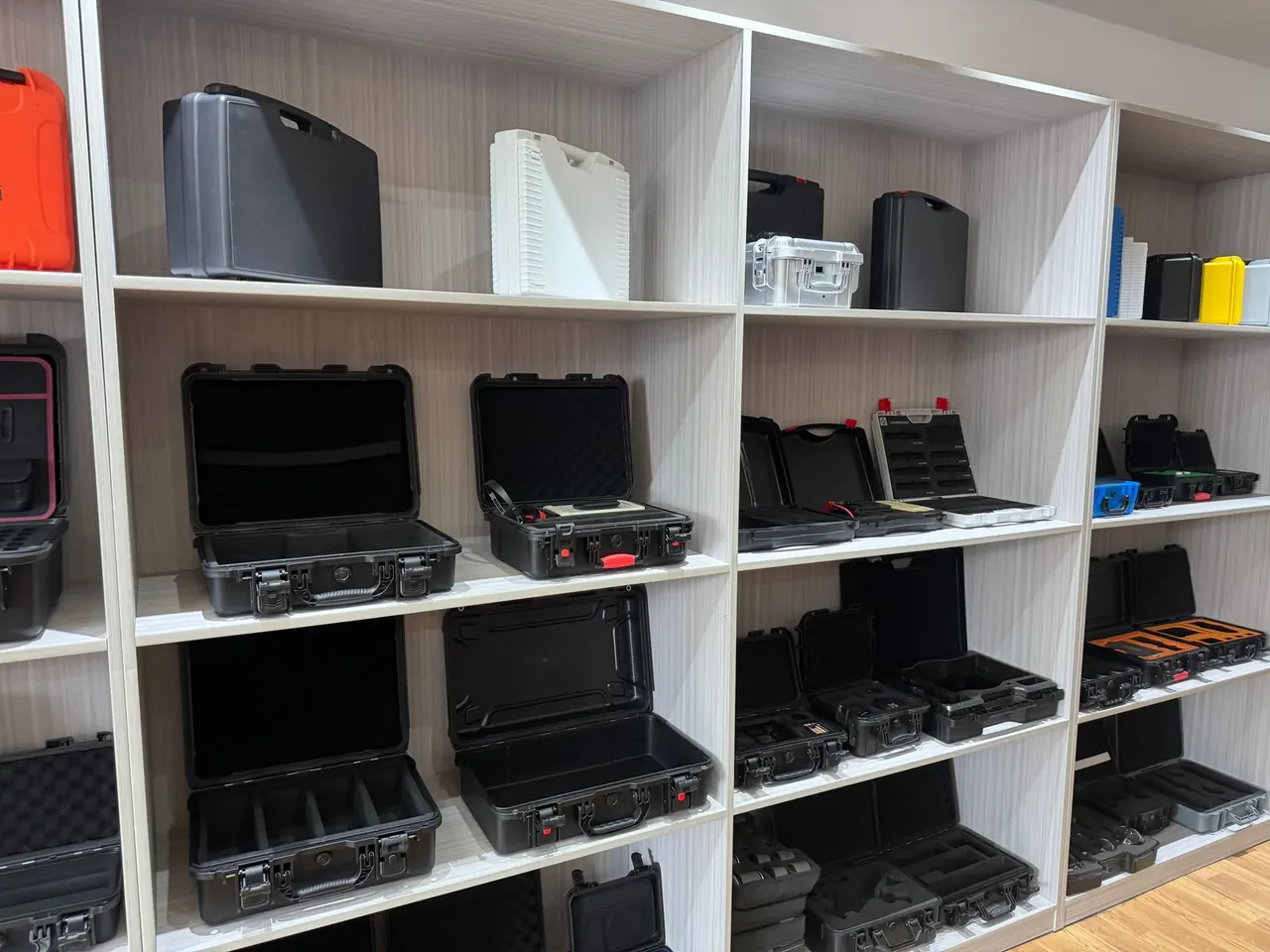
T0 starts on short shots at 60 to 70% fill and reads where the melt stops: a short stop means too few gates, a burnt end means poor venting, drag means draft. What comes out is a defect list.
First-article approval takes 5 parts, not 1: four positions across both cavities plus one draw after continuous running, every dimension measured, mating faces and lid fit included. A 0.3 mm spread between cavities means an unbalanced runner that no machine setting will fix, and that is where source factory plastic tool box OEM ODM suppliers have to touch the steel.
4. Where modification and colour change end
Modification and colour change are separate jobs in source factory plastic tool box OEM ODM work; mixing them wrecks the schedule. Colour change touches resin and machine only, so dark to light takes 30 min with purging; modification cuts steel, and one slider change costs 6 days.
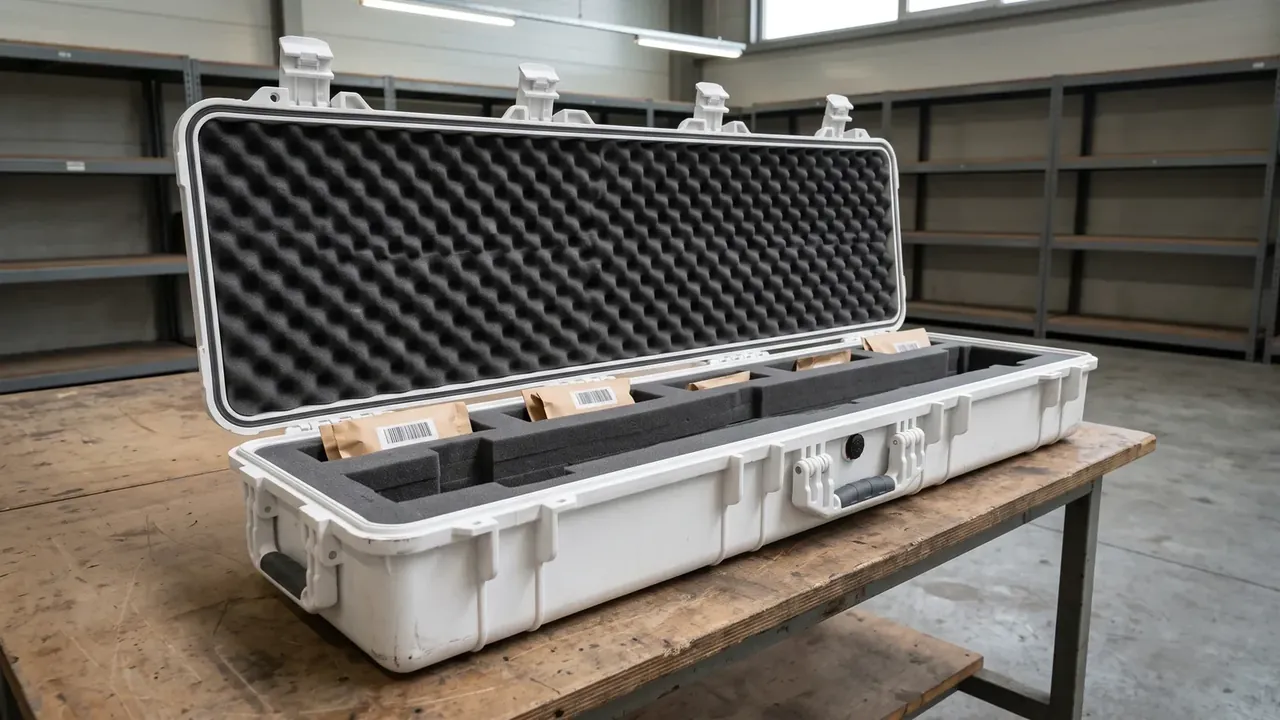
Tooling changes fall into three classes: process-fixable, minor repair such as deeper vents, a gate opened 0.2 mm or a moved ejector, and structural, such as wrong gate count.
Colour carries a hidden cost: dark resin left in the barrel prints streaks on light parts. High-regrind batches also get hopper drying at 80 °C for 2 h. The 30 min figure assumes clean barrel and hot runner.
5. Amortisation tiers by batch size
Three tiers only: 300 pcs, 1000 pcs, 3000 pcs. Steel, machining and trial shots are fixed, so a small batch carries most of them per unit, while past 3000 pcs the fixed part dilutes to almost nothing.
| Amortisation tier | Batch | Where fixed cost lands |
|---|---|---|
| 300 pcs | Trials, small runs | Steel and trials sit on each case |
| 1000 pcs | Repeat orders | Tool spread, cycle dominates |
| 3000 pcs | Volume | Fixed part near zero, material rules |
Tool life of 300,000 shots on two cavities equals 150,000 injections, the floor under any tier. A 500 pc batch uses under four thousandths of that life, so the rest is an asset; at 300,000 pcs it needs a plan for sliders, ejector pins and 6 cooling circuits.
A 1 mold 2 cavity box needing 6 days for one slider change, sitting in a 300 pc tier, eats every process margin it had.
The tier logic belongs in the process file. A ±0.3 mm tolerance and 0.5 mm warp ceiling can be held by machine settings at 300 pcs, but at 3000 pcs they depend on the tool itself.
Conclusion
In source factory plastic tool box OEM ODM work the first three cost items all sit in the tool: milestone order, cavity count against cycle, and the trial-to-first-article gate. A 1 mold 2 cavity set on a 95 s cycle, 650 t of clamp and 300,000 shots of life set the spread between the 300 pc and 3000 pc tiers, while a 3.2 mm wall, 1.5° draft, 1.6% shrinkage, ±0.3 mm tolerance and 0.5 mm warp ceiling give the 6 day modification and 30 min colour change their boundaries.
Related Reading
- Packing Split for OEM Case Shipments
- Tooling Economics: Plastic versus Wood
- Outgoing Inspection Acceptance Levels
Related Products
- 8 Series — Gun Cases; Military Equipment Cases; Camera Equipment Cases; Drone Cases; Watch Cases; Knife Cases; First Aid Cases; Electronics Equipment Cases
- WL8-2812 PP Gun Case — model WL8-2812
- All protective cases and toolboxes: 7 series, 158 models