

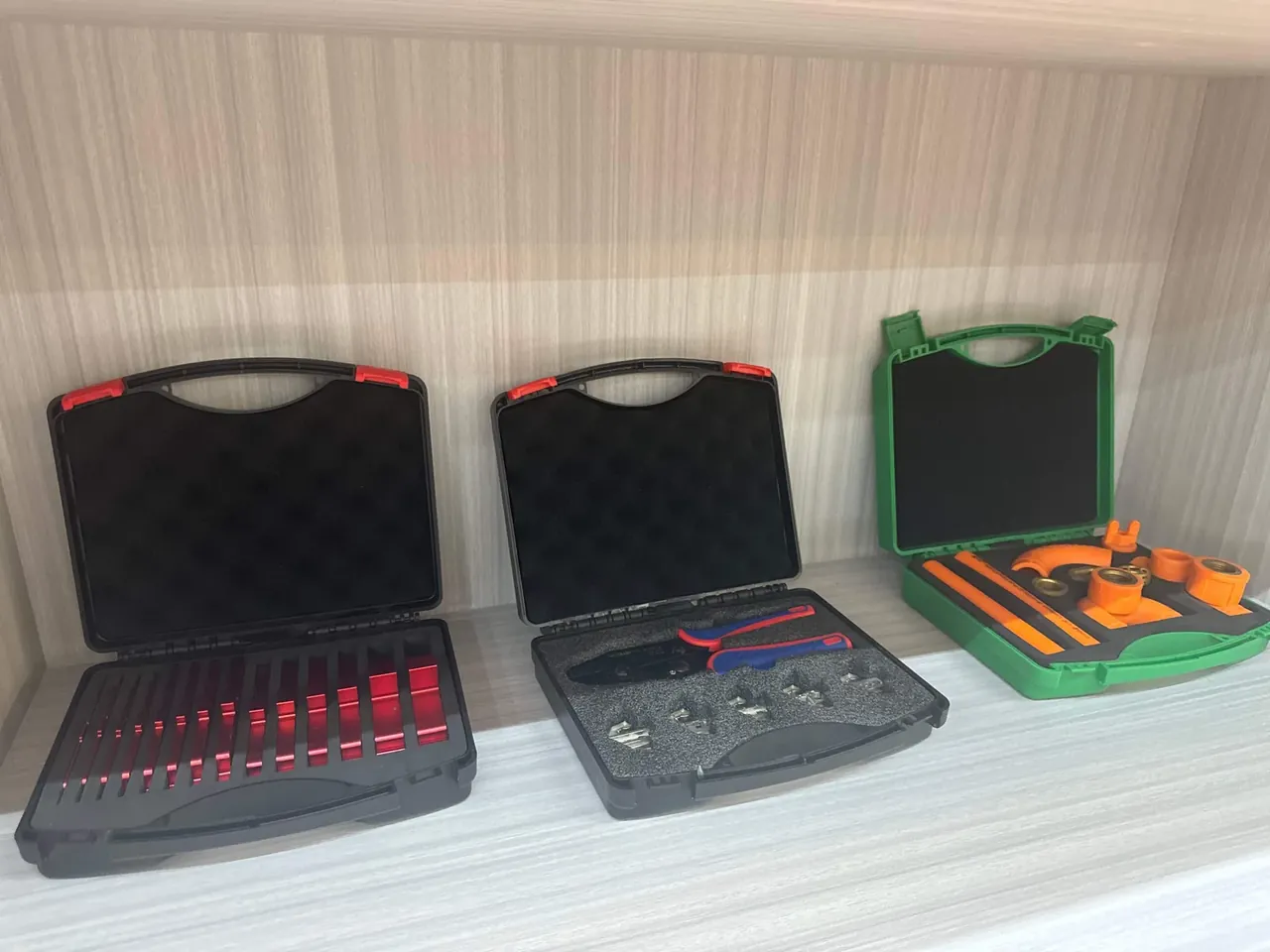
Quick answer: A Spec military black olive tan plastic protective case custom holds batch delta E at 1.5 with a 2.0% masterbatch across four 190-230 C zones.
Table of contents
- Three Masterbatch Ratios for a Spec military black olive tan plastic protective case custom
- Same-Mould Co-Injection Zones and Holding Pressure
- Sampling and Reading Batch Colour Difference
- Colour Drift After Xenon-Arc Ageing
- Matching Hardware Colour to the Shell
- FAQ
1. Three Masterbatch Ratios for a Spec military black olive tan plastic protective case custom
A Spec military black olive tan plastic protective case custom is 600×440×260 mm outside, 535×375×195 mm inside, 4.2 mm wall, 6.4 kg empty. Black, olive and tan each use one masterbatch at 2.0%, so the carrier share stays fixed and only the pigment differs. Carrier resin matches the shell grade, keeping melt flow from dragging a colour line into a streak. Each lot is dried by batch number; excess moisture silvers the black shell and lightens the green and tan. JUNZHIJIA treats 2.0% as a ceiling, not a target: more pigment holds hue but drops impact strength.
Fix 2.0% first and the zones and pressure share one datum. A yellow green lot is traced to its masterbatch and drying log, not hidden by raising heat.
| Colour lot | Masterbatch | Sample basis |
|---|---|---|
| Black | 2.0% | Standard black |
| Olive | 2.0% | Standard olive |
| Tan | 2.0% | Standard tan |
| Changeover | Trial shot | Logged comparison |
2. Same-Mould Co-Injection Zones and Holding Pressure
A Spec military black olive tan plastic protective case custom uses one mould with four barrel zones rising 190-230 °C; the steps only offset shear heat, not chase darker colour. Holding at 60 MPa keeps melt density until the gate freezes; relax it and the black corner sinks first while green and tan lose depth. Each colour logs its own four-zone curve, switching masterbatch but never mould, with a first-article colour check after any restart. Working span −25 °C to 60 °C is a product limit, logged apart from machine zones. Four latches at 420 N and 3-layer stacking belong to assembly, borrowed only for shell load recheck.
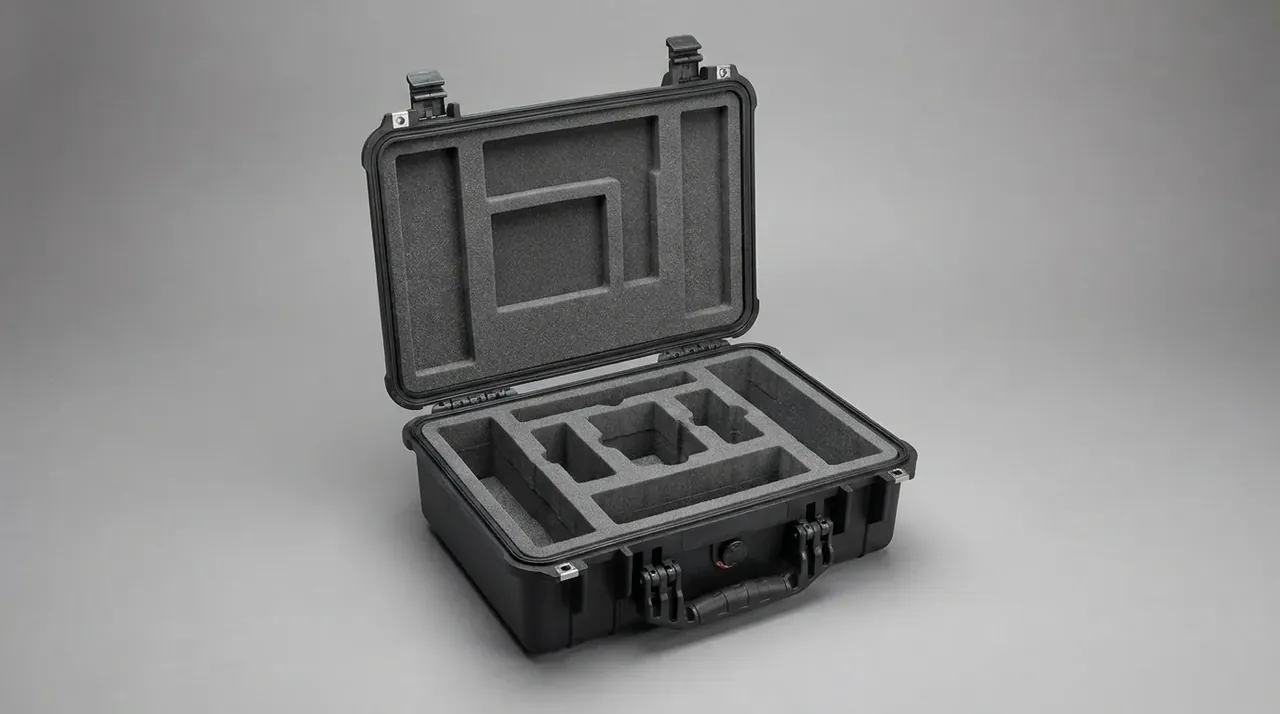
Zone drift shows up as colour difference first: any step in 190-230 °C pushes delta E from 1.5 toward 2.5. A melt sample per shift beats judging a finished lot.
| Colouring stage | Machine setting | Logged value |
|---|---|---|
| Four zones | 190-230 °C | Zone curves |
| Holding | 60 MPa | Before gate freeze |
| Masterbatch | 2.0% | By colour lot |
| Changeover | Masterbatch only | First-article check |
3. Sampling and Reading Batch Colour Difference
On a Spec military black olive tan plastic protective case custom the batch limit is delta E ≤1.5, sampled as three shells per machine, colour and shift, read on lid flat and side wall under standard light. The flat governs hue, the wall governs flow marks and thickness lightness; both must sit under 1.5 for one colour. One spectro, one standard sample, re-zeroed whenever either changes, or lots cannot be compared. Near 1.5, tell grey black from yellow tan before re-reading the zone curve.
Sampling skips gates and weld lines, which run dark by nature. Sealed samples stay with the lot number for direct recheck.
| Delta E reading | Sample point | Verdict |
|---|---|---|
| ΔE ≤1.5 | Lid flat | Batch passes |
| ΔE ≤1.5 | Side wall | Batch passes |
| Near 1.5 | Zone recheck | Hue fault first |
| Sealed sample | By lot | Direct recheck |
4. Colour Drift After Xenon-Arc Ageing
A Spec military black olive tan plastic protective case custom takes 500 h xenon-arc as the second colour check, with delta E ≤2.5 afterwards. Cut panels run alternating light and spray for 500 h, then the same points are re-read and the difference from the pre-age figure is the drift. Black drifts by surface chalking, green and tan by pigment lightfastness, so all three are balanced at the recipe stage. If 500 h lands near 2.5, check pigment data first, then whether 60 MPa left the skin porous.
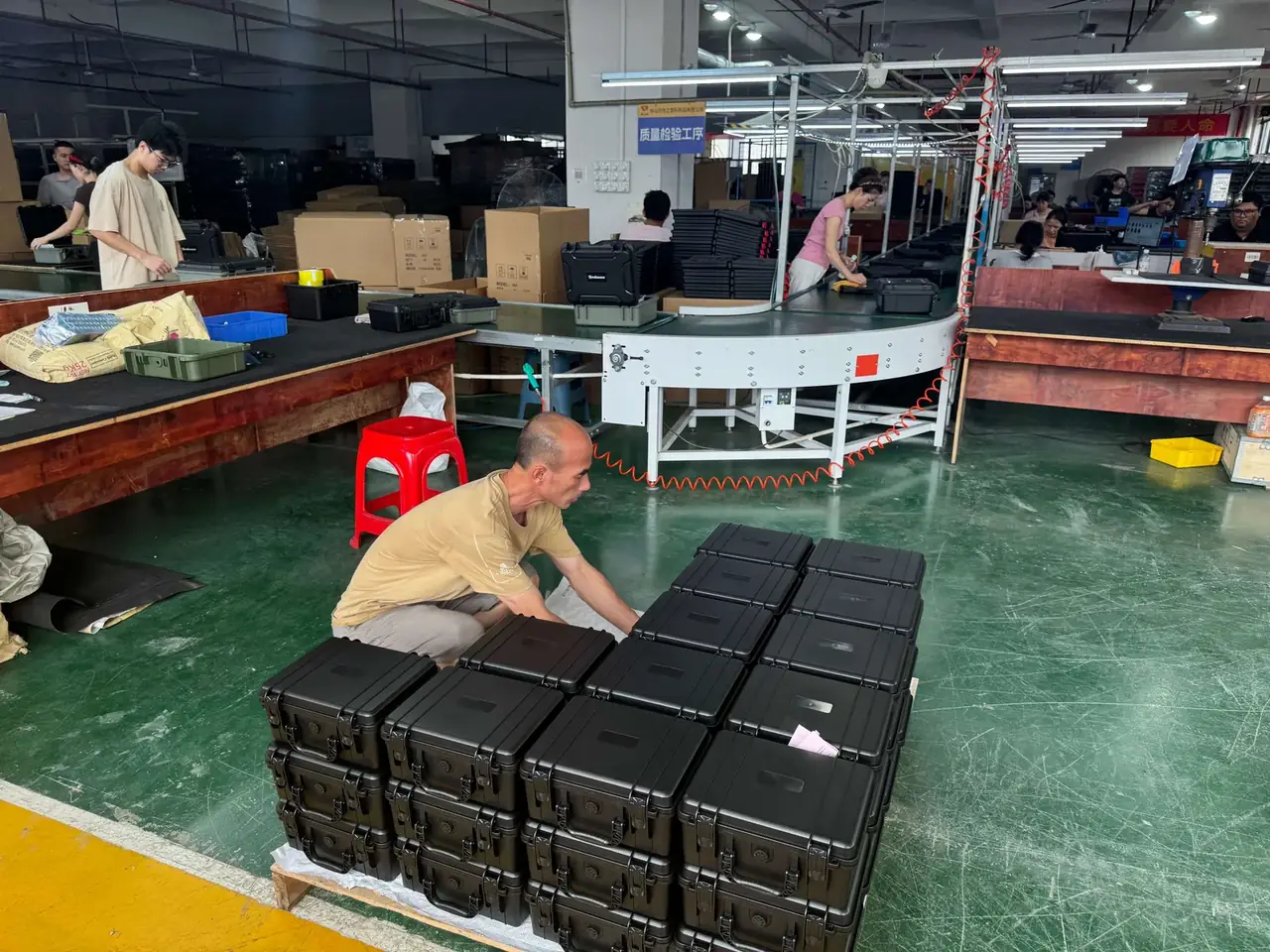
The 1.2 m drop and IP67 sit in the shell-structure recheck after colour verdicts, so age drift and assembly damage never share one sheet. Stacking 3 layers only checks post-load appearance, not the colour reading.
5. Matching Hardware Colour to the Shell
A Spec military black olive tan plastic protective case custom matches latches, handle and corner guards to the shell, since painted or natural hardware shifts by lot too. Against the shell standard, four latches are compared with the lid for lightness, guards with the side wall for hue; single pieces do not count, only the group. The 420 N clamp is unchanged, yet a one-step hardware gap makes the whole case look like two lots. Records follow the lot, and a new hardware supplier means a new sample.
Two tools govern this: the standard sample and the spectro. With both present, the colour number is aligned.
Conclusion
A Spec military black olive tan plastic protective case custom manages three-colour consistency as an injection parameter, not finished-part sorting: 600×440×260 mm outside and a 4.2 mm wall fix the datum, 2.0% masterbatch, four 190-230 °C zones and 60 MPa holding steady the melt, with delta E ≤1.5 and delta E ≤2.5 after 500 h as two repeatable verdicts. Black, olive and tan switch masterbatch only, samples are logged by point, and hardware is matched to the shell standard. JUNZHIJIA keeps masterbatch lots, zone curves and sealed shells on one batch card for colour-number traceability.
Related Reading
- Colour-number visual management for protective cases
- Specification terms for custom-colour plastic cases
- Hardware colour matching and sample approval
- Shell colour customization workflow
Related Products
- 8 Series — Gun Cases; Military Equipment Cases; Camera Equipment Cases; Drone Cases; Watch Cases; Knife Cases; First Aid Cases; Electronics Equipment Cases
- WL8-2812 PP Gun Case — model WL8-2812
- All protective cases and toolboxes: 7 series, 158 models