

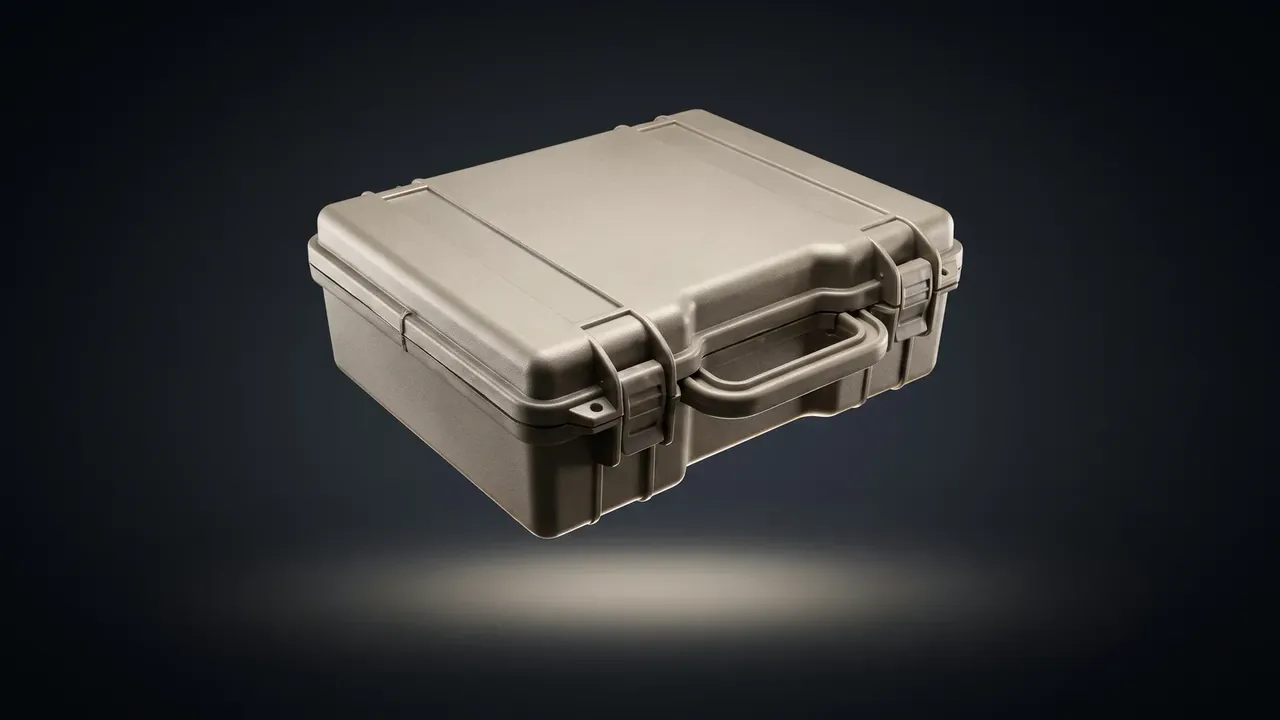
Quick answer: A special forces case is defined by four measurable things: a one-piece moulded shell with an 8 mm wall, six symmetric draw latches, one gasket ring matched to its groove, and a three-layer foam stack cut for a single item. What follows walks the moulding step, the closing load path and the foam interface, then hands over three measurements for an inspection sheet.
Table of contents
- What the name actually covers
- One-shot moulding: 1,600 tonnes and three constraints
- Six latches against one gasket ring
- Foam: density, hardness, a 2 mm corner radius
- The parameter table and three pre-foam measurements
- FAQ
1. What the name actually covers
A special forces case is neither a trademark nor one factory's model number. It names a family from logistics packaging: load-bearing walls, a lid held by symmetric draw latches, a cavity cut to one item.
Purchasing labels are looser than the objects: "military packing box" may mean a two-millimetre tote with no seal, "instrument case" often no gasket. Four numbers decide membership — cavity proportions, wall thickness, latch count, foam build.
| Common label | Typical cavity (mm) | Wall | Latches | Foam |
|---|---|---|---|---|
| Tote | 600 x 400 x 280 | 2–3 mm | none | none |
| Instrument case | 560 x 420 x 200 | 4–5 mm | two | single layer |
| Military packing box | 900 x 400 x 300 | 6–10 mm | four to six | two layers |
| Special forces case | 1,200 x 450 x 320 | 8 mm | six | three layers, cut |
Going from a three-millimetre wall to eight multiplies clamp force rather than raising it in a line, and two more latches add two slider sets. Two cases that look alike can differ threefold in price.
2. One-shot moulding: 1,600 tonnes and three constraints
Most shells are moulded in one shot from modified PP. A 1,200 mm cavity needs about 1,600 tonnes of clamp force and a tool over twelve tonnes — the price of a shell with no seam.
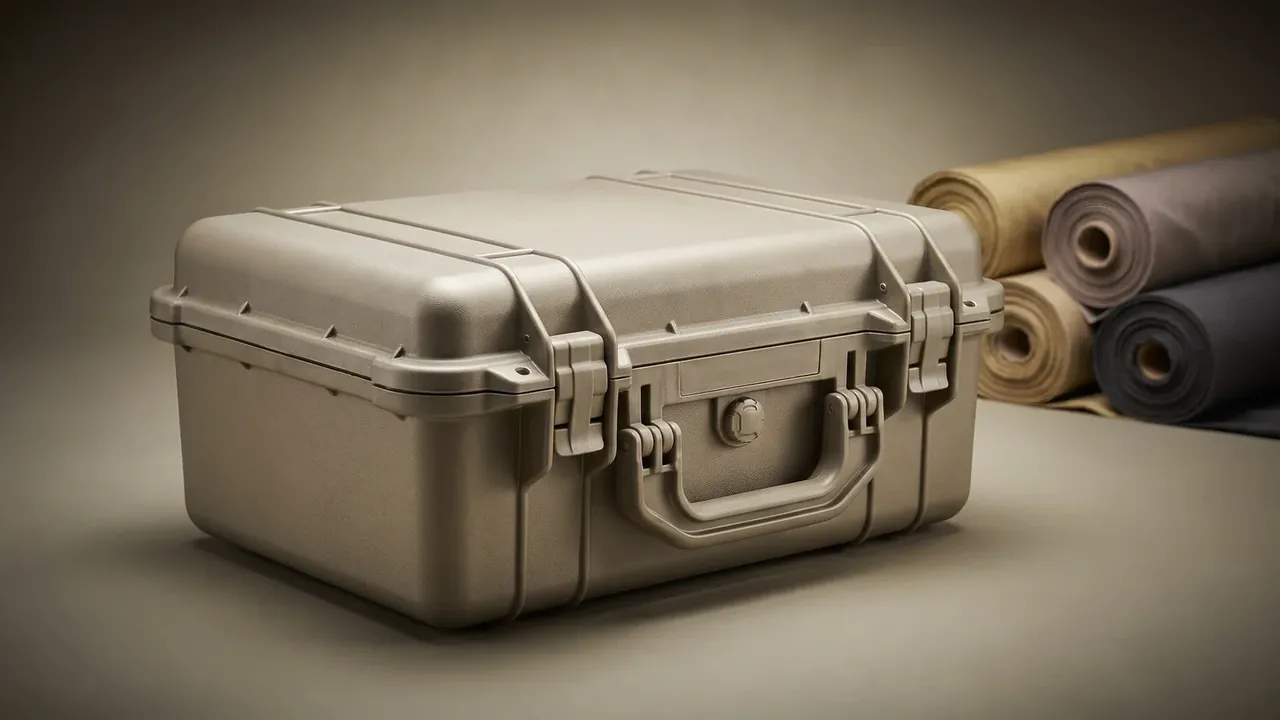
Wall thickness is only the first constraint. Draft comes second: long walls need one and a half to two degrees, or ejection leaves white stretch marks where a hand grips. Ribbing comes third — four to six cross ribs, 3 mm thick and 18 mm tall, holding lid deflection under 2 mm when loaded.
Eight millimetres is derived, not chosen. Four conditions set it: a 1.2 m cavity, 46 kg loaded, three-high stacking, a 1.2 m drop without cracking. Each extra millimetre adds about twelve percent to part weight and takes the cycle from 180 to 210 seconds.
3. Six latches against one gasket ring
A latch presses the lid onto the gasket and resists separation in transit. Two per long side, one per short side gives six at roughly 180 N each — over 1,000 N, enough for the inertial peak a loaded case sees on a vibration table.
| Closure part | Count | Per-unit figure | What overdoing it looks like |
|---|---|---|---|
| Draw latch | six | 180 N holding force, 5,000 cycles | rim waves, and the middle leaks |
| Silicone gasket | one ring | 8 mm cord, 30% compression | past 40%, rebound is gone within a year |
| Purge valve | one | 0.35 bar differential | omit it and the lid seizes after a temperature swing |
| Hinge | two | 5 mm stainless pin | past 100 degrees the lid sags |
Sealing is pushed too far more often than any other figure. A ten-millimetre cord in place of an eight feels tighter, so buyers assume margin, but past forty percent compression the silicone takes a permanent set and water arrives sooner. What seals is groove-to-cord fit: the groove about twenty percent narrower, so the section squeezes square. Rim flatness has to keep up, since a 1.2 m rim warped beyond 0.8 mm cannot be closed by adding latches.
The purge valve is the part most often deleted to save cost. Without it, a temperature swing pulls the lid down until the only way in is a pry bar, which burrs the rim.
4. Foam: density, hardness, a 2 mm corner radius
Foam decides whether equipment moves inside the case. The usual build is three layers: a base, a cut layer that locates, a lid layer that presses down. Material follows three criteria — density, hardness, cutting — rather than feel.
- Density: 45 kg/m³ PE for load-bearing items, 25 kg/m³ EVA for light ones, nothing under 20 except as a lid layer.
- Hardness: at equal density 45 and 60 Shore A differ; take 60 for heavy items so pockets do not collapse.
- Cutting: a CNC oscillating knife, pocket width to plus or minus 1.5 mm, a 2 mm fillet at the wall, tool path with the grain.
Tighter is not better. Interference beyond three millimetres tears the foam edge; under one millimetre, the item slides out when the case is turned over.
The lid layer is ten-millimetre EPDM sponge: it takes up vertical clearance and nothing else, and asking it to locate an item sideways is the most common build error.
5. The parameter table and three pre-foam measurements
The figures belong to the 1,200 x 450 x 320 mm cavity; scale other sizes by span, never one dimension alone.
| Parameter | Value | Condition |
|---|---|---|
| Wall thickness | 8 mm | average of three points at mid-wall |
| Empty weight | 16.4 kg | without foam |
| Loaded weight | 46 kg | equipment plus foam |
| Stacking | three high, 24 hours | no permanent set in the base |
| Drop | 1.2 m | six faces, three edges, one corner |
| Service temperature | -40 to 71 C | latches operable after cycling |
| Salt spray | 96 hours | neutral, no red rust on hardware |
| Ingress rating | IP67 | 1 m of water for 30 minutes |
Inspection comes down to three checks before the foam goes in: rim flatness within 0.8 mm over 1.2 m, latch gap within 1 mm, cavity diagonals within 3 mm. Pass those and the foam conversation can start.
Conclusion
Five items are worth checking before payment: cavity dimensions, wall thickness, latch count, seal construction, foam density. Put them in the enquiry and replies turn specific. The 8 mm wall, six latches and 96-hour salt spray are inspection points, not slogans. Fix the cavity first, then the wall, then the foam; reverse that order and the tool is cut twice, which is where the cost of a special forces case sits.
This article discusses the case body only — its specifications and design intent. It does not cover any handling, loading or use of the items inside.
Related Reading
- How a special forces case is configured for training, transit and field camps
- Ranking the criteria for a special forces case by load and opening frequency
- Shell moulding and wall distribution in injection-moulded protective cases
- Density, hardness and cut tolerance in removable foam inserts
Related Products
- 8 Series — Gun Cases; Military Equipment Cases; Camera Equipment Cases; Drone Cases; Watch Cases; Knife Cases; First Aid Cases; Electronics Equipment Cases
- WL8-2812 PP Gun Case — model WL8-2812
- All protective cases and toolboxes: 7 series, 158 models