


Quick answer: A Special Forces Case back from a coastal rotation should be graded before anyone lifts the lid. Latch pull force, hinge pin clearance and foam compression set define the grade, and the grade decides the response.
Table of contents
- Where inspection starts after salt fog and sand
- Cleaning order: sand first, salt second, oil last
- Pass and fail lines for latches and hinges
- How long a foam insert actually lasts
- Service life: intervals and replaceable parts
- FAQ
1. Where inspection starts after salt fog and sand
Three months on a coastal range is hard on any Special Forces Case: the sun-facing wall reads 55 °C at noon, 18 °C after dark, a 37 K swing absorbed daily. It returns with a white salt crust on the rim and wet grit in the latch pockets.
Grade first, open second. Lifting the lid drops rim grit into the cavity and turns the foam cutouts into sandpaper.
| Grade | Shell condition | Hardware response | Action |
|---|---|---|---|
| A | No distortion, salt on surface only | Opens one-handed, crisp return | Clean, re-check, reissue |
| B | Scuffed corners, local scratching | Pull force too high or too low | Fit a latch kit, re-check |
| C | Bulged wall, lid out of register | Hinge has play, lid will not seat | Retire shell, salvage parts |
Salt crust matters only where it reached the latch axle; a spotless shell can hide a latch that no longer holds. Polymer weathers slowly and steel fast, so spring, hinge pin and rivet differ two to three fold. Brown pitting is section loss and drops the case to grade B.
2. Cleaning order: sand first, salt second, oil last
Cleaning is not rinsing. Grit, salt and grease come off in that order; water early turns grit into lapping paste, oil early seals salt against metal.

- Dry blow: air under 0.3 MPa, nozzle 100 mm off the surface, working outward from the latch roots.
- Wet wash: neutral detergent under 40 °C, soft brush one way, rinse at once.
- Dry wipe: microfibre, single direction, never circles.
- Air dry: lid open, 30 minutes at 50 °C or four hours in still air.
The first step is the one people skip: a pressure washer drives water past the latch axle, and rust weeps out a fortnight later.
3. Pass and fail lines for latches and hinges
Hook a push-pull gauge under the claw and pull straight out: 45 N to 60 N is healthy, under 40 N the spring is tired, over 70 N grit or a burr is loading the axle.
Hinges are judged on clearance. If a 0.3 mm feeler enters the pin joint, replace the pin; at 0.5 mm replace the seat as well.
| Check point | Tool | In spec | Fail line | Action |
|---|---|---|---|---|
| Latch pull force | Push-pull gauge | 45 N to 60 N | Under 40 N or over 70 N | Replace latch kit |
| Hinge pin clearance | Feeler gauge | 0.15 mm or less | 0.3 mm enters | Pin and bush set |
| Gasket compression | Depth gauge | 25% to 35% | Under 20% | Replace gasket |
Tighten latch screws to 1.2 N·m by hand; a driver run to the stop cracks the nylon bush, and the crack shows at the next closing.
4. How long a foam insert actually lasts
Foam dies long before the shell, and silently: a collapsed insert looks new from outside.
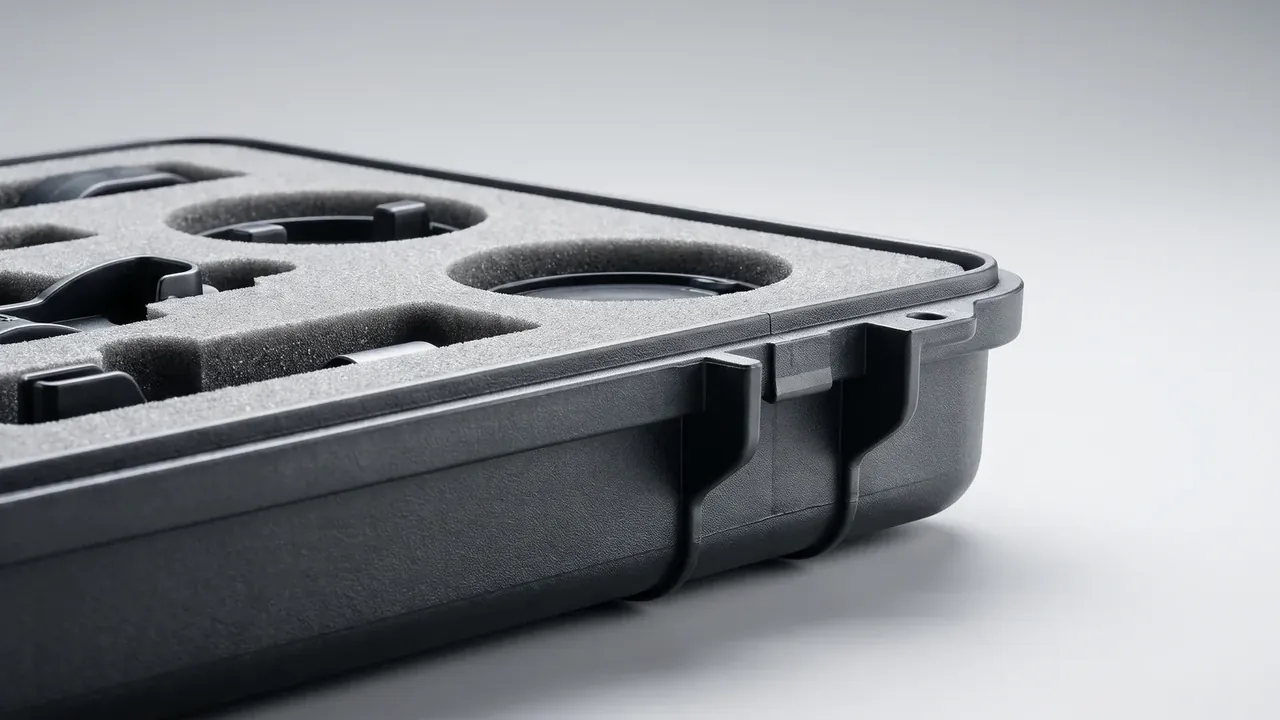
Mark a cutout floor, measure depth, load the case a few dozen times, measure again. Loss over original depth is the compression set.
Past 15% and it is due. A 20 mm polyethylene layer loses 2.5 mm in eight months at four loadings a week; closed-cell foam loses half that but chips at the cutout edges. Order by cutout number; one main plus two accessory pockets uses a third of the material in a full slab.
5. Service life: intervals and replaceable parts
Intervals follow the environment, not the calendar: the same case on a coast and in a conditioned room differs threefold in inspection frequency.
| Where it lives | Walk-round | Strip check | Escalation trigger |
|---|---|---|---|
| Coastal open storage, heavy salt | Monthly | Every 6 months | Any white bloom on metal |
| Inland, mostly vehicle transport | Quarterly | Every 12 months | Re-check latches after long hauls |
| Conditioned store, long standby | Every 6 months | Every 24 months | Check rim flatness |
Replace sealing parts first, carrying parts second:
- Latch assemblies: the whole unit, spring and claw together.
- Hinge pins and bushes: as a pair; a new pin in a worn bush regains play in weeks.
- Gaskets: cut to perimeter, joint at the midpoint of a long side.
- Foam inserts: per cutout, not per slab.
- Handles and rivets: together, once the handle root whitens.
A shell runs eight years or more, latches and foam two to three, so part replacement holds the annual cost of a Special Forces Case near a third of new.
Conclusion
These three thresholds put every reading on the same scale. Clean in order, judge latches by force, judge foam by set, replace by interval, and the four habits add up to service life. Most Special Forces Case failures come from a wrong call.
This article discusses only the container (case body) side of specifications and design intent, and does not cover any handling, loading or use of the contents.
Related Reading
- How the same case is configured for three field scenarios
- Judgement criteria when choosing a Special Forces Case
- Long-term sealing and reopening of war reserve cases
- Inspection and touch-up work on metal ammunition boxes
Related Products
- 8 Series — Gun Cases; Military Equipment Cases; Camera Equipment Cases; Drone Cases; Watch Cases; Knife Cases; First Aid Cases; Electronics Equipment Cases
- WL8-2812 PP Gun Case — model WL8-2812
- All protective cases and toolboxes: 7 series, 158 models