

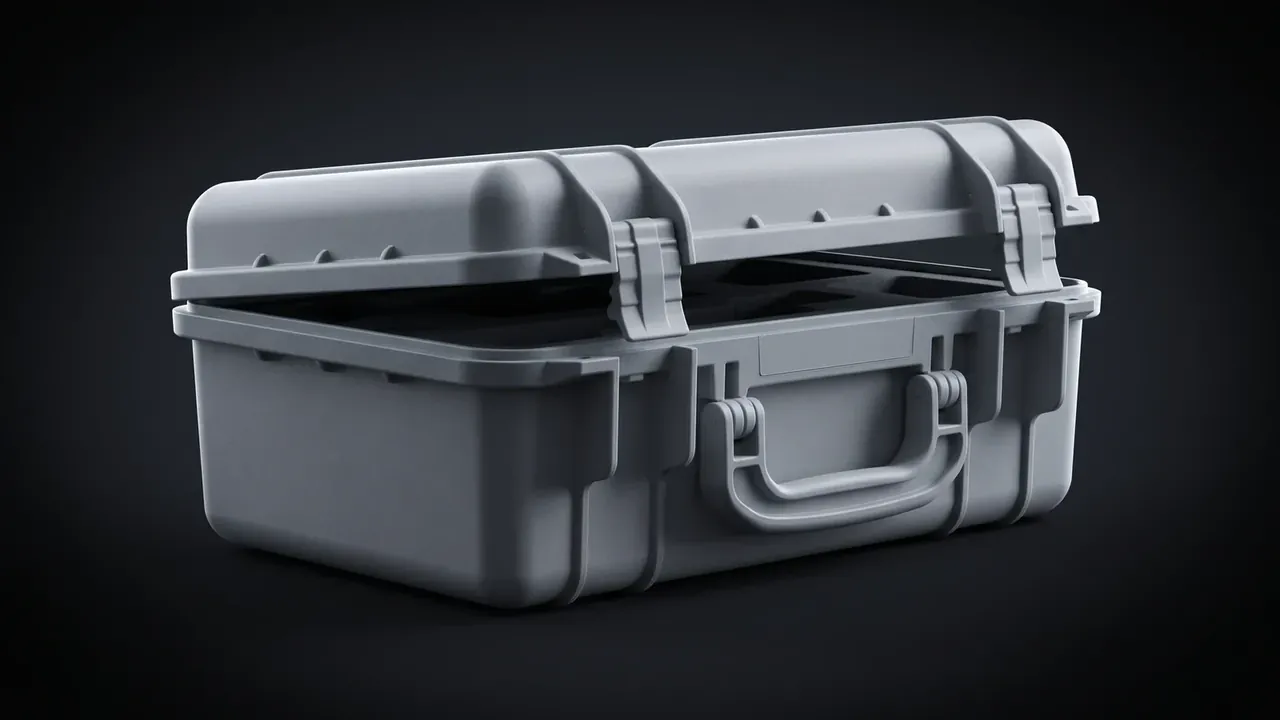
Quick answer: A Stackable Container stacks square only when five details are settled at drawing stage: rim groove and corner posts, wall and rib thickness, lid rib direction, latch and strap points, and base feet.
Table of contents
- Where a Stackable Container Gets Its Alignment
- Wall Thickness and Rib-to-Wall Ratio
- Lid Load and Rib Direction
- Latches, Straps and Load Paths
- Base Contact and the Feet
- FAQ
1. Where a Stackable Container Gets Its Alignment
The ring where lid meets body is the first alignment feature: it centres layer on layer and stiffens the joint. Eight millimetres tall with 0.4 mm clearance per side works; at 0.3 mm the lid seizes when ambient falls from 20 °C to minus 10 °C.
Second are four corner posts, 12 mm across and 5 mm tall, dropping into 90 degree cones 1 mm wider at the mouth, so only the last 2 mm tightens. Third is the corner taper, which sends horizontal load into the corner columns, not mid-wall.
| Feature | Tooling demand | Key size |
|---|---|---|
| Rim groove | Common mould frame, 0.2 mm coaxiality | 8 mm tall, 0.4 mm per side |
| Corner posts | Lifters, no weld line at the root | 12 mm across, 5 mm tall |
| Base taper | Deeper insert, polished to Ra0.8 | 90 degrees, 4 mm tall |
2. Wall Thickness and Rib-to-Wall Ratio
Thicker is not stronger. At 2.8 mm a Stackable Container keeps margin under a 1 m drop and a three-high stack; at 3.5 mm stiffness rises a tenth, weight a quarter, and the cycle stretches from 78 s to 105 s, since cooling scales with thickness squared.
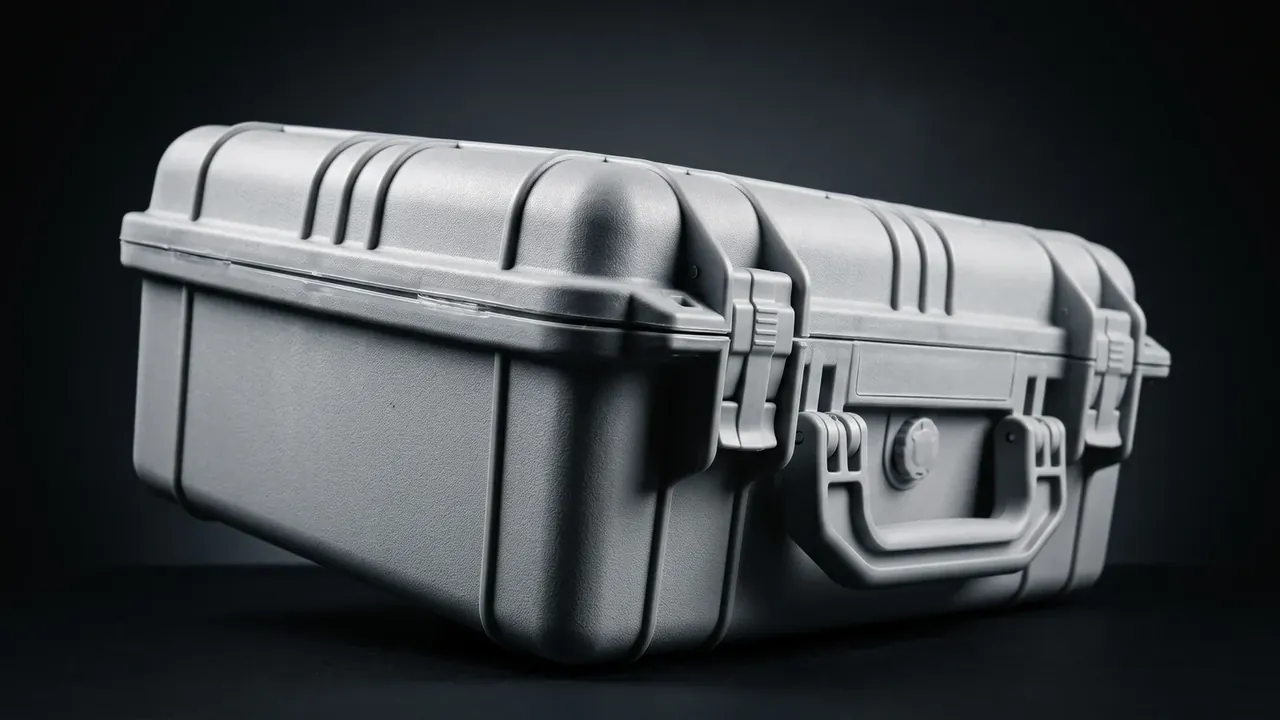
Rib roots at 0.6 of wall, here 1.8 mm, split sink from short shot: at 0.7 the root sinks onto the stacking face, at 0.5 the rib fills halfway. Draft is 1 degree outside and 1.5 inside, because short draft whitens the wall.
From 2.8 mm to 3.2 mm the lid deflects 0.2 mm less after thirty days while the cycle rises twenty percent, so Stackable Container walls stop near 2.8 mm and stiffness comes from ribs.
3. Lid Load and Rib Direction
The lid is the only plate spanning two supports, set at the long ends, so deflection climbs with the cube of a near full-length span; ribs across the short direction cut it to a quarter.
Cross them, or the flat band parallel to the ribs bulges. Ribs 6 mm tall, 1.8 mm thick and 90 mm apart take a 500 N centre load from 4.2 mm to 1.3 mm.
Ribs must stop 3 mm short of the rim, or they deform the lip and an 8 mm groove behaves as 5 mm. A 12 mm dome is stiffer but costs 12 mm of stack height, 48 mm over four tiers.
4. Latches, Straps and Load Paths
A latch on a Stackable Container holds the lid on the rim: 450 N each, two opposite on the long sides, faces aligned within 0.3 mm on one mould frame.
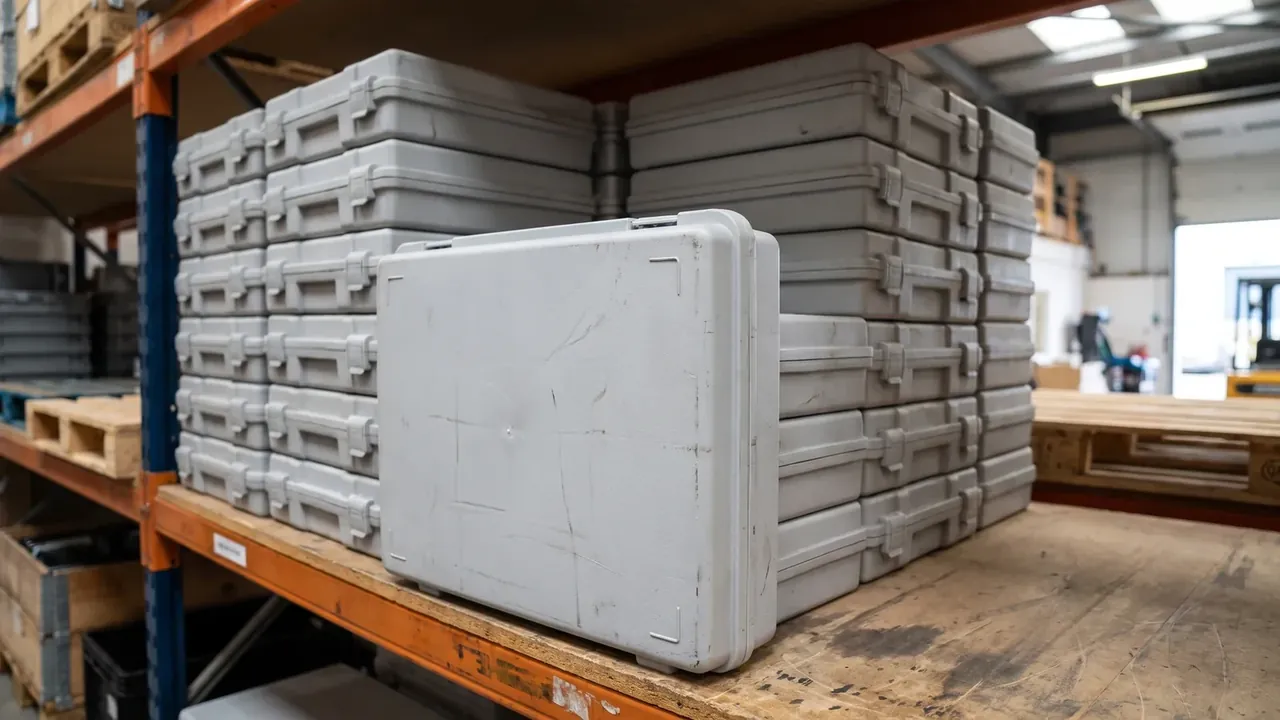
It does not restrain layers. When a stack shifts the groove and posts take the load, and strapping across a latch tilts the seat until the gasket fails.
Strap channels 2 mm deep and 25 mm wide keep the band off the rim: at 350 N the wall deforms 0.8 mm with them, 2.1 mm without.
5. Base Contact and the Feet
The base of a Stackable Container does not sit flat. Shrinkage leaves corners down and centre up, so capacity read off the full footprint is overstated threefold, and a plate-tested tier count fails on a warehouse floor.
| Base form | Contact share | Wear | Process cost |
|---|---|---|---|
| Four moulded PP pads | about 3.6% | grinds to dust | single shot |
| Four over-moulded TPU feet | about 3.6% | replaceable | second shot |
| Full ribbed base | about 72% | traps dust | deeper base |
| Bolt-on corner blocks | about 2.9% | replaceable singly | parts to stock |
An 85A shore TPU foot, 34 mm across and 3 mm tall, compresses 1.5 mm when full; a plain PP pad is cheaper but grinds to dust by the fourth tier. A 2 mm reverse crown lands the centre only under load.
Conclusion
Feet gather load into the corners, corners pass it to the rim, groove and posts hand it upward, lid ribs spread the mid-span moment. Walk that path on paper and the Stackable Container stacks as drawn.
This article discusses only the container (case body) side of specifications and design intent, and does not cover any handling, loading or use of the contents.
Related Reading
- How to read stacking specifications for a stackable container
- Why stackable containers collapse and what to do
- Injection machines and how a case body is moulded
- Routine maintenance points for case moulds
Related Products
- 8 Series — Gun Cases; Military Equipment Cases; Camera Equipment Cases; Drone Cases; Watch Cases; Knife Cases; First Aid Cases; Electronics Equipment Cases
- WL8-2812 PP Gun Case — model WL8-2812
- All protective cases and toolboxes: 7 series, 158 models