

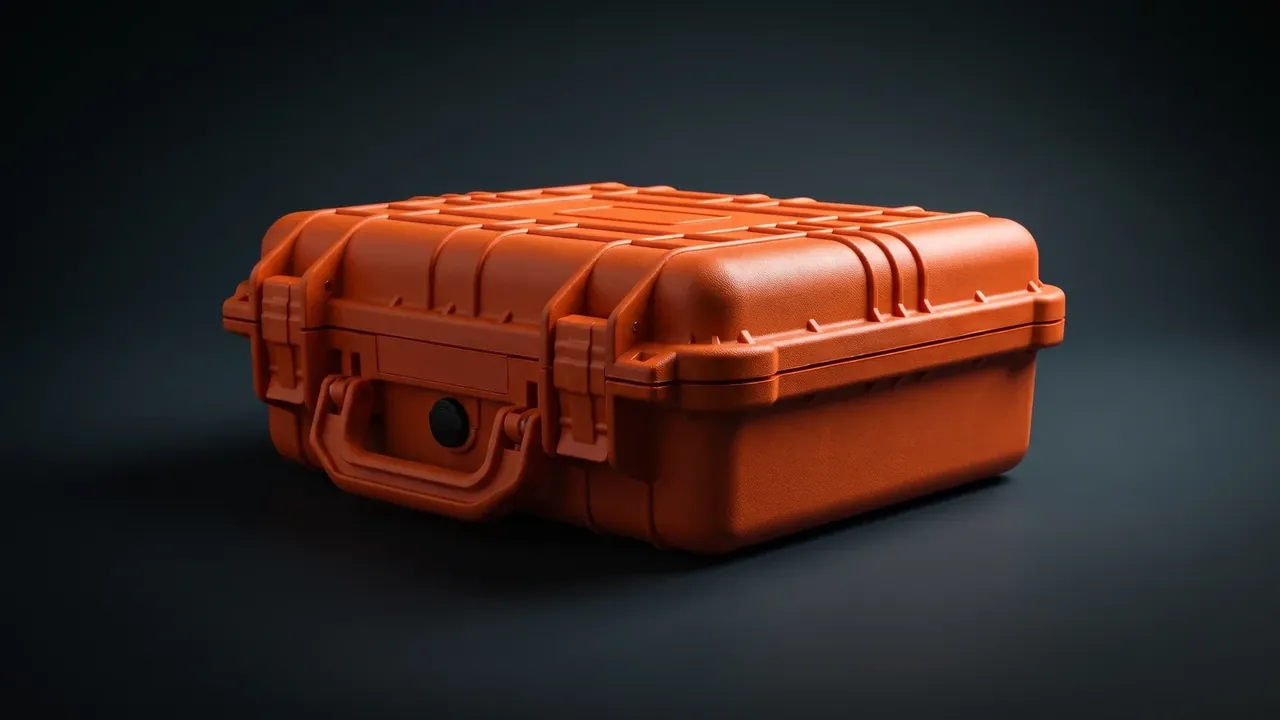
Quick answer: Acceptance of a Stackable Container belongs in clauses, not impressions. Eight test items, two sampling levels and three verdict rules put appearance and size on full inspection, and stack load, drop, corner and cold on sampling.
Table of contents
- Acceptance Starts With the Test Item List
- Dimensions, Wall Thickness and Static Stack Load
- Drop, Corner Impact and Low Temperature Brittleness
- Sampling Plans and Pass or Fail Rules
- Marking and Traceability at Dispatch
- FAQ
1. Acceptance Starts With the Test Item List
The first job is listing every item, not judging how a case looks. A missing line surfaces later, when a stack collapses over lid compression never on the sheet.
| Item | Requirement | Method |
|---|---|---|
| Appearance | No through defect, bubbles under 2 mm | Every unit |
| Outer size | ±3 mm on length, width, height | Every unit |
| Inner size | ±2 mm on length and width | Every unit |
| Wall thickness | 4.5 mm nominal, minus 0.3 mm | Sampled |
| Static stack | 3x rated, 1 hour, no buckling | Destructive |
| Drop | Hardware stays closed after cold soak | Destructive |
| Corner | 30 J impact, no through crack | Destructive |
| Marking | Moulded characters, legible | Every unit |
Four items run unit by unit; the rest need destructive sampling, size and wall first.
2. Dimensions, Wall Thickness and Static Stack Load
A 4.5 mm wall with the full 0.3 mm minus allowance is 4.2 mm, which takes 6% off case weight and far more off stack strength. Read nine points per sample, one per wall, two on the base, three on the lid, and judge on the lowest.
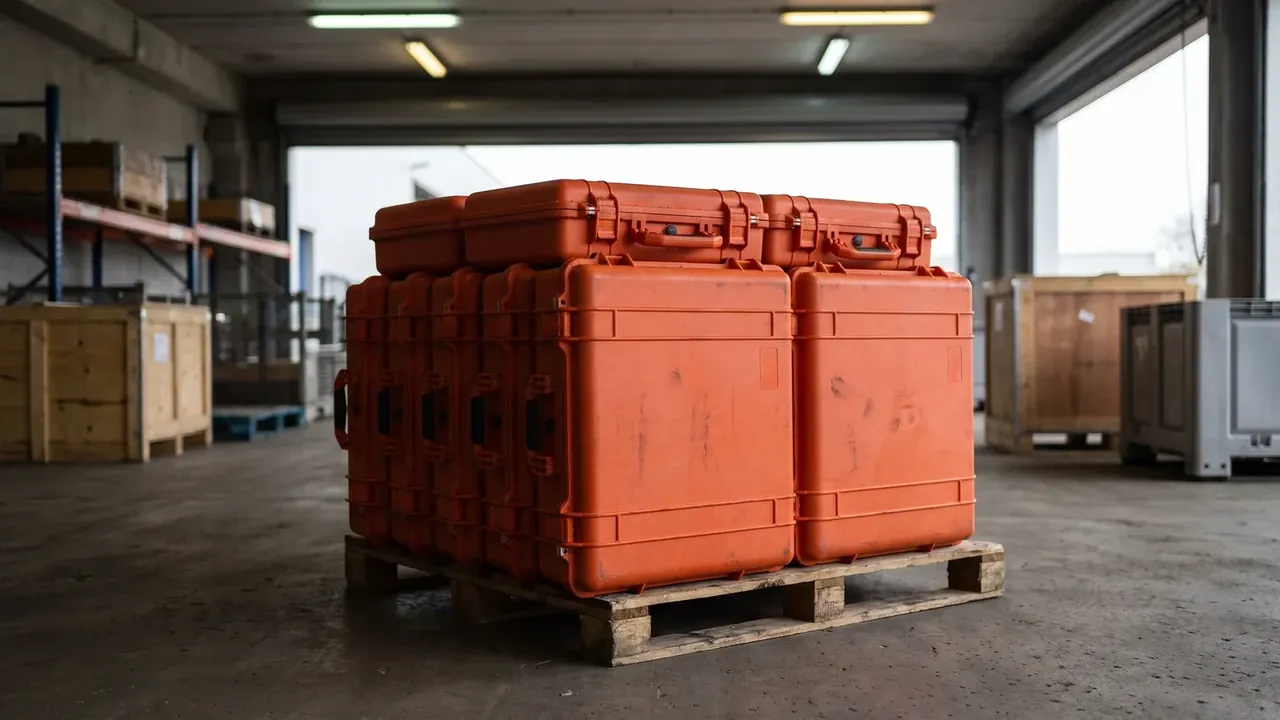
Static stack load is three times the rating, held one hour. Load in four stages of five minutes, reading lid deflection at each step; a single push records a peak, not a settled shape. At three times rated the lid may deflect 1.5% of body height, with residual set under 1.5% after 30 minutes of release.
Condition samples 24 hours at 23 °C ± 2 °C, with weights spread on 10 mm rubber pads.
3. Drop, Corner Impact and Low Temperature Brittleness
The drop sequence is five faces, three edges and one corner from 1.2 m onto a 50 mm steel plate. Samples condition at -18 °C for four hours, and the first drop lands within 30 seconds.
Corner strength uses a 30 J pendulum on the weakest corner, with no through crack and no latch release. The corner is the load entrance of a Stackable Container: the weight above, the forklift nudge and the first contact of a drop all arrive there.
Low temperature brittleness is judged at -40 °C for four hours with a Charpy impact of at least 8 kJ/m². A lot above 20% regrind typically loses 30% of its cold impact value.
4. Sampling Plans and Pass or Fail Rules
Sampling follows general inspection level II: AQL 0 for critical, 1.0 for major, 2.5 for minor defects. A lot of 501 to 1200 pieces draws 80 samples.
| Lot size | Sample | Critical Ac | Major Ac |
|---|---|---|---|
| 151 to 280 | 32 | 0 | 1 |
| 281 to 500 | 50 | 0 | 1 |
| 501 to 1200 | 80 | 0 | 2 |
| 1201 to 3200 | 125 | 0 | 3 |
Defect classes belong in the contract. A through crack, a failed latch or a stack collapse is critical; a short lip, a minus wall or a missing mark is major. A rejected lot gets one re-inspection on a doubled sample; tested samples never return.
5. Marking and Traceability at Dispatch
A mark has to bring one Stackable Container back within three years: material code, mould number, year and month, rated load in kilograms.
| Mark | Form | Used for |
|---|---|---|
| Material code | Moulded | Regrind level, cold performance |
| Mould number | Moulded | Machine, shot count, process record |
| Year and month | Moulded | Recall scope |
| Rated load | Moulded, in kg | Stack height on site |
| Lot number | Laser | Test report, retained samples |
Durability is checked by 50 isopropanol rubs. Three records must agree: samples held 24 months, process parameters archived by shot, regrind above 20% flagged.
Conclusion
Acceptance of a Stackable Container is not about a longer list but about clauses that hold: eight test items, two sampling levels, three records, each with a gauge, a limit and a record. Separate full inspection from sampling, write defect classes into the contract, mould the mark into the wall, and acceptance becomes evidence rather than opinion, which is what a Stackable Container standard is for.
This article discusses only the container (case body) side of specifications and design intent, and does not cover any handling, loading or use of the contents.
Related Reading
- Stacking design of stackable containers: load, interlock and stability
- Why stackable containers collapse and how to stop it
- Test and acceptance requirements for military air transport cases
- Factory inspection routine for military supply cases
Related Products
- 8 Series — Gun Cases; Military Equipment Cases; Camera Equipment Cases; Drone Cases; Watch Cases; Knife Cases; First Aid Cases; Electronics Equipment Cases
- WL8-2812 PP Gun Case — model WL8-2812
- All protective cases and toolboxes: 7 series, 158 models