

Quick answer: Stackable industrial case design needs a 6 mm base groove, a flat lid bearing face and a 2.4 m aisle; at 120 kg per case, five layers is the ceiling.
Table of contents
- Base Groove and Lid Bearing Face
- Unit Load and the Layer Arithmetic
- Pallet Size Sets Units per Pallet
- Stack Height, Aisles and Forklift Sightlines
- Stretch Film and Where Anti-Topple Stops
- FAQ
1. Base Groove and Lid Bearing Face
Sideways, a stack is held by one ring of plastic. The groove in the base runs 6 mm deep at each corner, and the feet of the unit above drop into it. Shallow it to 4 mm and the first forklift jolt shifts the upper layer 15 mm, enough for a five-high stack to fan out by layer three.
The lid finishes the joint. Its outer frame must stay flat across 12 mm of width so the base above has a seat. Mould it as an arch and contact shrinks to a central patch, doubling pressure until a pale mark shows, and a 0.5 mm feeler gauge sliding in at more than two edges means the lid is warped.
| Locating feature | Groove depth | Anti-slip method | Suitable floor |
|---|---|---|---|
| Four corner wells | 6 mm | groove wall plus rubber pad | epoxy screed |
| Long channel | 8 mm | rib and channel interlock | bare concrete |
| Flat base, no groove | 0 mm | stretch film only | level deck |
| Groove with pin | 10 mm | drop pin | vibration bay |
Friction belongs to the same calculation. Polypropylene on concrete runs near 0.3, so a cornering truck slides the load; a 2 mm rubber pad lifts that to 0.6, and stackable industrial case design lives on this ring rather than on lid thickness.
2. Unit Load and the Layer Arithmetic
The layer count in stackable industrial case design is a division. A rated 120 kg describes a case sitting under load at 23 °C; at five layers the bottom unit holds the four above it, 480 kg, plus its own weight for 600 kg.
Stackable industrial case design runs on three moves. Take the long-term rating first, 120 kg at 23 °C, and a 40 °C warehouse takes 20% off, leaving 96 kg. Multiply the layers above by unit weight, 4 × 120 = 480 kg. Divide 480 by 96 and the answer is 5, so five is a ceiling rather than a comfortable setting.
| Layers | Unit rating | Load on bottom case | Risk |
|---|---|---|---|
| 2 | 120 kg | 120 kg | none |
| 3 | 120 kg | 240 kg | faint lid marking |
| 4 | 96 kg | 360 kg | ribs begin to creep |
| 5 | 96 kg | 480 kg | critical, flush only |
| 6 | 96 kg | 600 kg | permanent depression |
A dent is the first warning. At four layers a 0.3 mm mark springs back; at five it reaches 0.8 mm and stays; at six the 600 kg presses a 1.5 mm hollow that a week of rest will not recover. Fatigue in stackable industrial case design starts from that 1.5 mm.
3. Pallet Size Sets Units per Pallet
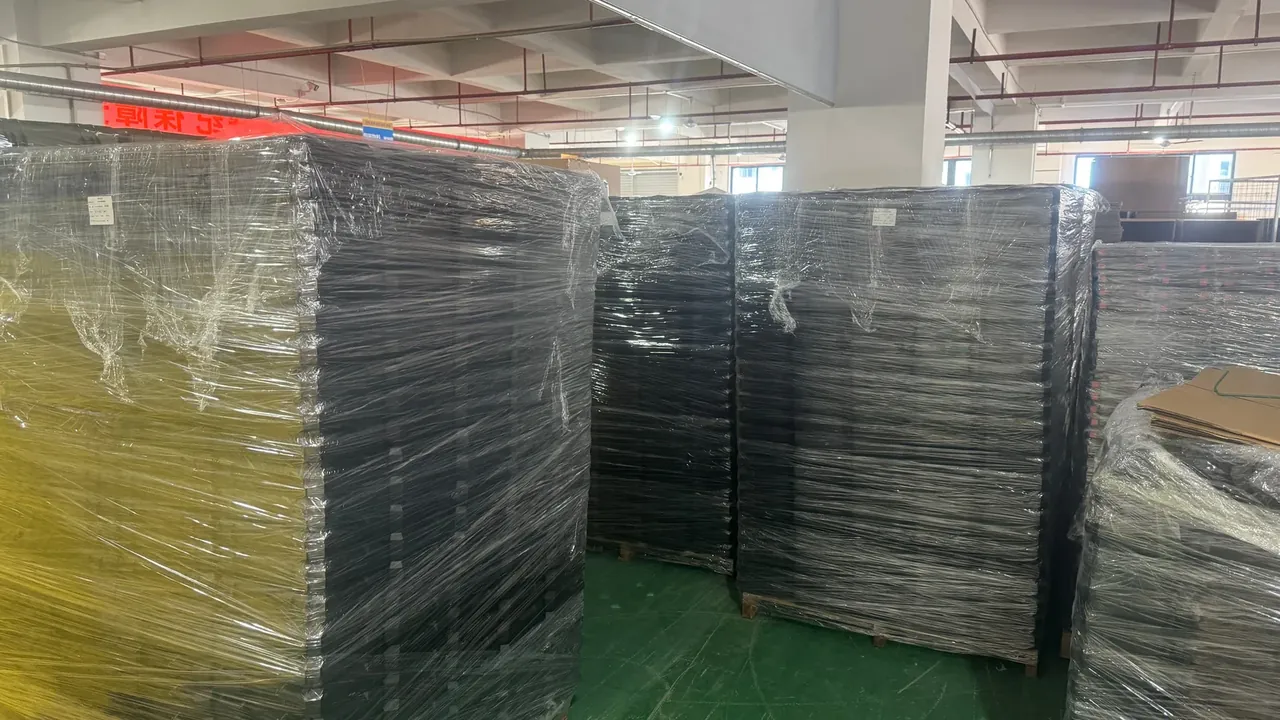
The pallet fixes units per load and payload per trip. On a 1200 × 1000 mm deck, a 520 × 420 mm footprint goes two across and two along, four per layer, twenty at five high. Overhang past the deck edge stays under 20 mm; beyond it the corner feet lose support and the stack leans by layer three.
Height is unit height plus compression. Five layers of 320 mm make 1.6 m; with a 150 mm pallet the load reaches 1.75 m against a common 1.8 m limit. Racks sit 450 mm apart for fork clearance, so stack height plus 100 mm of pick allowance must land inside that.
| Pallet size | Units per pallet | Stack height | Suitable truck |
|---|---|---|---|
| 1200 × 1000 mm | 20 | 1.8 m | 1.5 t counterbalance |
| 1100 × 1100 mm | 16 | 1.45 m | 1.5 t counterbalance |
| 1200 × 800 mm | 8 | 1.45 m | 1.5 t counterbalance |
| 800 × 600 mm | 3 | 1.1 m | manual jack |
Narrow the deck to 1200 × 800 mm and eight units remain at 1.45 m. Small yards settle on that shape once a manual jack replaces the counterbalance, and it is the pallet most often quoted for stackable industrial case design at low volume.
4. Stack Height, Aisles and Forklift Sightlines
Aisle width follows the swing of a loaded truck, so stackable industrial case design has to be read with the building. A 1.5 t counterbalance needs 2.4 m of clear width to turn square into a bay in one movement; at 2.0 m the driver reverses once and loses 40 s a trip. At 1.8 m the eye line of 1.1 m is blocked by the top layer, so mirrors belong at every aisle end.
Put the rejection rule in the procedure. Stacking rule: if the top layer drifts more than 20 mm horizontally after 24 h of static standing, or any lid shows a permanent depression, the stacking plan is rejected. That 20 mm is 1.1° at 1.8 m, which the eye cannot resolve, so measure with a plumb line.
Two figures, two uses. The 2° lean tolerance belongs to the weekly walk-round; the 20 mm after 24 h is the acceptance value, run once per new size.
5. Stretch Film and Where Anti-Topple Stops
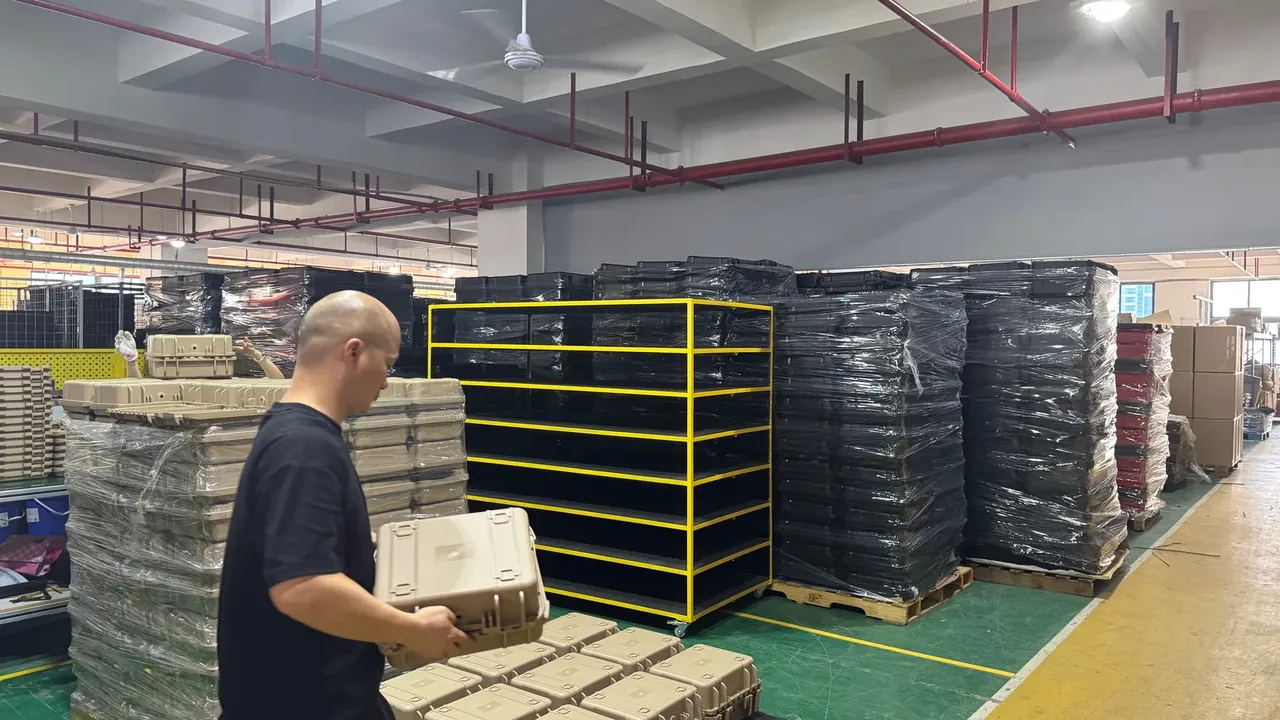
Film makes a stackable industrial case design behave as one block. Three wraps at 150% stretch hold twenty units against roughly 300 N of sideways push. What film cannot do is correct alignment: a 30 mm offset inside the stack is simply locked in.
Three limits follow. Keep the top open, because a sealed top collects condensation on the lid. Fit corner boards so the film bears on cardboard rather than plastic corners. Above 1.8 m, or on a floor with more than 3 mm of variation, add a guard rail or strapping.
Strapping needs placement, not just tension. Two vertical bands pass under the pallet, one horizontal band sits between layers three and four at about 400 N; overtighten and the lid buckles. PP strap turns brittle below 5 °C, so winter stores switch to composite and cut breakage from 8% to under 1%.
Labour is the forgotten step. At 1.8 m a person on the floor reaches layer four, and layer five needs a 300 mm platform or a lift table. Without either, the top case gets shoved up at an angle and its corner lands on the lid, which is where stackable industrial case design ends.
Related Reading
- How multi-case stacks are built
- Four feet, load share and layer count
- Pallet planning before the first stack
- Usable volume inside a case
Related Products
- 8 Series — Gun Cases; Military Equipment Cases; Camera Equipment Cases; Drone Cases; Watch Cases; Knife Cases; First Aid Cases; Electronics Equipment Cases
- WL8-2812 PP Gun Case — model WL8-2812
- All protective cases and toolboxes: 7 series, 158 models