

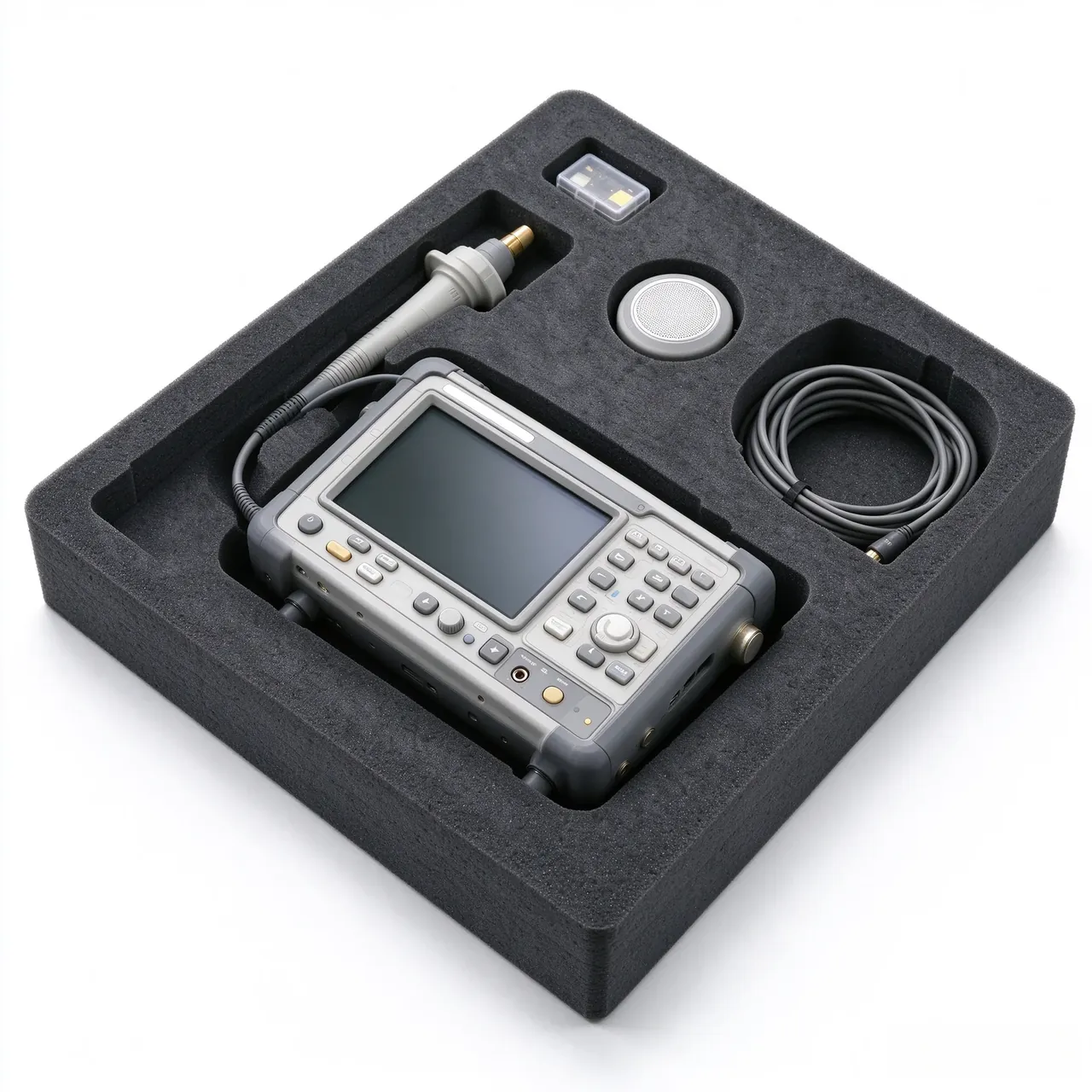
Quick answer: Stage audio mixer portable shockproof box: relief foam that clears 100 mm fader travel, 2.5–3.5 mm walls and an 8 kg shell that opens in 20 s.
Table of contents
- A mixer's real enemy is point load on the panel, not the fall
- Cutting relief foam for faders and knobs
- Blow-moulded latch case versus flight case weight
- A fast open: arranging the lid pocket
- Separating the cable bay from the power module
- FAQ
1. A mixer's real enemy is point load on the panel, not the fall
A mixer survives a drop more often than it survives a night with weight resting on its faders.
Take a 16-channel console: roughly 5 to 12 kg, around 320 × 140 × 455 mm, with 100 mm motorised faders across the surface. A 32-channel desk runs wider, near 440 mm, and reaches 10 kg. Mass alone is not the issue. The issue is which few square centimetres carry that mass once the case lies on its side.
The panel is a thin sheet drilled for fader slots and knob holes, so most of its stiffness has been cut away. Rest the whole console on one row of caps and the contact patch is under 5 cm², pushing local pressure past 0.05 MPa. Plastic caps deform first and jam in their slots afterwards.
A stage audio mixer portable shockproof box answers this by turning point load into area load. The insert stays clear over the panel and touches down only at the perimeter and behind the screen, so nothing presses the control surface in transit.
The gap also keeps hands free: faders are reachable the moment the lid opens.
2. Cutting relief foam for faders and knobs
In a stage audio mixer portable shockproof box, relief is a stack of depths matched to each part, not a hole. Fader travel is 100 mm, the cap stands about 8 mm above the panel, so the foam over that strip sits 1 mm below the cap top.
Width matters too: cut each slot 2 mm wider than the largest cap. Tighter grips the edge and a fader never returns to zero; looser lets caps knock all the way to the venue.
Knobs need side support, not top pressure: bore slightly under the knob diameter and leave 2 mm of air beneath.
The screen is the third zone: build a raised rim so pressure lands on the bezel, set 1 mm above the glass.
Then measure the stage audio mixer portable shockproof box insert: a cap compressed by more than 0.3 mm fails. Read it diagonally with calipers, close for 24 h, read again; no spring-back means the foam is loading the panel.
| Panel part | What pressure does to it | Insert treatment |
|---|---|---|
| Fader cap | Edge deforms, travel turns stiff | Slot 2 mm wider, floor 1 mm below cap |
| Knob | Pointer drifts, shaft takes side load | Round hole grips the skirt, 2 mm clearance |
| Screen | Glass shows pressure marks | Raised rim carries the bezel |
| Headphone and USB sockets | Solder joints crack | Cut-through openings, no contact |
| Power switch | Accidental switching, bent lever | Deeper recess with a soft pad in the lid |
3. Blow-moulded latch case versus flight case weight
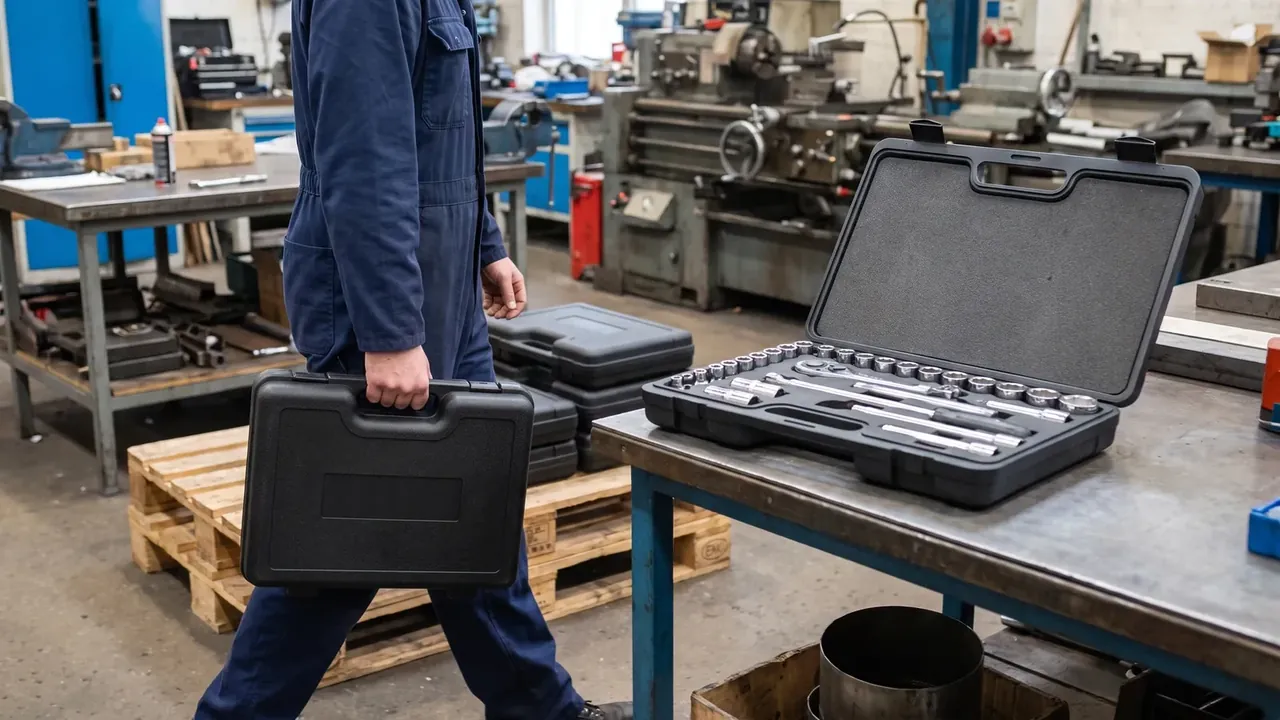
Two shells of the same internal size can differ twofold in empty weight. A panelled flight case uses plywood and aluminium with 9 mm walls, plus latches and castors; a stage audio mixer portable shockproof box uses 2.5–3.5 mm walls and ribs.
The difference shows at load-in: a 6.5 kg console in a 6 kg latch case lands near 12 kg, light enough for one person; in a heavier flight case it needs a second pair of hands or a ramp.
| Case type | Empty weight | Where it fits |
|---|---|---|
| Hand-carried latch case | 5–8 kg | One-person load-in, drives under two hours |
| Wheeled latch case | 8–12 kg | Long walkways and multi-venue days |
| Panelled flight case | Heavier by board and extrusion | Fixed installs with crew and trolleys |
| Soft wheeled bag | Under 3 kg | Rehearsals and light trips without stacking |
This is the trade a stage audio mixer portable shockproof box makes: thickness for weight, ribs for rigidity. The cost is puncture resistance. A sharp metal edge leaves a dent, and a deep dent disturbs the gasket face.
Drop figures need care: a 1.0 m corner drop on an empty shell is one test; loaded, with the centre of gravity off-centre, it is worse. Extrusion wins at corners, a moulded shell spreads stress through ribs. The venue decides.
4. A fast open: arranging the lid pocket
Twenty seconds is the working limit before a set: lid up, power out, cable in, master fader raised, all without looking away from the stage.
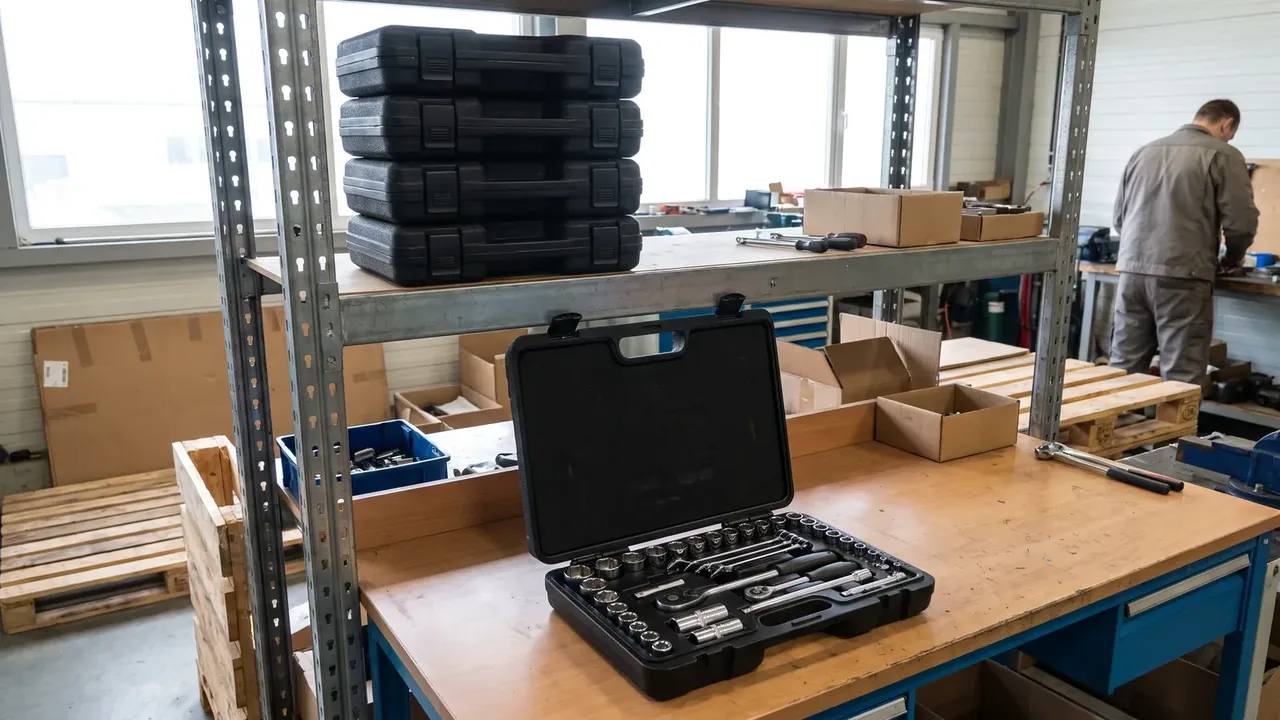
The lid carries the first three steps: adapter on the handle side, opening downward, USB and network cables in the middle under an elastic strap, spare caps and fuses on the hinge side.
In a stage audio mixer portable shockproof box, keep pocket depth under 30 mm or it presses on the panel. A 1680D fabric with a clear window over the power indicator shows the console is live at a glance.
One rule settles the contents: if it is not needed during the show, it does not go in the lid. Every open and close happens directly above the control surface, and each extra item adds one more chance for grit or a scratch. A stage audio mixer portable shockproof box keeps that pocket shallow on purpose.
5. Separating the cable bay from the power module
Cable and power bays are split for heat and insertion force, not for tidiness.
Console draw is modest, often around 43 W on a 16-channel desk, but the adapter itself runs warm and a sealed pocket lets that heat build. Give the adapter its own bay with two 3 mm vent slots in the wall.
Size the cable bay to the coil diameter. XLR plugs scratch jackets when they share space with power leads, so fit a removable divider 10 mm below the bay mouth.
Leave 30 mm behind the power inlet, or the console comes out for every plug-in. If a stage audio mixer portable shockproof box is built for leave-in wiring, cut a notch and line its edge with soft rubber.
The cable bay also pulls the centre of gravity toward the handle, so a 12 kg packed stage audio mixer portable shockproof box hangs level.
Related Reading
- Cooling and damping for rack cases
- Carrying recorders into the field
- Carton or hard case for shipping
- Plastic cases against wooden crates
JUNZHIJIA
Related Products
- 8 Series — Gun Cases; Military Equipment Cases; Camera Equipment Cases; Drone Cases; Watch Cases; Knife Cases; First Aid Cases; Electronics Equipment Cases
- WL8-2812 PP Gun Case — model WL8-2812
- All protective cases and toolboxes: 7 series, 158 models