

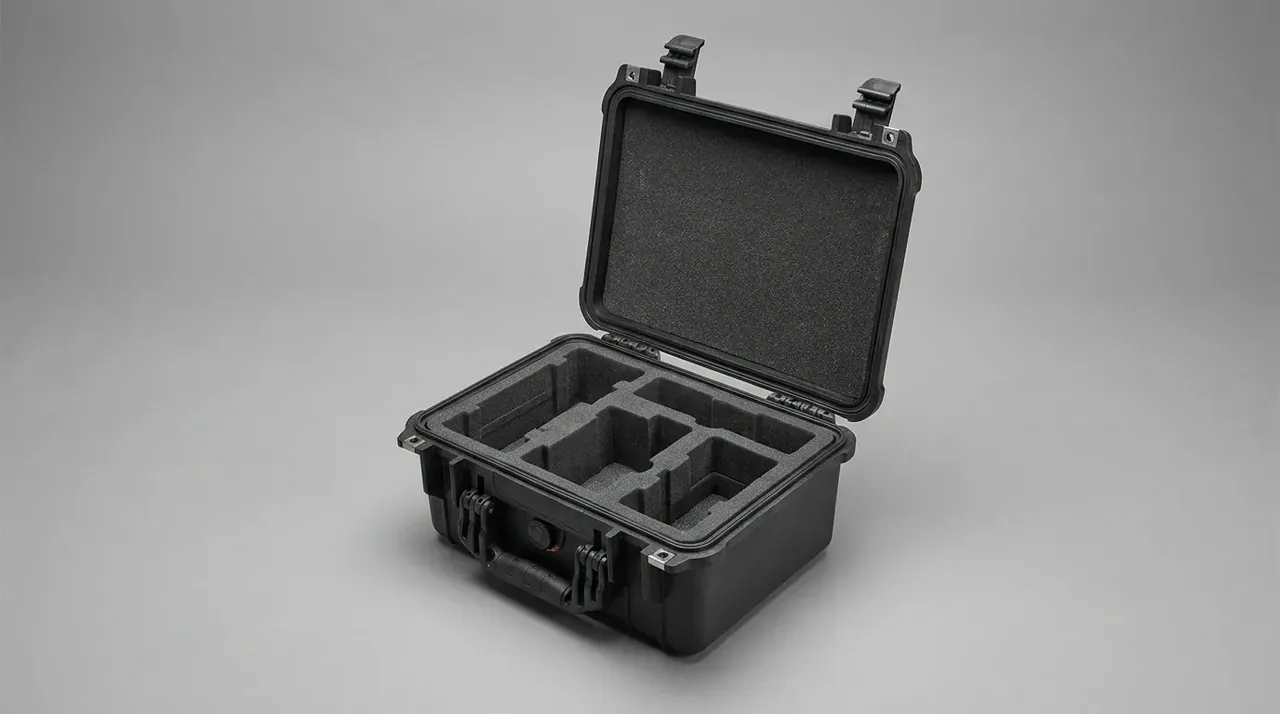
Quick answer: A storage inspection case needs dissipative walls of 10^6 to 10^9 ohms, a 4 mm² ground braid, five separate bays and 20 mm clearance at 1000 V.
Table of contents
- Static Charge Is the First Gate for a Storage Inspection Case
- Why the Imager and the Gloves Need Separate Bays
- Clearance in the 1000 V CAT III Compartment
- Ex ib Compliance: Metal, Grounding and Surface Resistance
- A -20 to 55 °C Envelope at 12 kg
- FAQ
1. Static Charge Is the First Gate for a Storage Inspection Case
Carry a 460 mm case down a 12 m aisle at 25 °C and 30% RH and the lid can build 4 kV; touch the steel frame of a battery room with that charge and the spark can ignite gas near its lower explosive limit.
Charge can be stopped from building or drained after it forms. The shell does the first with conductive masterbatch in PP at 10^6 to 10^9 ohms; a 4 mm² braid from every metal insert to an external stud does the second.
Why not go fully conductive at 10^3 ohms? The case is carried by hand, and a shell that conducts well gives fault current a wider path through the carrier at 1000 V. The dissipative window drains in 2 s and holds touch current to milliamps.
Below 10^6 ohms the risk flips: a conductive corner across a live busbar shorts the tool to the circuit, and an arc carries two orders of magnitude more energy than a static spark.
| Step into the room | Risk | Case-side measure | Set value |
|---|---|---|---|
| Carrying the lid | 4 kV on the surface | conductive masterbatch PP | 10^6 to 10^9 ohms |
| Ground stud | broken drain path | 4 mm² braid to stud | 0.1 ohm or less |
2. Why the Imager and the Gloves Need Separate Bays
The imager looks through a 45 mm germanium window; one sliding pass against foam leaves a 1 µm to 2 µm scratch that shows as a fixed dark band later. Gloves ask for the opposite: 0.5 mm rubber must stay flat, because a hard crease thins the fold faster than age does.
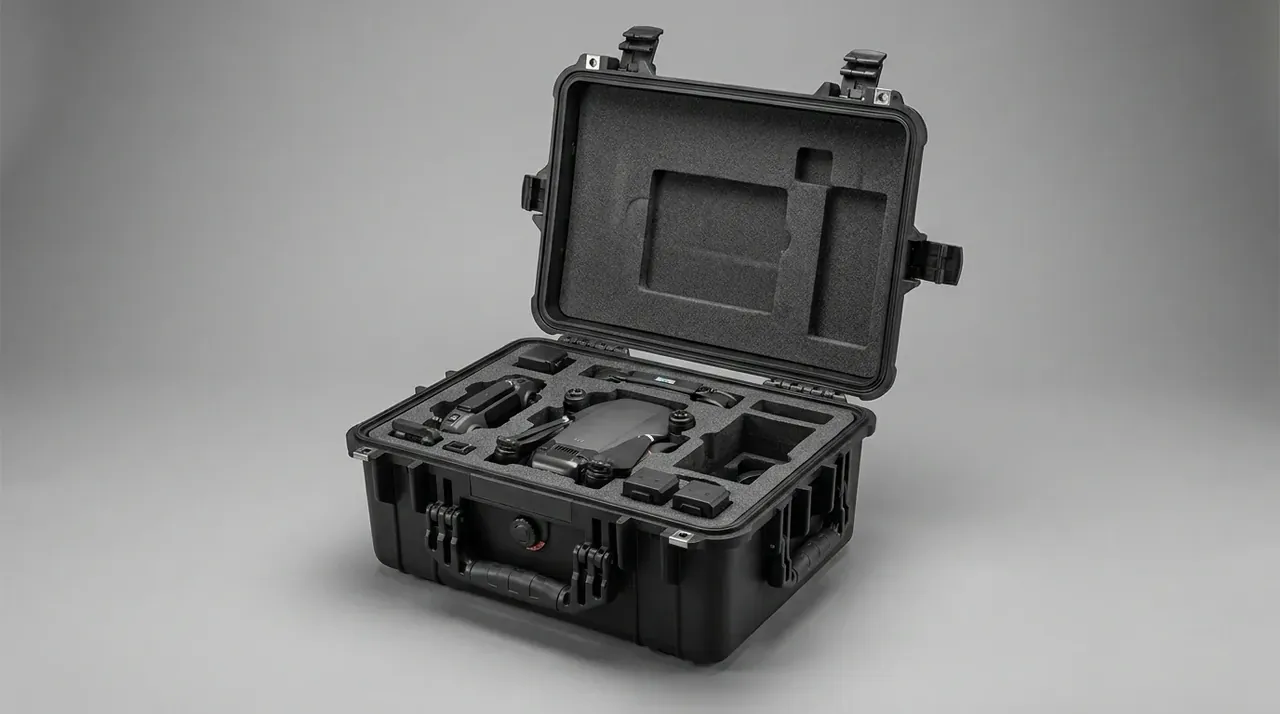
Those demands cannot share a cavity: the window needs air, the glove needs support. So there are five bays, the imager on a 5 mm step with a 1.5 mm ring around the barrel, and a spreader that opens the glove into three arcs with 15 mm of slack at the 130 mm palm.
Separation also protects the parts from each other: foam debris on a glove forces a dielectric re-test, and talc on the window drives up cleaning.
Five bays come from the tool list.
| Bay | Contents | Key dimension |
|---|---|---|
| Rear left, large | thermal imager, 0.95 kg | 5 mm step, 1.5 mm ring |
| Front centre | gloves, 410 mm long | 3 arcs, 15 mm slack |
| Right, long | 1000 V CAT III meter | 60 mm deep, 120 mm probe seat |
| Front left | spare probes and leads | two 30 mm slots |
| Lid pocket | record card and label | 8 mm deep |
3. Clearance in the 1000 V CAT III Compartment
Dropping a meter into a foam hole is not a bay: the instrument already carries creepage, and the case must keep that distance through compression, moisture and loose parts.
The bay is 60 mm deep, the meter upright on 8 mm of EPE compressed by 2 mm. Two 120 mm probes get a 20 mm channel behind a 6 mm wall.
Clearance is 20 mm: at 1000 V and pollution degree 2 the creepage requirement is about 8 mm, and a case adds condensed film and probe movement, so 2.5 times that yields 20 mm, held by a divider 10 mm above the meter.
Probe slots are cut at an angle. A straight slot lets the probe climb under vibration until it presses the lid; an angled slot keeps the tip down and lets gravity return it.
4. Ex ib Compliance: Metal, Grounding and Surface Resistance
Ex ib is intrinsically safe, tolerant of one fault without ignition. The case carries no circuit, but its metal does, and anything that can be hidden is hidden.
Hinge pins and latch springs are the only metal: each pin in a 3 mm recess under a plastic cap, each spring enclosed in PA66 with 2 mm of press face showing. No metal handle or nameplate sits outside.

The ground stud is the one exception: a 6 mm brass post with 1 mm knurling on a 4 mm² braid to the room bonding bolt, measuring 0.1 ohm or less, three orders below body resistance.
The plate is 80 mm by 50 mm, yellow on black, set into a moulded recess rather than drilled, because a drilled hole breaks wall continuity.
| Compliance item | Measure | Value |
|---|---|---|
| Surface resistance | one conductive compound throughout | 10^6 to 10^9 ohms |
| Ground path | 6 mm post, 4 mm² braid | 0.1 ohm or less |
| Exposed metal | pins recessed 3 mm | one point outside |
| Marking | moulded recess, no drilling | plate 80 mm by 50 mm |
| Static decay | four conductive feet | 1000 V to 100 V in 2 s |
5. A -20 to 55 °C Envelope at 12 kg
Temperature inside a battery enclosure is never constant: the ceiling reaches 55 °C in summer, northern sites fall to -20 °C at night.
At 55 °C the EPE liner takes compression set faster: 30 days under load costs 2 mm, and raising density from 38 kg/m³ to 45 kg/m³ cuts that to 1.2 mm. At -20 °C PP loses about 40% of its impact strength, so the 4.5 mm wall carries six ribs and passes a 1.0 m six-face drop.
The 12 kg limit comes from the load: 3.2 kg shell, 0.95 kg imager, 0.6 kg meter, 1.8 kg of gloves and probes, plus records, for 11.4 kg with 0.6 kg of margin.
A 120 mm handle rated at 300 N keeps one hand comfortable for 30 min; two shoulder points rated at 500 N take the strap. At 460 mm by 350 mm by 190 mm it slides under a service vehicle seat.
Opening in 6 s is the quiet specification: two latches press with one thumb, and the lid holds at 100 degrees so the other hand stays free.
Conclusion
A storage inspection case balances two opposing constraints: charge must drain, yet a fault must not find a wide path, which puts the surface at 10^6 to 10^9 ohms. The window needs air and the gloves need a spreader, so five bays. A 4 mm² ground, 20 mm clearance and 11.4 kg show where those constraints land.
Related Reading
- General layout for new energy service kits
- Insulation practice for power inspection instruments
- Selection rules for utility protective cases
- Protective cases in explosive atmospheres
Related Products
- 8 Series — Gun Cases; Military Equipment Cases; Camera Equipment Cases; Drone Cases; Watch Cases; Knife Cases; First Aid Cases; Electronics Equipment Cases
- WL8-2812 PP Gun Case — model WL8-2812
- All protective cases and toolboxes: 7 series, 158 models