

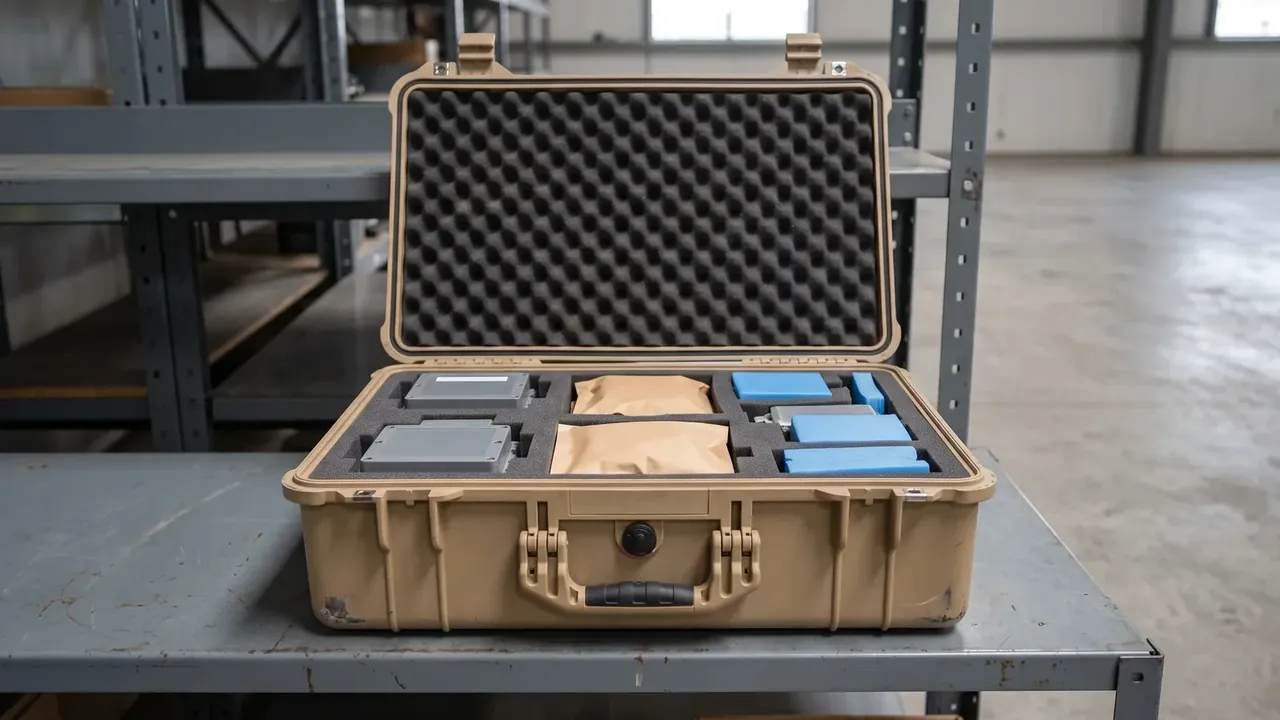
Quick answer: A Studio light stand heavy duty wheeled case with a 6.2 mm wheel-base plate and 14 mm lid stops holds misalignment at 0.7 mm after a 6 km concrete tow.
Table of contents
- Wheel-base plate thickness of the Studio light stand heavy duty wheeled case
- Height of the upright stop blocks in the lid
- Case-mouth misalignment after the tow distance
- Wheel-base settlement under off-centre load
- Plate-thickness floor for long-case batches
- FAQ
1. Wheel-base plate thickness of the Studio light stand heavy duty wheeled case
When long poles stand upright, the shell carries an eccentric moment on the wheel-base side, not an even load. The Studio light stand heavy duty wheeled case passes it into a 6.2 mm plate across the base tail, with 90 mm wheels at each end, so a 1180 x 420 x 300 mm long shell twists over a quarter of its length. Thin the plate and towing bows its face, shifting the lid-to-base seam.
The shell wall is 4.8 mm, yet the plate is built separately to 6.2 mm, joined by inserts into the base ribs. A 1110 x 350 x 235 mm cavity is the clear space for upright poles, and plate thickness is deducted from it, so the 14 mm stops are balanced against it. Strain gauges sit above the wheel base.
| Plate tier | Measured plate | Mouth offset after 6 km |
|---|---|---|
| Thin 5.4 mm | 5.4 mm | 0.83 mm, over limit |
| Nominal 6.2 mm | 6.2 mm | 0.62 mm |
| Thick 7.0 mm | 7.0 mm | 0.55 mm |
Only plate thickness moves across the tiers. The thin tier reaches 0.83 mm, past the 0.7 mm ceiling.
2. Height of the upright stop blocks in the lid
Towed upright, the pole load bears on the inner lid, which would fold inward without support. The Studio light stand heavy duty wheeled case stands two 14 mm blocks near the mouth, so weight reaches the mouth through blocks and lid ribs rather than the sealing flange alone. Too short and the poles lever the seam open; too tall and the lid meets the base before the latches reach 470 N.
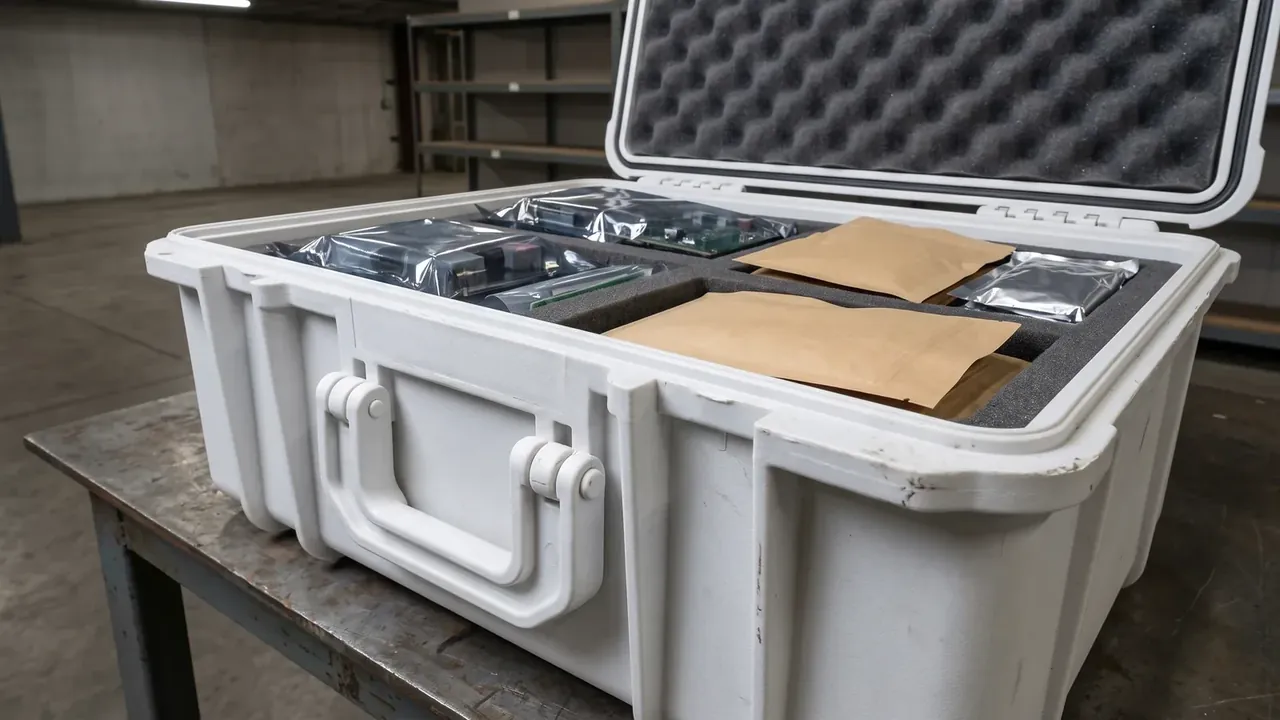
A 3 mm gap keeps the lid foam off the blocks. The Studio light stand heavy duty wheeled case places them 40 mm toward the tail from the midpoint of the 1110 x 350 x 235 mm cavity long side, directly above the wheel base. Two gasket rings at 22% compression sit around the flange; an IP66 benchmark rain check reads only flange contact.
3. Case-mouth misalignment after the tow distance
The tow rig lays a concrete floor for a 6 km run, and the Studio light stand heavy duty wheeled case completes it at 22 kg loaded with 90 mm wheels down throughout, reading mouth misalignment every 1 km. A feeler gauge and dial indicator take the larger of two long-side seam gaps, held under 0.7 mm. The first 2 km barely moves; past 4 km the thin-plate samples climb and the gap widens by 6 km.
| Tow distance | Nominal 6.2 mm offset | Thin 5.4 mm offset |
|---|---|---|
| 2 km | 0.21 mm | 0.28 mm |
| 4 km | 0.40 mm | 0.58 mm |
| 6 km | 0.62 mm | 0.83 mm |
The curves separate only after 4 km. The Studio light stand heavy duty wheeled case never releases on a 2 km reading. After the run the case is measured again. The four latches are released and the lid re-tightened to 470 N each. A second reading is then taken. A gap over 0.08 mm points to a loose latch seat, not misalignment. Offset is booked at the mouth, settlement at the plate.
4. Wheel-base settlement under off-centre load
Long poles are rarely centred, so off-centre loading is the normal case. The Studio light stand heavy duty wheeled case shifts its 22 kg load 60 mm toward one wheel base, measuring how far the plate sinks against the base datum, held at or below 0.5 mm. A bowed plate shows as settlement before the seam shifts.
Four dial indicators sit at the plate corners of the Studio light stand heavy duty wheeled case; zeroed at 9.4 kg empty and loaded to 22 kg, the largest sink is the settlement. The 6.2 mm plate reads 0.41 mm and the 5.4 mm plate 0.57 mm, past 0.5 mm.
5. Plate-thickness floor for long-case batches
Set the plate-thickness floor at the tier where wheel-base settlement first exceeds 0.5 mm, and exclude the tiers beyond it from the accepted batch. Working back, the 5.4 mm tier reads 0.57 mm under a 60 mm offset while the 6.2 mm tier holds 0.41 mm, so 6.2 mm becomes the starting thickness for long-case batches. The line is drawn from settlement, not the tow end value.
| Misalignment band | Plate tier | Disposition |
|---|---|---|
| Within 0.7 mm and settlement within 0.5 mm | Nominal 6.2 mm | Release |
| Above 0.7 mm | Thin 5.4 mm | Retest wheel base |
| Settlement beyond 0.5 mm | Reject zone | Whole batch rework |
Eight shells per batch are sampled for plate thickness under the release rule of the Studio light stand heavy duty wheeled case: any one under 6.0 mm is pulled, and two on the line send the whole batch back. JUNZHIJIA copies plate thickness, 6 km offset and off-centre settlement onto one process card, and a material change triggers another 6 km concrete tow.
Conclusion
A 6.2 mm wheel-base plate with 14 mm stops keeps the Studio light stand heavy duty wheeled case within 0.7 mm of misalignment and 0.5 mm of settlement after a 6 km concrete tow; the off-centre retest covers poles that are not centred. When choosing this kind of long shell, ask first whether plate thickness and stop height come with readings you can recheck.
Related Reading
- Can wheels be added to a protective case? Matching trolley handles and castors to load
- Trolley case wheels: PU vs TPR vs Nylon on concrete and airport floors
- Case wheel service: treating bearings after water ingress
- Film crew lighting equipment heavy duty transit case
Related Products
- 8 Series — Gun Cases; Military Equipment Cases; Camera Equipment Cases; Drone Cases; Watch Cases; Knife Cases; First Aid Cases; Electronics Equipment Cases
- WL8-2812 PP Gun Case — model WL8-2812
- All protective cases and toolboxes: 7 series, 158 models