

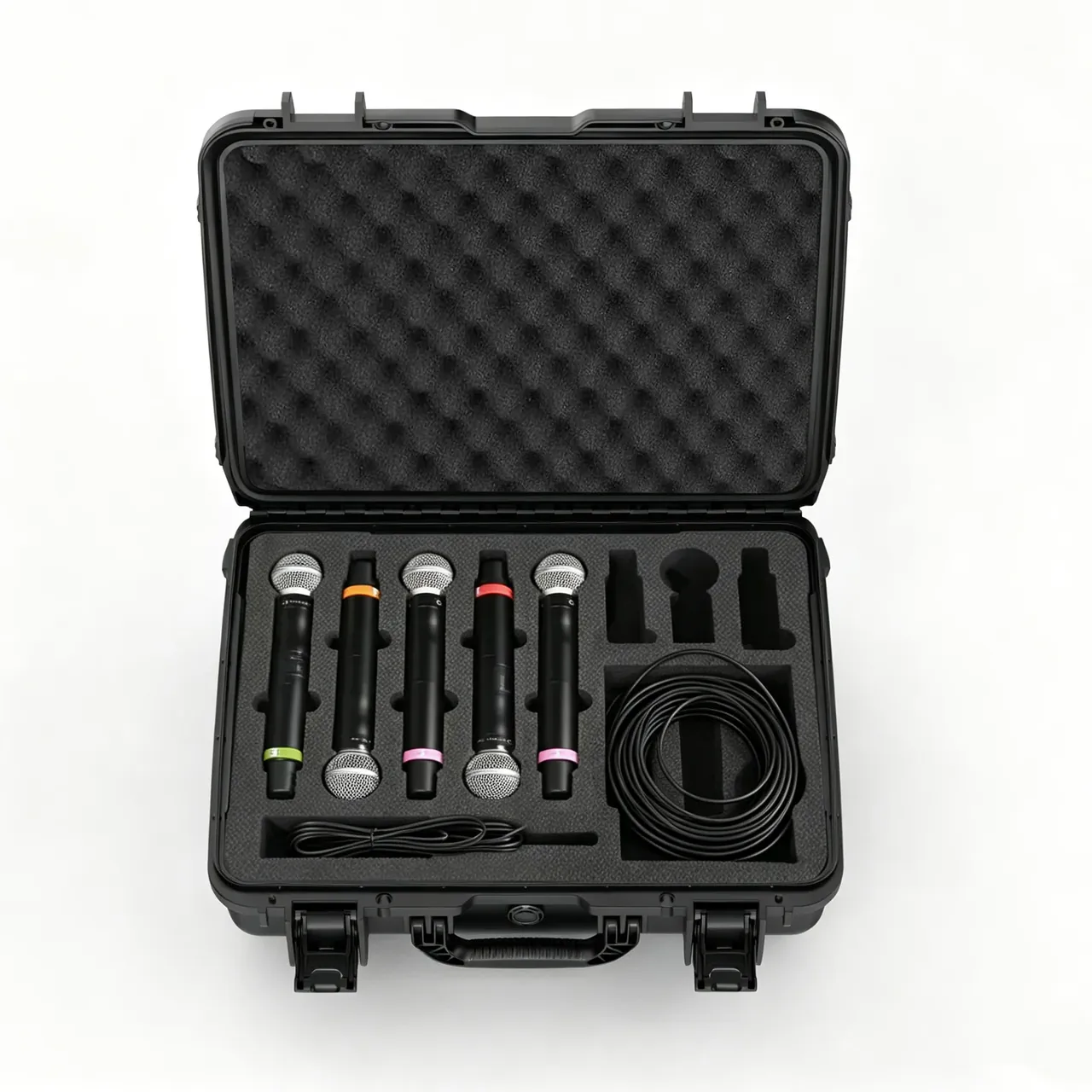
Quick answer: A studio precision condenser mic foam hard case settles humidity before it settles foam, since above 60% RH no desiccant keeps up.
Table of contents
- Why humidity comes before the foam
- What foam outgassing does to a diaphragm
- Stowing the shock mount and clip together
- Desiccant dose and replacement cycle
- Hard case or soft bag in a studio
- FAQ
1. Why humidity comes before the foam
A large-capsule condenser diaphragm is 3–6 µm of gold-sputtered Mylar, 25–34 mm across and a few dozen microns from its backplate. Past 60% RH water bridges that gap, capacitance drifts, and the noise floor climbs before the crackle starts.
A studio precision condenser mic foam hard case cannot fix a room, so the reading comes before the lid closes. A pointer hygrometer costs little, and 40%–50% RH is the band to hold: below 40% diaphragm tension drifts, above 60% RH the lid seals the problem in.
| Stage | Risk | What the case does |
|---|---|---|
| Reading before closing | Damp air shut in | Wait 10 min for a steady figure |
| Opening for a mic | Air exchange each time | Stay under 10 s, close at once |
| Long storage | Saturated silica releases water | Swap every 6–8 weeks |
| Carry and drop | Grille pressed on the mount | Layered insert, grille clear |
The hygrometer belongs inside the case. A room reading 45% RH can hide a cabinet at 55%, and ten points is enough to decide the wrong way.
2. What foam outgassing does to a diaphragm
New foam smells of solvent and process residue leaving the cells, and a closed case gives it only 25–35 L of air to build up in.
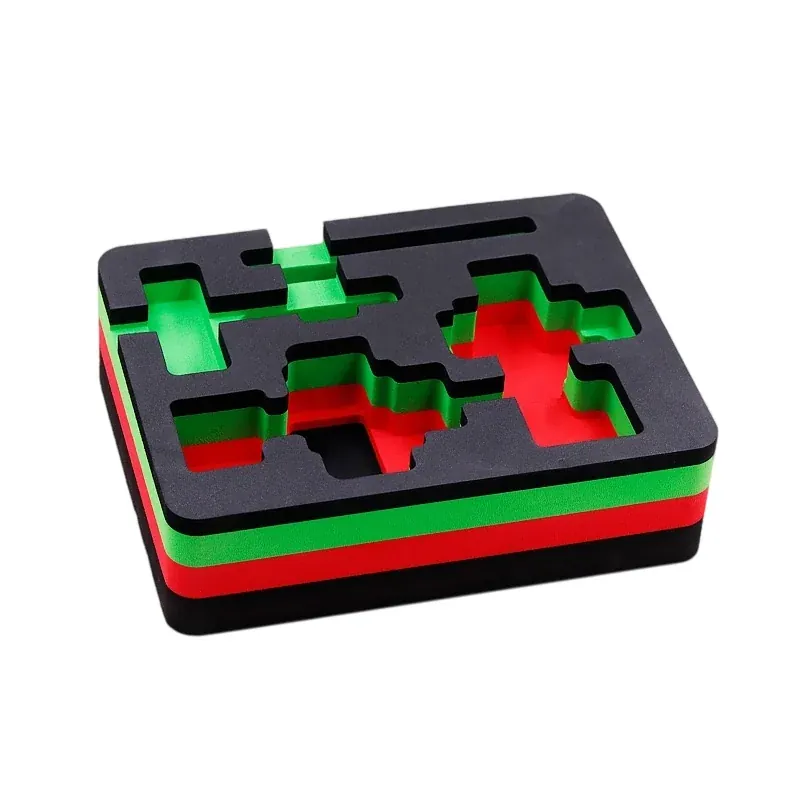
Foam in a studio precision condenser mic foam hard case runs 25–40 kg/m³. Open cells absorb shock well, and the price is a large internal surface that adsorbs and releases vapour. Below 25 kg/m³ the pores are coarse and shed crumbs; above 40 kg/m³ recovery slows and a cavity wall stops standing after one compression.
Airing is the fix. Leave a new case open in moving air for 48 h. Foam washes in lukewarm water with neutral detergent, rinses, and dries in shade for 72 h, never in sun, since ultraviolet breaks the polyurethane chains. Wipe the cut face before loading and look for crumbs, which travel into the grille and bond to the diaphragm.
For long storage inside a studio precision condenser mic foam hard case, closed-cell EVA is the steadier liner. It does not breathe, so outgassing drops by an order of magnitude, at the cost of a harder feel and tighter cavity tolerances.
3. Stowing the shock mount and clip together
A shock mount is two rings, a set of elastic cords and a post, all of which push a microphone towards the wall when shoved in as it is.
| Storage style | Microphones it suits | What it costs |
|---|---|---|
| Mic left in the mount | 200–300 g small capsules | 40 mm more depth, 15% more volume |
| Separate bays | 300–600 g large capsules | 40 s longer to set up |
| Mic only, mount in a bag | Location work | Mount unprotected, cords age |
A mounted mic stands about 40 mm taller than the bare body, so the cavity follows the assembled outline, with 8 mm between wall and grille so cord tension dies in the foam. Separate bays suit 300–600 g bodies and need a 5 mm divider; the post and rings catch on neighbours, so cut the bay to the mount's widest outline.
Clips are a different problem. Jaws of plastic or metal concentrate force on a 15 mm band and leave a mark in the finish, so set the bay with jaws down and the body floating, and let the foam carry the body. Drop testing a studio precision condenser mic foam hard case runs at 0.8 m, the height of a slide off a desk: check the grille for dents, the XLR for slack, and the cords for a slipped hook. Fail one and the cavity is recut.
4. Desiccant dose and replacement cycle
More desiccant is not better. Space is limited, and a pile of beads in a corner blocks a cavity and can press on the microphone.
Dose by volume: 50–100 g of colour-indicating silica for 25–35 L, in a non-woven bag set into the lid recess. Beads of 2–4 mm carry the surface area that matters; powder becomes contamination the moment a bag fails. A studio precision condenser mic foam hard case is sized around that bag, not around a full corner of beads.
Blue turning pink means near saturation. The beads revive at 120 °C for 2 h spread 20 mm deep, then cool before bagging; after five or six cycles the pores collapse and the bag is replaced rather than dried again.
The cycle follows openings. Three a week in a wet season means about six weeks per bag, and once a month stretches to three months. Write the failure line into the log of any studio precision condenser mic foam hard case: an interior above 60% RH for 24 h counts as a failed seal, so change the silica and re-test before blaming the latch.
5. Hard case or soft bag in a studio
A hard case and a soft bag answer different questions. One handles dust, crush and moisture, the other handles speed, and most studios keep both.
Sealing is where a studio precision condenser mic foam hard case wins. A blow-moulded or injection-moulded shell with a silicone gasket and two latches slows air exchange enough for silica to hold its ground, and storage at 18–25 °C keeps the swing small.
A fabric bag breathes, keeps out coarse dust only, and follows room humidity exactly. It offers pockets, a strap and a zip that opens in a second, which suits a day of swapping three microphones. A workable split keeps working mics on stands under covers and spares in a hard case with silica and a meter.
One point gets missed: keep the case off windowsills and air-conditioner outlets. A closed shell in direct sun runs more than 10 °C above room temperature, and the silica releases what it held.
Related Reading
- Suspension storage for interview microphones
- Keeping humidity in check inside camera cases
- Packing a recordist's travelling kit
- How much of the quoted volume you actually get
JUNZHIJIA
Related Products
- 8 Series — Gun Cases; Military Equipment Cases; Camera Equipment Cases; Drone Cases; Watch Cases; Knife Cases; First Aid Cases; Electronics Equipment Cases
- WL8-2812 PP Gun Case — model WL8-2812
- All protective cases and toolboxes: 7 series, 158 models