

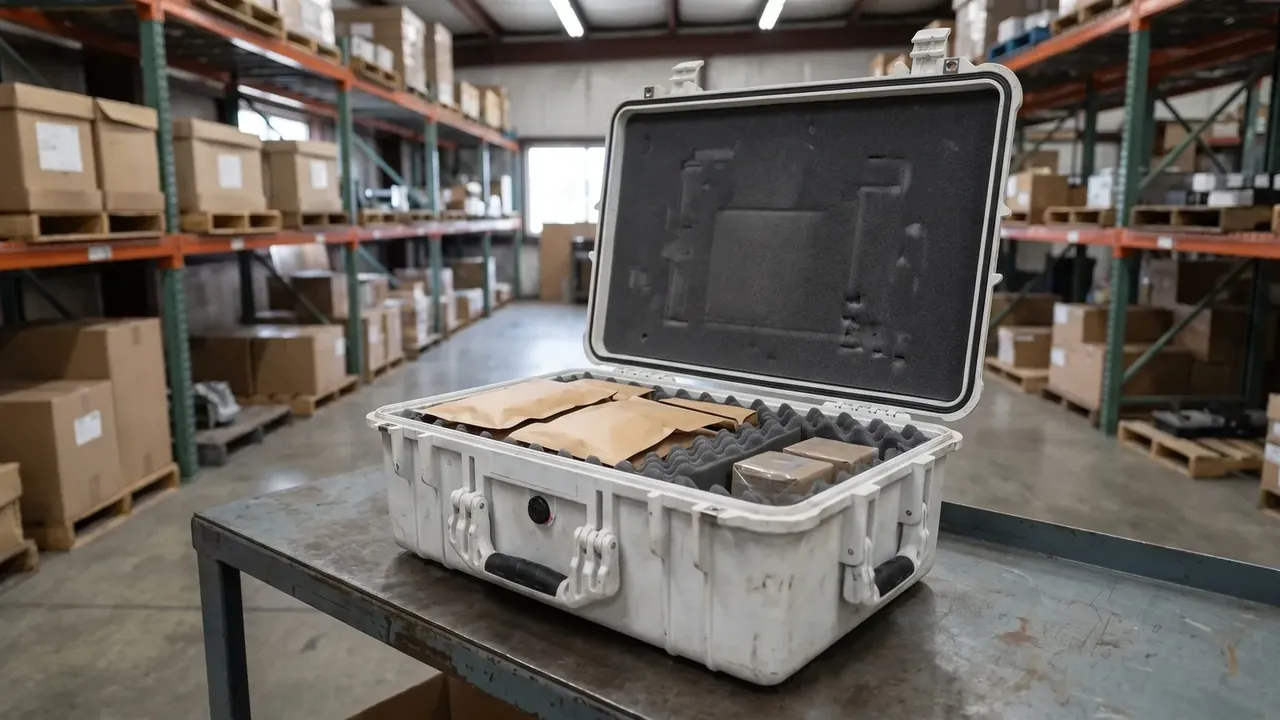
Quick answer: Studio softbox & accessories hard storage box survives 96 h of three-tier 60 kg stacking, keeping rib creep under 0.70 mm at 102 mm rib pitch.
Table of contents
- Rib pitch of the Studio softbox & accessories hard storage box
- Lid batten thickness
- Inter-rib sag after ninety-six hours of stacking
- Lid flatness rechecked after unloading
- Pitch setting for the storage batch
- FAQ
1. Rib pitch of the Studio softbox & accessories hard storage box
Three tiers of cases sit on a tray for four days: whether the span between ribs slowly sags and how thick the lid batten is both show up once the load comes off.
The shell measures 655 by 455 by 245 mm outside and 585 by 390 by 180 mm inside, with a 4.8 mm wall; lateral ribs are pressed into the tray floor in one shot. Nominal pitch is 102 mm centre to centre, ribs sharing the floor material so no glued weak line remains. A Studio softbox & accessories hard storage box uses one continuous tray rather than loose blocks, since upper case weight must run along the ribs into the walls evenly.
The rig applies 3 tiers, 60 kg and 96 h of static load, lids up, mass centred on the top lid. Widen the pitch and the floor between ribs bends slowly down; narrow it and empty weight climbs. A Studio softbox & accessories hard storage box treats 102 mm as a candidate, not a verdict.
2. Lid batten thickness
The lid batten is a second load path. At 6.0 mm, a continuous ridge along the inner lid edge lands on the mouth step when closed; a Studio softbox & accessories hard storage box uses it to carry top load from the lid into the four walls instead of letting the lid hold it alone.
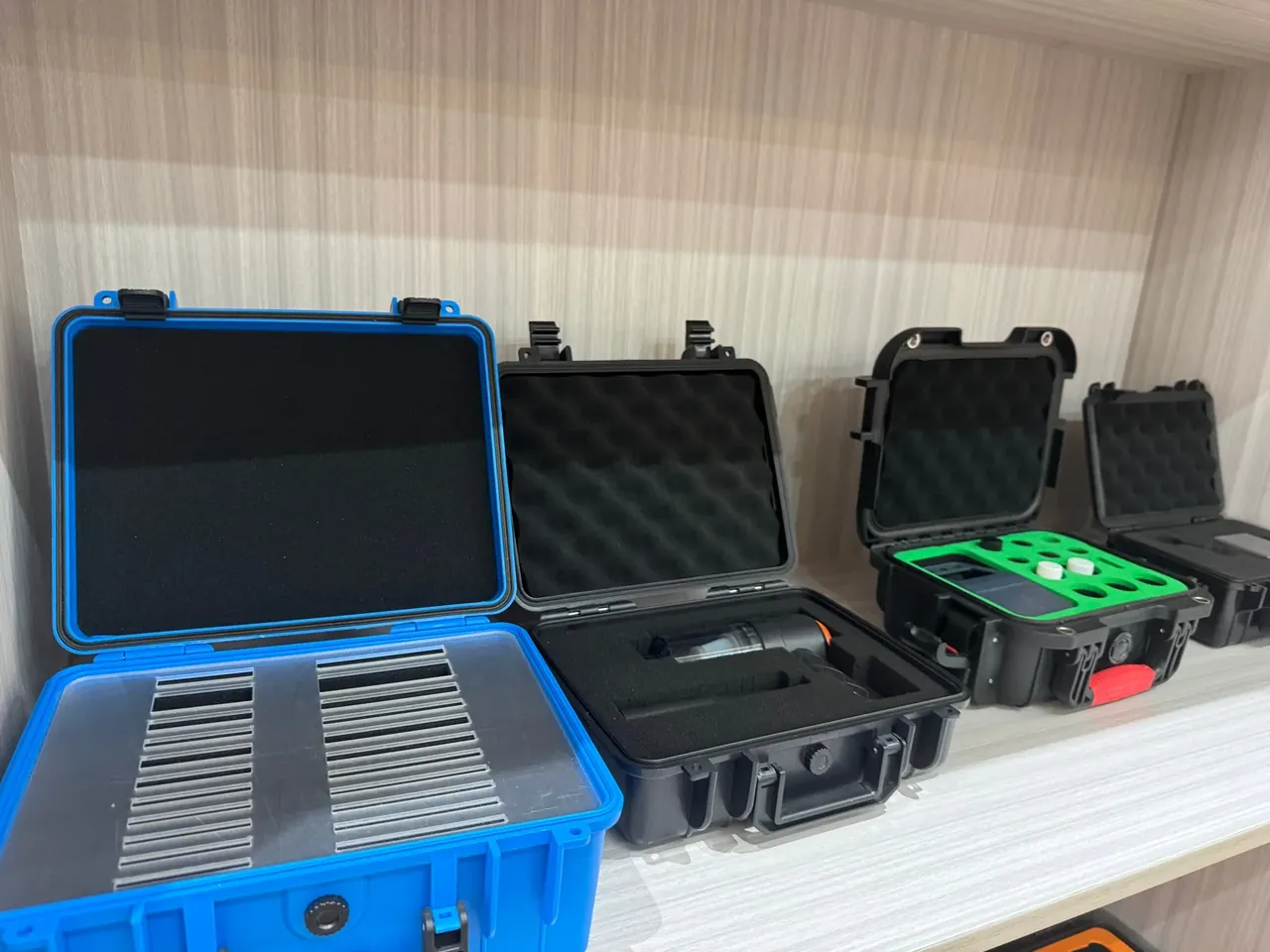
Two gasket rings at 20% compression follow an IP66-style spray and dust spot check, and four front latches at 420 N each press the batten onto the step. After a swing from -10 C to 50 C, latch bolts are retorqued to confirm the batten has not lifted.
A thin batten lets the lid bulge; a thick one makes closing stiff. Only 6.0 mm is accepted.
3. Inter-rib sag after ninety-six hours of stacking
At 96 h the mass comes off, the case rests 2 h to rebound, then a dial gauge reads sag at the mid-span of every rib gap, limit 0.70 mm. A Studio softbox & accessories hard storage box probes mid-span, not the rib crown, because creep shows most where the floor has no support.
| Rib-pitch tier | Centre spacing | 96 h mid-span sag |
|---|---|---|
| Narrow tier | 78 mm | 0.38 mm |
| Nominal tier | 102 mm | 0.62 mm |
| Wide tier | 126 mm | 0.86 mm |
All three tiers ran together and the spread came out tidier than expected. The 78 mm narrow tier sagged 0.38 mm, almost no visible bend. The 102 mm nominal tier reached 0.62 mm, still inside the 0.70 mm line, yet kept a faint mark after rebound. The 126 mm wide tier sank to 0.86 mm, past the read line, with a slight lid dish. A Studio softbox & accessories hard storage box does not judge from one reading: three samples per tier are tested and the largest in each is compared. Creep threatens not the first drop but a four-day slide that will not come back. The rig log notes the hourly increment: fast for 8 h, then flattening, stable by 96 h.
4. Lid flatness rechecked after unloading
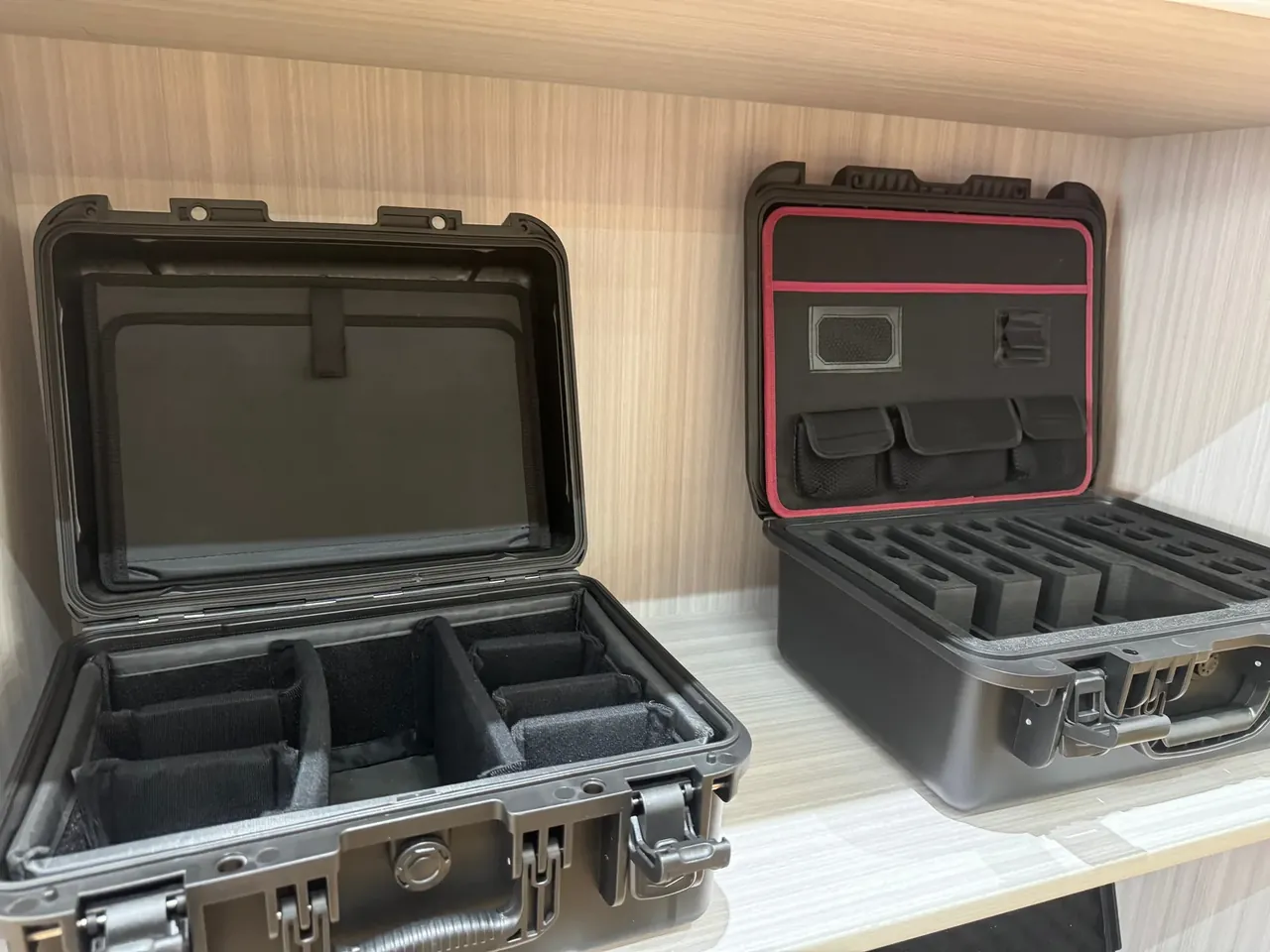
Unloading brings one more check: lay the lid on a surface plate and measure flatness across both diagonals with a feeler gauge, holding to 0.40 mm. A Studio softbox & accessories hard storage box logs lid flatness apart from inter-rib sag, since floor creep does not reach the lid at once.
| Stacking interval | Cumulative static hours | Lid flatness deviation |
|---|---|---|
| End of day one | 24 h | 0.12 mm |
| End of day two | 48 h | 0.26 mm |
| End of day four | 96 h | 0.40 mm |
Take the shell from -10 C to 50 C and the material shrinks then grows, loosening the batten fit; if the flatness readings before and after differ by over 0.10 mm, recheck batten thickness and latch force.
5. Pitch setting for the storage batch
Setting the batch follows one line: take the widest tier whose sag at the ninety-sixth hour still stays under 0.70 mm, and send wider support ribs back for mould rework. A Studio softbox & accessories hard storage box writes that on the batch card, pinning the boundary between 102 mm and 126 mm.
| Sag reading | Matching rib-pitch tier | Batch disposition |
|---|---|---|
| 0.38 mm | 78 mm narrow tier | Kept as heavy-load reserve |
| 0.62 mm | 102 mm nominal tier | Adopted as the pitch setting |
| 0.86 mm | 126 mm wide tier | Returned for mould rework |
The empty case is 7.1 kg and the loaded case 18 kg. Before handover a Studio softbox & accessories hard storage box gets one more IP66-style mouth seal check; the drawing leaves rib pitch at plus or minus 1.5 mm, beyond which it returns to forming.
Conclusion
Put 96 h, 3 tiers and 60 kg on the rig and inter-rib sag plus lid flatness become the two honest acceptance sheets for a Studio softbox & accessories hard storage box. The 102 mm pitch, the 6.0 mm batten, and the 0.70 mm and 0.40 mm read lines lock into one another; drop any one and long stacking is not supported. Its worth lies not in a stiff lid but in measuring back to the original shape after unloading.
Related Reading
- Broadcast and Film Equipment Cases: Large Payloads, Flight Schedules and Fast Turnarounds
- Film crew lighting equipment heavy duty transit case
- Film Production Equipment Case: Turnover Protection for Camera and Lighting Gear
- Camera Equipment Case Guide: Hard Case Sizing, Foam Buffer and Moisture Control
Related Products
- 8 Series — Gun Cases; Military Equipment Cases; Camera Equipment Cases; Drone Cases; Watch Cases; Knife Cases; First Aid Cases; Electronics Equipment Cases
- WL8-2812 PP Gun Case — model WL8-2812
- All protective cases and toolboxes: 7 series, 158 models