

Quick answer: A supplier exit is settled by the handover package, not the meeting: nine items, three drawing versions, a graded tool and 24 months of traceability.
Table of contents
- The Supplier Exit Package: Nine Items
- Grading the Tool: Three States, Three Valuations
- Drawing Versions: Three Checks Before Anyone Signs
- Thirty Days, Two Parallel Batches
- Five Shipping Protections and 24 Months of Traceability
- FAQ
1. The Supplier Exit Package: Nine Items
Once the exit is agreed, everything left is clerical. Our package lists 9 items: tooling and spares, 3 drawing versions (2D assembly, 3D model, controlled PDF), the process parameter sheet, gauges, golden samples, the sub-supplier list, open orders, work in process, and 36 months of quality records. Miss one and the incoming moulder spends 2–6 weeks catching up, while output waits.
The list works because it turns handover into tick boxes. A supplier exit rarely fails on refusal; it fails when both sides assume the work is already done.
| Handover item | Form | Acceptance step | Cost if missing |
|---|---|---|---|
| Tooling | Physical tool plus spares, 2 stamped marks | Water test, 50 dry cycles | New tool, 45 days |
| Drawings | 2D, 3D and controlled PDF, 3 versions | Check revision against change notes | Dimensional rework, first-lot yield down 6 points |
| Gauges | 6 dedicated gauges plus calibration records | Re-measure 3 retained samples | Judged items fall from 12 to 5 |
| Golden samples | 3 signed parts plus 2 colour plaques | Compare appearance and fit | Colour disputes with no reference |
| Records | 36 months of quality and process data | Trace 3 lots back to source | Chain breaks, no evidence in a claim |
The item people forget is the gauges. Without them the new moulder falls back on calipers, 12 judged features become 5, and dimensional disputes surface around the third batch.
2. Grading the Tool: Three States, Three Valuations
Tooling is the only asset in a supplier exit that carries weight and a stand-alone price. A 1.8 t case tool has 4 lifting points, and its state should be graded before anyone moves it, otherwise the incoming party starts bargaining at the sight of the steel.
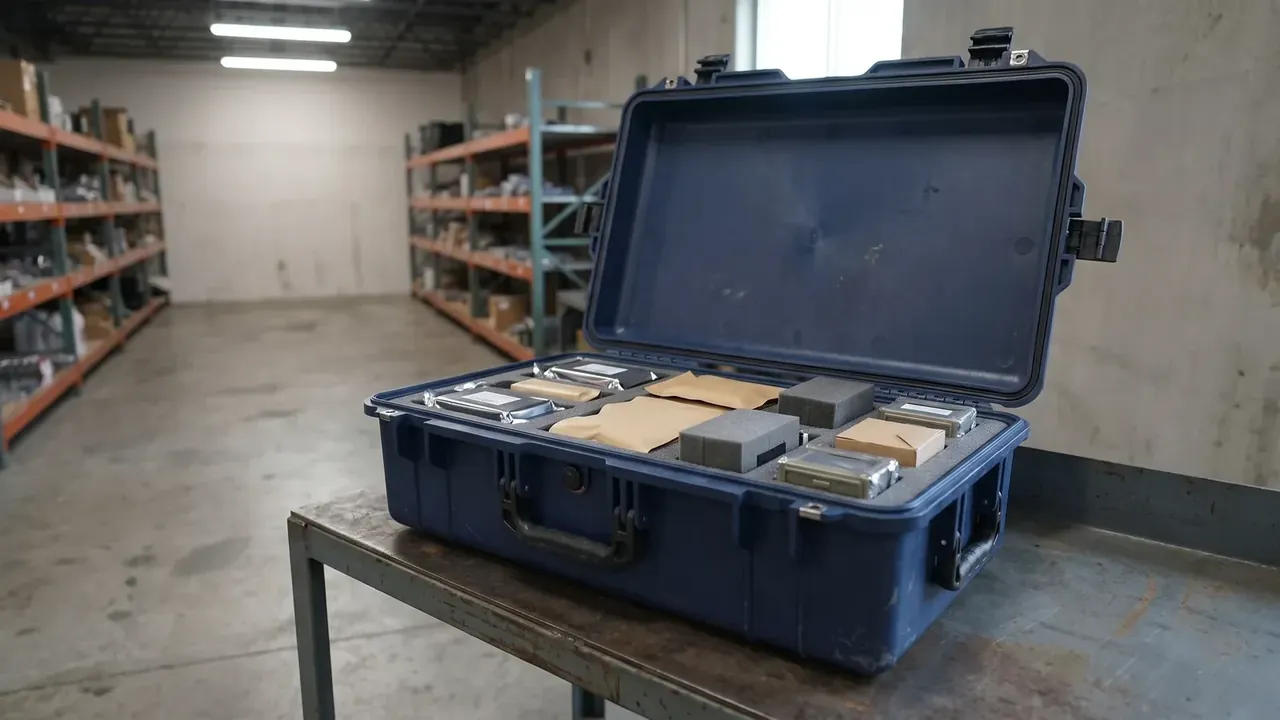
Serviceable: no flash build-up on cavity or parting line, guide-pin clearance within 0.05 mm, cooling circuit holding 0.4 MPa for 30 min. Needs repair: parting line crushed beyond 0.1 mm, or a blocked circuit, 7–10 days of work. Scrap: cracked cavity, an insert that cannot be reproduced, or under 5,000 cycles left.
Three valuation routes: 60% of replacement cost, remaining cycles (3% off per 10,000 cycles), or scrap value plus verifiable machining cost. On one tool the three routes differ by CNY 24,000, so state the route in the contract, not at the handover meeting.
Photograph the tool in 6 frames — cavity, parting line, nameplate, water fittings — and file them with the handover sheet. Stamp 2 marks on non-mating surfaces: cavity number and tool number. Spares travel with the tool at 15% of its value, and on an 8-cavity tool every cavity gets its own number.
3. Drawing Versions: Three Checks Before Anyone Signs
What changes hands is a revision, not a folder. First check that revision numbers and change notes close: 1 note per change, approval dated no later than the drawing. Second, pull 30 critical dimensions and measure them on the physical tool or part, logging any deviation above 0.1 mm. Third, confirm the electronic file matches the stamped paper copy.
Only then sign, and sign as 3 parties: outgoing, incoming, purchasing. With one signature missing, every later change becomes an argument. Accept the set sheet by sheet and give A0 sheets their own numbering; a scan is not a controlled drawing.
The usual failure is not a missing drawing but mixed revisions: the 3D model frozen at T2 sampling, the 2D assembly already at T4, the PDF on a third version. A first article made from that set matches a drawing and still will not take the existing hardware.
4. Thirty Days, Two Parallel Batches
Allow 30 days and run 4 gates: D-30 package and kick-off, D-15 first parallel batch, D0 switch, D+15 review and final payment. Put the gates in the handover agreement, not in an email thread.
| Handover gate | Timing | Owner | Deliverable |
|---|---|---|---|
| Package sign-off | D-30 | Purchasing | Signed 9-item list |
| First parallel batch | D-15 | Both plants | 300 pcs each, yield gap ≤2 points |
| Switch | D0 | Incoming plant | First-article report and parameter sheet |
| Review | D+15 | Purchasing and quality | Deviation list and actions |
| Final payment | D+30 | Finance | Settlement less the 10% retention |
Two parallel batches are the point of the exercise. Batch one shows dimensions and fit, batch two shows whether the process holds; a yield gap within 2 points clears the switch. Carry the problem into volume and rework costs several times the parallel run.
5. Five Shipping Protections and 24 Months of Traceability
Five protections before the tool leaves: one coat of rust preventive, 3 wraps of stretch film, 1 timber crate per tool, 500 g of desiccant, and 2 shock labels on the crate. Over 260 km use a flatbed, at least 4 straps, and photograph loading and unloading.
Hold back 10% of the final payment against package completeness and parallel yield. It is not a penalty; it gives the handover an ending.
Traceability outlives the supplier exit by 24 months. A batch problem inside that window still obliges the outgoing supplier to support the investigation, provided the lot number traces back to their production. Records kept for 36 months cover that period plus a year of buffer.
Conclusion
A supplier exit is not won at the table but in whether the list is worked item by item: 9 handover items, 3 tool states, 3 drawing checks, 30 days and 2 parallel batches. Fix the valuation route and the 10% retention in the agreement, and the tooling and drawing handover stops being a guessing game — with 24 months of traceability behind it.
This article covers case-side specifications only and does not address any handling, loading or use of the contents.
Related Reading
- Arranging the transition between suppliers
- Writing mould ownership clauses
- IP clauses in custom case contracts
- What a case tool costs to build
- The three gates of supplier qualification
Related Products
- 8 Series — Gun Cases; Military Equipment Cases; Camera Equipment Cases; Drone Cases; Watch Cases; Knife Cases; First Aid Cases; Electronics Equipment Cases
- WL8-2812 PP Gun Case — model WL8-2812
- All protective cases and toolboxes: 7 series, 158 models