

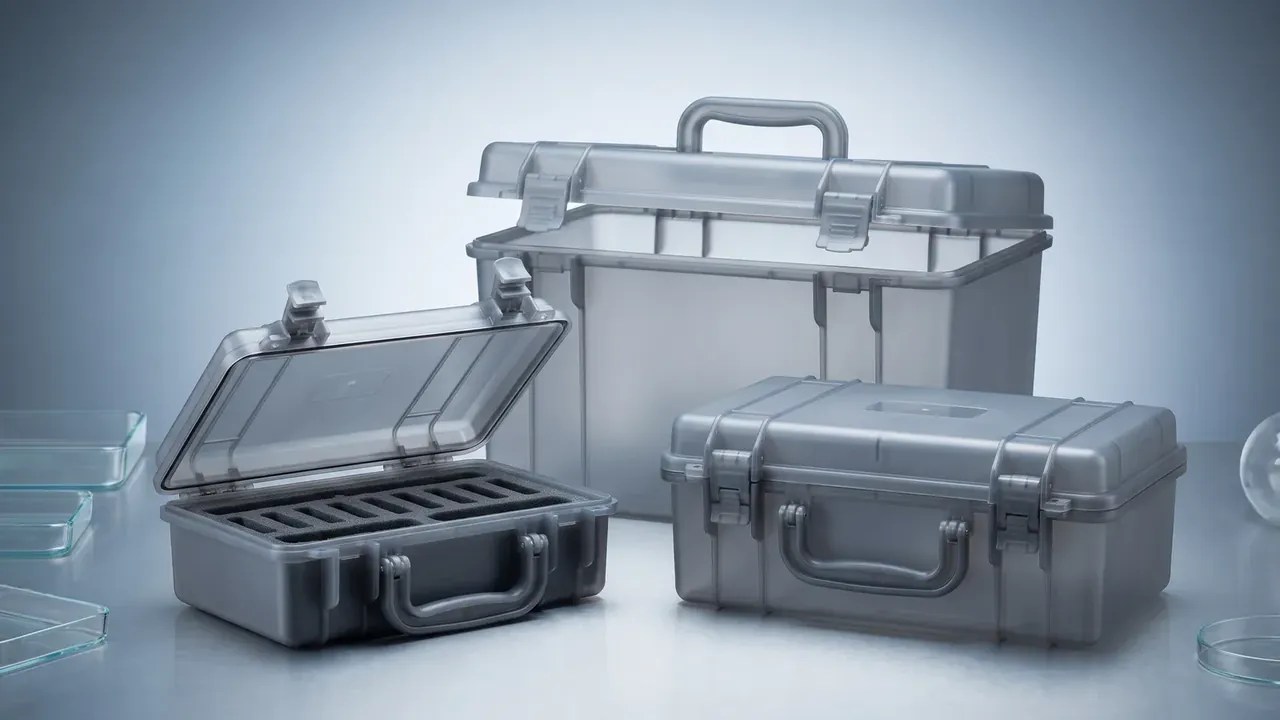
Quick answer: Surveying Instrument Transport Case at 620×460×320 mm holds 21 kg loaded, stacks five high with 84 kg on the bottom shell, and carries a 60×20 mm plate.
Table of contents
- Number Plates and Ledger Fields on a Surveying Instrument Transport Case
- Pairing Cases with Instruments in One Stock Check
- What the Bottom Case Carries Under Five High
- Turn Count Against the Gasket Change Point
- Three Parts That Keep Coming Back in the Repair Log
- FAQ
1. Number Plates and Ledger Fields on a Surveying Instrument Transport Case
Eight total stations, four levels, one crew: every shell rides the truck by day and sits in the store at night. The Surveying Instrument Transport Case is out of sight longer than the instrument, so the number is the only thread back to it.
The plate on a Surveying Instrument Transport Case is 60×20 mm aluminium, two φ4 mm rivets on the left of the lid face, 35 mm in from the rim. Six digits are stamped 6 mm high and lacquered so a year of abrasion still reads. The ledger needs five columns, of which only two move daily.
| Ledger field | Carrier | When it changes |
|---|---|---|
| Case number | Lid plate plus first column | Once at handover |
| Resident instrument | Label inside the cavity | On re-pairing |
| Accumulated turns | Dispatch docket | Every return |
| Gasket change date | Sticker under the rim | At the swap |
The plate never goes on a side wall, where a stacked case covers it. It also must not span a lid rib: across two 12 mm ribs the rivets load at three points, the plastic whitens and the plate lifts 1 mm after two years.
2. Pairing Cases with Instruments in One Stock Check
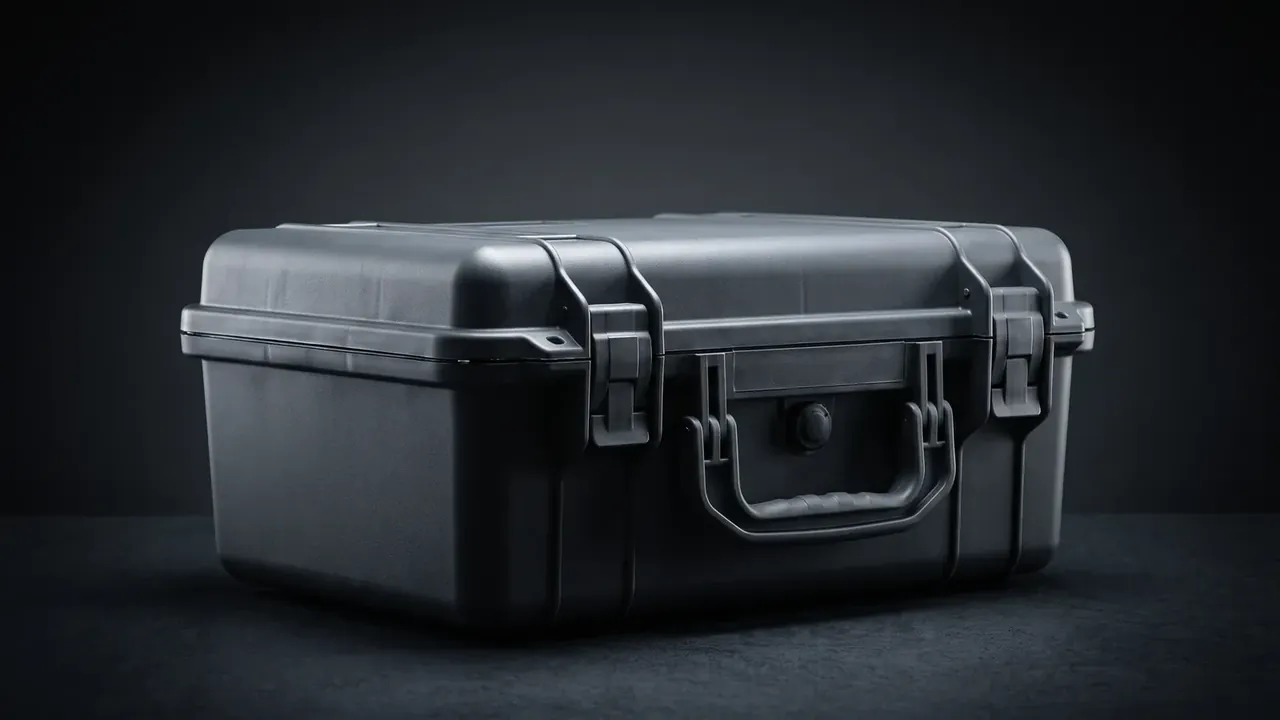
Counting runs plate against ledger, never instrument against ledger. Forty shells in four rows, each lid number ticked, and the pass takes about 25 min, four times faster than opening every case.
Pairing rests on the resident column: one instrument, one case, cavity cut to 570×410×270 mm around that body. A different model opens the fit from 5 mm to 20 mm, and under braking the body crosses the cavity, strikes a wall and rebounds in 0.3 s with three times the static force. Cavity tolerance is therefore +2 mm, never minus.
A check also finds the case-here-instrument-away state; a 5.8 kg empty Surveying Instrument Transport Case cannot carry 84 kg of loaded shells above it, so a red card with the calibration docket goes on the handle and the unit leaves the pile.
3. What the Bottom Case Carries Under Five High
One layer is 21 kg, so five layers put 84 kg on the bottom. The lid face covers 0.285 m², giving 2.9 kPa, small until it sits there for thirty days.
| Layers | Load on bottom | Lid pressure |
|---|---|---|
| 3 high | 42 kg | 1.4 kPa |
| 5 high | 84 kg | 2.9 kPa |
| 7 high | 126 kg | 4.3 kPa, lid bows 2 mm |
On a Surveying Instrument Transport Case, three ribs each way at 12 mm high on a 150 mm pitch hold the panel; at 4.3 kPa the span between ribs bows 2 mm and does not recover, so that shell leaves the stack. Heat adds to it: a top-row store reaches 45 ℃, polypropylene loses a fifth of its modulus, and 2.9 kPa takes deflection from 1.5 mm to 2.0 mm.
Staggered layers beat aligned ones. An 80 mm offset lets corners interlock, and two 25 mm straps at 400 N hold the block through a forklift turn; aligned, an upper rim rests on the lid joint below and a nudge shifts it 30 mm.
4. Turn Count Against the Gasket Change Point
Three hundred trips a year is 1500 cycles in five years. The gasket changes at 24 months or 300 turns, whichever comes first, not when it fails.
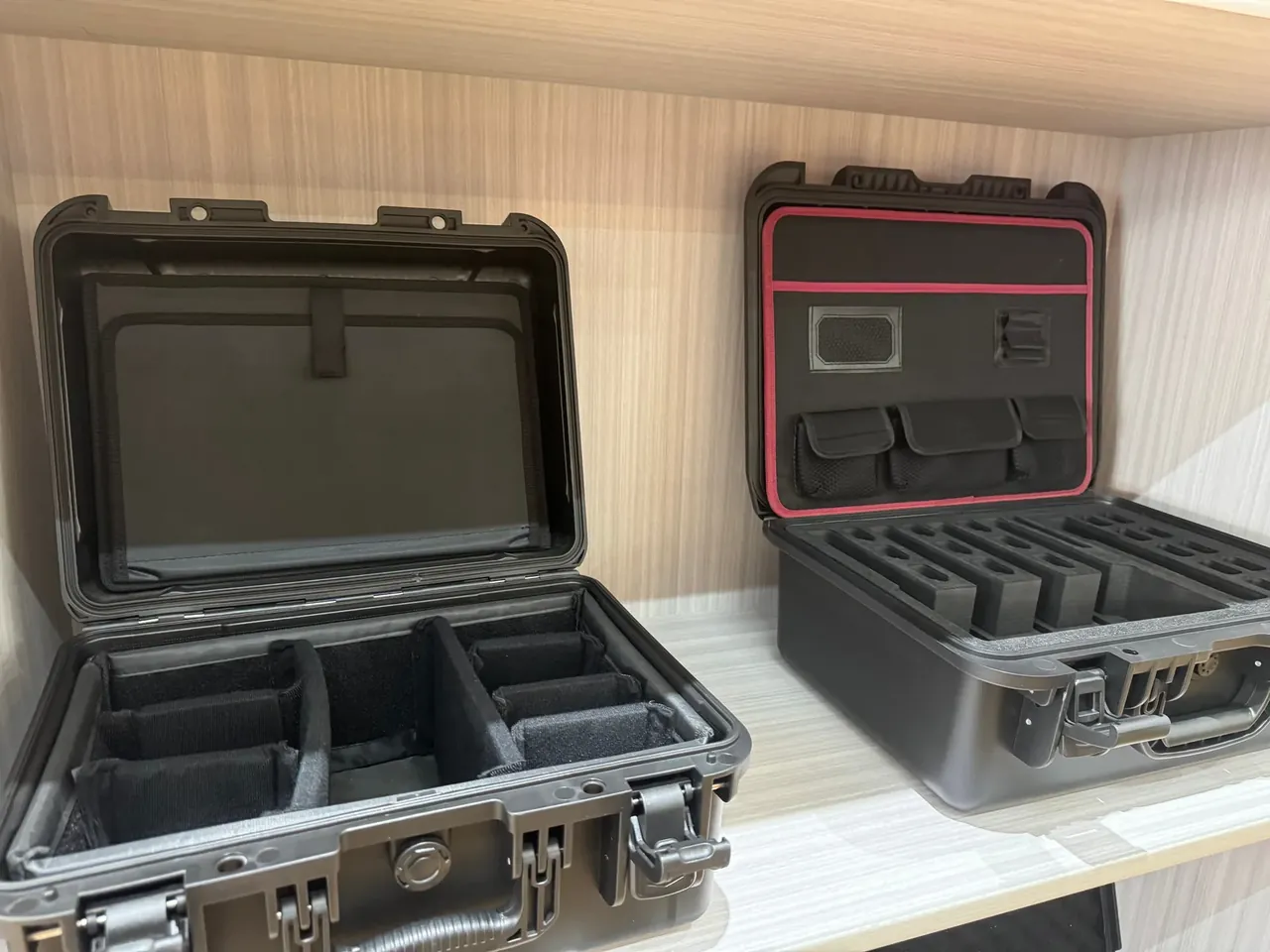
EPDM at Shore A 55 sits at 25% compression and takes a permanent set past 30%. After 1500 cycles it recovers 80% of its height, rim compression falls from 25% to 20%, and IP67 at 1 m for 30 min stops holding.
No removal is needed to judge it. Shine a light along the closed seam: more than three breaks in the bright line condemns the strip, and two entries with a 0.05 mm feeler gauge settle it. The φ5 mm 304 hinge pin loses 0.1 mm over the same cycles, leaving 0.2 mm of play that tilts the lid 3 mm and shears the strip as it compresses. Pins in a Surveying Instrument Transport Case are drawable with an 8 mm knurled head and cost a third of a gasket, so they are replaced at 4.8 mm.
5. Three Parts That Keep Coming Back in the Repair Log
Across thirty histories the frequent entries are hinge pins, latch seats and the rim groove; only two shells had cracked walls, both forklift impacts, which counts as damage rather than wear.
| Part | First turn count | Action |
|---|---|---|
| Hinge pin | Around 900 | Draw and replace the φ5 mm pin |
| Latch seat | Around 700 | Change the seat, keep the shell |
| Rim groove | Around 1200 | Clean, then decide on the strip |
Seat wear comes from the diagonal force at closing: each latch pulls 480 N and half of it runs diagonally, turning the bore oval until the long axis reaches 7 mm and the seam opens 0.5 mm on that side.
The groove collects grit. Crews pack up on bare ground, 0.2 mm grains lodge there, and the next closure presses them into the strip, leaving pits that leak on the following trip. Walls are the least of it: a 3.2 mm polypropylene wall cycled 200 times between -30 ℃ and 70 ℃ moves 0.4 mm and leaves hinge bores, and lid alignment, where they were.
Conclusion
Three entries carry the ledger: a 60×20 mm plate that lets forty shells be counted in 25 min, an 84 kg static load that limits the top row to three layers, and 1500 cycles that wear out the pin and the strip long before any wall. The life of a Surveying Instrument Transport Case is set by the ledger, not by wall thickness.
This article covers the specification and design meaning of the container (case) only, and does not address any handling, loading or use of the contents.
Related Reading
- Shipping Carton Versus Hard Case
- Field Survey Equipment in One Case
- Cavity and Lid Foam for a Total Station Case
- Working Out Usable Cavity Volume
Related Products
- 8 Series — Gun Cases; Military Equipment Cases; Camera Equipment Cases; Drone Cases; Watch Cases; Knife Cases; First Aid Cases; Electronics Equipment Cases
- WL8-2812 PP Gun Case — model WL8-2812
- All protective cases and toolboxes: 7 series, 158 models