

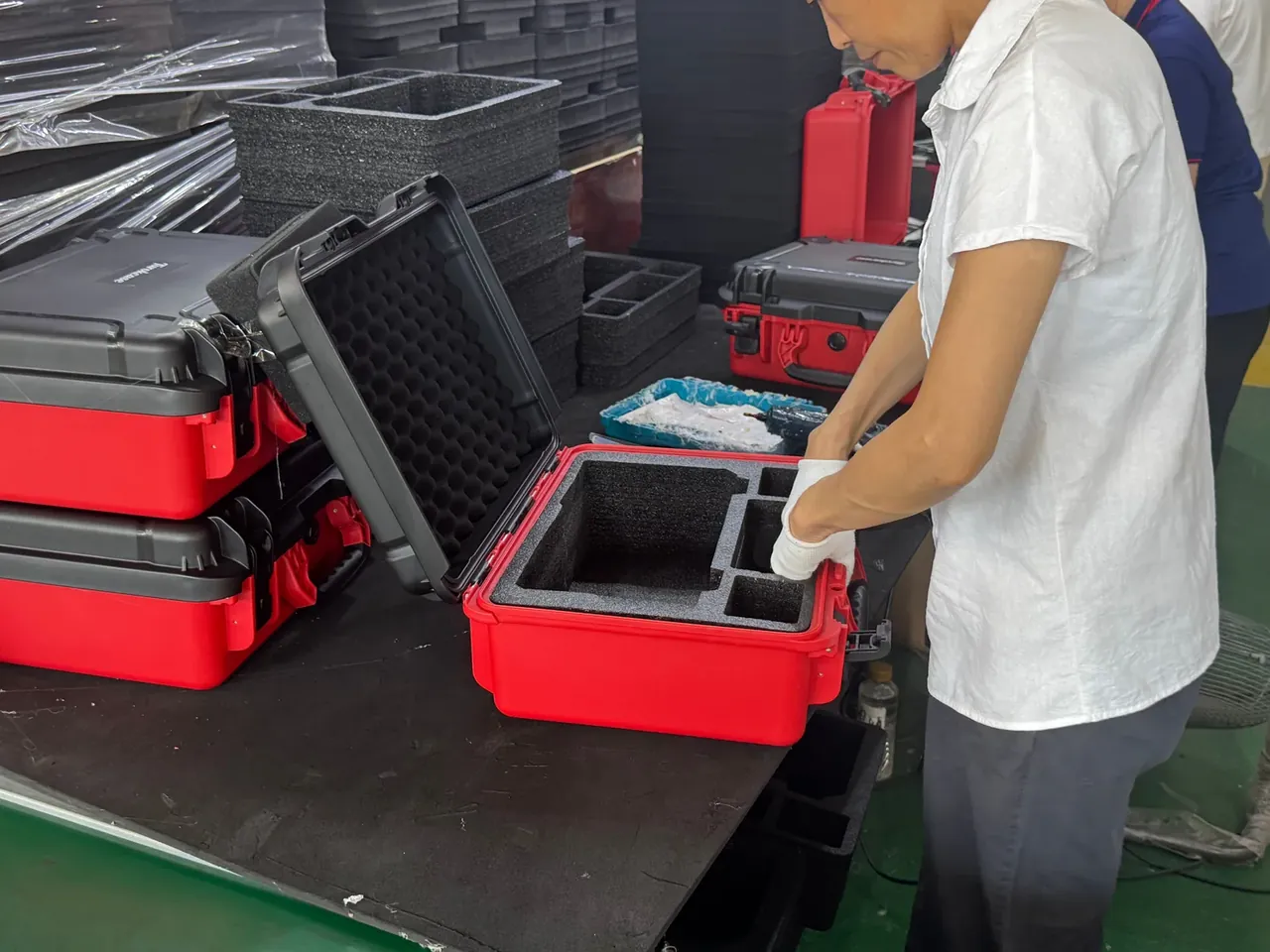
Quick answer: A Tactical armor and exercise equipment box OEM limits lid deflection to 1.6 mm after 24 h at 3 tiers, and resists nameplate cracks at a 1.0 m drop.
Table of contents
- Parting Line of the Nameplate Recess
- Draft Angle Allocation on Lid Ribs
- Deflection Readings After Three-Tier Stacking
- Crack Inspection at the Nameplate After a Drop
- Rib Thickness Sampling on Custom Batches
- FAQ
1. Parting Line of the Nameplate Recess
A Tactical armor and exercise equipment box OEM measures 640×460×290 mm outside, 570×395×220 mm inside; the wall runs 4.6 mm, the bare shell weighs 7.6 kg, and rated load is 16 kg. The lid top reserves a 90×50 mm nameplate recess, sunk 2.2 mm, formed in the lid tool rather than bonded on.
Where the parting line runs decides whether the recess releases cleanly. Set it at the pocket floor and one mould half carries the whole side wall, giving a clean face. Cross the mouth and a mismatch leaves flash along the 90 mm edge, lifting a bonded plate at the corner. A 2.2 mm recess in a 4.6 mm wall leaves 2.4 mm of solid material at the floor, which must carry the tier above yet survive the ejector pins.
Rounded pocket corners spread stress away from a sharp angle. A square pocket cracks at its corner under drop shock, and the nameplate is exactly the crack-inspection spot, so the radius is structural.
2. Draft Angle Allocation on Lid Ribs
Six ribs on the lid underside of a Tactical armor and exercise equipment box OEM run in a mixed radial and grid layout, each 3.4 mm thick with a 1.5° draft. Too little draft and ejectors leave white marks at the rib root; too much cuts rib height and stacking stiffness.
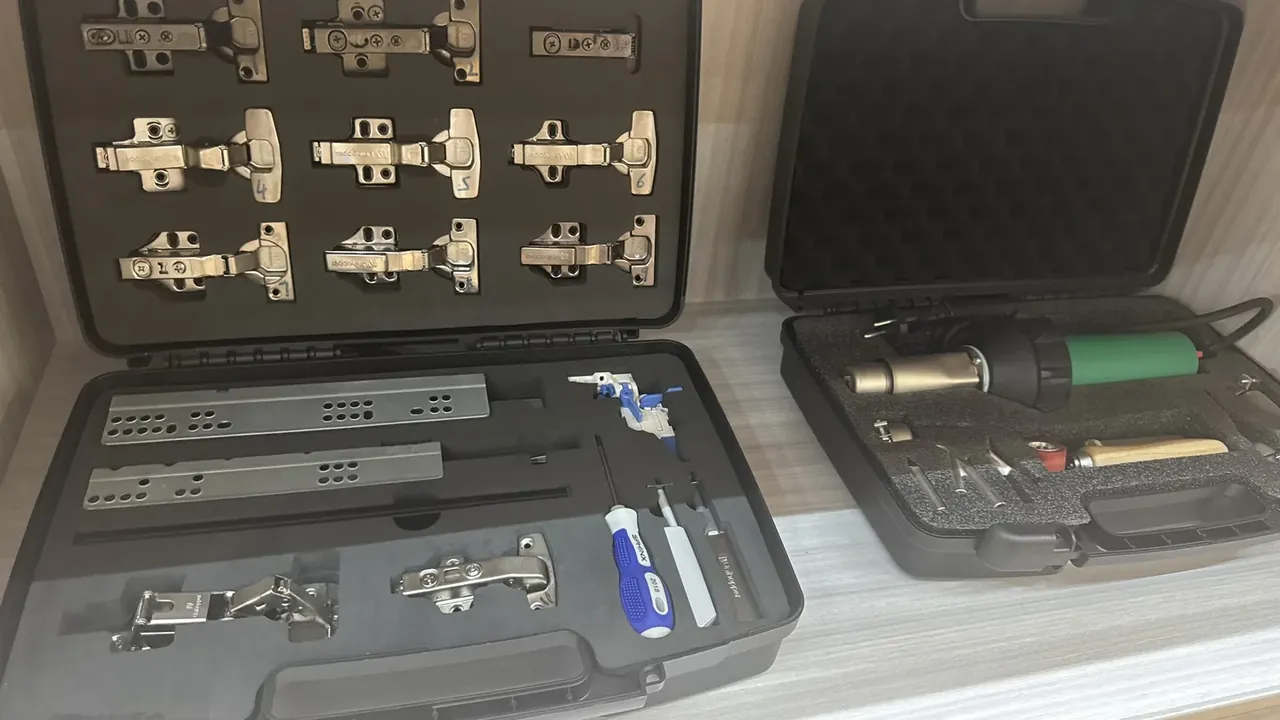
Rib thickness and draft are read together. On a 4.6 mm lid, a 3.4 mm rib reaches about seven tenths of the main wall; thicker brings a sink mark opposite the rib, thinner softens the lid centre under three tiers. Four latches ring the mouth at 440 N each, the lid seats on the step, and the assembled Tactical armor and exercise equipment box OEM reaches IP66, with gasket squeeze clear of rib height.
| Rib zone | Thickness | Draft | Role |
|---|---|---|---|
| Centre rib | 3.4 mm | 1.5° | carry stack centre load |
| Long-edge rib | 3.4 mm | 1.5° | share long-span bending |
| Short-edge rib | 3.4 mm | 1.5° | resist corner curl |
| Recess surround | 3.4 mm | 1.5° | stiffen the pocket |
3. Deflection Readings After Three-Tier Stacking
Stacking stiffness of a Tactical armor and exercise equipment box OEM runs at 3 tiers for 24 h, with a dial gauge at the lowest lid centre. The reading is lid sag relative to the mouth plane, capped at ≤1.6 mm. Load is fixed at 16 kg with no spacer between tiers, so interlock corners bear directly.
| Stacked tiers | Elapsed time | Lid centre sag | Verdict |
|---|---|---|---|
| 1 tier | 24 h | ≤0.5 mm | pass |
| 2 tiers | 24 h | ≤1.0 mm | pass |
| 3 tiers | 24 h | ≤1.6 mm | pass |
Readings are logged tier by tier. One tier for 24 h sinks the centre by about 0.5 mm, mostly gasket and step settling. A second tier doubles the load and sag climbs near 1.0 mm as ribs share bending. A third tier pushes toward the 1.6 mm line, where the six ribs and recess surround show their worth. Shave rib thickness to 2.8 mm and the third-tier reading rises, so every Tactical armor and exercise equipment box OEM inspection sheet states measured rib thickness. Read the gauge every 8 h; a still-drifting figure means creep and fails. After unloading, reject any lid not recovering within 0.3 mm of its start.
4. Crack Inspection at the Nameplate After a Drop
Drops on a Tactical armor and exercise equipment box OEM run at 1.0 m with the lid up, then the four pocket corners and floor are checked for whitening or fine cracks. Inspection walks the 90 mm edge under 10× magnification and uses dye penetrant on the floor; judging the lid gap from a distance is not an inspection.
| Deflection reading | Load | Stacked tiers | Drop height | Nameplate state |
|---|---|---|---|---|
| 1.6 mm | 16 kg | 3 tiers | 1.0 m | no crack |
| 1.2 mm | 16 kg | 3 tiers | 1.0 m | no crack |
| 0.8 mm | 16 kg | 2 tiers | 1.0 m | no crack |
The closer sag runs to the limit, the more residual stress sits at the pocket floor and the easier a crack starts at the radius.
5. Rib Thickness Sampling on Custom Batches
Lid cycling of a Tactical armor and exercise equipment box OEM runs 3200 open-close cycles, after which the six rib roots are re-measured. Three parts per cavity are pulled and two points per part read; a value inside 3.4 mm ±0.2 mm passes, and an out-of-family cavity is flagged for draft or holding pressure.
Rib thickness and stacking sag are linked. A cavity down at 3.0 mm pushes the third-tier reading toward 1.6 mm and thins the drop margin. JUNZHIJIA files each cavity thickness record with the batch, and trial and production lines share one dial gauge and calliper, so a Tactical armor and exercise equipment box OEM moves from trial shot to production part on matched readings.
Conclusion
One acceptance line for a Tactical armor and exercise equipment box OEM is ≤1.6 mm after 3 tiers over 24 h; the other is no nameplate crack after a 1.0 m drop. Parting at the pocket floor, 1.5° draft and 3.4 mm ribs hold that line together. Lock the parting position on the drawing first, then ask the tool shop for per-cavity rib thickness and the stacking convergence curve; that beats comparing a nominal lid thickness. JUNZHIJIA keeps those per-cavity records, and trial and production parts are accepted with the same calliper.
Related Reading
- What to check in custom cut foam
- Setting a custom case MOQ baseline
- How OEM and ODM custom cases divide the work
- Pocket layout arithmetic for pre-cut foam
Related Products
- 8 Series — Gun Cases; Military Equipment Cases; Camera Equipment Cases; Drone Cases; Watch Cases; Knife Cases; First Aid Cases; Electronics Equipment Cases
- WL8-2812 PP Gun Case — model WL8-2812
- All protective cases and toolboxes: 7 series, 158 models