

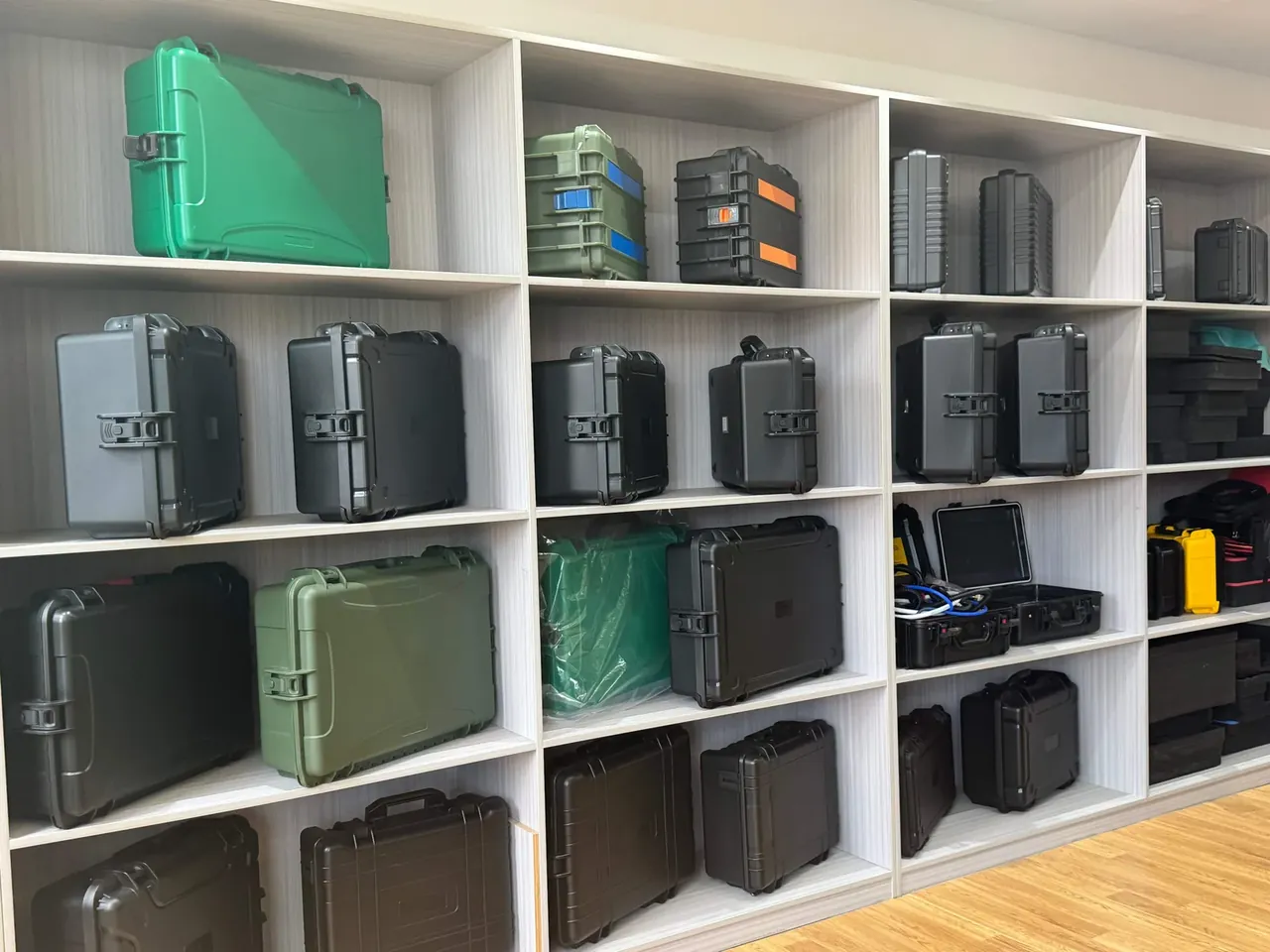
Quick answer: Tactical supply storage box factory direct supply rests on one mould: 3.8 mm walls within ±0.2 mm, ΔE ≤1.5 colour, 3 of 200 sampled, 8-high stacking.
Table of contents
- Tactical supply storage box factory direct: what same-batch, same-mould means
- Where 3.8 mm Walls and ±0.2 mm Land on the Corners
- Colour Difference ΔE 1.5 and Three Units per 200
- Eight-High Stacking and the 600×400×320 mm Rack Account
- 200-Unit MOQ, 25 Days and Batch Traceability
- FAQ
1. Tactical supply storage box factory direct: what same-batch, same-mould means
A factory-direct price is easy to quote and hard to keep. The buyer's question is whether the next run will stand on the same shelf as this one. A tactical supply storage box factory direct order is therefore judged on three traces: colour, wall thickness and outer size, all tied to one mould number.
Colour is read as ΔE on a spectrophotometer under D65. Wall thickness is read with an ultrasonic gauge on side walls and base. Outer size is checked against 600×400×320 mm, with the cavity at 545×345×270 mm. The records only count when they carry the same mould and batch numbers.
Without a mould number, colour and wall data belong to no machine.
| Sourcing step | Evidence requested | Pass value |
|---|---|---|
| Sample approval | First-article report and colour chip | ΔE ≤1.5 |
| First production run | Mould number and batch number | 3.8 mm ±0.2 mm walls |
| Replenishment | Comparison with the original chip | ΔE ≤1.5 |
2. Where 3.8 mm Walls and ±0.2 mm Land on the Corners
On a tactical supply storage box factory direct shell, 3.8 mm is a nominal side-wall figure, not a promise that every point measures the same. Moulding thickens at corners, base fillets, latch seats and wheel bosses, because flow pressure and cooling rate differ.
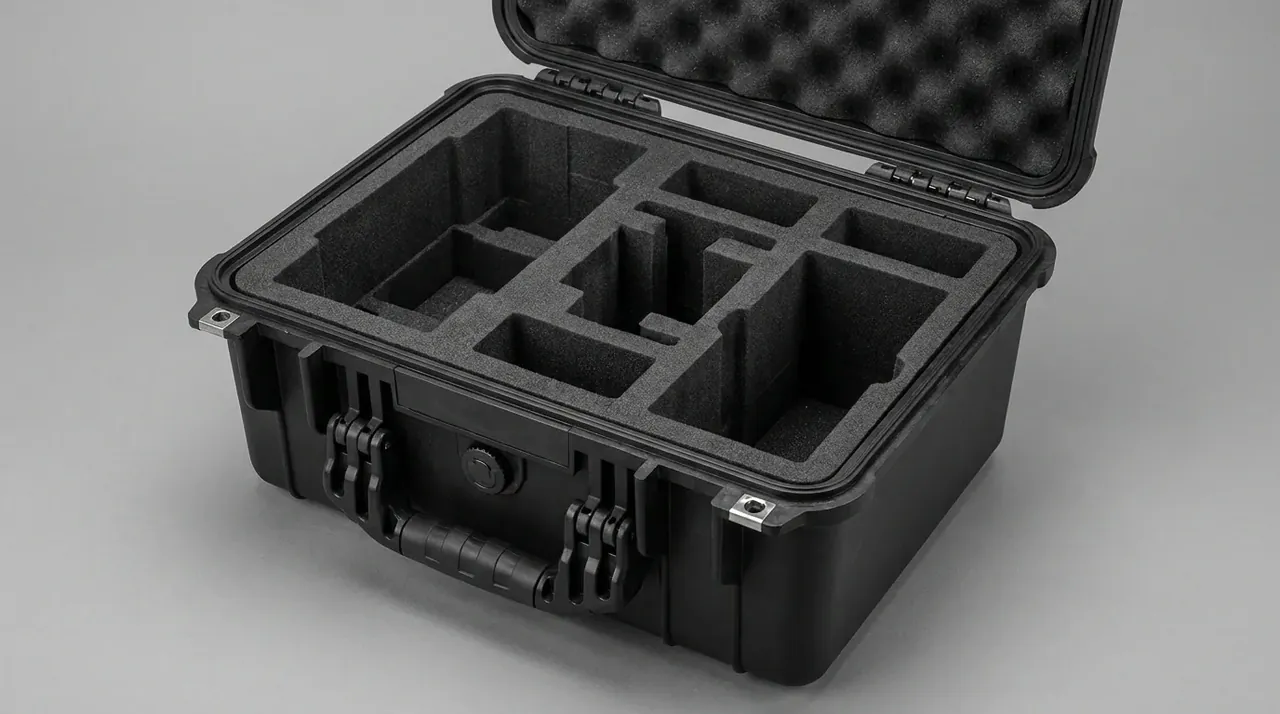
The tolerance sets the band at 3.6 to 4.0 mm. Readings below 3.6 mm point to low packing pressure or a hot mould; readings above 4.0 mm cluster at rib roots, where the extra material is structural.
Under 6.0 kg empty and 22 kg loaded, the side wall works in bending, not compression. At the low end it bulges first, and that face meets the rack upright.
| Delivery risk | Trigger | What it costs |
|---|---|---|
| Wall drifts thin | Low packing, 3.6 mm measured | Lower stiffness, bulge under stack |
| Colour drifts | Masterbatch lot changes | ΔE above 1.5, visible on one shelf |
| Size drifts | Tool wear, 1 mm growth | 600 mm edge jams the shelf |
| Latch seat thin | No local thickening | 350 N preload cannot be held |
3. Colour Difference ΔE 1.5 and Three Units per 200
On a tactical supply storage box factory direct case, ΔE 1.5 is an experience line. Two boxes on one shelf read as different shades once ΔE passes 1.5, and olive and dark grey show it soonest.
Colour control rests on three fixed things: one masterbatch lot, one mould number, one mould-temperature window. A new lot or mould needs a new colour chip, because venting and cooling layout can turn one formula into two shades.
Sampling takes 3 units from each 200 — first, middle and last off the tool — since both ends drift most. The readings are filed with the chip number so replenishment has something to match.
4. Eight-High Stacking and the 600×400×320 mm Rack Account
A tactical supply storage box factory direct unit at 600×400×320 mm suits racking: two fit side by side on a 1200 mm shelf, and 320 mm lets a standard opening take two tiers.

At eight high, the bottom unit carries seven. At 28 kg per loaded box that is 196 kg on a 600×400 mm lid, about 8 kPa. The lid should not carry it alone; four latches tie lid to base.
The 1.0 m drop and IP54 test different things. The drop looks at corners and latch seats; IP54 looks at the gasket and latch preload. Four latches at 350 N each give 1400 N of preload, landing on the seats, not thin lid wall.
| Control value | Sampling and method | Action past the limit |
|---|---|---|
| ΔE ≤1.5 | Spectrophotometer, D65 | Recolour the whole batch |
| 3.8 mm ±0.2 mm | Ultrasonic gauge, wall and base | Adjust packing and mould heat |
| Eight-high stack | 28 kg units, 24 h static | Thicken lid ribs |
| 350 N per latch | Tension gauge, per unit | Change latch lot |
5. 200-Unit MOQ, 25 Days and Batch Traceability
For a tactical supply storage box factory direct order, the 200-unit minimum is not arbitrary. One mould must be set, tuned, colour-matched and approved, and that time and scrap spread over the run. Two hundred also makes a 3-unit sample meaningful.
The 25-day lead time breaks into mould and chip approval, scheduling, moulding, hardware assembly, packing and dispatch. Colour matching and trial shots slip, because production cannot start until both pass; chip approval in week one beats chasing later steps.
Traceability needs five fields: mould number, batch number, chip number, wall record and the 3-unit report. Put the mould number on the order and the supplier returns to the same tool; the −20 °C to 60 °C range stays in the file.
Conclusion
The value of a tactical supply storage box factory direct purchase is not the quotation; it is whether one tool can repeat one box. Three measured numbers hold it — ΔE ≤1.5 colour, 3.8 mm ±0.2 mm walls, 3 of 200 sampled — and eight-high stacking, a 1.0 m drop and IP54 close it. Put the mould number on the order and replenishment has a baseline; keep the chip with the batch and the shelf stops changing shade run by run.
Related Reading
- Choosing a tactical storage box for each setting
- Quotation, MOQ and lead time in factory-direct buying
- Vetting a source factory and its samples
- How explosion-proof tactical equipment boxes are built
Related Products
- 8 Series — Gun Cases; Military Equipment Cases; Camera Equipment Cases; Drone Cases; Watch Cases; Knife Cases; First Aid Cases; Electronics Equipment Cases
- WL8-2812 PP Gun Case — model WL8-2812
- All protective cases and toolboxes: 7 series, 158 models