

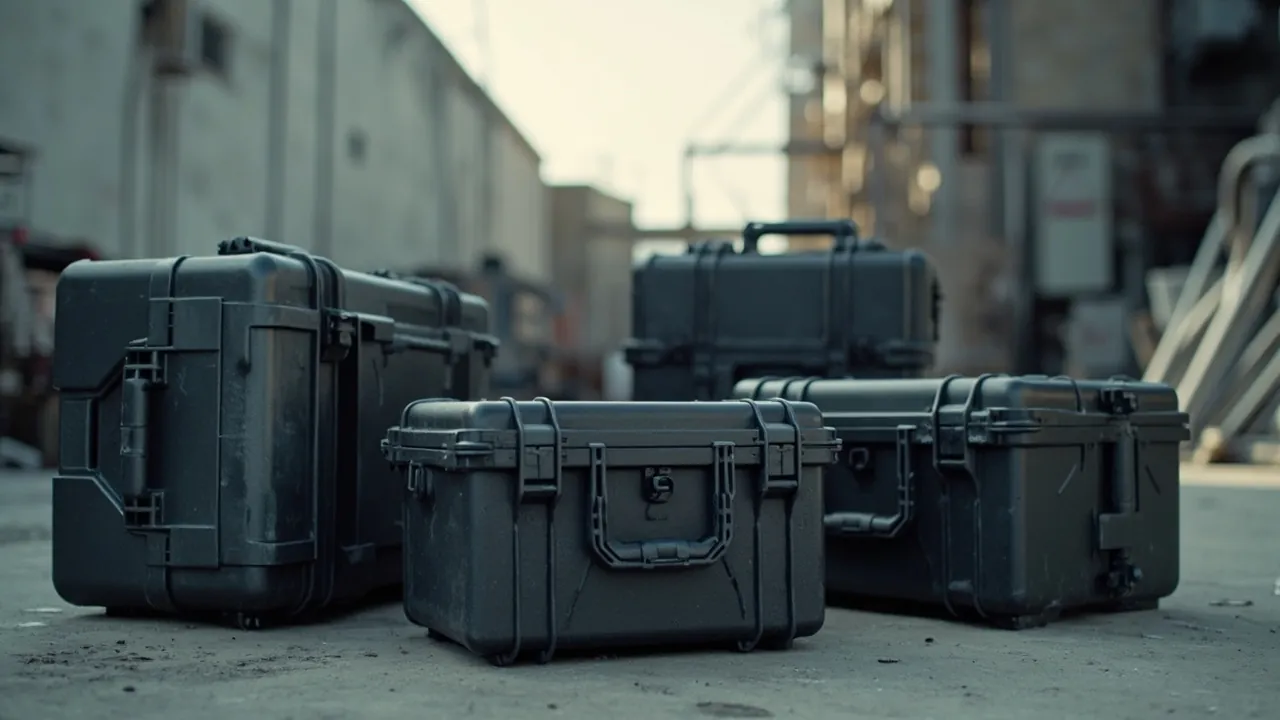
Short answer: choose a tactical storage box in the order "scenario first, size second, configuration third" — not by reading a specification table. The same case has completely different governing requirements in different duties. Field use prioritises ingress protection and drop resistance. Vehicle mounting prioritises stacking stability and body stiffness. Long-term warehousing prioritises moisture control and stacking strength. Precision equipment prioritises interior lining and cushioning. Collection storage prioritises sealing, light exclusion and material compatibility. The scenario identifies the must-not-fail items (an ingress protection level for anything outdoors, an anti-loosening latch for vehicle duty); the size determines load efficiency; the configuration determines whether the budget was well spent. Reverse that order — fall for one impressive specification first and then try to make the scenario fit — and the almost inevitable outcome is a case that turns out not to work once it arrives. This guide gives selection checklists for five typical scenarios, a repeatable method for sizing, matching boundaries for material and ingress protection, decision logic for interior configuration, and a table for allocating budget by scenario. All figures are typical or empirical values; selection should be confirmed against the actual duty parameters and the supplier's drawings.
Table of Contents
- Start with the conclusion: scenario, then size, then configuration
- What a "tactical storage box" actually is
- Five decision dimensions and how to find the must-not-fail items
- Scenario one: field work and emergency supply storage
- Scenario two: vehicle mounting and mobile transfer
- Scenario three: long-term warehousing and inventory management
- Scenario four: precision equipment and tool storage
- Scenario five: long-term collection storage
- How to size the case and calculate usable volume
- Ingress protection boundaries: when IP67 is mandatory
- Trading off material and weight
- Interior lining and divider logic
- Latches, handles and stacking extensibility
- Budget allocation: where the money should go
- FAQ
- Closing remarks and related reading
Start with the conclusion: scenario, then size, then configuration
The greatest risk in selection is being driven by specifications. Every line of a specification table is persuasive, but specifications only sort into priorities inside a scenario. Three examples make the point.
- A case rated IP67 that is mainly used to store tools indoors means the money spent on immersion performance is almost never used;
- A steel case with an 8 kg tare weight that must be carried by hand three times a day converts the money spent on stiffness into a daily handling burden;
- A case whose cavity dimensions do not match the contents may achieve only half its potential load efficiency, however high its rating.
The correct order is therefore three steps.
- Define the scenario: service environment (indoor, outdoor, vehicle-mounted, warehouse), the physical form of water (splash, jet, immersion), dust concentration, low-temperature limit, handling method and frequency. This step produces the must-not-fail items.
- Define the size: work from the contents to the required cavity dimensions and volume, then align to pallet modules and stacking layers.
- Define the configuration: within the candidates that satisfy the first two steps, set material, seal, latch and lining — and only then compare prices.
Finding the must-not-fail items is simple: ask "if this is not met, will the application fail?" If yes, it is a must-not-fail item. If no, it is a tradeable. For outdoor long-term storage, the ingress protection level is a must-not-fail item; case colour and nameplate style are normally tradeables.
What a "tactical storage box" actually is
In B2B language, "tactical storage box" is a colloquial name for a class of rigid container engineered to industrial or military specification for the storage and transfer of equipment and supplies. Structurally it overlaps heavily with "protective case", "waterproof case", "equipment case" and "tool case"; the differences are mainly in styling and accessory configuration, not in principle. What evaluates it is still measurable physical quantities:
- External dimensions and stacking footprint (mm);
- Internal dimensions and effective volume (mm / L);
- Tare and gross weight (kg);
- Ingress protection (IP code);
- Impact and drop performance (approached via ISTA and ASTM D4169);
- Stacking strength and storage period;
- Replaceability of seals and latches.
Understanding this keeps the name from steering the selection: the name sets a style expectation; the parameters set a technical commitment. For product background, start with what is an outdoor protective case and the IP67 protective case product definition.
Five decision dimensions and how to find the must-not-fail items
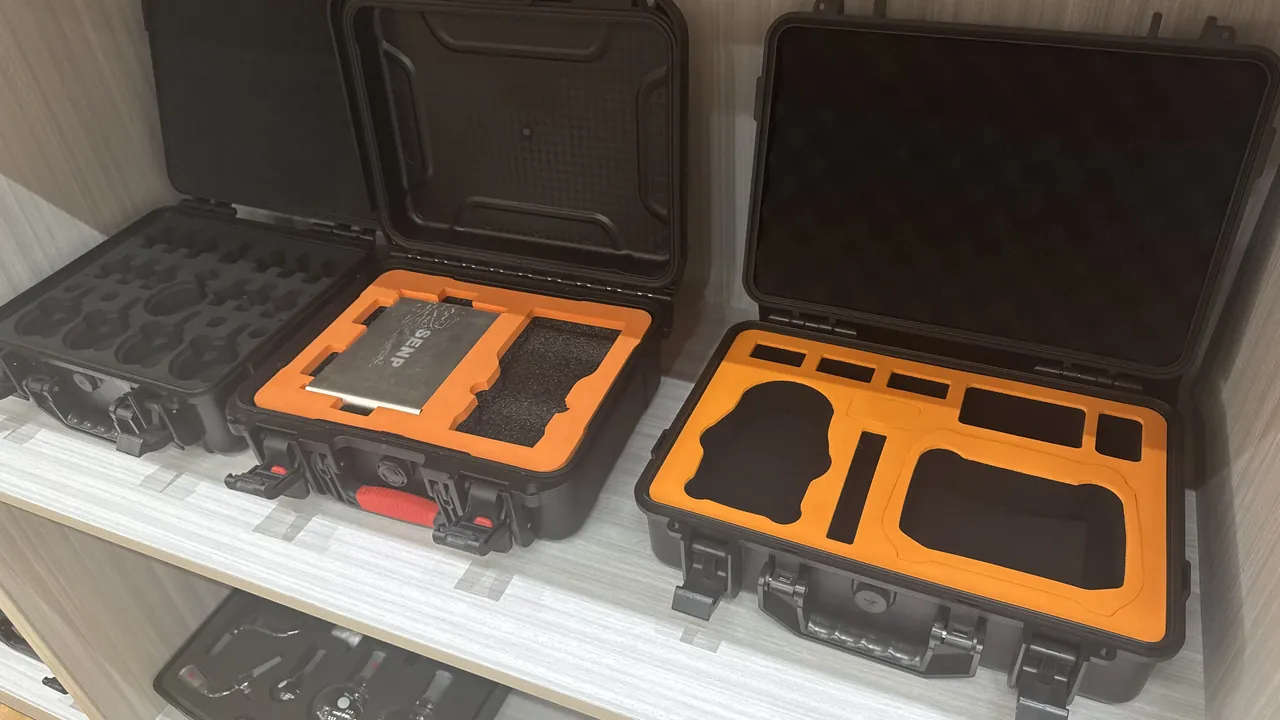
Collapse every scenario's selection factors and five decision dimensions emerge. Each has a lower bound and an upper bound: the lower bound decides whether it works at all, the upper bound decides how well it works.
| Dimension | Key question | Typical lower bound | Typical upper bound |
|---|---|---|---|
| --- | --- | --- | --- |
| Ingress protection | In what form do water and dust appear? | IP5X class is enough indoors | Outdoor and wash-down need IP6X + IPX5 or better |
| Structural stiffness | Will it be stacked long term, or loaded on one side? | Carries the target layer count | No rim deformation after 72 hours fully loaded |
| Material and weight | Who carries it, and how often? | 20–25 kg gross for one person | Lower tare at the same volume |
| Interior and dividers | What goes in and how is it accessed? | Contents must not shift | Pre-cut foam or thermoformed tray |
| Latch and access | Cycle frequency, need for anti-opening? | Repeatable closing force | Metal latch with anti-loosening feature |
How to use it: treat the table as a checklist, fill in your own duty parameters row by row, then mark the lower bounds. Every candidate meeting all lower bounds can move to price comparison. The upper-bound items are precisely where extra spending is genuinely justified.
Scenario one: field work and emergency supply storage
Typical duty: stored in the open or semi-sheltered, exposed to rain, day-night temperature swings and condensation, possibly set on the ground or in standing water, opened frequently.
Must-not-fail items:
- Ingress protection not lower than IP6X + IPX5. Dust and spray are routine outdoors; where standing water is possible, add IPX7. See what is IP67 rating.
- Low-temperature limit matched. Where winter minima reach below -20 °C, rule out homopolymer PP and similar brittle materials; prefer HDPE or modified copolymer PP.
- Weather-resistant seal. For prolonged outdoor exposure, specify EPDM, the best all-round choice for weather, water and ozone resistance.
- One-piece handle and body. Avoid through-wall handle designs, which create a leak path; choose one-piece moulded or over-moulded structures.
Tradeables: colour, nameplate, wheels, pressure valve.
Recommended configuration: HDPE body + grooved compression EPDM seal + metal cam latch + thin wall lining (5–10 mm closed-cell foam) + a designated desiccant space. Where metal equipment is stored, add VCI vapour-phase corrosion protection.
An easily missed detail: the breathing effect caused by day-night temperature swings. Air inside warms and expands during the day and is expelled; it cools and contracts at night and draws in damp outside air. The fix is a waterproof breather valve, which lets air exchange slowly through a microporous membrane while blocking liquid water. Note, though, that the ingress protection report must correspond to the valved configuration, and membrane condition belongs on the maintenance list.
Scenario two: vehicle mounting and mobile transfer
Typical duty: stored long term in a truck bed, van or boot, exposed to continuous vibration, braking and acceleration, road impacts and in-vehicle heat.
Must-not-fail items:
- An anti-loosening latch. This is the most critical and most commonly overlooked item in vehicle duty. Vibration gradually works ordinary plastic catches loose. Choose a metal cam latch with an over-centre self-locking action, or a structure with a positive retaining detent. Details are in case latch selection.
- Stacking stability. Top and bottom faces should carry location features — recesses or flanges — so cases cannot misalign laterally while the vehicle is moving.
- In-vehicle heat resistance. A closed vehicle interior can exceed 60 °C in summer, and the material must tolerate that long term without obvious softening or deformation. This matters especially for polymer cases.
- Body stiffness. One-sided loading and torsion are common in transfer, and the rim must stay flat to preserve the seal.
Tradeables: wheels, shoulder strap, styling.
Recommended configuration: HDPE or copolymer PP body + grooved seal + metal latch + anti-slip stacking features + rigid dividers (for easy access) + tie-down points for the lining.
A practical check: run a loaded braking simulation — place the fully loaded case in the vehicle and run several fore-and-aft displacement trials at normal braking severity, then observe whether the case slides, whether latches loosen and whether contents shift. It tells you more than any specification table.
Scenario three: long-term warehousing and inventory management
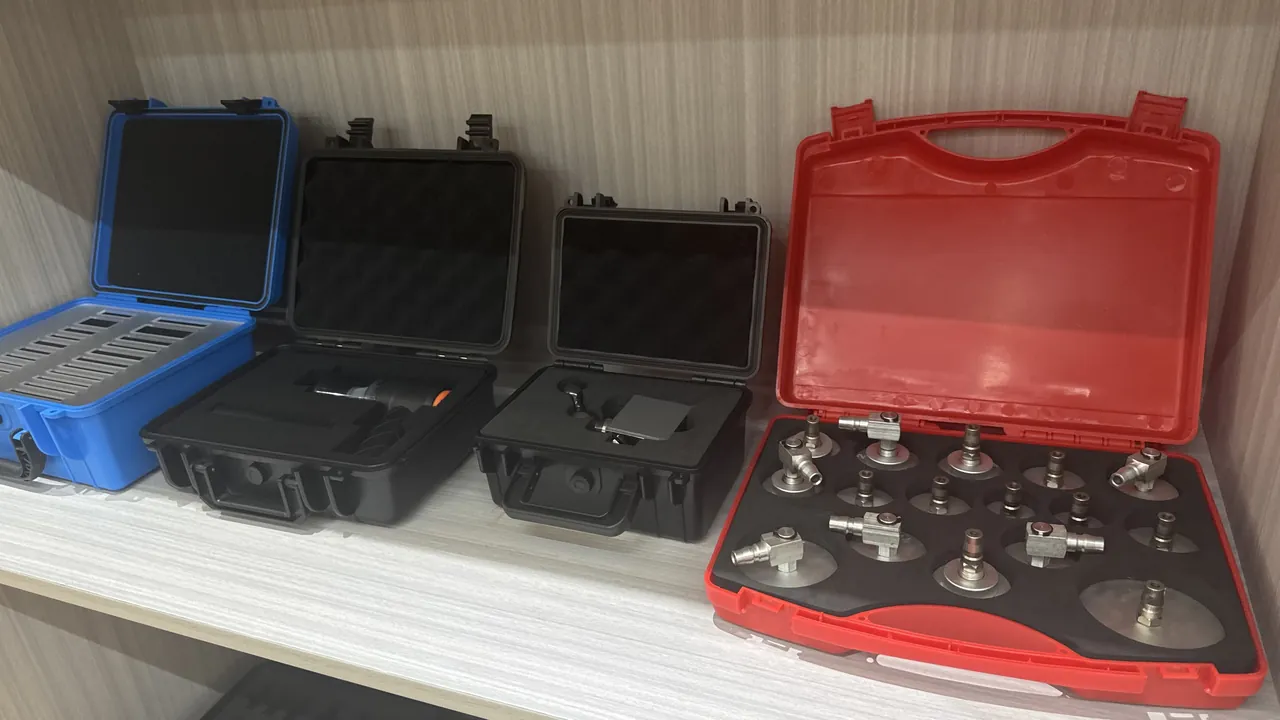
Typical duty: multi-layer stacking in a warehouse, possibly untouched for 1 to 5 years, humidity needs controlling, and stock counting and in-out management are required.
Must-not-fail items:
- Stacking strength matched to the storage period. State the layer count and storage duration, then estimate at 30 % to 50 % of short-term compressive strength (an empirical figure), with a further reduction for creep-prone materials such as HDPE. Where the storage period exceeds three years at a high layer count, a steel case is safer on the creep dimension. See why military steel ammo cans suit long-term storage.
- A complete moisture control system. A sealed case is not a dry case: desiccant and a humidity indicator card are needed, plus VCI where metal parts are stored.
- Identification and traceability. The case should have a clear, durable identification area — label pocket, screen-printed zone or moulded-in marking — for inventory management.
Tradeables: appearance, opening style (top-loading versus front-opening), whether a removable tray is included.
Recommended configuration: material chosen by storage period + grooved seal + measured desiccant + humidity indicator card + VCI (for metal contents) + rigid divider boards (for layer load carrying) + an identification system.
An efficiency detail worth acting on: match the case footprint to pallet modules such as 1200 mm × 1000 mm and 1200 mm × 800 mm. The utilisation gain from module matching is usually larger than anything gained by making the case a little thinner.
Scenario four: precision equipment and tool storage
Typical duty: the contents are gauges, instruments, power tools or precision components that must not be knocked, damped or dusted, and need good access.
Must-not-fail items:
- Cushioning matched to item weight and drop height. This follows the cushion curve: heavier items and higher expected drops need thicker foam. A layered build — low-density outer to absorb large deflection, medium or high-density inner for support — is the empirical recommendation. See case internal foam types.
- Non-hygroscopic lining. Avoid open-cell polyurethane sponge (absorbs water and oil, ages and sheds) for precision work; prefer closed-cell EVA or PE foam.
- Access convenience. Where items are handled often, choose a rigid divider grid or a sliding tray rather than a single hollowed foam block.
Tradeables: bespoke thermoformed tray, anti-static lining (which becomes a must-not-fail item once electronics are involved).
Recommended configuration: medium-stiffness body + grooved seal + CNC pre-cut EVA (laminated layers) + rigid dividers + humidity indicator card.
A budget note: in this scenario, the return on investment in the lining is usually higher than on the case itself. A case with a slightly lower rating but a well-fitted lining can outperform a higher-rated case whose contents are loose inside. Design variables for bespoke interiors are in case custom foam factors.
Scenario five: long-term collection storage
Typical duty: preserving items with commemorative or collection value — vintage equipment accessories, insignia, documents, photographs, memorabilia — over periods measured in years or longer, requiring light exclusion, humidity control, dust exclusion and material compatibility.
Must-not-fail items:
- Sealing and humidity control. Collection-grade storage is humidity sensitive, so the case needs good sealing plus a humidity indicator card and measured desiccant to hold relative humidity in a sensible band.
- Light exclusion. Prolonged light exposure causes material ageing, colour migration and fading, so the case should be opaque or stored away from light.
- Material compatibility. This is the most technical and most often neglected item in collection care: lining and packing materials must not release acids or plasticisers. Avoid polyvinyl chloride (PVC) materials in direct contact with collection items; prefer inert materials and acid-free paper.
- Low odour and low emission. A new case may carry residual odour; choose low-emission formulations, or air the case before use.
Tradeables: appearance, stacking, whether a lock is fitted.
Recommended configuration: a well-sealed case + acid-free or acid-free tissue wrapping + inert interleaving + humidity indicator card + measured desiccant + storage away from light + an annual opening and inspection routine.
A practical collection-care reminder: do not wrap metal or paper items directly in ordinary zip bags or in anything other than acid-free materials. Some plastic films release plasticisers, and prolonged contact can leave hard-to-remove marks on metal surfaces or embrittle paper. Where flexible wrapping is genuinely required, use archival-grade acid-free materials.
How to size the case and calculate usable volume
Getting the size wrong is the hardest mistake to fix with configuration later. This four-step method works.
Step one: list the contents. Record the outline dimensions of each item (length × width × height, or diameter × length), item weight, quantity, whether it tolerates load, and whether it needs its own compartment.
Step two: lay out and estimate. Trial an arrangement by layer × row × column to obtain the cavity length, width and height needed. Regularly shaped items reach an empirical 70 % to 85 % utilisation; irregular items need a trial layout.
Step three: add assembly allowance and lining thickness. Allow 1–2 mm per side (an empirical value) to absorb dimensional tolerance; where foam lining is used, add the foam thickness and the web thickness.
Step four: align to external modules and check stacking. Adjust external dimensions so the footprint divides evenly into the pallet edge, and verify that the load at the target layer count sits within the case's capability.
| Loading method | Utilisation (empirical) | Access convenience | Suitable for |
|---|---|---|---|
| --- | --- | --- | --- |
| Loose bulk stowage | 70 %–85 % | Poor | Impact-tolerant, low-value, fast loading |
| Rigid divider grid | 60 %–75 % | Very good | Mixed tools and equipment |
| Pre-cut fitted foam | 55 %–70 % | Good | Repeat storage of a fixed model |
| Single hollowed foam block | 45 %–60 % | Medium | One precision device |
| Bespoke thermoformed tray | 65 %–80 % | Very good | High-value irregular items |
A rule of thumb: when unsure which size to choose, go one size up but fill the surplus space with lining. Wasted space can be recovered with lining; insufficient space cannot be solved by any configuration.
Ingress protection boundaries: when IP67 is mandatory
The core question is not "higher is better" but "does it match the form of water present".
| Form of water and dust on site | Suggested combination | Notes |
|---|---|---|
| --- | --- | --- |
| Dry indoor, light dust | No requirement, or IP5X as a reference | No need to pay for water protection |
| Dusty indoor, occasional splash | IP6X + IPX4 | Cost and performance balanced |
| Semi-sheltered outdoor, occasional spray | IP6X + IPX5 | A common starting configuration |
| Open air, wash-down, dusty | IP6X + IPX5 or IP6X + IPX6 | Common site and yard requirement |
| Possible standing water | IP6X + IPX5 + IPX7 | Fording, standing water on the ground |
| Long immersion or special subsea duty | IP6X + IPX8 (depth and time agreed) | Conditions must be separately agreed |
Three criteria worth remembering.
- Water levels are not a simple progression. A sample that passes IPX7 will not necessarily pass the IPX5 jet test, because the two assess different failure modes — static head pressure versus dynamic water impact. The technical agreement must state each digit, with substitution by X not acceptable.
- The common IPX7 condition (1 m for 30 minutes) is not "any depth, any duration". Deeper or longer requires IPX8 with the conditions agreed separately.
- An ingress protection rating describes the case, not the condition inside it. Internal humidity still needs desiccant and maintenance.
Trading off material and weight
The first constraint on material choice is not strength but "how does this case move?"
HDPE (high-density polyethylene). The best low-temperature toughness (retains it from -30 °C to -40 °C), good chemical resistance and low vapour permeability, making it the mainstream choice outdoors and in vehicles. The trade-offs are lower stiffness (rib-dependent), a scratch-prone surface, and noticeable creep under high long-term stacking.
Copolymer PP. Balances cost and stiffness, suited to indoor and semi-outdoor duty; less capable at low temperature than HDPE.
Homopolymer PP. High stiffness at low cost, but clearly brittle at low temperature — it must be ruled out for cold duty.
PC and PC/ABS alloys. Excellent stiffness and impact resistance with a quality surface finish, and commonly compared against ABS in selection; see PP, ABS and PC case materials compared.
Steel. The best compressive strength, puncture resistance and long-term stacking, with no creep; the trade-offs are high weight and a coating system for corrosion protection.
Aluminium. Light, non-magnetic and visually refined, but less resistant to local impact than steel, and dissimilar-metal contact points need isolation.
A full comparison of polymer systems is in protective case plastic materials.
| Material | Low-temp toughness | Weight | Long-term stacking | Corrosion | Suitable duty |
|---|---|---|---|---|---|
| --- | --- | --- | --- | --- | --- |
| HDPE | Excellent | Medium | Fair (creeps) | Excellent | Outdoor, vehicle, damp |
| Copolymer PP | Good | Low | Fair | Good | Indoor, semi-outdoor |
| Homopolymer PP | Poor | Low | Fair | Good | Indoor, ambient temperature |
| PC / PC-ABS | Good | Medium | Good | Good | Precision equipment, finish-critical |
| Steel (coated) | Excellent | High | Excellent | Depends on coating | Long-term warehousing, tall stacks |
| Stainless steel | Excellent | Highest | Excellent | Excellent | Coastal, marine, chloride-bearing |
| Aluminium | Good | Low | Good | Good | Light transfer, non-magnetic needs |
A weight check formula you can use directly:
Gross weight = case tare weight + Σ(item weight × quantity) + lining weight
If gross weight exceeds the one-person handling limit (an empirical industry band of 20–25 kg), there are three routes: reduce the load, switch to a wheeled case, or move to palletised transfer. Do not paper over a design problem with "two people can lift it" — two-person lifting sharply reduces handling efficiency and increases one-sided loading on the body.
Interior lining and divider logic
The lining decides whether the case is pleasant to use. The decision follows four steps.
Step one: is cushioning needed? Impact-tolerant contents with their own packaging → thin lining is enough. Shock-sensitive or precision items → cushioning design required.
Step two: are dividers needed? Mixed items → rigid divider grid. A single fixed model → pre-cut foam.
Step three: is moisture control needed? Damp conditions or long storage → closed-cell foam + desiccant + VCI (for metal parts).
Step four: how often is it accessed? Frequent access → divider grid or sliding tray. Infrequent → fitted foam.
| Lining option | Cushioning | Load efficiency | Access | Moisture resistance | Suitable for |
|---|---|---|---|---|---|
| --- | --- | --- | --- | --- | --- |
| None | Poor | 95 %–100 % | Poor | — | Impact-tolerant, loose |
| Thin wall lining (5–10 mm) | Medium | 82 %–92 % | Medium | Good | General shock and scuff protection |
| Pre-cut EVA (20 mm) | Good | 70 %–80 % | Good | Good | Fixed models, precision items |
| Thick pre-cut EVA (40 mm) | Very good | 55 %–65 % | Good | Very good | High-value equipment, harsh transport |
| Rigid divider grid | Low | 75 %–85 % | Very good | — | Mixed tools and equipment |
| Bespoke thermoformed tray | Good | 65 %–80 % | Very good | Good | High-value irregular items, repeat delivery |
Choosing between dividers and foam is a recurring point of hesitation; see case divider versus foam.
Latches, handles and stacking extensibility
These three decide how the case behaves once it is in service, and they are the most commonly underestimated items.
Latches. Three criteria: is closing force stable and repeatable (does the case feel the same every time), is there an anti-loosening feature (essential for vehicle duty), and can it be replaced (it is a consumable). Metal cam-action latches beat one-piece plastic catches on all three. Where a padlock is to be fitted, confirm that the lock does not reduce seal compression.
Handles. Prefer a structure moulded into the body (one-piece or over-moulded) and avoid through-wall designs that create a leak path. A ten-minute loaded static suspension check is simple and effective: hang the fully loaded case and look for whitening, crazing or visible deformation at the handle roots.
Stacking extensibility. Three things to check: whether top and bottom faces have location features; whether different case sizes can be mixed in a stack (usually yes within one series, but confirm across series); and whether stack load transfers through the reinforced zones. Structural essentials are in case stacking structure.
A purchasing strategy: if you need several cases, choose the sizes within a single series. Cases in one series are usually designed as a set for footprint module, stacking geometry and stack height, and mixing them gives noticeably better stability and space utilisation.
Budget allocation: where the money should go
With the same budget, how it is allocated decides the real-world experience.
| Scenario | Budget priority | Compressible |
|---|---|---|
| --- | --- | --- |
| Field work | Ingress protection and sealing (35 %–45 %), weather-resistant material (20 %–25 %) | Appearance, accessories |
| Vehicle transfer | Anti-loosening latch and stacking features (30 %–40 %), body stiffness (25 %) | Lining complexity |
| Long-term warehousing | Material and stacking strength (30 %–40 %), moisture control (20 %–30 %) | Access convenience |
| Precision equipment | Interior cushioning (40 %–50 %), sealing (20 %) | Appearance, rating headroom |
| Collection storage | Sealing and humidity control (35 %–45 %), material compatibility (25 %) | Stacking strength, appearance |
Three general principles.
- Must-not-fail items cannot be cut. Saving on the ingress protection level for an outdoor duty gets repaid later in damaged contents.
- The marginal return on lining usually exceeds that on the case rating. With a limited budget, get the lining right first, then consider raising the rating one step.
- Maintainability is worth paying for. A case whose seals, catches and hinges can be ordered separately normally outlives a product designed to be scrapped whole.
JUNZHJIA, manufactured by KeXin New Materials (Guangdong) Co., Ltd., covers protective cases, tool cases, military-specification storage boxes and waterproof junction boxes, serving wholesale, distribution, OEM/ODM and global supply. Material systems, ingress protection levels, latch types and bespoke interiors can be configured to the customer's scenario, with test documentation and spare parts support.
FAQ
Q: What should I decide first when choosing a tactical storage box? A: Scenario first, then size, then configuration — because specifications only sort into priorities inside a scenario. Step one establishes six duty parameters: service environment (indoor, outdoor, vehicle-mounted, warehouse), the form of water (splash, jet, immersion), dust concentration, low-temperature limit, handling method and frequency, and access frequency. Those six produce the must-not-fail items — the ingress protection level for outdoor duty, the anti-loosening latch for vehicle duty, low-temperature toughness for cold duty. Step two back-calculates cavity dimensions and volume from the contents, aligned to pallet modules and stacking layers. Step three compares material, seal, latch and lining among the candidates that satisfy the first two steps. Reverse the order and the typical outcome is a case that does not work once it arrives — an IP67 case for indoor tools that is never immersed, or an 8 kg steel case bought for a duty that involves carrying it three times a day.
Q: Which ingress protection level should I choose? A: Match the form of water, not the highest number. Dry indoor with light dust needs no rating; dusty indoor with occasional splash takes IP6X + IPX4; semi-sheltered outdoor takes IP6X + IPX5; open-air, wash-down and dusty duty takes IP6X + IPX5 or IP6X + IPX6; possible standing water — fording, water on the ground — requires adding IPX7; long immersion or special underwater duty requires IPX8 with depth and duration agreed separately. Three criteria to remember. First, water levels are not a simple progression: a sample that passes IPX7 will not necessarily pass the IPX5 jet test, because the two assess different failure modes — static head pressure versus dynamic water impact. Second, the common IPX7 condition of 1 m for 30 minutes is not "any depth, any duration". Third, an ingress protection rating describes the case, not the condition inside it; internal humidity still needs desiccant and maintenance. Details are in what is IP67 rating.
Q: What is most often overlooked in vehicle use? A: The anti-loosening capability of the latch. Continuous vehicle vibration means that an ordinary plastic catch gradually works loose — and once a catch pops open the seal fails and contents can spill. Vehicle duty calls for a metal cam latch with over-centre self-locking, or a structure with a positive retaining detent, plus a stated proportion of closing force retained after a defined number of cycles. Next is stacking location features: top and bottom faces should carry recesses or flanges so cases cannot misalign laterally over bumps and concentrate load. Third is in-vehicle heat resistance: a closed vehicle interior can exceed 60 °C in summer and the material must tolerate it long term without obvious softening, which matters especially for polymer cases. Fourth is body stiffness: one-sided loading and torsion in transfer require the rim to stay flat to preserve sealing. A loaded braking simulation — several fore-and-aft displacement trials at normal braking severity — quickly reveals sliding, latch loosening and content movement.
Q: For long-term warehousing, should I choose steel or a polymer case? A: Use storage period and handling frequency as the two axes. Long storage (beyond three years) with low handling frequency points to steel, because steel barely creeps at ambient temperature, so tall long-term stacks do not slowly deform the body or lose rim flatness, and stacking strength and puncture resistance are better. Short storage with frequent handling points to polymer (HDPE), because tare weight is low, net payload at the same volume is higher, and low-temperature toughness is good (retained from -30 °C to -40 °C). When both are high, the usual compromise is a steel frame with a polymer skin, or a polymer case with metal hinges and latches. Two hard constraints also apply: insulation or non-magnetic requirements rule out steel, and coastal, marine or chloride-bearing environments should be assessed against 316 stainless or hot-dip galvanising first. Whichever route you take, long-term warehousing needs a complete moisture control system — desiccant, humidity indicator card, and VCI where metal parts are stored.
Q: Is the interior lining really more important than the case rating? A: With a limited budget, the marginal return on lining usually exceeds raising the case rating — provided the case already meets the scenario's lower bounds. The reason is that the shell provides environmental protection (moisture, dust, immersion) while the lining provides mechanical protection (cushioning, location, anti-shift), and actual damage more often comes from the latter: contents colliding with each other, transport shock, knocks during access. A case with a slightly lower rating but a well-fitted lining can outperform a higher-rated case whose contents are loose. Note, however, that where immersion is genuinely possible, the ingress protection level is a must-not-fail item and lining cannot substitute for it. Interior decisions follow four steps: is cushioning needed, are dividers needed, is moisture control needed, how frequent is access. For damp duty, avoid open-cell polyurethane sponge (absorbs water and oil, ages and sheds) and prefer closed-cell EVA or PE foam.
Q: What special requirements apply to collection storage? A: Four, of which material compatibility is the most technical and most often neglected. First, sealing and humidity control: fit a humidity indicator card and measured desiccant to hold relative humidity in a sensible band. Second, light exclusion: prolonged exposure causes material ageing, colour migration and fading, so the case should be opaque or stored away from light. Third, material compatibility: lining and packing materials must not release acids or plasticisers, PVC materials must not contact collection items directly, and inert materials and acid-free paper are preferred. In practice, wrap items in archival-grade acid-free paper or acid-free tissue. Fourth, low odour and low emission: new cases may carry residual odour, so choose low-emission formulations or air the case before use. One operational reminder: do not wrap metal or paper items directly in ordinary zip bags, since plasticisers released by some films can leave hard-to-remove marks on metal or embrittle paper over long contact. Inspect annually, reading the humidity indicator card before the contents.
Q: How should I verify the load capacity of a case? A: Use a simple formula: gross weight = case tare weight + Σ(item weight × quantity) + lining weight. If it exceeds the one-person handling limit (an empirical industry band of 20–25 kg, extending to about 30 kg for occasional short transfers), there are three routes: reduce the load, switch to a wheeled case, or move to palletised transfer. Three points to note. First, do not paper over the design problem with "two people can lift it" — two-person lifting sharply reduces efficiency and increases one-sided loading on the body. Second, tare weight varies widely — at the same volume a steel case may weigh 1.5 to 2.5 times an HDPE case, so although steel is stronger, its net payload in manual handling is actually lower. Third, run a suspension check once loaded — hang the fully loaded case for ten minutes and look for whitening, crazing or visible deformation at the handle roots, then carry it some distance to assess centre-of-gravity stability. Keep heavy items low and central in the case.
Q: Why is it better to choose sizes within one series? A: Cases in a single series are usually designed as a set for footprint module, stacking geometry and stack height, so mixing them gives noticeably better stability and space utilisation. Three specific benefits. First, consistent modules: footprints are proportional, so stack load transfers evenly rather than concentrating and causing local deformation. Second, matched location features: top recesses and bottom flanges interlock, preventing lateral misalignment during bumps or handling. Third, combinable heights: different case heights can be combined to reach a target stack height, which helps when optimising a fixed rack or vehicle space. When mixing across series, verify three things: whether the footprints form an effective bearing surface, whether the location features engage, and whether the total stack weight is within the capability of the bottom case. If cross-series stacking is unavoidable, add a rigid divider board between layers to convert point load into distributed load and markedly reduce local compression risk.
Q: With a limited budget, what can be cut? A: What can be cut are the add-ons that do not affect function; what cannot be cut are the must-not-fail items. Compressible items: cosmetic finishing and custom colour, decorative accessories, non-essential lighting or marking systems, appearance grades beyond the requirement; lining can be simplified in non-precision applications (thin lining instead of pre-cut foam); the ingress protection level can drop one step where deep immersion is not involved. Must-not-fail items: the scenario's critical requirements — ingress protection for outdoor duty, anti-loosening latches for vehicle duty, low-temperature toughness for cold duty, stacking strength and moisture control for long-term warehousing, and cushioning for precision equipment. A practical allocation by scenario: field work puts 35 % to 45 % into ingress protection and sealing and 20 % to 25 % into weather-resistant material; vehicle duty puts 30 % to 40 % into latch and stacking features; long-term warehousing puts 30 % to 40 % into material and stacking strength and 20 % to 30 % into moisture control; precision equipment puts 40 % to 50 % into interior cushioning. One general principle applies throughout: spend on maintainability — a case whose seals, catches and hinges can be ordered separately normally outlives a product designed to be scrapped whole.
Closing remarks and related reading
Back to the question in the title: choose a tactical storage box in the order "scenario first, size second, configuration third". The scenario sets the must-not-fail items — ingress protection outdoors, anti-loosening latches in vehicles, low-temperature toughness in cold duty, stacking strength and moisture control for long-term warehousing, cushioning for precision equipment, and sealing, light exclusion and material compatibility for collection storage. The size sets load efficiency: back-calculate the cavity from the contents, allow assembly clearance, align to pallet modules — get those three right and the later configuration choices actually matter. The configuration decides whether the budget was well spent: the marginal return on lining usually exceeds raising the case rating one step, and maintainability is the long-term return most worth funding.
Three things to do. First, turn the duty into a checklist — fill in the six duty parameters and mark the lower bounds; only candidates meeting them move to price comparison. Second, run physical verification — a paper layout trial for dimensions, a loaded suspension and braking simulation for structure. Both cost very little and catch most problems early. Third, write maintainability into the purchase terms — seals, catches and hinges orderable separately, with a stated spare parts lead time.
JUNZHJIA, manufactured by KeXin New Materials (Guangdong) Co., Ltd., covers protective cases, tool cases, military-specification storage boxes and waterproof junction boxes, serving wholesale, distribution, OEM/ODM and global supply. Material systems, ingress protection levels, latch types and bespoke interiors can be configured to the intended scenario, with test documentation and spare parts support.
Related reading