

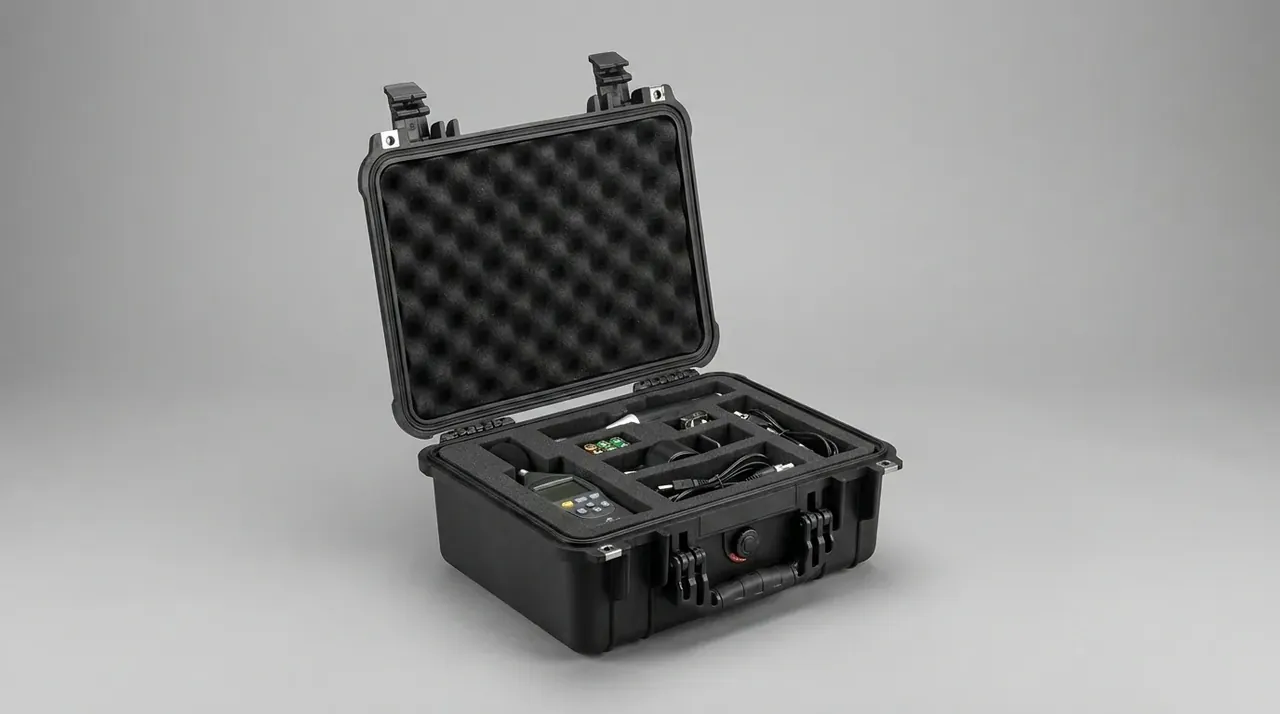
Quick answer: A teaching kit case holds up when four numbers line up: 1.0 m drops on six faces three times each, R8 corners, 3 mm walls and 1.5 kg per cell.
Table of contents
- The drop budget: six faces, three times
- R8 corners and a 3 mm wall
- Anti-misload slots in the dividers
- Clear lids and 90 openings a day
- FAQ
1. The drop budget: six faces, three times
After one 18-week term, corner splitting on 84 teaching kit case units fell from 12% to a single case. The change was not the resin but the criterion written on the drawing: 1.0 m, three drops on each of six faces, 18 in total, onto a 50 mm slab, lid opened straight after to check corners and hinge pockets.
Three drops per face is not a supplier punishment: students carry the box along corridors, so side and corner impacts dominate while flat landings are rare. Corners take 6 of the 18 drops, exactly where splitting starts.
Order matters too: corner first, face later, and a corner crack keeps opening through the flat drops, so the pass line reads crack length rather than breakage.
| Impact point | Drops | Pass criterion |
|---|---|---|
| Corner | 6 | No through crack, whitening at R8 ≤3 mm |
| Edge | 6 | No split edge, dent at 3 mm wall ≤0.5 mm |
| Face | 6 | No puncture, lid gap still ≤1.5 mm |
Measure the lid gap after the 18th drop: a gap grown from 1.0 mm to 1.5 mm means a permanent set, and the next drop opens at the latch.
Sample 4 units from each 20-unit batch and log every dropped serial.
2. R8 corners and a 3 mm wall
Corners concentrate stress. Opening the outer radius from R3 to R8 cuts peak corner stress by about 22% in the same 1.0 m drop and pulls whitening from 7 mm to under 3 mm. The radius is not styling; it spreads load across a longer arc.
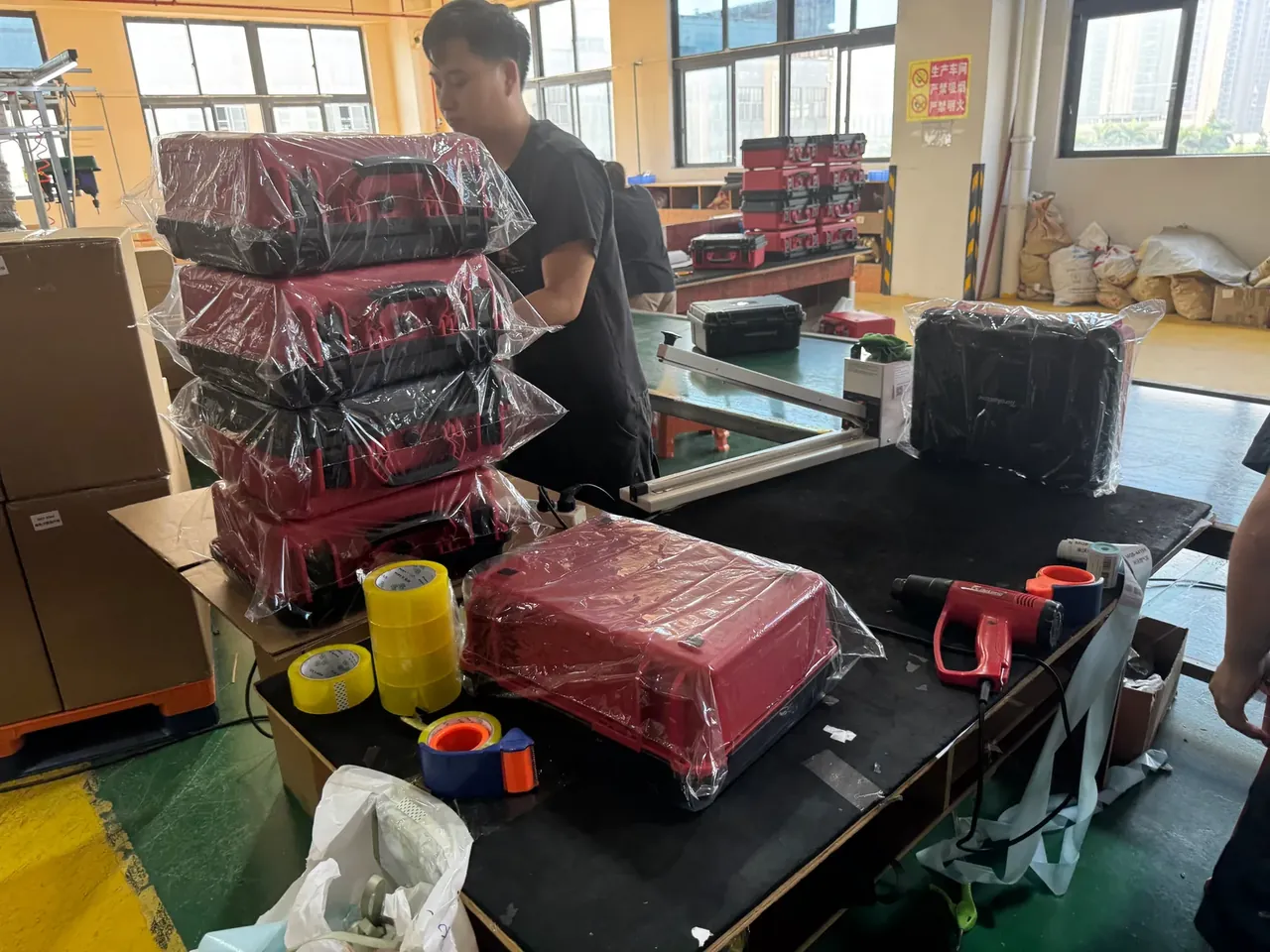
A 3 mm wall is the compromise between impact and weight. At 2.5 mm the box loses 0.4 kg but cracks at the corner on the second corner drop; at 3.5 mm it gains 0.6 kg, and a 45-student class lifting it 90 times a day feels the wrist first.
State the wall tolerance as ±0.15 mm. Moulded corners usually run 0.1 mm thin because the melt changes speed at the turn, leaving a 2.6 mm band inside the R8 where cracks begin.
Ribs belong in the base, not the side walls, where they push against the divider set and stop cells seating. A 2 mm grid at 40 mm pitch cuts base bulge from 2.2 mm to 0.8 mm. Grade rib roots at R1.5 so the rib does not become a new stress riser, and keep ribs off the bosses to avoid trapped gas. The grid cost 2 s of cooling on the same tool.
Change one variable at a time between builds, or the gap between 12% and one case cannot be attributed.
3. Anti-misload slots in the dividers
A reversed divider is the commonest classroom failure. Twelve cells map to twelve equipment sets, and one divider fitted the wrong way shifts every cell behind it. The slot is 2 mm deep and 8 mm wide on one side only, so the divider drops in one orientation.
At 2 mm the groove is the smallest feature a gloved hand can feel; a 1 mm groove gets loaded backwards anyway, and a 3 mm groove splits first at the mouth under the 1.5 kg load.
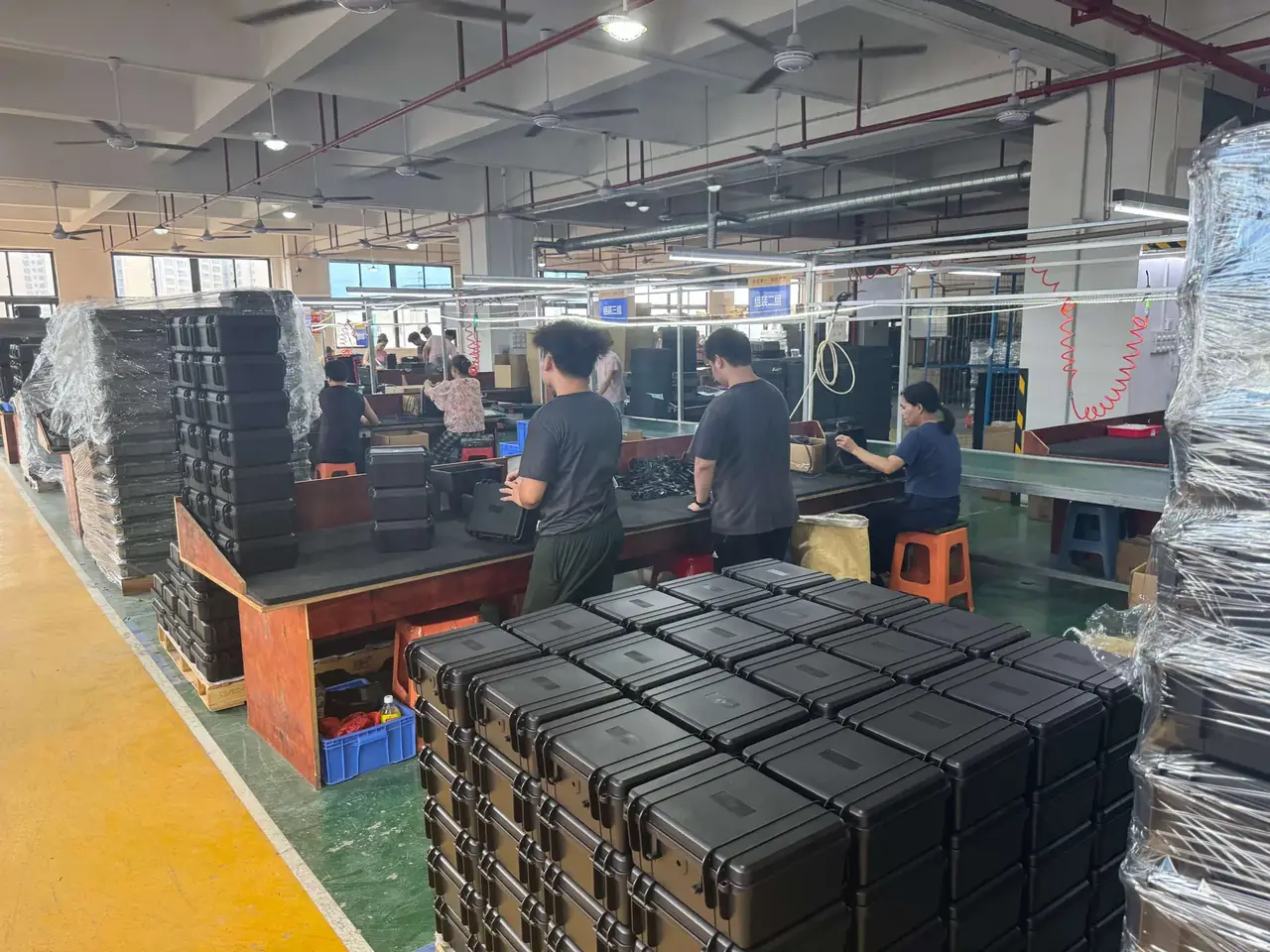
The 1.5 kg figure is the heaviest equipment set. Dividers run 2.5 mm polypropylene, and a 1 mm ledge under the cell traps the lower edge, so a 40 N sideways push will not tip it.
Compartment count follows class size: 45 students make 15 groups of three, so 12 cells cover one lesson list with 2 spare for consumables.
| Cells | Cell size | Load | Divider | Group |
|---|---|---|---|---|
| 8 | 90 × 80 mm | 1.5 kg | 2.5 mm | Two |
| 12 | 70 × 60 mm | 1.5 kg | 2.5 mm | Three |
| 16 | 55 × 50 mm | 1.2 kg | 2.0 mm | Four |
A one-piece divider set sliding into dovetail slots comes out in 8 s, and dust clears in one brush pass.
Cell positions are dimensioned from one datum corner, with 0.5 mm clearance to the wall so thermal movement does not jam the divider.
4. Clear lids and 90 openings a day
Forty-five students open and close the box 90 times a day, which is 8100 cycles over 18 weeks at five days a week. Specify hinges at 20,000 cycles for two terms of headroom, and latches at 15,000, where the first failures show in year two.
The clear lid is 3 mm PC at 88% transmission and 3% haze. Students see whether each item is back in its cell without opening the box, removing about 30 openings a day and easing the hinge count.
Scratch resistance comes from the coating: a 500 g ball from 1 m dents an uncoated sheet 1.8 mm and a coated one 0.6 mm, at the cost of raising pencil hardness from HB to 2H and banning alcohol cleaners.
The label slot sits inside the lid, 45 × 20 mm, takes a paper card swapped once a term with no adhesive, held to ±0.3 mm so it neither rattles nor needs a fingernail.
Lid sealing relies on a foam gasket at 30% compression. A 3 mm lid spreads load to all four sides, and even witness marks after a drop show the impact did not sit only on the corners.
Conclusion
Match the action to the structure and the teaching kit case stops being a guess: carrying maps to handle and hinge pockets, opening to the stay and gasket, picking to cells and misload slots, closing to latches and lid gap, putting away to the label slot and clear lid, a fumbled drop to R8 corners and a 3 mm wall. Six actions, six dimension sets, checked line by line at purchase instead of judged from a sample photo. Close the drop line at 1.0 m on six faces three times with whitening under 3 mm, close the cells at 12 of 1.5 kg, close the cycle count at 90 openings a day against 20,000 hinge cycles. With all three on the drawing, the repair rate stays at the one-case level.
This article discusses container-side specifications and design implications only, and does not cover any handling, loading or use of the contents.
Related Reading
- Lab equipment case structure and fit-out
- Forensic lab sampling case layout
- Writing English labels for cases
- Choosing a training equipment case
Related Products
- 8 Series — Gun Cases; Military Equipment Cases; Camera Equipment Cases; Drone Cases; Watch Cases; Knife Cases; First Aid Cases; Electronics Equipment Cases
- WL8-2812 PP Gun Case — model WL8-2812
- All protective cases and toolboxes: 7 series, 158 models