

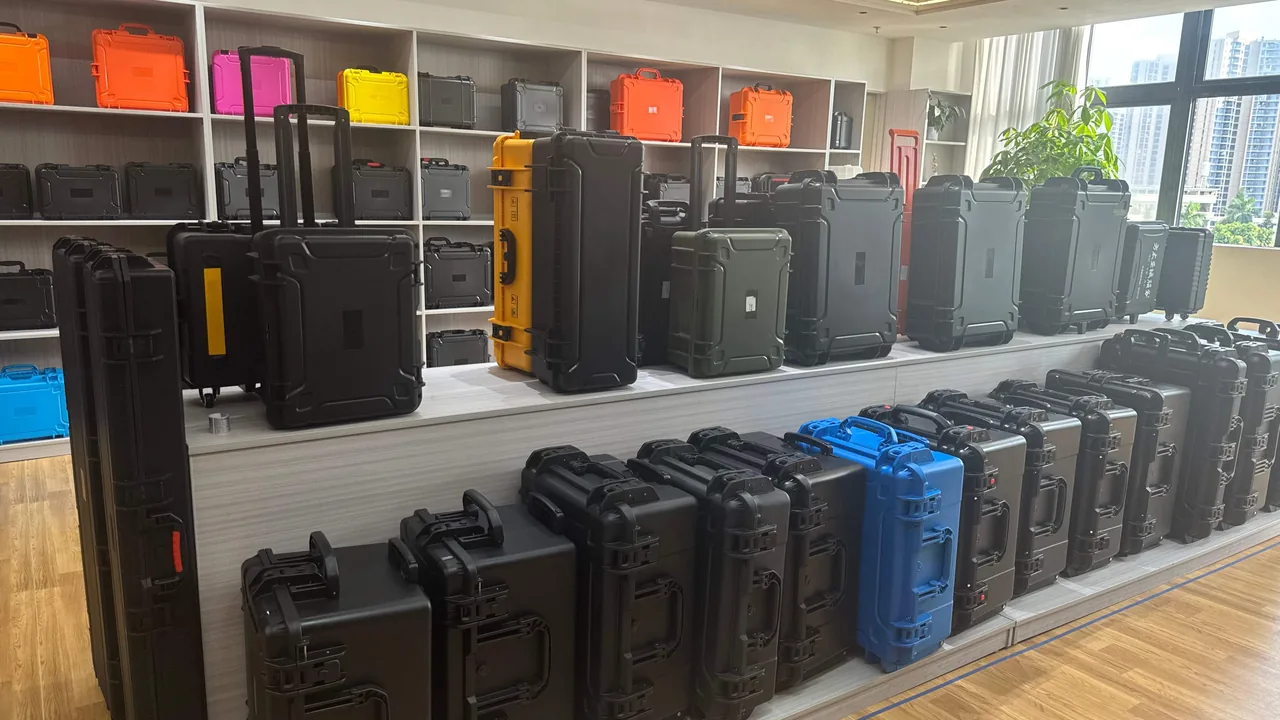
Forensic work moves equipment along a long chain: sampling swabs and wipes, forceps and scissors, blood tubes and specimen bottles, evidence bags and metal cans, tamper-evident seals and serialised labels, plus portable rapid analysers and field documentation terminals. If any link in that chain is damaged during road, air, sea or backpack transport, the loss is not limited to the hardware. It also includes a sampling opportunity that cannot be repeated and evidence that may be ruled inadmissible. A forensic case is therefore not a generic container. It is part of evidence integrity.
JUNZHIJIA's protection principle for forensic work is straightforward: separate sampling tools, evidence containers and analytical instruments into dedicated zones, then use a reproducible liner structure, a declared sealing level and traceable identification so that every opening and closing can be recorded and reviewed. The value of a case is not how much it holds, but whether the equipment is still in a known, usable condition after every transfer.
Table of Contents
- The Forensic Equipment Chain and Where Protection Actually Matters
- Partitioned Storage for Sampling Tools and Swabs
- Evidence Containers and Tamper Seal Compatibility
- Shell Materials and IP65 / IP67 Sealing Selection
- Cushioning Liners: Layered Structure and Material Choice
- Temperature, Humidity, Condensation and Pressure Equalisation
- Cross-Contamination Control and Disinfectant Compatibility
- Vibration Protection for Portable Analysers and Field Terminals
- Chain-of-Custody and Serialised Traceability
- Transport Testing and Receiving Acceptance Criteria
- Stacking, Palletising and Vehicle Loading
- Failure Modes and Engineering Countermeasures
- Customisation, OEM/ODM and Documentation
- Frequently Asked Questions FAQ
- Conclusion and Related Reading
The Forensic Equipment Chain and Where Protection Actually Matters
Protection requirements should be defined along two separate lines: equipment usability and evidence integrity. Equipment usability asks whether a sampling tool can be used immediately on arrival: whether a swab head has absorbed moisture, whether a forceps tip has been chipped out of alignment, whether a sharps container has leaked after being inverted. Evidence integrity asks whether the temperature, sealing state and identity marking of an already-collected specimen have remained continuous in transit.
The consequences are not symmetrical. A deformed forceps can be replaced at the cost of time. A contaminated swab or an evidence bag whose seal has partly lifted costs something that cannot be rebuilt. Within one case, unused equipment and sealed evidence must therefore occupy physically separate zones, and those zones should be independently sealed so that a humidity or temperature excursion in one compartment does not affect both categories at once. The broader logic of sample transport is covered in Laboratory Sample Transport Cases: Design Essentials, while this article concentrates on the forensic specifics of swabs, evidence containers and seals.
Table 1. Forensic equipment zones mapped to protection levels
| Zone | Typical contents | Impact sensitivity | Humidity sensitivity | Suggested sealing | Liner approach |
|---|---|---|---|---|---|
| --- | --- | --- | --- | --- | --- |
| A Sampling tools | Forceps, scissors, saws, scrapers | High (tip deformation) | Low | IP65 | Formed pockets plus thin IXPE layer |
| B Swabs and consumables | Sterile swabs, tubes, microcentrifuge vials | Medium | Very high (moisture ruins them) | IP67 | Separate compartments plus desiccant |
| C Evidence containers | Bags, bottles, metal cans | Low | Medium | IP67 | Elastic retention plus seal channel |
| D Instruments | Portable analyser, field terminal | Very high | High | IP67 | Wrapped foam plus isolation posts |
| E Documents and seals | Seals, labels, custody forms | Low | Medium | IP54 | Document sleeve plus pressure plate |
Partitioned Storage for Sampling Tools and Swabs
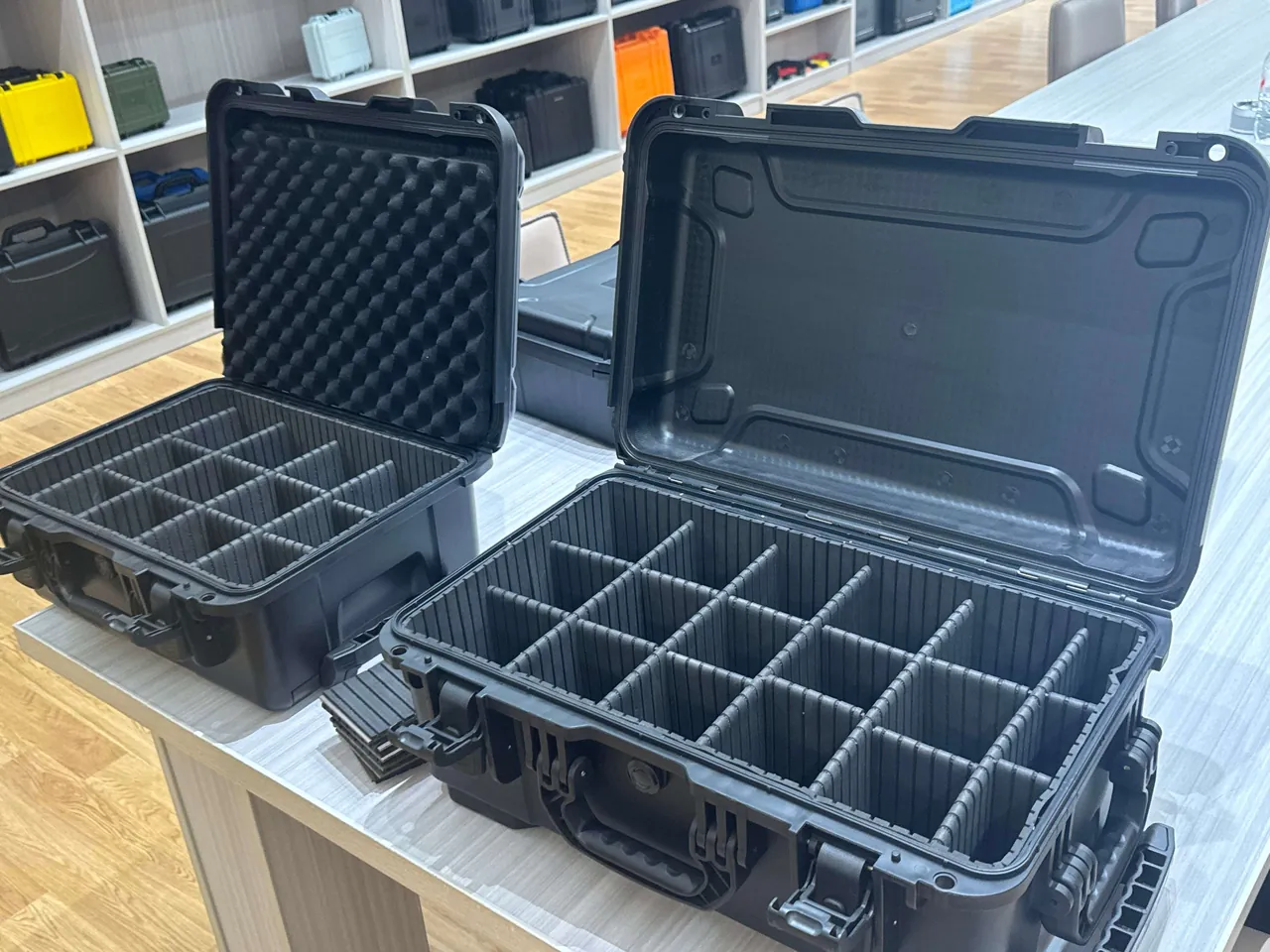
Sampling tools present a specific conflict: they are long and thin, their tips are fragile, and there are many of them. An open foam cut-out is convenient but does nothing to stop a tool sliding along its channel and colliding with its neighbour once the case is turned over. A workable approach constrains each tool on three faces. A formed pocket at the base fixes horizontal position, a narrowed throat grips the tool at the neck, and the lid foam applies light preload when the case closes. With three-face restraint, vertical impact simply compresses the foam instead of displacing the tool.
Swabs and micro-sampling consumables are governed by cleanliness and moisture rather than mechanical strength. Once the fibrous head of a swab takes up moisture, sampling efficiency and downstream amplification results are both affected. In practice swabs are kept sealed in their original batch pouches, then placed as a group inside an independent IP67 compartment together with desiccant. The compartment lid should not use a coated surface that sheds particles, and cut edges need edge sealing, because after repeated opening and closing loose fibre becomes a source of cross-contamination.
Tools that must be reached continuously, such as forceps and scissors used mid-sampling, belong in a shallow upper tray so the operator does not have to bend or dig. Spares and low-frequency items go into lower or side bays. The opening sequence should be fixed by zone labels and colour coding, otherwise different staff reorganise the case according to personal habit and destroy a liner fit that was already validated. Comparable retention methods for delicate instruments are described in Precision Instrument Cases: Location and Cushioning Design.
Evidence Containers and Tamper Seal Compatibility
Evidence containers include paper evidence bags, plastic evidence bags, screw-top specimen bottles, metal cans and dedicated collection tubes. Their requirements differ sharply from those of ordinary instruments. Paper bags need some breathability to avoid internal condensation, while plastic bags and bottles must resist leakage. A practical arrangement places the two in different zones of the same case, with paper items toward the outer layer and plastic items toward the inner layer behind a secondary sealed bag, so that any leaked liquid cannot migrate along the liner by capillary action.
The tamper-evident seal is the visible proof of chain of custody and is also the component most easily damaged by case geometry. Seals are usually single-use adhesive or threaded designs that are sensitive to creasing, compression and heat. If a seal partially lifts in transit because the liner pressed against it, the evidence itself may be intact yet still be challenged during disclosure. Seals therefore need a dedicated flat storage channel, at least one millimetre deeper than the seal thickness, with smooth burr-free walls. A sealed container placed into the case should have its seal facing upward and clear of the hard edges of adjacent containers, with a thin EVA separator where necessary.
Labels and serial numbers must be managed alongside the seals. Once an item leaves the scene, its item number, seal number, sealing time and handling officer need to form a continuous record. For long-term retention, Sealed Archive Cases: Sealing and Retention Management discusses sealing and label weatherability, and Medical Sample Transport Cases: Temperature Control and Compliance provides a comparable framework for the transport leg.
Shell Materials and IP65 / IP67 Sealing Selection
Forensic scenes are often outdoors or semi-outdoors: rain-soaked locations, riverbanks, vehicle boots and temporary examination tents. The shell must first survive ultraviolet exposure and low-temperature cycling without becoming brittle, and second keep the interior dry under short immersion or prolonged high humidity. Engineering plastics such as PP, ABS, PC and their blends suit small and medium sizes with complex geometry and precision liners, while rotationally moulded LLDPE suits large volumes and heavy loads formed as a single body.
Sealing level should follow actual exposure rather than the highest available number. Brief rain wash and vehicle wake spray are typical IP65 duty. Short immersion, wading transfers or long sea freight in high humidity call for IP67. The difference between the two classes is set out in IP65, IP66 and IP67: What Actually Differs; from a forensic angle two points deserve emphasis. First, evidence containers frequently hold paper, so water ingress is close to irreversible and IP67 should be chosen whenever wading risk exists. Second, gasket material must be compatible with the disinfectants used on site, or repeated wiping will accelerate ageing. Material matching is examined further in Case Seal Materials: Selection and Compatibility.
The shell must also be cleanable, an attribute that is often overlooked. Where seams, hinge recesses and latch bases form narrow grooves that are hard to reach, residues collect there. Good design reduces deep narrow recesses, rounds the transitions, and lets a wipe pass through in a single stroke.
Cushioning Liners: Layered Structure and Material Choice
The liner, not the shell, is the real functional core. The shell resists external load; the liner keeps that load within what the equipment can tolerate. Forensic equipment combines very different masses, mixing rigid tools with flexible consumables, so a single foam density rarely satisfies both ends of the range. High-density foam carries load well but has a short energy-absorbing stroke, while low-density foam absorbs energy well but gives insufficient support to light items.
A practical answer is a three-layer build: a hard contact layer, an energy-absorbing layer and a retention layer. The contact layer uses higher-density EVA or PE in direct contact with tools and instruments, providing dimensional stability and compressive support. The middle IXPE or medium-density EVA absorbs energy and flattens the impact peak through controlled compression. The retention layer bonds to the case floor and prevents the whole liner from shifting after repeated impacts. The lid carries a matching closing layer that creates preload when shut, suppressing residual movement. Foam density and morphology trade-offs are discussed in more detail in Custom Foam Inserts: Structure and Process.
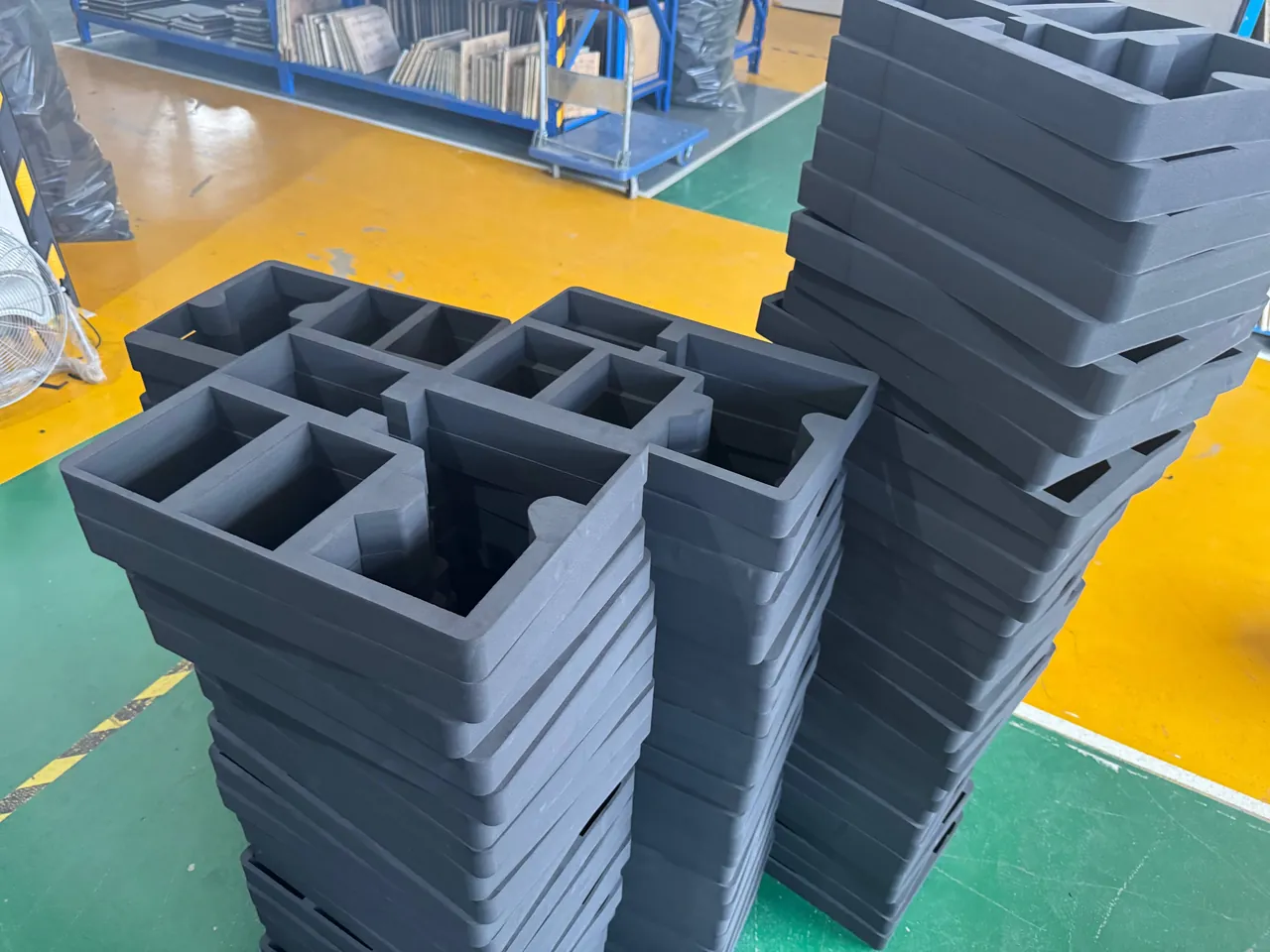
Three criteria govern liner design. First, in a fully loaded state no single item may move freely without applied force. Second, after drop testing from one metre onto six faces and three edges, instruments must still power on and swab packaging must remain intact. Third, after five hundred open and close cycles the liner must show no permanent collapse or torn pockets. Writing these three into the acceptance file is far more enforceable than requesting that "the foam be good". In addition, the liner must not use materials that release plasticiser or shed particles, which would contaminate swab and container surfaces.
Temperature, Humidity, Condensation and Pressure Equalisation
Forensic specimens are temperature sensitive, and temperature excursions can change the stable state of certain samples directly. For swabs and paper evidence bags, humidity is the more critical variable. Interior moisture comes from three sources: ambient air trapped at closing, water carried in on the equipment itself, and repeated condensation driven by day-night temperature cycles. Adding desiccant without managing structure and pressure usually fails after the first significant temperature drop.
The controls should be combined. Structurally, fit a breathable waterproof pressure equalisation valve so that internal and external pressure converge quickly as altitude and temperature change, preventing the gasket from being sucked in or pushed out. For drying, dose silica gel or molecular sieve to the free interior volume and pair it with a humidity indicator card so that the arrival decision rests on a reading rather than a guess. Where a stable temperature is required, add a phase-change cooling module inside the case and separate the cold source from the zone that directly touches evidence containers, so that localised over-cooling does not occur. Valve selection and placement are covered in How a Case Pressure Equalisation Valve Works.
One caution: desiccant is not a substitute for sealing. If the case does not reach its design sealing level, external moist air keeps replenishing the interior and the desiccant simply saturates faster. The correct order is to solve sealing first, then address drying and indication.
Cross-Contamination Control and Disinfectant Compatibility
Forensic work is more sensitive to cross-contamination than routine laboratory work. Three pathways dominate: direct contact between items, dust and particles released during opening, and capillary migration of residual liquid through liner pores. The countermeasures map one to one: zone isolation, low-shedding materials and impermeable separators.
Zone isolation requires that equipment and evidence from different cases or different batches be physically separated. Where several cases travel in one case body, a removable divider combined with a disposable liner bag works well: the divider provides structural separation while the disposable bag provides a single-use clean interface, and replacing the bag clears residues. Liner materials should be closed-cell or low-shedding. Open-cell foam absorbs energy well but its pores become a hiding place for residues and microorganisms, so its cleanability has to be assessed rather than assumed.
Disinfectant compatibility is an easily missed acceptance item. Field disinfectants commonly include chlorine-based preparations, alcohols and peracetic acid types, and they attack metals, gaskets and some plastics to varying degrees. Design review should state an approved disinfectant list and verify that gaskets and markings survive the specified wiping frequency. Metal hardware should default to 316 stainless steel, and markings should default to solvent-resistant ink or laser etching rather than a decal that lifts after cleaning.
Vibration Protection for Portable Analysers and Field Terminals
Portable analysers, Raman and infrared rapid screening instruments, documentation terminals and scene lighting commonly integrate precision optics and disk-based storage, so their vibration requirements exceed those of ordinary sampling tools. Failure is usually not a single dramatic drop but cumulative low-amplitude vibration that loosens components, shifts optical paths or wears connectors. Liner design must therefore address sustained vibration, not only one-off impacts.
For sustained vibration, a common approach gives the instrument a compressible gap on all sides so that it sits in elastic suspension rather than hard clamping. The gap is derived from the maximum acceleration the instrument permits and the compressibility of the foam, typically sizing the support area at one and a half to two times the unit mass and ensuring residual displacement in any direction stays within the instrument limit. The base of the unit should rest on a continuous foam face rather than on the hard points of a shell rib, avoiding point loading. Where a unit has a detachable battery or port cover, remove it before transport or fit a retention device.
For equipment that must run for long periods on site, cooling and protection conflict: cooling needs openings, protection needs closure. One option is to transport the unit powered down and deploy it after arrival. If operation inside the case is unavoidable, fit a waterproof breathable membrane over the opening and evaluate the trade-off between airflow and protection level. Overall equipment selection logic is described in Instrument Case Selection Guide.
Chain-of-Custody and Serialised Traceability
Chain of custody requires a verifiable record at every transfer, from collection and sealing through transport, handover, examination and retention. As the transport carrier, the case can support the system on two levels: traceability of the case itself and traceability of its contents.
At case level, the usual approach assigns a unique number to each case and fixes it with a weather-resistant label or laser etching in a low-wear location, recording the case number against the handling officer. A QR code or RFID tag can bind the case number to an electronic register so that handover is scanned rather than handwritten, removing disputes over handwriting. Identification methods and weatherability are covered in Case Asset QR Code Tracking.
At content level, the rule should be one item, one code, one position. Every pocket carries a fixed number, and each item's number is registered against its pocket. Seal numbers correspond one to one with container numbers, and handover checks seal integrity before counting items. Every opening should leave a time, reason and operator in the accompanying record sheet. Should damage occur, the specific step can then be identified quickly instead of the whole batch being held responsible.
Transport Testing and Receiving Acceptance Criteria
Whether a design works must be verified through reproducible testing. Forensic equipment cases generally need three families of test: drop and impact, vibration, and environmental cycling. Drop testing verifies the energy absorption and retention of the liner. Vibration testing exposes resonance points and loosening fasteners. Environmental cycling confirms that gaskets and materials remain stable under alternating temperature and humidity.
Table 2. Test items, purposes and pass criteria
| Test type | Purpose | Reference method | Pass criteria |
|---|---|---|---|
| --- | --- | --- | --- |
| Free drop | Verify liner absorption and retention | ISTA 2A / GB/T 4857 series | Instrument powers on, swab packaging intact, no permanent liner collapse |
| Random vibration | Expose resonance and loose fasteners | ASTM D4169 cycle | No detached parts, no connector displacement |
| Stacking | Verify long-term static creep | GB/T 4857 stacking item | No permanent deformation, latches still operate |
| Thermal cycling | Verify material and seal stability | High-low temperature methods | No gasket cracking, no internal condensation |
| Rain / immersion | Verify sealing level | GB/T 4208 corresponding class | No interior water, indicator card within limit |
| Salt spray | Verify hardware corrosion resistance | GB/T 10125 | No red rust on hardware, latch function normal |
Two clarifications are necessary. Salt spray testing ranks schemes against one another; it cannot be extrapolated directly into field service life and does not support any certification claim. Receiving acceptance should run at two levels: before dispatch, verify each sample case item by item and retain images; on arrival, check seals, quantities, humidity indicator cards and appearance against the packing list, record any discrepancy and feed it back rather than absorbing it on site.
Stacking, Palletising and Vehicle Loading
Forensic cases are frequently stacked in storage and transit to save space, and the resulting static load travels through the liner into the equipment inside. Under prolonged stacking the foam creeps, and more so at elevated ambient temperature. The shell therefore needs load-bearing structure at the four corners and the base so that upper weight is channelled into the shell rather than the liner. The maximum stack tier and maximum single-case mass should be specified and marked on the case, so that a site does not over-stack to save room.
For palletised transport, the case base must make full contact with the pallet surface, avoiding a situation where only the four corners land between deck boards and the middle is left unsupported. When securing with stretch film or strapping, tension should stay within the range that does not crush the shell. For cases holding precision instruments, prefer a pallet cage or frame over direct compression strapping. During vehicle loading, place heavy cases low and light cases high, and keep tall, high-centre-of-gravity cases away from the door so that they cannot topple when it opens.
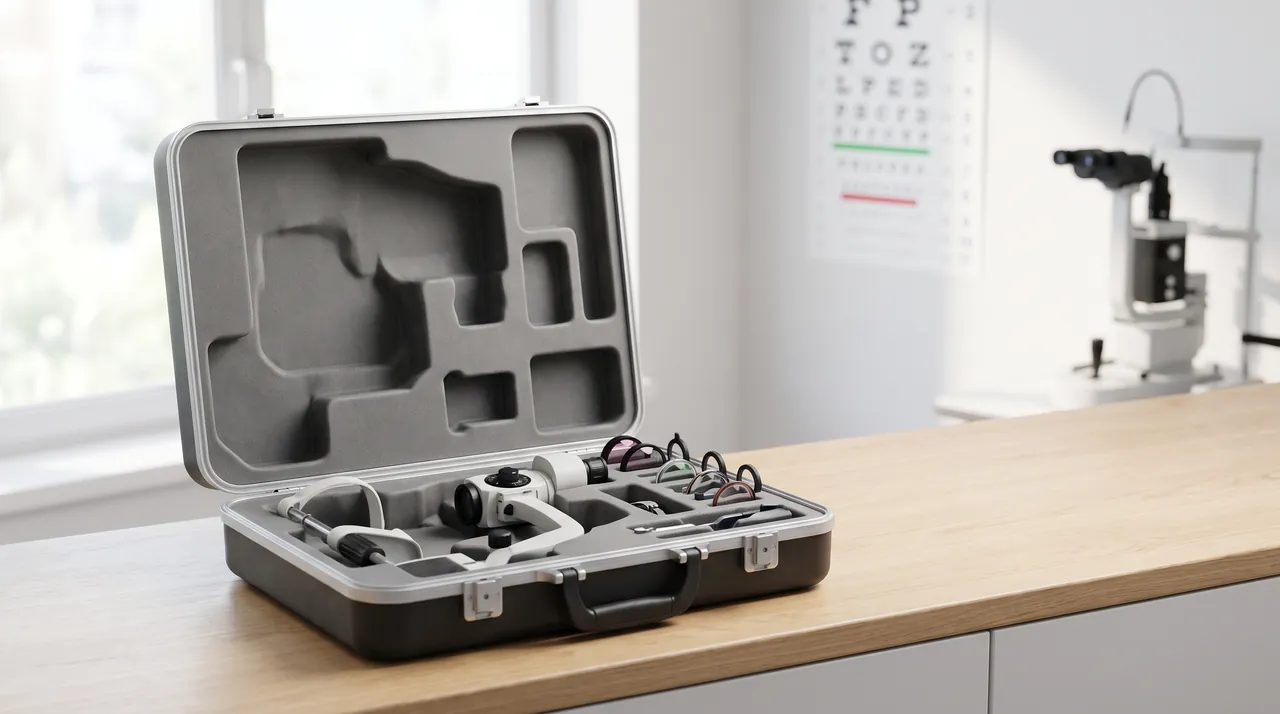
On long routes with multiple transfer nodes, a quick check at each node is worthwhile: strap tension, case displacement, humidity indicator status and seal integrity. The action is cheap, and it sharply reduces the chance of discovering a problem only at the destination.
Failure Modes and Engineering Countermeasures
Systematising field feedback is the most direct way to improve the reliability of the next production batch. The table below summarises common failure phenomena, likely root causes and engineering countermeasures for forensic equipment cases.
Table 3. Common failure modes and engineering countermeasures
| Failure phenomenon | Likely root cause | Engineering countermeasure |
|---|---|---|
| --- | --- | --- |
| Deformed tool tips | Loose pocket, tool slides along channel | Three-face restraint, narrowed throat, lid preload |
| Damp swabs | Insufficient compartment sealing, saturated desiccant | Independent IP67 compartment, desiccant sized to volume |
| Partially lifted seal | Liner compression, shallow channel | Dedicated flat channel, 1 mm clearance, smooth walls |
| Instrument fails to start | Vibration shifts optics or loosens connectors | Elastic suspension, support area scaled to mass |
| Internal condensation | No pressure equalisation, day-night cycling | Fit breathable waterproof valve, add indicator card |
| Hardware corrosion | Seal failure or disinfectant residue | 316 stainless steel, defined disinfectant list |
| Liner collapse | Long-term stacking creep, wrong density | Load path through shell, specified stack tiers |
| Label detachment | Ink not solvent resistant, adhesive failure | Laser etching or solvent-resistant ink |
Each row should map to a specific drawing dimension, material grade and acceptance test during design review, rather than remaining a textual requirement.
Customisation, OEM/ODM and Documentation
Forensic case specifications depend heavily on the user's equipment list and workflow, so a standard product usually needs customisation of liner, partitions, markings and accessories. A typical process begins with the equipment list and dimensional survey, moves through liner design, sample build, drop and vibration verification, then to pilot production and batch acceptance. For units with specific procedural needs, the case can reserve a charging bay for instruments, a seal storage area, a sleeve for record forms and a spare consumables bay. Cooperation models are described in OEM and ODM Custom Protective Cases, and a practical checklist for proving process feasibility appears in Protective Case Sampling and Approval.
Accompanying documentation is often underestimated, yet for a forensic unit it matters as much as the case body. Suggested deliverables include a packing list with pocket map, liner material description, sealing level and test reports, cleaning and disinfection instructions, seal usage and replacement guidance, and a maintenance interval schedule. Documents should be sealed in a waterproof sleeve fixed inside the lid so that they never mix with evidence.
Frequently Asked Questions FAQ
Q: Why does a forensic laboratory need a dedicated protective case instead of an ordinary toolbox or a general transport box?
A: The cost of failure is not uniform in forensic work. An ordinary toolbox is designed mainly to carry and shield tools, and its interior is typically one open space with little awareness of protecting trace evidence. In a forensic setting, however, collected specimens and unused equipment must be physically separated, swab consumables are extremely moisture sensitive, and the tamper-evident seal on an evidence container is vulnerable to compression and creasing. No ordinary toolbox structure satisfies all of these at once. A dedicated case breaks the need into four verifiable dimensions: zoning, sealing, cushioning and traceability, so that after every transfer both the state of the equipment and the identity of the evidence can be checked. Just as importantly, a dedicated case fixes the packing sequence and pocket numbering so that different officers hand over consistently, reducing failures caused by individual packing habits. That consistency is precisely what makes a later audit possible, at a point when nobody still remembers how a particular case was packed.
Q: How should sampling swabs and applicators be protected against moisture inside a case?
A: Moisture control should be layered rather than relying on a single desiccant sachet. First, swabs normally ship in sealed batch pouches and should stay in that original packaging until use, rather than being opened early. Second, place the swabs in an independent sealed compartment separated from other equipment, because metal tools can carry condensation into the same space. Third, dose silica gel or molecular sieve to the free volume of that compartment and add a humidity indicator card so that on arrival the relative humidity can be read directly against a limit. Fourth, understand that desiccant is not a substitute for sealing. If the compartment never reaches its design sealing level, external moist air keeps replenishing the interior and the desiccant saturates quickly. The correct order is therefore to verify sealing first, then add drying and indication, and finally to write the humidity limit into the acceptance criteria. A common field mistake is to keep adding desiccant to a compartment that is quietly leaking air.
Q: How should tamper-evident seals be secured inside the case so they are not damaged in transit?
A: The key requirement is flat storage with no compression and no contact between the seal and hard edges. Provide a dedicated flat channel in the liner, roughly one millimetre deeper than the seal thickness, with the inner walls smoothed and edges sealed so that burrs cannot score the seal surface or its adhesive layer. A sealed evidence container should be packed with the seal facing upward, and the plane carrying the seal must not touch the hard edge of an adjacent container or any metal item. Where necessary, separate containers with a thin EVA divider. Do not stack multiple seals in one channel, since the accumulated pressure can cause partial lifting, particularly at elevated temperature. Before delivery, confirm through simulated transport testing that seals remain intact after handling, and add seal integrity to the handover checklist so that problems surface at the point of transfer. Replacing a damaged seal in the field is never neutral, because the replacement itself has to be documented.
Q: How should IP65 and IP67 be chosen for forensic scenarios?
A: The choice follows actual exposure conditions rather than a simple comparison of numbers. If the case only travels inside a sheltered vehicle, or only faces rain wash and wake spray, IP65 usually suffices. Where wading transfers, flooded roads, long sea freight in high humidity or brief immersion on site are possible, IP67 should be the target, because the case often holds paper evidence bags and swabs whose damage is effectively irreversible. Two further points matter. Sealing level is a whole-case rating: latches, the pressure equalisation valve, seams and cable exits can all become weak points and must be assessed together. In addition, gasket material must be compatible with the disinfectants used on site, since repeated wiping accelerates ageing and eventually breaks the seal. The rating, the gasket material and the disinfectant list should be written into the technical requirement as a single package. Testing the assembled case, not only the gasket, is the only way to confirm the rating that actually reaches the field.
Q: How can sampling tools and a portable analyser be accommodated within a limited internal volume?
A: The core approach is to allocate space using two axes, impact sensitivity and frequency of use, rather than placing items by size alone. Instruments with high impact sensitivity should sit close to the case centre of gravity and be held in elastic suspension with a compressible gap on all sides. Frequently used sampling tools belong in shallow pockets that can be reached as soon as the case opens, reducing search time. A continuous foam layer or divider should separate the two groups so that a tool cannot strike an instrument housing during an impact. If space is genuinely tight, move low-frequency spares and consumables to a secondary case or side bay, keeping only the essential on-scene configuration in the main case. That reduces both the total mass and the internal conflict between zones. After design, verify the fully loaded configuration through drop and vibration testing. A layout that looks balanced on paper can still shift once the consumables are packed at full working weight.
Q: What should be done when the humidity indicator card inside the case reads above its limit?
A: A reading above the limit means humidity in the case or in one compartment has exceeded the set threshold, and the response should be graded rather than an immediate finding that evidence has failed. First, confirm which compartment the card represents, how far above the limit the reading is, and how long the condition has persisted, comparing against the record made at packing time to judge whether this was gradual accumulation or a single event. Next, inspect the sealing state, focusing on whether the gasket shows compression set, whether the pressure equalisation valve is blocked and whether all latches are fully closed, since most excursions stem from seal failure or saturated desiccant. For equipment, items can usually be dried to manufacturer requirements and reassessed for usability. For swabs and consumables, treat moisture exposure as failure and replace them rather than using them. For sealed evidence, follow institutional procedure, document the assessment fully, and never continue the chain on appearance alone. The indicator card is a screening tool rather than a verdict, and its limit should be set against the specimen types the unit actually handles.
Q: Could the liner material shed particles and contaminate evidence?
A: This is a risk that must be assessed in advance for forensic work. Shedding comes mainly from three sources: low-density open-cell foam releasing debris after repeated abrasion, adhesive layers behind stick-on liners ageing and failing, and unsealed cut faces releasing fibre during opening and closing. Countermeasures include preferring closed-cell or low-shedding foam, heat-sealing or wrapping every cut face, avoiding large double-sided adhesive sheets inside the case in favour of mechanical channels or heat lamination, and adding a replaceable clean liner over any area that directly contacts swabs and evidence containers, changed on a scheduled basis to remove residues. During design review, run a simulated open-and-close test and inspect liner surfaces and pocket bases for visible debris after several hundred cycles, recording the result in the acceptance file so that shedding risk stays within a measurable bound. Ask the supplier which foam grade and which edge treatment are used, because those two choices, more than the case shell, determine whether the interior stays clean.
Q: What factors typically affect the lead time for a custom forensic equipment case?
A: Lead time depends mainly on the complexity of four stages. The first is requirement confirmation, covering the equipment list, dimensional survey, zoning requirements and marking rules; the more complete the list and the fewer the changes, the less rework follows. The second is liner design and tooling: a standard case body combined with a custom liner usually keeps the schedule short, whereas a new shell mould lengthens it considerably because mould design, trial runs and rework are involved. The third is verification testing, since drop, vibration, stacking and environmental cycling all need scheduling, and third-party reports add further time. The fourth is volume and documentation, because batches with barcodes, serial numbers and accompanying documents require extra marking and checking work.
Conclusion and Related Reading
A forensic case proves its worth after every transfer: equipment usable and every specimen identifiable. Zoning, sealing, cushioning, moisture control and traceability form one verifiable protection chain, which JUNZHIJIA supports with custom liners, seals and OEM/ODM production.
Related Reading