

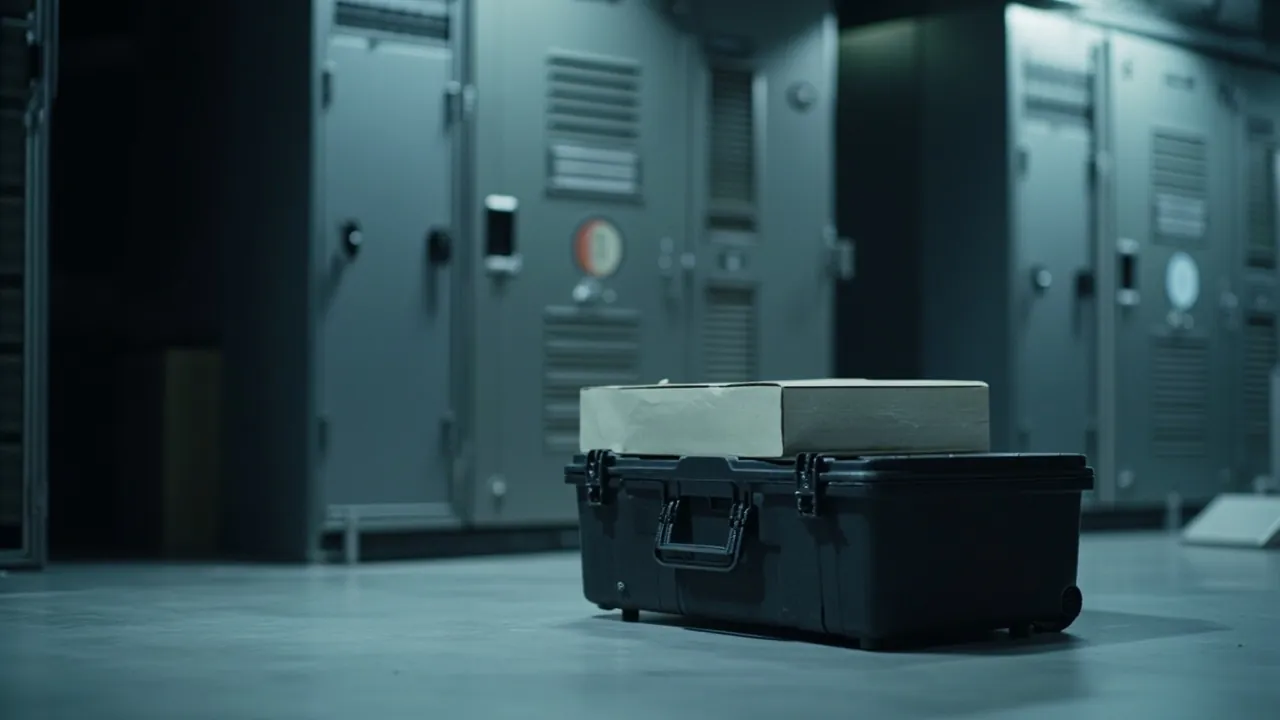
A sealed archive and classified-media transport case is the most composite product in the protective case field: it has to counter fire, water and magnetism, three load types with completely different natures whose protection mechanisms are not interchangeable and in some cases actively conflict. The conclusion first: the design of a sealed archive transport case must satisfy three conditions at once. First, fire protection, meaning that in a fire scenario the internal temperature and humidity must stay within the limits the media can tolerate for the specified duration. Second, moisture protection, because paper archives are extremely humidity-sensitive: high humidity causes mould and hydrolysis, low humidity causes embrittlement, and humidity fluctuation is more damaging than any absolute value. Third, magnetic protection, because magnetic tape, hard drives and some semiconductor media can suffer data erasure or partial demagnetisation in a strong magnetic field. The technical requirements should be built around ISO 11799 document storage requirements, UL 72 fire tests for record protection equipment, the ISO 834 and GB/T 9978.1 fire resistance test methods, ASTM A753 soft magnetic alloys, the IP grades of IEC 60529 / GB/T 4208, ISO 9706 permanent paper requirements, and the transport test methods of ISTA and GB/T 4857.
The characteristic failure pattern for archival media is delayed onset. An industrial device shows damage immediately, whereas damage to archival media is often discovered years later: acid hydrolysis makes paper gradually brittle and yellow over decades, fungal metabolic products leave stains that cannot be removed and continue to corrode the fibres, and partial demagnetisation of magnetic media may affect only a few sectors and only surfaces when those files are next requested. This means the design objective is not that the case looks intact, but that the rate of degradation is held at a negligible level.
Classified media add a further management dimension. Transporting classified media is not only a physical protection problem but a chain-of-custody integrity problem: who handled the media and when, whether the seal was breached, whether seal numbers run in an unbroken sequence. The integrity of that information is often more important than the technical specification of the case itself. The design must therefore incorporate sealing, marking, tamper evidence and handover records as part of the whole solution, not treat them as process matters outside the case.
This article is written for archive custodians and store managers, for staff responsible for classified media, for logistics and security personnel in judicial, prosecutorial and financial archive departments, and for engineering and quality staff at archive furniture suppliers. It sets out the mechanisms of the three threats, the standards framework, material and structural selection, sealing and custody design, and validation methods. It also describes how JUNZHJIA approaches this class of composite protective case and where the collaboration boundaries sit.
Contents
- 1. Three Threats to Archives and Classified Media: Fire, Water and Magnetism
- 2. Standards Framework: ISO 11799, UL 72, DA/T 6 and Custody Requirements
- 3. Fire Scenarios: Fire Ratings, Time-Temperature Curves and Criteria
- 4. Fire-Resistant Structure: Insulation, Intumescent Seals and Thermal Deformation
- 5. Moisture Control: Relative Humidity, Fluctuation and Acid-Free Materials
- 6. Mould, Pests and Pollutant Gases
- 7. Magnetic Shielding: Principles and Shielding Effectiveness
- 8. What Makes Magnetic and Semiconductor Media Different
- 9. Degaussing, Destruction and Media Lifecycle Management
- 10. Sealing, Tamper Evidence and the Custody Chain for Classified Media
- 11. Gasket Systems, Pressure Equalization and Handling Design
- 12. Palletisation, Store Staging and Stacking
- 13. Validation and Acceptance: Fire, Water and Shielding Testing
- 14. Common Misconceptions and Selection Recommendations
- Frequently Asked Questions
- Conclusion and Related Reading
1. Three Threats to Archives and Classified Media: Fire, Water and Magnetism
Threat one: fire. Fire does not damage archives through temperature alone but through a combination of temperature, moisture and smoke. High temperature causes thermal degradation and charring of paper. Water used for suppression causes paper swelling, ink bleeding and mould. Acidic particles and soot in smoke settle on paper surfaces and continue to corrode them. More importantly, even when flame never touches the media directly, a rise in internal temperature is enough to embrittle paper.
Threat two: water. Water sources include rain ingress, burst pipes in the store, firefighting water and condensation. Water damage to paper archives is delayed in effect: soaked paper begins to grow mould within hours, and the damage caused by mould continues even after drying.
Threat three: magnetism. Magnetic media such as tape, hard drives and floppy disks suffer partial or complete demagnetisation in a sufficiently strong external field. Demagnetisation is extremely covert: the media looks intact and the drive still recognises it, but some regions are unreadable and unrecoverable. Strong fields can also affect some semiconductor memory devices.
The interaction between the three threats makes protection harder:
| Interaction | Mechanism | Consequence |
|---|---|---|
| --- | --- | --- |
| Fire to water | Suppression introduces large volumes of water | Burn then soak, composite damage |
| Water to mould | High humidity after soaking | Continuous mould corrosion |
| Fire to seal failure | Heat softens and deforms gaskets | Smoke and moisture enter |
| Shielding to thickness | Shielding layer adds wall thickness and weight | Conflicts with portability |
| Insulation to volume | Insulation consumes internal volume | Conflicts with capacity requirement |
One key insight: the three protection types are structurally interdependent. Thicker insulation improves fire performance but reduces internal volume and increases weight. Magnetic shielding needs high-permeability material, which is both costly and heavy. Tighter sealing increases condensation risk. The design task is therefore not to stack three protections but to find the best combination within a given weight, volume and cost constraint.
2. Standards Framework: ISO 11799, UL 72, DA/T 6 and Custody Requirements
ISO 11799, Information and documentation: document storage requirements for archive and library materials. This standard sets requirements for the storage environment of archive and library materials, covering temperature, relative humidity, air cleanliness, lighting and pest control. Its central idea is stability first: it specifies not only absolute temperature and humidity ranges but emphasises that temperature and humidity should remain stable and avoid frequent fluctuation.
UL 72, Fire resistance tests for record protection equipment. This is the most frequently cited fire test standard for record protection equipment, with classifications named after the maximum permitted internal temperature. Common classes cover paper as the protected medium at a higher temperature class, film and photographic media at an intermediate class, and tape and disk magnetic media at the lowest temperature class. Some classes also add a humidity control requirement to cover the humidity sensitivity of magnetic media. The specific class values and applicable media should always follow the standard text and the project technical agreement.
ISO 834 and GB/T 9978.1 fire resistance test methods. These standards specify fire resistance test methods for building elements under standard fire conditions, and their time-temperature curve is the general basis for fire resistance testing. An archive case's fire design can reference that curve to define the external fire condition, but note that a building element test and a record protection equipment test use different criteria: the former addresses structural load bearing and insulation, the latter addresses internal temperature and humidity limits.
ASTM A753 soft magnetic alloys. This standard covers the classification and properties of nickel-iron soft magnetic alloys such as permalloy-class materials, and is a reference for magnetic shielding material selection.
DA/T 6, Archive furniture. This standard specifies dimensions, materials and technical requirements for archive furniture, with acid-free materials and structural stability among its concerns.
ISO 9706, Paper for documents: requirements for permanence. This standard specifies durability requirements for document paper including alkaline reserve, and is a reference for selecting lining paper in archive packaging.
Custody requirements. The classification, sealing, handover and destruction of classified media follow the applicable management rules and internal procedures. In packaging design, these requirements should be converted into concrete technical clauses: seal installation position, non-restorable tamper evidence, number legibility and record sheet format.
| Standard | Domain | Focus | Relationship to case design |
|---|---|---|---|
| --- | --- | --- | --- |
| ISO 11799 | Document storage environment | Temperature and humidity stability, cleanliness | Sets internal environment targets |
| UL 72 | Record protection equipment | Fire class and internal limits | Directly defines fire criteria |
| ISO 834 / GB/T 9978.1 | Fire resistance test methods | Time-temperature curve | Provides external fire condition |
| ASTM A753 | Soft magnetic alloys | Permeability and classification | Basis for shielding material selection |
| DA/T 6 | Archive furniture | Material and structural requirements | Reference for liners and structure |
| ISO 9706 | Permanent paper | Alkaline reserve, durability | Basis for lining paper selection |
| Custody rules | Classified media management | Seal and handover integrity | Converted into sealing and record clauses |
3. Fire Scenarios: Fire Ratings, Time-Temperature Curves and Criteria
The first step in fire design is being clear about what fire protection actually protects against.
Fire protection does not mean the case survives undamaged. This is the most common misconception. The objective of record protection equipment is not to keep the case intact, but to keep internal temperature and humidity within the limits the media can tolerate under the specified fire duration and external temperature condition. The case itself may be severely deformed or need scrapping after the event, and provided the media inside never exceeded its limits, the equipment has met its design objective.
The role of the time-temperature curve. A standard fire scenario is described by a curve in which external temperature rises rapidly to a peak and is then held for a period. Test duration is one of the dimensions used to classify protection levels, with typical steps of 30 minutes, one hour and two hours.
Three elements of the criterion:
Element one: maximum temperature limit. Media differ greatly in temperature tolerance. Paper can remain usable after brief exposure to higher temperatures, while the critical temperature for magnetic media and film is far lower. This explains why record protection equipment is classified by media type.
Element two: humidity limit. Under high temperature, moisture contained in the case materials is released as vapour and raises internal humidity. For magnetic media and film, a rise in humidity is as fatal as a rise in temperature. Some classes therefore add a humidity control requirement alongside the temperature limit.
Element three: duration. The length of time the limits must be held. Duration requirements relate directly to the application scenario: a store in a city centre with fast fire service response and a remote site with limited firefighting access should not share the same duration requirement.
| Media type | Temperature sensitivity | Humidity sensitivity | Typical protection approach |
|---|---|---|---|
| --- | --- | --- | --- |
| Paper archives | Relatively low | High | Insulation plus dry lining |
| Photographs and film | Medium | High | Intermediate temperature class plus humidity control |
| Magnetic tape | High | High | Lowest temperature class plus humidity control |
| Hard drives and semiconductor media | High | Medium | Lowest temperature class plus shielded cavity |
| Mixed media batch | By the most sensitive item | By the most sensitive item | Design to the strictest requirement |
A practical warning: a mixed media batch should be protected to the level of the most sensitive medium. If a shipment contains paper archives, photographic film and magnetic tape together, the design should be based on the tape requirement rather than the fact that most of the volume is paper. This principle is often overlooked in design reviews yet determines the outcome in a real fire.
4. Fire-Resistant Structure: Insulation, Intumescent Seals and Thermal Deformation
Fire-resistant structure can be broken into four layers.
Layer one: the outer structural layer. This carries mechanical strength and initial fire resistance. Material should have a high melting or decomposition temperature and retain structural integrity at high temperature. A metal shell is a common choice, but metal's thermal conductivity needs attention: if the insulation between inner and outer shells is poorly designed, the metal shell becomes a fast heat conduction path.
Layer two: the insulation layer. This is the heart of fire performance. Its effectiveness depends on thermal conductivity, thickness and continuity of placement. The common approach is to fill the space between inner and outer shells with low-conductivity material while avoiding through-metal thermal bridges. Fasteners, hinges and latches are the main sources of thermal bridging and need isolated treatment.
Layer three: intumescent sealing. The gasket provides airtight and watertight function at ambient temperature, and must expand at high temperature to fill gaps created by thermal deformation. Intumescent seal material expands rapidly in volume when heated, maintaining seal continuity as the structure deforms and thereby blocking smoke and hot gas ingress.
Layer four: internal cushioning and moisture absorption. The layer in direct contact with the media must simultaneously be acid-free, low-outgassing and moisture-buffering. Some designs include an absorbent material inside to take up water vapour released during the high-temperature phase and slow the rise in internal humidity.
Controlling thermal deformation is a frequently overlooked problem. Materials have different expansion coefficients at high temperature, producing relative displacement at structural joints. If the seal design cannot absorb that displacement, gaps form during the most critical later stage of the fire. Design review should include a specific analysis of seal continuity after heating, not merely verification of the seal at ambient temperature.
| Structural layer | Function | Key parameter | Common failure |
|---|---|---|---|
| --- | --- | --- | --- |
| Outer structural layer | Strength and initial fire resistance | Melting point, high-temperature strength | Softening and collapse |
| Insulation layer | Block heat conduction | Conductivity, thickness, continuity | Thermal bridge causing local overheating |
| Intumescent seal | Maintain sealing when hot | Expansion ratio, activation temperature | Expansion timing mismatch |
| Internal cushion and absorber | Protect media, control humidity | Acid-free, low outgassing, absorption | Material outgassing contaminating media |
5. Moisture Control: Relative Humidity, Fluctuation and Acid-Free Materials
Humidity management for paper archives follows a principle that runs against intuition: stability matters more than the absolute value.
Principle one: relative humidity should stay stable within a sensible band. The ideal storage relative humidity for paper archives sits in a mid-range band, neither dry enough to embrittle the paper nor damp enough to trigger hydrolysis and mould. Even more critical than the band is the magnitude of fluctuation: frequent humidity swings make paper repeatedly absorb and release moisture, causing fibre fatigue, dimensional change and cockling. ISO 11799's stability-first philosophy reflects exactly this.
Principle two: three routes to suppress fluctuation. Used together:
- Sealing and barrier. Reducing external moisture ingress is the foundation of fluctuation control.
- Moisture-buffering material. A material with some moisture absorption capacity takes up and releases water, acting as a humidity buffer. This is the physical reason archive packaging uses acid-free moisture-buffering board.
- Desiccant control. Used to control the initial humidity in transport. Desiccant quantity must not be excessive, because an overly low internal relative humidity embrittles paper instead.
Principle three: acid-free material is the baseline requirement. Acidic materials acidify paper through contact and vapour migration, accelerating hydrolysis. Liners, interleaves and labels in direct contact with archives should all be acid-free and carry some alkaline reserve to neutralise acid generated in future.
| Humidity control measure | Mechanism | Key parameter | Caution |
|---|---|---|---|
| --- | --- | --- | --- |
| Gasket system | Block external moisture | Seal continuity and compression | Requires pressure equalization |
| Moisture-buffering material | Absorb and release water | Absorption capacity and response rate | Must be acid-free and replaceable |
| Desiccant | Lower initial humidity | Quantity and target humidity | Avoid over-drying |
| Acid-free lining | Prevent acid migration | pH and alkaline reserve | Material must be confirmed |
| Temperature stability | Reduce condensation and swing | Insulation performance | Works with fire structure |
The coupling between temperature and humidity deserves emphasis. At constant moisture content, a fall in temperature raises relative humidity. Insulation design therefore serves not only fire protection but indirectly humidity control: a case with small temperature swings also has more stable internal relative humidity. That synergy is where the value of composite protection design lies.
6. Mould, Pests and Pollutant Gases
Mould is the primary biological threat to long-term archive preservation. Mould growth needs three conditions: suitable temperature, elevated relative humidity and a nutrient source. Cellulose in paper, binding adhesives, starch paste and some plastic materials can all serve as nutrient sources.
Three points of attack against mould:
Point one: humidity control. Holding relative humidity below the mould growth threshold is the most direct measure. Note that humidity control capability in a transport scenario is limited, which places more reliance on sealing plus desiccant.
Point two: eliminating nutrient sources. Use acid-free liner materials free of starch and protein adhesives. This serves both acid prevention and mould prevention at the same time.
Point three: avoiding introduction of live organisms. Packaging materials can carry spores and pests during storage and transport. Keep packaging materials sealed, treat by fumigation or low temperature where necessary, and inspect visually before use.
Pest protection follows similar logic, the priority being to prevent the packaging material itself from becoming a habitat and transmission route. Paper and wood-based packaging materials carry higher risk; plastic and metal carry lower risk.
Pollutant gases are an easily overlooked threat. Sulphur dioxide, nitrogen oxides, organic acids such as acetic acid, and aldehydes accelerate paper acidification and metal corrosion. Sources include both the external environment and outgassing from the packaging materials themselves. Packaging materials should therefore use low-outgassing formulations. Wood-based materials and some adhesives in particular can release acetic acid in a sealed environment, corroding both archives and metal parts.
| Biological and chemical threat | Trigger | Consequence | Control measure |
|---|---|---|---|
| --- | --- | --- | --- |
| Mould | High humidity plus nutrient | Staining, fibre corrosion, ongoing degradation | Humidity control, acid-free material, clean packaging |
| Pests | Carried in packaging, store environment | Bore holes, debris | Material selection, incoming inspection |
| Pollutant gases | Material outgassing, external environment | Acidification, metal corrosion | Low-outgassing materials, sealing |
| Dust particles | Poor sealing | Abrasion, soiling | Gasket system, clean handling |
| Light | Ultraviolet exposure | Fading, fibre degradation | Opaque outer layer, dark storage |
Light is not a biological threat but matters just as much. Ultraviolet radiation directly damages the molecular structure of cellulose and fades inks. The case should therefore be opaque, liners and interleaves should be light-blocking, and prolonged direct sun exposure should be avoided during transport.
7. Magnetic Shielding: Principles and Shielding Effectiveness
Magnetic shielding has the highest technical threshold of the three protections. Its objective is not to block magnetic fields entirely but to attenuate the internal field to a level insufficient to affect the media data.
Two shielding mechanisms:
Mechanism one: flux diversion through high-permeability material. Such materials, for example nickel-iron soft magnetic alloys, have very high permeability and draw magnetic flux lines into themselves and along the shielding layer, reducing the flux reaching the interior space. Shielding effectiveness relates to material permeability, layer thickness and number of layers.
Mechanism two: eddy current cancellation in high-conductivity material. An alternating field induces eddy currents in a conductor, and the field produced by those eddy currents opposes the applied field, weakening the internal field. This mechanism works for alternating fields and is limited for static fields.
A three-layer structure in engineering practice. High-performance magnetic shielding typically combines several layers of high-permeability material with high-conductivity material, with isolation between layers. Adding layers significantly improves shielding effectiveness but raises weight, cost and manufacturing difficulty.
Shielding effectiveness is expressed in decibels, with higher values indicating greater attenuation. Design should start by establishing the maximum magnetic field strength the media can tolerate and then deriving the required shielding effectiveness, rather than selecting on a higher-is-better basis. This logic mirrors fire design: criteria first, solution second.
Three practical details deserve particular emphasis:
- Openings and gaps are the main leakage paths for magnetic shielding. Shielding effectiveness is extremely sensitive to small holes and seams, so any vent, viewing window or cable passage in the shielded cavity must receive dedicated design work, otherwise local leakage will substantially reduce overall effectiveness.
- The mechanical stress sensitivity of shielding material. Some high-permeability materials lose permeability after bending, impact or manufacturing stress. This means that after a drop, the case's shielding performance may already have degraded with no visible sign. Validation and periodic inspection should therefore include shielding effectiveness re-measurement.
- The shielding layer must form a continuous closed path. Cover plates, seams and fastening methods all affect shielding continuity, so the design should ensure the shielding layer forms a continuous magnetic path when closed.
| Shielding mechanism | Material characteristic | Applicable field | Main limitation |
|---|---|---|---|
| --- | --- | --- | --- |
| Flux diversion | High-permeability soft magnetic alloy | Static and low-frequency fields | Stress sensitive, high cost |
| Eddy current cancellation | High-conductivity metal | Alternating fields | Limited effect on static fields |
| Multilayer composite | High permeability alternating with high conductivity | Broad frequency range | Weight and process complexity |
| Active compensation | Sensing plus opposing field | Specific scenarios | Requires power, system complexity |
For how shielding structures integrate with case bodies, see the discussion of shielding layers and structural coordination in ESD shield case design.
8. What Makes Magnetic and Semiconductor Media Different
Not all digital media are the same. Understanding the differences determines the correct protection level.
Magnetic tape. Tape records data by magnetising particles, with relatively low coercivity, making it sensitive to external fields, and it is also sensitive to temperature and humidity. Tape has an additional risk called print-through, where adjacent layers influence each other magnetically, and this is worsened by long storage at elevated temperature.
Hard disk drives. HDD recording density is high and the magnetic domains are small, making them more sensitive to stray fields. An HDD is also a precision mechanism, sensitive to vibration and shock, with an extremely small head-to-platter gap, so a shock can damage the head or scratch the platter. HDD transport therefore needs both magnetic and vibration protection.
Solid-state media such as SSDs, flash and USB drives. These store charge, are generally unaffected by ordinary magnetic fields, but are sensitive to electrostatic discharge and suffer from data retention decay over time. High temperature also accelerates charge leakage. The protection focus for solid-state media is therefore ESD, temperature, humidity and mechanical shock, not magnetic shielding.
Optical discs. Insensitive to magnetic fields, but sensitive to scratches, ultraviolet light and temperature and humidity change.
| Media type | Magnetic sensitivity | Temperature and humidity | Mechanical | ESD | Protection focus |
|---|---|---|---|---|---|
| --- | --- | --- | --- | --- | --- |
| Magnetic tape | High | High | Medium | Medium | Shielding plus temperature and humidity control |
| Hard disk | High | Medium | High | Medium | Shielding plus vibration protection |
| Solid-state media | Low | Medium | Low | High | ESD, temperature, moisture |
| Optical disc | Low | Medium | Medium | Low | Scratch, light and humidity control |
| Paper archive | Low | High | Low | Low | Humidity, fire, acid-free |
| Photographic film | Low | High | Low | Low | Temperature and humidity, light blocking |
How to handle mixed media. When a batch contains several media types, the solution should be set by the most sensitive dimension, while accounting for conflicts between protection measures. For example, a magnetic shielding layer adds wall thickness and therefore affects insulation and capacity, and ESD dissipative material and a shielding layer need structural isolation from each other. This kind of multi-objective optimisation is precisely what makes composite protective case design difficult, and it is the reason early and deep collaboration with the supplier matters.
9. Degaussing, Destruction and Media Lifecycle Management
A magnetic field is both a threat and a management tool. In classified media management, degaussing is used to render data on magnetic media unrecoverable.
Three distinct things need separating:
First: magnetic protection during transport. The objective is to prevent data from being damaged or read, a protective function.
Second: degaussing at end of life. The objective is to make data unrecoverable, a destruction function. The effectiveness of degaussing is usually assessed by residual magnetic flux density or residual signal level, with verifiable criteria.
Third: physical destruction. For solid-state media and some highly sensitive scenarios, physical destruction such as shredding or melting is often more reliable than degaussing. Solid-state media cannot be erased by degaussing, and some magnetic media may retain recoverable information if degaussing is incomplete.
Three implications for case design:
- If a case must also serve as a carrier for degaussing operations, it must not contain ferromagnetic parts, which would disturb the uniformity of the degaussing field and could themselves become magnetised.
- If a case is used to move media to a destruction site, the design should include a not-openable-in-transit sealing requirement and handover records.
- If a case is used to stage media awaiting destruction, the magnetic environment requirements and access control process for that area must be defined.
| Disposal method | Applicable media | Effectiveness criterion | Impact on case design |
|---|---|---|---|
| --- | --- | --- | --- |
| Degaussing | Tape, hard disks and other magnetic media | Residual signal level | No ferromagnetic parts in the case |
| Physical shredding | Solid-state media, optical discs, paper | Maximum particle size | Must contain debris |
| Melting | Metal and semiconductor devices | Structure unrecoverable | Not a case design issue |
| High-temperature incineration | Paper archives | Complete carbonisation | Requires permits and dedicated containers |
| Data overwriting | Rewritable media | Overwrite passes and verification | Requires power and operating conditions |
An important practical note: degaussing equipment and case compatibility must be verified in advance. If the case contains ferromagnetic fasteners, latches or shielding layers, placing it in a degausser can cause two problems: the case may shield the degaussing field so that erasure is incomplete, or the case itself may become magnetised and act as a new field source in later transport. A case used for degaussing operations should therefore use non-ferromagnetic materials, or the media should be removed for degaussing.
10. Sealing, Tamper Evidence and the Custody Chain for Classified Media
For classified media, seal and custody chain integrity is part of the design and not something outside the process.
Three requirements for seal design:
- Non-restorable tamper evidence. The seal or sealing structure should leave an unrestorable trace once opened. Common approaches include single-use destructive seals, numbered seals and tamper-evident labels.
- Unique identity. Every seal should carry a unique number matched one-to-one with a handover sheet. Numbers must be legible, abrasion resistant and must not detach in transit.
- Recordability. The handover record should include seal number, handover time, the people involved, case condition and the result of the contents check.
Design features that support this on the case:
- Seal installation point. A dedicated point should be provided so the seal bridges the joint between lid and body, ensuring any attempt to open the case destroys the seal.
- Seal protection. The seal should not sit in a location exposed to abrasion or impact, otherwise mechanical action in transit can cause accidental damage and a custody dispute.
- Case numbering. The case should carry a unique number, forming a double-numbering system with the seal, so that case identity remains clear if a seal is replaced.
- Visible opening evidence. The gasket and latch system should make it easy to judge whether the case has been opened.
| Design requirement | Objective | Implementation | Verification |
|---|---|---|---|
| --- | --- | --- | --- |
| Non-restorable seal | Prove whether opened | Single-use seal, tamper label | Opening test |
| Unique number | Traceable identity | Seal number plus case number | Record reconciliation |
| Seal protection | Avoid accidental damage | Recess or guard design | Inspection after transport test |
| Handover record | Define responsibility | Handover sheet and contents check | Process audit |
| Contents control | Verifiable contents | Internal manifest pocket or electronic manifest | Periodic count |
On the interaction between seals and latches, see case lock customization options and case hinge and latch sealing systems for the discussion of latch structure and sealing continuity.
11. Gasket Systems, Pressure Equalization and Handling Design
The gasket system serves fire protection, moisture protection and dust protection at the same time, making it the meeting point of composite protection.
Three technical points for sealing:
Point one: gasket face design. The sealing face should have adequate width and compression, consistent all the way around the perimeter. Any local defect in the sealing face becomes a leakage path, so the machining accuracy of the seal groove and the assembly process are critical.
Point two: gasket material selection. The material must tolerate high temperature, humidity and ageing simultaneously. In fire design, the behaviour of the gasket at high temperature, whether softening, shrinking or expanding, directly affects sealing continuity, so it must work together with the intumescent seal structure.
Point three: matching sealing to pressure equalization. A tightly sealed case develops a pressure differential when temperature or ambient pressure changes, and without pressure equalization the differential causes repeated gasket deformation and fatigue and may deform the case structure. The solution is a hydrophobic vent valve that allows gas through while blocking liquid water and particles. For valve selection and installation, see the role and selection of pressure equalization valves.
Handling design. Archive and classified media cases are usually heavy, and handling may involve stairs, lifts and vehicles. The design should consider grip positions, centre of gravity distribution, whether castors are needed, and whether castors compromise sealing and structural integrity. For handling accessory selection, see case wheels and trolley handle design.
The weight-versus-capacity trade-off is a real constraint. Fire insulation and magnetic shielding both add significant weight. In scenarios requiring manual handling, single-case weight often becomes the primary factor limiting the protection level, rather than technical feasibility. The design brief should therefore establish the handling method as an input condition at an early stage.
12. Palletisation, Store Staging and Stacking
In practice a transport case is often not only a transport tool but also a staging container inside the store. This is frequently overlooked at the design stage even though it directly affects shelving and space planning.
Three considerations for palletisation:
- Match standard pallet dimensions. This reduces wasted space and simplifies forklift handling.
- Securing on the pallet. Use locating features or straps, so the case does not move relative to the pallet in transit.
- Stacking pattern. If multiple layers are stacked on a pallet, specify the orientation and avoid putting the seal face at the bottom.
Four requirements for store staging:
- Environmental conditions. The store's temperature and humidity targets should be consistent with the internal requirement, because the case's buffering capacity is finite and long-term staging still depends on the store environment.
- Placement. Avoid direct floor contact, to limit the effect of floor moisture and pipe leaks.
- Light and heat sources. Keep away from windows, radiators and heating pipework.
- Periodic inspection. Cover case appearance, seal condition, tamper seal integrity and humidity indicator readings.
Stacking requirements. The number of layers should be set from case weight, load capacity and shelving conditions. One point deserves emphasis: fire performance depends on structural integrity, and long-term deformation from stacking weakens the structure and therefore the fire performance. Stacking levels should accordingly be set with a safety margin rather than at the ultimate load capacity.
| Stage | Key requirement | Common problem | Measure |
|---|---|---|---|
| --- | --- | --- | --- |
| Palletisation | Match standard pallet | Waste space from mismatch | Fix pallet specification early |
| Securing | No movement in transit | Resting on self-weight only | Locating features or straps |
| Stacking | Correct orientation, limited layers | Seal face pressed at the bottom | Mark the stacking orientation |
| Staging | Controlled environment | Long-term reliance on case buffering | Align store and case requirements |
| Inspection | Periodic condition check | Appearance only, no function | Include shielding and seal re-measurement |
On service life management, see protective case service life assessment for the discussion of gasket and hardware replacement intervals. For archive cases, gaskets and seal-related hardware are the maintenance priority, while degradation of the magnetic shielding layer must be found by re-measurement rather than by eye.
13. Validation and Acceptance: Fire, Water and Shielding Testing
A validation plan should cover all three threats, each with independent criteria.
Fire validation. The objective is to confirm that under the specified fire condition and duration, internal temperature and humidity never exceeded the media limits. Testing should follow the standard method for fire resistance testing of record protection equipment, with the media temperature and humidity limits, test duration and external time-temperature curve all stated. Note that where standards such as ISO 834 or GB/T 9978.1 are cited, their nature as a test method basis should be made clear, and the fire rating should rest on the actual criteria in the test report.
Water and moisture validation. This covers seal integrity testing such as pressure decay, immersion or spray testing, and internal humidity change measurement. For archive cases, humidity inside the case should continue to be monitored after a water test, because a small but continuous ingress is more covert than a single large ingress.
Magnetic shielding validation. This covers shielding effectiveness testing and post-transport re-measurement. Re-measurement is especially important because high-permeability material is stress sensitive and a transport shock may already have degraded shielding performance with no visible sign.
| Validation item | Method | Example criterion | Re-measurement requirement |
|---|---|---|---|
| --- | --- | --- | --- |
| Fire resistance | Internal temperature and humidity recording under standard fire condition | Not exceeding media limits | On structural or material change |
| Seal integrity | Pressure decay or air-tightness test | Within permitted decay | Periodic sampling |
| Water resistance | Immersion or spray test | No internal water ingress | After gasket replacement |
| Internal humidity | Internal humidity record after thermal-humidity cycling | Within target band | Periodic sampling |
| Magnetic shielding | Shielding effectiveness test | Meets media tolerance requirement | After transport and periodically |
| Tamper seal | Opening test and abrasion test | Non-restorable, legible marking | On seal batch change |
| Transport | ISTA or GB/T 4857 program | Structurally sound, no leakage | On design change |
On the correct scope of MIL-STD-810H. If that standard is cited when setting vibration and shock conditions, it should be stated clearly that it is used only as an environmental test method basis and does not imply any military certification. See understanding MIL-STD-810H environmental test methods and transport packaging test procedures and ISTA.
14. Common Misconceptions and Selection Recommendations
Misconception one: fire protection means the case will not burn. The real criterion is whether internal temperature and humidity exceed their limits within the specified duration. A case that is scrapped while the media survives is a design success, not a failure.
Misconception two: stronger magnetic shielding is always better. Establish the media's field tolerance first and derive the required shielding effectiveness from it. Over-design adds unnecessary weight and cost.
Misconception three: validating the seal at ambient temperature only. Different expansion coefficients create gaps when hot, so seal continuity must be verified in the hot condition.
Misconception four: ignoring the stress sensitivity of shielding layers. Shielding effectiveness may degrade after impact with no visible sign, so post-transport re-measurement is required.
Misconception five: rating a mixed media batch by the fact that most of it is paper. Rate by the most sensitive medium, so if any tape is present, the tape requirement governs.
Misconception six: treating the tamper seal as a process issue rather than a design issue. Seal position, protective structure and marking legibility all need to be designed into the case.
Selection recommendation checklist:
- Establish the media types and the most sensitive dimension, and set the protection level baseline from that.
- Define the required fire duration and convert it into a verifiable criterion.
- Design fire protection in four layers: outer structure, insulation, intumescent seal and internal cushion.
- Use acid-free lining material with alkaline reserve, and provide a moisture-buffering layer.
- Establish the field tolerance of the media and the required shielding effectiveness, avoiding both over- and under-design.
- Give dedicated design attention to any opening in the shielded cavity to preserve shielding continuity.
- Design a three-part control scheme of non-restorable sealing, unique numbering and handover records.
- Provide a gasket system, hydrophobic vent valve and humidity indicator card.
- Establish the handling method and a single-case weight limit, and balance protection level against portability.
- Build a validation plan covering fire, water and shielding effectiveness, with defined re-measurement intervals.
On supplier selection. A sealed archive and classified-media transport case spans fire-resistant structure, insulation materials, acid-free liners, magnetic shielding, sealing systems and sealing and marking design, and a single supplier rarely covers every link. During OEM/ODM collaboration, confirm whether the supplier can support structural drawing review, material confirmation, sample fit-up, shielding and sealing integration, and validation coordination. JUNZHJIA provides protective case capabilities covering case structural design, moulded insert and acid-free buffer layer customization, sealing and pressure equalization structures, and sample fit-up and validation records, and its manufacturing system at Kexin New Materials (Guangdong) Co., Ltd. can develop custom solutions by media type and protection level with OEM/ODM supply. For selection methods, see the instrument case selection guide and how to choose a protective case OEM factory.
Frequently Asked Questions
Q: What standard should be used to judge whether an archive transport case is fire resistant? A: The criterion is not whether the case survives, but whether internal temperature and humidity exceed the limits the media can tolerate under the specified fire condition and duration. This is the most common misconception: the design objective of record protection equipment is to save the media inside during a fire, not to save the case. A case that is severely deformed or needs scrapping after the event is a design success provided the media inside remained intact. In engineering practice the fire resistance test method for record protection equipment is normally used as the basis, with classifications named after the maximum permitted internal temperature and differentiated by media type: paper can tolerate higher temperatures, photographic film and photographs somewhat less, and tape and disks have the lowest limits. Some classes also add a humidity control requirement to address the humidity sensitivity of magnetic media. Specific class values, test durations and applicable media should follow the standard text and the project technical agreement. One further reminder: a mixed media batch should be rated by the most sensitive medium, not by volume proportion.
Q: Why can magnetic shielding not simply be made thicker? A: Because magnetic shielding design should start from the media field tolerance and work back, not start from material thickness. The correct logic is to establish the maximum magnetic field strength the media can withstand without data damage, derive the required shielding effectiveness from that, and then select the material and layer combination. Skipping the first step produces one of two errors: under-design, where shielding effectiveness falls short of the actual need, or over-design, where the pursuit of high effectiveness adds substantial wall thickness, weight and cost, compresses internal volume and undermines handling feasibility. Shielding performance is also not a single function of thickness: it depends on permeability, number of layers, interlayer isolation, and the leakage through openings and seams. Seams in particular deserve emphasis, because shielding effectiveness is extremely sensitive to small holes and gaps. Any vent, viewing window or cable passage in the shielded cavity becomes a leakage path and must receive dedicated design and verification work, otherwise local leakage substantially reduces overall effectiveness.
Q: Why does magnetic shielding material need periodic re-measurement? A: Because high-permeability soft magnetic materials are sensitive to mechanical stress. Permeability in these materials falls after bending, impact, vibration or manufacturing stress, and the drop is completely invisible. After a drop, collision or rough handling, the shielding layer may have undergone microscopic plastic deformation or stress redistribution that degrades shielding effectiveness, while the case exterior, gaskets and latches all appear and function normally. Validating shielding effectiveness only at the factory therefore misses an entire class of degradation. A validation plan should specify shielding effectiveness re-measurement after the transport test and on a fixed cycle during service, especially after any significant impact event. The method can be a shielding effectiveness test or magnetic field attenuation measurement, with criteria tied to the media field tolerance. Continuity of the shielding layer should also be confirmed at each re-measurement, since the fastening condition of cover plates and seams affects shielding continuity. Logging each re-measurement against the case serial number builds a performance history that reveals drift before it becomes a data loss event.
Q: For paper archives, is lower humidity always better? A: No. Stability matters more than the absolute value, and over-drying is equally harmful. The ideal storage relative humidity for paper archives sits in a mid-range band: too dry and the paper loses bound water and embrittles, too damp and hydrolysis and mould follow. Even more critical is the magnitude of fluctuation: frequent humidity swings make paper repeatedly absorb and release moisture, causing fibre fatigue, dimensional change and cockling, and this cumulative damage is often more destructive than sitting permanently at the edge of the band. This is why document storage requirements emphasise stability first. Engineering practice uses three routes together to suppress fluctuation: a gasket system to reduce external moisture ingress; moisture-buffering material that absorbs and releases water as a humidity buffer, which is the physical reason archive packaging uses acid-free moisture-buffering board; and desiccant to control initial humidity. One important caution: desiccant quantity must not be excessive, because an overly low internal relative humidity embrittles paper. Temperature and humidity are also coupled, so a case with small temperature swings has more stable internal relative humidity, which means insulation design serves fire and humidity control at once.
Q: How should tamper seals for classified media be designed to be reliable? A: Treat seal design as a design problem rather than a process problem, satisfying non-restorable tamper evidence, unique identity and recordability. Non-restorable evidence means the seal or sealing structure must leave an unrestorable trace once opened, commonly achieved with single-use destructive seals, numbered seals and tamper-evident labels. Unique identity means each seal carries a unique number matched one-to-one with the handover sheet, and that number must be legible, abrasion resistant and must not detach in transit. Recordability means the handover record should include seal number, handover time, the people involved, case condition and the contents check result. Three features need to be designed into the case body. First, a seal installation point arranged so the seal bridges the lid-to-body joint, ensuring any attempt to open destroys it. Second, seal protection, keeping the seal out of locations exposed to abrasion or impact, since mechanical action in transit can cause accidental damage and a custody dispute. Third, case numbering forming a double-numbering system with the seal, so identity remains clear if a seal is replaced. Bring the seal installation point and protective structure into the structural drawings at the design stage rather than attaching them to a finished product.
Q: Do solid-state drives and magnetic tape have the same magnetic field requirements? A: No. The sensitivity dimensions of the two media differ greatly and the protection focus must be designed separately. Magnetic tape records data by magnetising particles, has relatively low coercivity and is sensitive to external fields, and it is also sensitive to temperature and humidity; it additionally suffers print-through, where adjacent layers influence each other magnetically, worsened by high temperature. Hard disks have high recording density and small magnetic domains, making them more sensitive to stray fields, and they are precision mechanisms with an extremely small head-to-platter gap, so they are also highly sensitive to vibration and shock and require both magnetic and vibration protection in transit. Solid-state media store charge, are generally unaffected by ordinary magnetic fields, but are sensitive to electrostatic discharge and suffer data retention decay over time, with high temperature accelerating charge leakage. Their protection focus is therefore ESD, temperature, humidity and mechanical shock, not magnetic shielding. Optical discs are insensitive to magnetic fields but sensitive to scratches, ultraviolet light and temperature and humidity change. When a batch contains several media types, set the solution by the most sensitive dimension and watch for conflicts between measures, for example a shielding layer adding wall thickness that affects insulation and capacity, and ESD dissipative material and shielding layers needing structural isolation.
Q: Does an archive case need a pressure equalization valve? A: Yes, and the need is greater with a high-seal design. The purpose of the gasket system is to reduce moisture and particle ingress, but a fully sealed case has a side effect: a pressure differential develops between inside and outside when temperature or ambient pressure changes. That differential causes two problems: the gasket undergoes repeated deformation leading to fatigue, permanent set and seal failure, and the case structure deforms under the differential, which over time can affect sealing face fit and structural integrity. A hydrophobic vent valve allows gas through while blocking liquid water and particles, so internal cleanliness is preserved while the differential is equalised. Three parameters matter in selection: opening differential, which should match the expected pressure range; venting rate, which should satisfy gas exchange demand under the rate of temperature change; and protection rating, which should be no lower than the case's overall requirement. Mount it where it is unlikely to be struck or to collect water, and make sure the valve is not blocked by liners or labels, since that would defeat the equalisation function. Verify valve patency during validation.
Q: Why is failure in an archive case so hard to detect in time? A: Because damage from all three threats tends to be delayed and covert. On fire protection, after a fire or high-temperature event the performance of gaskets, insulation and intumescent seals may already have degraded while the exterior still looks acceptable. On magnetic shielding, high-permeability material loses permeability after impact, so shielding effectiveness degrades with nothing visible on the case. On moisture protection, a small but continuous ingress is more covert than a single large ingress: the paper may show only slight rippling or minor edge swelling while mould grows slowly. Partial demagnetisation of magnetic media may also affect only some sectors, so the media is recognised normally by a drive and the problem only appears when a specific file is requested. The management recommendation is a three-line inspection system: appearance inspection covering case, gaskets, seals and markings; functional re-measurement covering seal integrity, internal humidity and shielding effectiveness; and contents verification covering the manifest and read sampling, all on fixed cycles. An appearance-only inspection programme cannot cover most of the degradation paths above. For maintenance methods, see how to clean and maintain a protective case.
Q: How do you validate that a sealed archive and classified-media case design is acceptable? A: Establish independent criteria for each of the three threats and validate them in combination. For fire, follow the standard fire resistance test method for record protection equipment, with criteria requiring internal temperature and humidity to remain within the limits of the chosen media for the specified test duration and external time-temperature curve, and note that where standards such as ISO 834 or GB/T 9978.1 are cited, their nature as a test method basis should be made clear. For water and moisture, verify seal integrity by pressure decay combined with immersion or spray testing, and continue monitoring internal humidity after the test, because slow continuous ingress is more covert than a single ingress event. For magnetic shielding, test shielding effectiveness first and re-measure after the transport test to capture the degradation caused by material stress sensitivity. For sealing, run tamper seal opening and abrasion tests to confirm non-restorable evidence and marking durability. For transport, whole packaged product testing can follow an ISTA or GB/T 4857 program, with criteria covering structural soundness, absence of leakage, intact tamper seals and no internal environmental excursion. Where standards such as MIL-STD-810H are cited to set vibration and shock conditions, state clearly that they are used only as an environmental test method basis and do not imply military certification. All validation results should be documented with defined re-measurement intervals.
Conclusion and Related Reading
Designing a sealed archive and classified-media transport case is fundamentally a search for a coordinated solution among three protection mechanisms that are not interchangeable: fire, moisture and magnetism. The core contradiction is that the three protections are structurally interdependent. Thicker insulation compresses capacity and adds weight, a magnetic shielding layer adds wall thickness and cost, tighter sealing raises condensation risk, and single-case weight is itself limited by the handling method. The path forward comes down to four steps: establish the media types and the most sensitive dimension to set the protection baseline; convert the fire duration, humidity band and magnetic field limits into verifiable criteria; design the structure around outer shell plus insulation plus intumescent seal plus internal cushion and absorber, together with layered magnetic shielding, and pair it with a sealing and custody scheme; then validate through a combination of fire, water and shielding effectiveness testing with defined post-transport and periodic re-measurement.
On the supply side, a manufacturer able to cover fire-resistant structural design, insulation and acid-free material provision, shielding integration, sealing system development and validation coordination can materially reduce degradation risk for archival media in transport and staging and improve the completeness of compliance evidence. JUNZHJIA supports protective case customization for archive and classified-media transport, developing case bodies and moulded inserts by media type and protection level, providing acid-free buffer layers and sealing with pressure equalization, and integrating shielding structures, with sample fit-up and validation records. This suits archive furniture channels and professional archive management organisations that need stable long-term supply and OEM/ODM collaboration.
Related Reading