

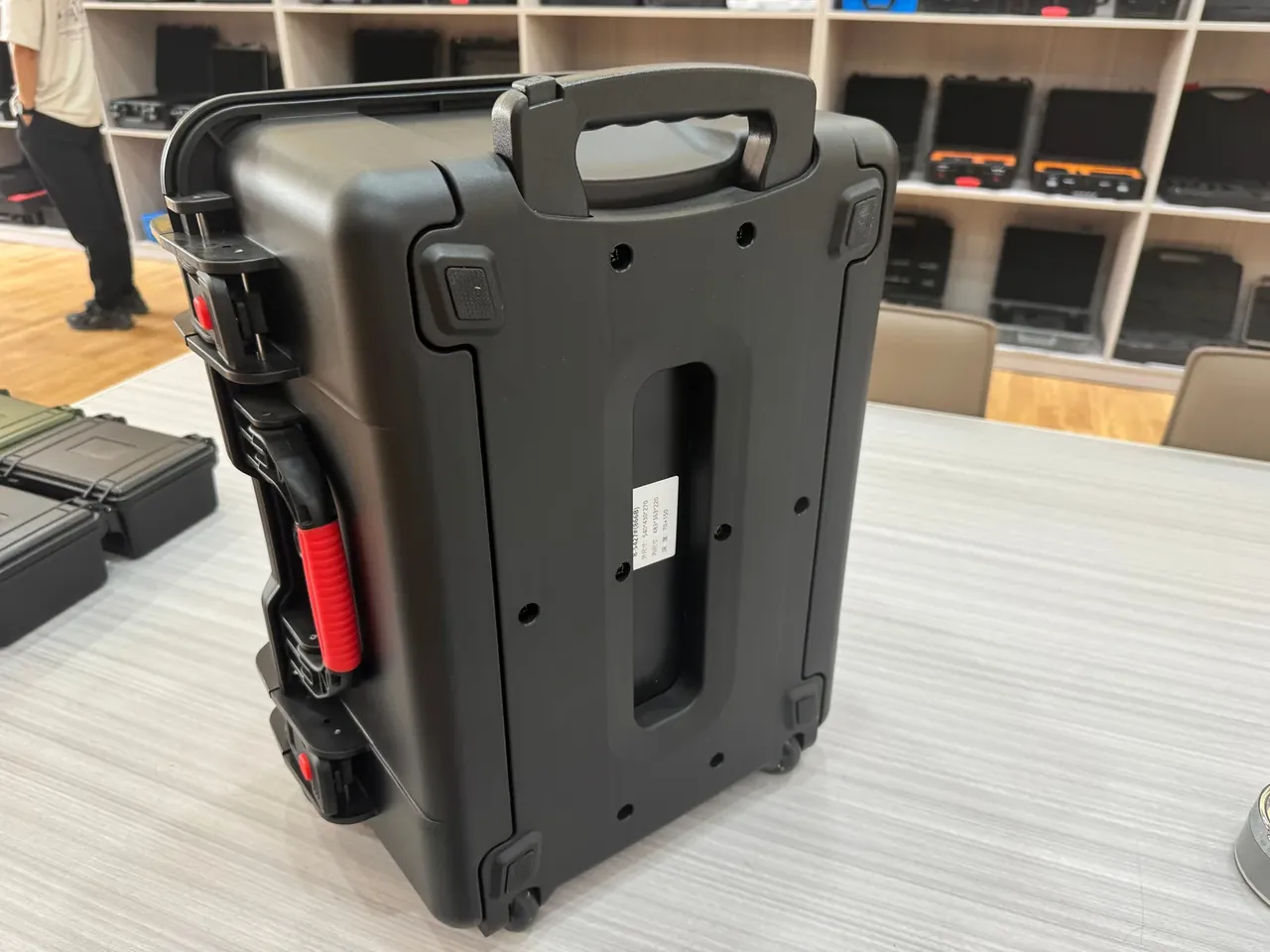
Quick answer: Three sampling rounds hold only when each answers one question: structure, colour, then packaging consistency, on 2, 3 and 5 samples.
Table of contents
- Why sampling rounds are split by question
- Round one: structure and assembly only
- Round two: appearance and colour only
- Round three: packaging and production consistency
- Freeze points that make three rounds enough
- FAQ
1. Why sampling rounds are split by question
A 45-litre case takes three passes, and each may answer one class of question: does the lid close on the body, does the surface survive raking light, is the moulded part the one that was signed off. Run all three in one meeting and the readings contaminate each other.
Tighten the lid gap from 0.5 mm to 0.3 mm and the grain stretches deeper. Push colour one shade darker and melt temperature climbs 10 °C, shrinkage follows, dimensions slide back two weeks. Freeze structure first and the tool needs one gate and one vent change; change both and it sees three revisions, turning 29 days into 41.
| Round | The only question it answers | Frozen at the end | Release test |
|---|---|---|---|
| T1 | Does the case close and assemble | Wall 2.6 mm and rib layout | Both samples assemble, no interference |
| T2 | Does the surface match the colour chips | Three colours and grain depth | ΔE ≤1.2 on all three samples |
| T3 | Is the moulded part the same part | Tool and process parameter sheet | Five samples inside the first-off band |
| Extra | A frozen item was overruled | Freeze value rolled back and logged | Only after a change note is approved |
One release test per round leaves nowhere to hide a maybe.
2. Round one: structure and assembly only
T1 takes 2 samples and 7 days, the only pass where structure may move. What gets measured is closure: lid gap, latch effort, hinge play, cavity against drawing.

Lid gap is checked with feeler gauges at four corners: a 0.25 mm blade enters, a 0.30 mm blade does not. A corner that refuses means look at lid warp before touching the tool. Latch effort sits between 45 N and 70 N; below it the latch opens in transit vibration, above it one hand cannot work it and the crew reaches for a screwdriver.
Wall freezes here at 2.6 mm, tolerance ±0.08 mm, so T2 and T3 read the same section. Move the wall and shrinkage plus flatness move with it, voiding every number collected so far.
The cavity is checked at 20 mm above the base, mid-height and 15 mm below the rim, two readings each, spread capped at 0.6 mm. A wide spot sits opposite the gate. Hinge play is allowed 0.15 mm, beyond which the lid shifts sideways once closed.
3. Round two: appearance and colour only
T2 takes 3 samples and 10 days and accepts no structural complaints. The variables are surface: colour, gloss, grain, weld lines, drag marks.
Three colours are fixed — body, accent, black hardware. Three chips go on the table, master in the middle and one limit either side, compared in a D65 cabinet at 45 cm and 45 degrees. The line is ΔE ≤1.2; anything above returns to the machine.
Gloss is read at 60 degrees, target 12 to 18 GU, on front, side and lid top. A spread above 3 GU points at uneven mould temperature, so check the water circuit first; a new resin lot only moves the deviation to another face.
Grain is 0.08 mm, five points, and a 0.02 mm difference is visible in raking light. At the end of T2 the colours freeze and the three chips are signed into the record.
4. Round three: packaging and production consistency
T3 takes 5 samples and 12 days and tests only whether the moulded part reproduces what the first two rounds froze.

First-off against last-off means the same tool and the same shift: part one and part 500, both measured for lid gap and wall. A difference above 0.1 mm says mould temperature drifted inside the shift. Packaging is trialled at 6 cases per carton, 5-ply board, on a 1200 mm × 1000 mm pallet stacked 3 tiers and kept under 1.5 m.
The tool freezes at T3. A later rib or vent change needs a change note and a fresh round outside the schedule.
5. Freeze points that make three rounds enough
Three rounds freeze three things: wall, colour, tool. They go into one record with five fields — sample ID, frozen value, open issues, owner, release signature.
Open issues are capped at 3 per round. A carried issue changes shape: a gap left at T1 becomes an unreadable colour reading at T2 and a first-off deviation at T3.
| Round | Samples | Duration | Open issues | Cumulative tool changes |
|---|---|---|---|---|
| T1 | 2 | 7 days | 3 | 1 |
| T2 | 3 | 10 days | 3 | 2 |
| T3 | 5 | 12 days | 3 | 3 |
| Total | 10 | 29 days | 9 | 3 |
Two root causes explain most four-round projects. A drawing arrives at T1 with 4 undecided dimensions, so the sample exposes a structural change nobody could freeze. Colour is raised at T3, after the tool has frozen, turning a colour change into a tool change.
Extra rounds are a sequencing failure, not a skill failure. The ceiling is one gate, one vent, one rib; if three revisions do not converge, the missing document is a signed freeze list.
Conclusion
Three rounds work because each is narrow: T1 owns structure and wall, T2 owns appearance and colour, T3 owns packaging and production consistency, and only after all three freeze does the tool become fixed. Ten samples, 29 days and a three-change ceiling are not predictions; they mark where a project can still turn back cheaply. Write the freeze values into five record fields and the process stops depending on who remembers.
This article covers case-side specifications only and does not address any handling, loading or use of the contents.
Related Reading
- From drawing to signed-off sample
- When a sample fee can be refunded
- Five checks on three sample cases
- Trial moulding: first shot, short shot, packing
Related Products
- 8 Series — Gun Cases; Military Equipment Cases; Camera Equipment Cases; Drone Cases; Watch Cases; Knife Cases; First Aid Cases; Electronics Equipment Cases
- WL8-2812 PP Gun Case — model WL8-2812
- All protective cases and toolboxes: 7 series, 158 models