


Quick answer: Tool carrier specifications are worked back from the load list, not picked from a catalogue. Measure the largest envelope and the heaviest item, set the cavity, let the carrying method fix the ratio and handle position, then write walls, weights and tolerances as numbers so two factories build the same unit.
Table of contents
- Tool carrier specifications: working back from the load list
- Rounding rules for envelope and compartment size
- Writing shell and textile specifications
- Load distribution and mounting points
- Hardware selection and the tolerance table
- FAQ
1. Tool carrier specifications: working back from the load list
Lay out one shift's tools, measure the largest in three axes, weigh the heaviest, count pieces per station. Those three numbers start the cavity; skip them and it ends up long but shallow.
| Design input | How to measure | What it fixes | Example |
|---|---|---|---|
| Largest envelope | Callipers, three axes | Net length and depth | 240 mm net, 65 mm deep |
| Pieces per shift | Count per station | Compartments and tiers | Twelve, one tier |
| Heaviest item | Scale, average of three | Base thickness | 2.5 mm |
| Carrying method | Distance and steps | Handle type, ratio | Hand carry, 2.2 to 1 |
2. Rounding rules for envelope and compartment size
Envelope sizes round to what can be carried. Hand-carry bodies run 400 to 520 mm long, 300 to 360 mm wide, under 220 mm high; above that the base catches the calf and the user lifts with two hands.
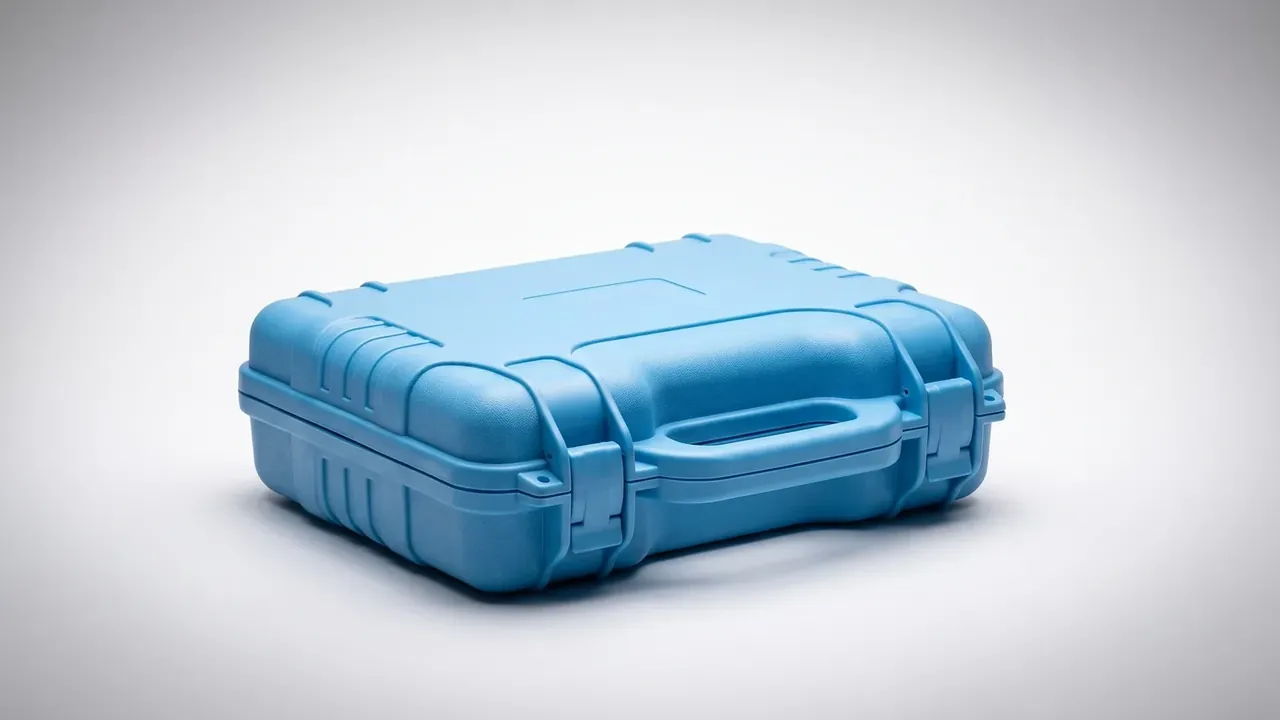
Compartment maths is finer. Net size is the envelope plus 4 to 6 mm per side: under 4 mm a gloved hand cannot extract the tool, over 6 mm it rattles. Divider thickness counts separately, 2.0 mm for moulded ribs and 12 mm for foam, and mixed dividers force the net length to be recalculated.
3. Writing shell and textile specifications
Shell and textile are two languages on one drawing, so they sit in separate columns: the shell states grade, wall, rib and draft; the soft body states cloth, weight and coating. Merged into "thick and durable", neither can be inspected.
| Item | Injection shell | Textile body |
|---|---|---|
| Material | PP homopolymer, MFI 8 g/10 min | 1680D polyester filament |
| Thickness or weight | 3.0 mm wall, 3.5 mm base | 1200 g/m² base cloth |
| Reinforcement | 4.5 mm ribs at 60 mm pitch | Double-row stitch, 6 per 25 mm |
| Surface | Grain, 1.5 degree draft | PU coating 0.15 mm, matt |
| Temperature | −20 to 60 °C | −10 to 55 °C |
Weight and thickness are not interchangeable. At 1200 g/m², 1680D is thicker but softer than 600D, and puncture resistance comes from yarn density; PU at 0.15 mm reaches 150,000 flex cycles against 80,000 at 0.10 mm, but cracks at winter folds.
4. Load distribution and mounting points
Weight leaves a tool carrier by handle or strap, base and side points, and the split decides where ribs and wall go.
On a hand-carry unit the handle takes everything. On a shoulder unit the strap takes the vertical load and the ears the horizontal component, amplified by walking to 1.8 times static.
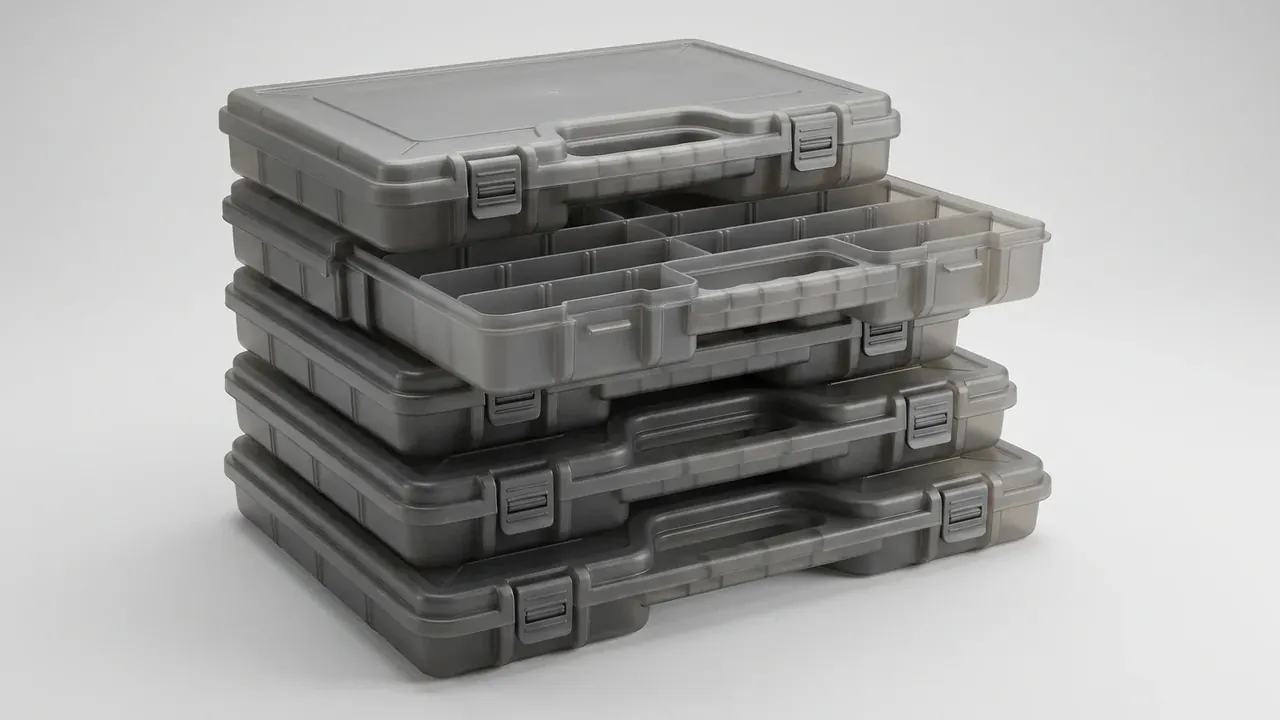
Two rules follow: ears on one side sit 60 percent of body length apart, or the unit sways, and 20 mm from the edge, or the wall tears. Attachments stay under 3 kg per point, mounted over a rib.
5. Hardware selection and the tolerance table
Hardware often collapses into "as per sample". Latches, hinges, handles and locks each need a line: material, plating, breaking force, cycle life. A 304 latch needs 0.8 mm spring steel; 0.6 mm loses thirty percent of its force by 3000 cycles.
| Item | Nominal | Tolerance | Check |
|---|---|---|---|
| Envelope length, width | 480 × 320 mm | ±1.5 mm | Tape, three points |
| Envelope height | 210 mm | ±1.0 mm | Height gauge |
| Compartment width | 62 mm | ±1.0 mm | Callipers, three points |
| Diagonal difference | none | within 2.0 mm | Two diagonals |
| Lid seam gap | none | within 1.2 mm | Feeler gauge |
| Handle hole centres | 260 mm | ±0.8 mm | Dedicated gauge |
Tolerances separate what can be held from what must be: envelope size is the datum, compartment size governs pick-up, diagonal difference decides whether the unit rocks.
Conclusion
Tool carrier specifications multiply four actions: measure the load, fix the cavity, split the paths, lock the tolerances. The first two decide whether the unit works, the last two whether it reproduces, and in numbers a tool carrier becomes a product.
This article covers container-side specifications and design implications only, not the handling, loading or use of the contents.
Related Reading
- What a tool carrier is: formats from hand carry to shoulder carry
- Tool carrier selection: working radius and load split
- Structure and assembly of internal dividers
- Fabric comparison for tool bags
Related Products
- 8 Series — Gun Cases; Military Equipment Cases; Camera Equipment Cases; Drone Cases; Watch Cases; Knife Cases; First Aid Cases; Electronics Equipment Cases
- WL8-2812 PP Gun Case — model WL8-2812
- All protective cases and toolboxes: 7 series, 158 models