

Quick answer: Tool case drawers split three or five ways; loose parts come out 30% faster in five shallow layers, but a 78 mm deep socket only fits 42 mm.
Table of contents
- Counting Retrieval Steps
- Layer Height Sets What Fits
- Slides and Load Distribution
- What the Fifth Drawer Costs in Height
- Matching Drawers to Shift Rhythm
- FAQ
1. Counting Retrieval Steps
Ten minutes before shift change, a 13 mm socket has moved from the top drawer to the bottom. Three-drawer tool case drawers need 2.4 pulls and 22 seconds to recover it; five drawers need 1.6 pulls and 15 seconds.
Count every action: lid, pull, search, close. Twenty-four tools in three layers means 8 per layer, 2.4 pulls and 5.8 steps; over five layers, 4.8 tools per layer gives 1.6 pulls and 4.6 steps. That 1.2-step gap is 7 seconds.
| Item | Three drawers | Time | Five drawers | Time |
|---|---|---|---|---|
| 13 mm standard socket | 5 steps | 19 s | 3 steps | 11 s |
| Hex key set, 8 pieces | 4 steps | 16 s | 3 steps | 10 s |
| 13 mm deep socket, 78 mm | 3 steps | 12 s | 6 steps | 35 s |
| 300 mm torque wrench | 4 steps | 14 s | Lid opens | 48 s |
The gain is visible area. Five tools per layer show everything in one pull; eight tools force about three to be shifted aside before a label appears, and that handling never enters the step count but does enter the clock.
Deep sockets reverse the result. A 42 mm layer cannot take a 78 mm socket, so it sits in the top compartment and costs 6 steps instead of 3.
2. Layer Height Sets What Fits
Tool case drawers with three layers give 75 mm of clear height each; five layers compress that to 42 mm. At 42 mm only standard sockets, hex keys and bit boxes lie flat; at 75 mm a 78 mm deep socket lies flat and a 60 mm driver head stands upright.
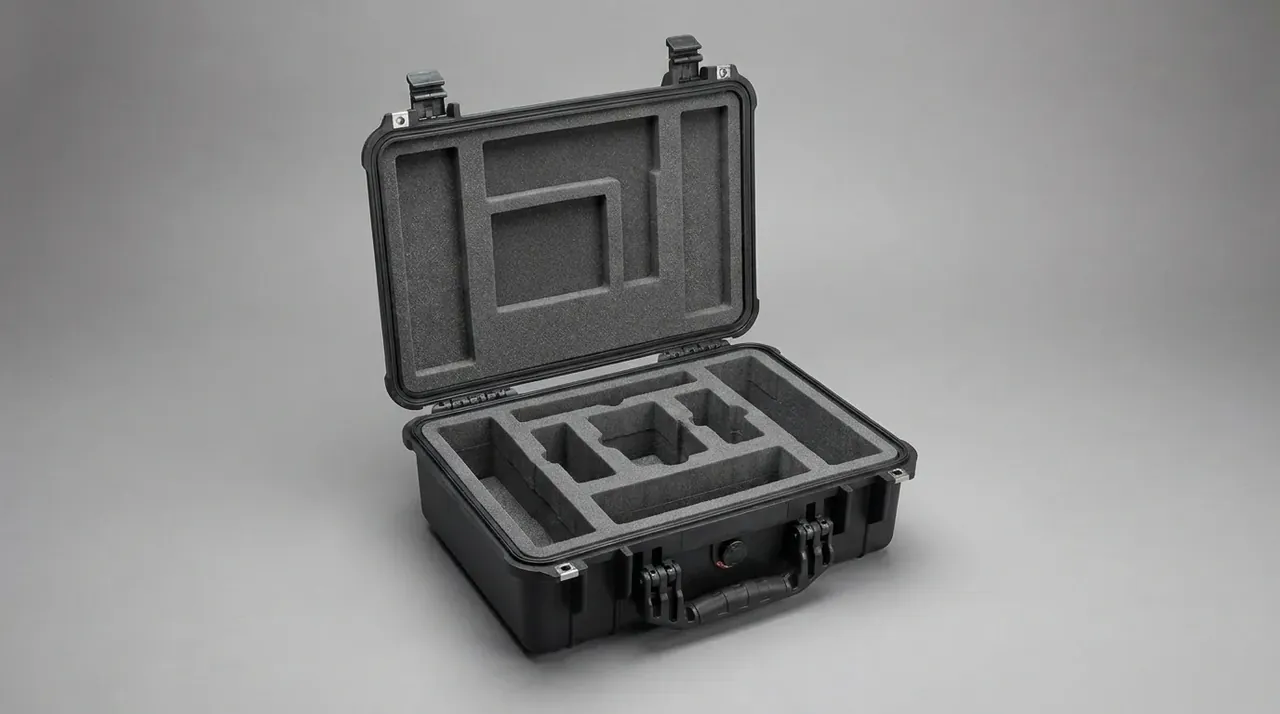
Set height from the tallest resident tool plus 8 mm of clearance: a 78 mm socket needs 86 mm to stand, or 42 mm lying flat plus 80 mm of drawer length.
Five layers need not be equal. A 55 mm top layer over four 35 mm layers adds only 20 mm overall and still carries the deep sockets.
| Clear height | Fits | Does not fit |
|---|---|---|
| 35 mm | Bit boxes, 8 hex keys | 13 mm deep socket |
| 42 mm | Standard sockets, circlip pliers | Driver heads over 60 mm |
| 55 mm | 300 mm torque wrench, flat | Upright socket rail |
| 75 mm | 78 mm deep socket, flat | 500 mm extension bar |
Height converts into count: 42 mm holds 12 standard sockets, 35 mm holds 9, and the two extra drawers barely restore a 24-tool set.
Pocket depth eats height as well. A 15 mm recess with 5 mm walls removes 10 mm of width, while an 8 mm recess in a 75 mm layer gains 12% of flat area.
3. Slides and Load Distribution
Tool case drawers with three layers ride on 350 mm full-extension slides rated 8 kg each; five layers use the same length at 4 kg, because every slide eats 6 mm of layer height.
Load follows gravity, heaviest lowest. Three layers take 10, 8 and 6 kg for 24 kg total; five take 6 kg at the base and 4 kg above for 20 kg, so the same tools lose 4 kg of rating.
Full extension moves the drawer 300 mm forward and tilts a loaded three-drawer case 4°, which calls for anti-tip feet or a 70% load limit.
Slide life scales with count. Five drawers at 120 openings a day over 750 working days reach 90,000 cycles, well past the 50,000 rating of a 25 mm slide, so the specification moves to 35 mm.
| Layout | Clear height | Load per layer | Total load | Case height | Empty weight |
|---|---|---|---|---|---|
| Three drawers | 75 mm | 8 kg | 24 kg | 296 mm | 9.8 kg |
| Five drawers | 42 mm | 4 kg | 20 kg | 323 mm | 11.9 kg |
| Five, mixed | 55 / 35 mm | 6 / 4 kg | 21 kg | 316 mm | 11.2 kg |
Mounting direction moves the rating again. Base-mounted slides carry load through the drawer floor; side mounts load two thin panels and cost 2 kg per layer, which is the trade five-drawer cases make to save height.
4. What the Fifth Drawer Costs in Height
Tool case drawers build to 296 mm in three layers and 323 mm in five. In a 1200 mm van interior, four three-drawer cases reach 1184 mm; four five-drawer cases reach 1292 mm, so only three fit and the payload drops 25%.
Weight climbs with it, 9.8 kg against 11.9 kg. Past 10 kg, forty trips a shift add 84 kg of lifting.
Wear concentrates at the corners. Ground contacts rise from 4 to 6 and corner replacement drops from 4 years to 3.
Posture shifts too: on a 900 mm bench the top drawer of a 323 mm case sits at 1150 mm, trading bending for 12° more shoulder elevation.
The 27 mm buys layering, not volume. Volume comes from length and width; drawer count only decides how tools are arranged.
5. Matching Drawers to Shift Rhythm
Weigh the share of tall items first. Under 10%, five layers of tool case drawers win and loose parts come out 30% faster; between 10% and 30%, a mixed case with a 55 mm top layer; above 30%, three layers, because nothing has to be relocated.
Then intensity. Under 40 picks a shift, 7 seconds is worth 4.7 minutes a day; above 60, the 2.4 minutes saved per shift reaches 10 hours a year.
Pooled cases with drifting tools suit five labelled layers; personal cases with fixed positions suit three deep ones.
Two extra slides take annual checkpoints from 6 to 10 and shorten slide replacement from 3 years to 2.
Conclusion
Put retrieval time on the bench and the trade becomes computable. For 40 picks a shift, 34 on standard tools at 7 seconds saved returns 238 seconds; 6 on deep sockets at 23 seconds lost takes back 138; the net is 100 seconds, about 1.7 minutes a shift, or 7 hours across 250 shifts. That does not repay 2.1 kg of extra carrying weight and 25% less stacking density. Let deep sockets fall to 5% of picks and the net passes 4 minutes a shift, which flips the answer to five drawers. Count the tall items, then the picks per shift, and the three-versus-five question for tool case drawers settles itself.
This article discusses container-side specifications and design implications only, and does not cover any handling, loading or use of the contents.
Related Reading
- How toolbox compartments are laid out
- How to choose a toolbox size
- Height limits for stacked toolboxes
- Where compartmented plastic tool boxes are used
Related Products
- 8 Series — Gun Cases; Military Equipment Cases; Camera Equipment Cases; Drone Cases; Watch Cases; Knife Cases; First Aid Cases; Electronics Equipment Cases
- WL8-2812 PP Gun Case — model WL8-2812
- All protective cases and toolboxes: 7 series, 158 models