

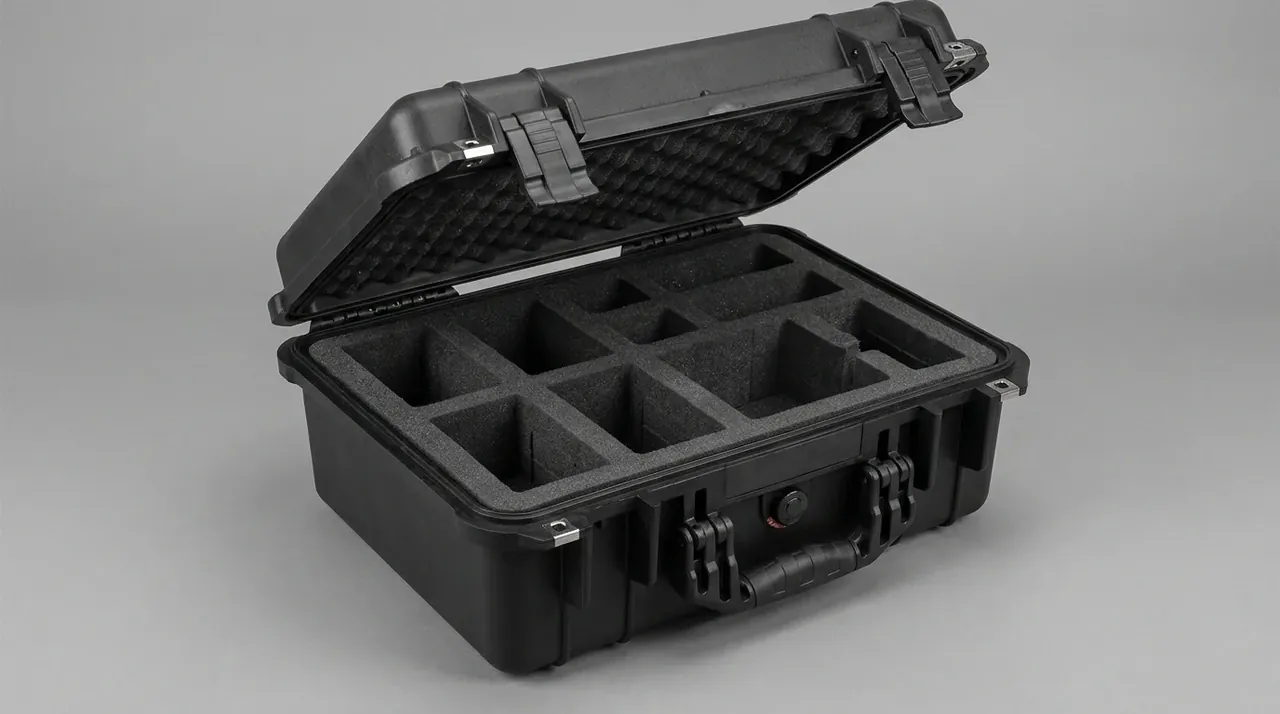
Quick answer: A tool case returns a tool in 6 s where a bag takes 14 s; at 40 reaches a day the gap costs 5 min 20 s, or 21 hours across a 240-day year.
Table of contents
- Where the eight seconds go
- How forty-two tools go back
- Twelve kilos on strap and handle
- Three-high stacking and floor space
- Which trades suit a bag
- FAQ
1. Where the eight seconds go
Same bench, same job: 6 s in a hard case, 14 s in a bag. The gap is not hand speed but where the tool lives. A precut pocket holds one shape, so the fingers stop searching; a bag pocket is fabric on fabric, and the hand parts two layers before it knows the wrench is there.
Split the reach into four stages: open 2 s against 3 s, search 1 s against 8 s, draw 2 s each, return 1 s each.
| Stage | Hard case | Soft bag | Source of the gap |
|---|---|---|---|
| Open (s) | 2 | 3 | One latch against a double zip |
| Search (s) | 1 | 8 | Fixed pocket against overlapping slips |
| Draw (s) | 2 | 2 | No difference |
| Return (s) | 1 | 1 | No difference |
| Total (s) | 6 | 14 | All 8 s sit in search |
Seven of the eight seconds sit in search, so a smoother zip changes nothing and a clearer layout changes everything. At 40 reaches a day that is 320 s, or 5 min 20 s, and 21 hours across 240 working days.
Volume sets the search time. On one set of 42 tools the case mapped 42 pockets one to one and search held at 1 s; the bag offered 9 slips at 4.7 tools each, and search climbed until the 42nd tool took 11 s.
2. How forty-two tools go back
Return is the stage nobody times. Foam cut to the outline accepts one orientation, and a crooked tool stops the lid closing; a bag slip takes a tool at any angle, so a hard shove counts as tidying up.
All 42 tools away took 4 min 10 s with the case and 9 min 30 s with the bag, a gap of 5 min 20 s, for the same reason: an empty tray pocket shows at a glance, while nine slips must be counted one by one.
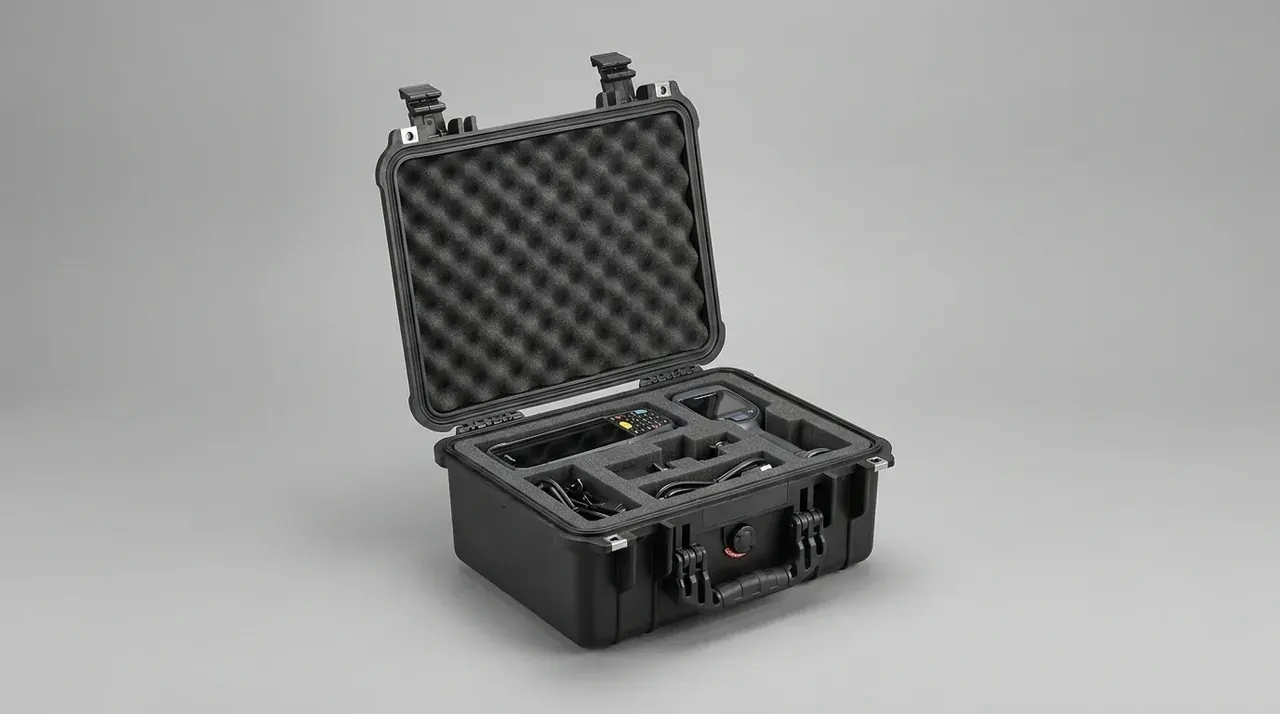
Opening angle decides whether one hand is enough. The lid swings to 180° and lies flat against the back so the wrist never twists; a bag unzips flat, but the sagging fabric leaves under 120° of usable mouth.
Losses are the hidden cost. One empty pocket out of 42 is visible before the shift ends; a missing screwdriver surfaces at the next job. At one loss a quarter and 45 CNY a replacement that is 180 CNY a year, and it never reaches a purchase order.
Durability splits too: two 4 mm stainless pin hinges at the rear corners against one size-8 zip, whose slider carries the highest load at 90° of opening and wears 1.8 times faster when worked half open.
3. Twelve kilos on strap and handle
Twelve kilos is the ordinary load here, and the body reads it very differently on a strap and on a handle: the strap spreads it across the trapezius, the handle drives it into four fingers.
Twelve kilos is 118 N. A 50 mm strap with 120 mm of contact gives 6000 mm², 19.7 kPa on average and a 34 kPa peak 30 mm outside the collarbone; a 28 mm handle with 90 mm of grip gives 2520 mm², 46.8 kPa and a 61 kPa peak.
| Carry mode | Contact area | Mean pressure | Peak pressure | Adjustments in 30 min |
|---|---|---|---|---|
| Bag, single strap | 6000 mm² | 19.7 kPa | 34 kPa | 2 shoulder swaps |
| Bag, both straps | 12000 mm² | 9.8 kPa | 22 kPa | None |
| Case, one hand | 2520 mm² | 46.8 kPa | 61 kPa | 7 hand swaps |
| Case, two hands | 5040 mm² | 23.4 kPa | 39 kPa | 2 hand swaps |
Above 40 kPa the reflex is to swap: over 30 min the single-hand carry swapped 7 times and the strap twice, and every swap breaks the rhythm of reaching a latch.
A wider strap falls under 25 kPa; a handle cannot follow, because 28 mm is near the palm limit. At equal load the peak differs by 27 kPa, which is why a bag holds its own over middle distances.
4. Three-high stacking and floor space
At 560 mm × 350 mm × 230 mm, three cases stack to 690 mm and slide under the 750 mm above a van wheel arch; a bag has no rigid top, so the second layer collapses and the options are hanging or flat.
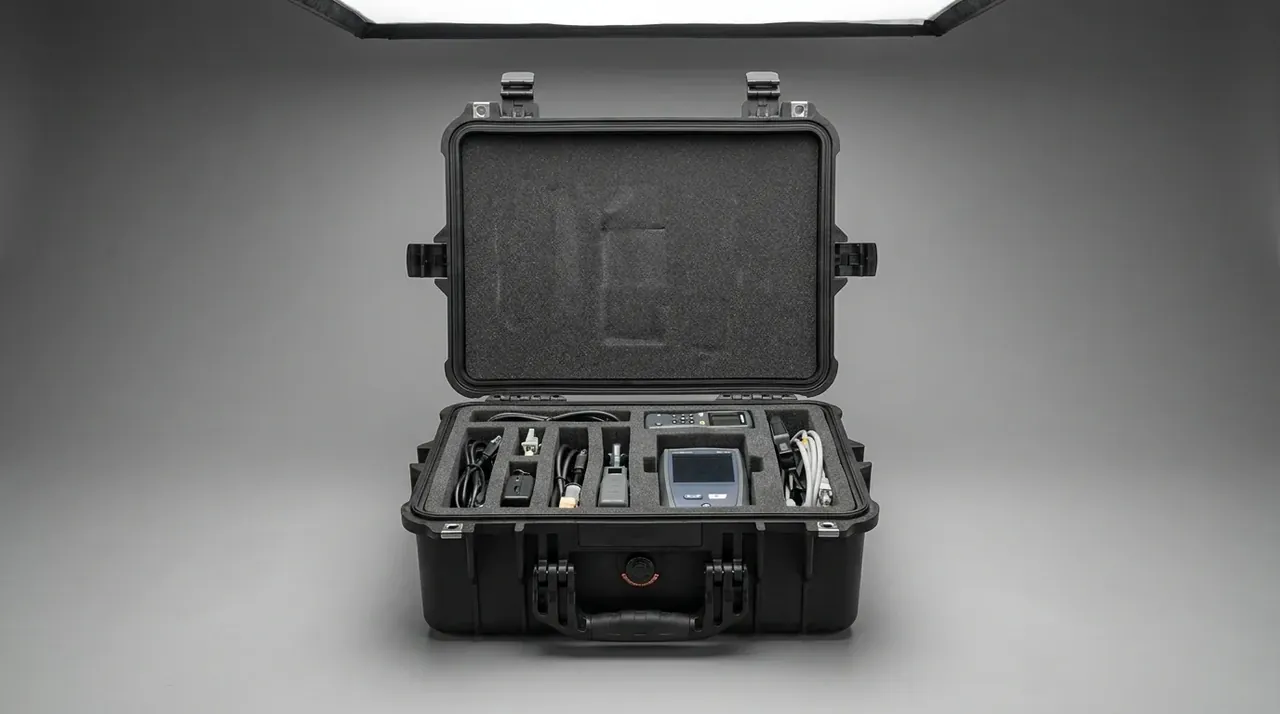
Twelve cases take 0.196 m² each, 2.35 m² in all; twelve bags flat need 4.1 m² and leave no 600 mm aisle, while the stack frees 0.9 m to walk in a 1.8 m body.
Cycle counts separate the two service lives. The case hinges gained 0.2 mm of play after 30,000 openings and its latches still self-locked; the bag zip began catching at 8,000 cycles and its strap stitching pulled at 1.5 years under 12 kg, so five years against 1.5 is 3.3 replacement cycles.
Repetition reverses the price signal: one case covers five years, the bag needs 3.3 units in the same window, and the purchase total overtakes the case.
5. Which trades suit a bag
Three facts decide it, not price: tool count, reaches a day, and whether the hands stay free. Under 12 tools and 20 reaches the bag wins; 30 tools, 40 reaches and a route with a 1.2 m drop or rain leave the case without a substitute.
| Item | Soft bag | Hard case |
|---|---|---|
| Unit price (CNY) | 180 | 558 |
| Reach time a year (h) | 21.3 | 0 |
| Time cost a year (CNY) | 1280 | 0 |
| Service life (years) | 1.5 | 5 |
| Five-year purchase (CNY) | 600 | 558 |
| Five-year total (CNY) | 7000 | 558 |
Trades follow it: cable pulling, low-voltage testing and air-conditioning work live on carrying and free hands, while machining set-ups, mould repair and field service live on tool count and return discipline. One crew often runs both.
Payback has one formula: saved hours turned into money, then the price difference divided by it. Eight seconds times 40 reaches times 240 days is 21.3 h, worth 1280 CNY at 60 CNY an hour, so 378 CNY gives 0.30 years, or 3.5 months.
On price alone 558 CNY against 180 CNY reads as 3.1 times more; add five years of time cost and the columns swap.
Conclusion
The comparison lands on two numbers: 8 s per reach and a 3.1 times price gap. Multiply the 8 s by the real daily reach count and the working days, price the hours at the labour rate, and the annual cost of the bag appears; divide the 378 CNY difference by that figure and payback falls out. At 40 reaches and 60 CNY an hour it is 3.5 months, while at 10 reaches it is 14 months, already close to the 1.5-year life of the bag, so a case then buys return discipline and stacking rather than speed. Draw the line hard: 20 reaches with 30 tools means a case, while 10 reaches with a dozen tools means the bag is enough and the money belongs in dividers.
This article discusses container-side specifications and design implications only, and does not cover any handling, loading or use of the contents.
Related Reading
- Hard case and soft tool bag roles
- Tool bag specifications and checks
- Hard tool case shell and fittings
- Tool bags against other carry formats
Related Products
- 8 Series — Gun Cases; Military Equipment Cases; Camera Equipment Cases; Drone Cases; Watch Cases; Knife Cases; First Aid Cases; Electronics Equipment Cases
- WL8-2812 PP Gun Case — model WL8-2812
- All protective cases and toolboxes: 7 series, 158 models