

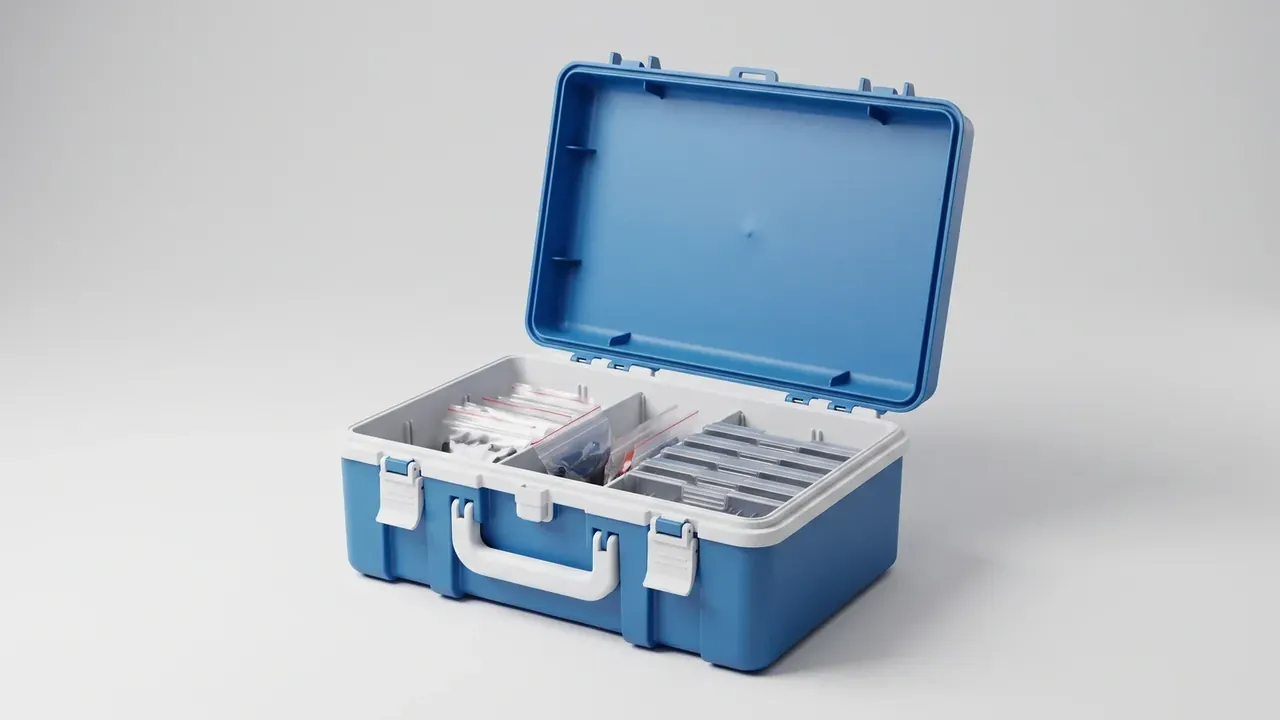
Quick answer: A transit case specification is not three numbers but values that push against each other. Internal size follows the contents, external size the pallet module, wall thickness sets tare and load, and the stacking case rechecks the wall.
Table of contents
- Six Inputs Behind a Transit Case Specification
- Internal and External Dimensions with Tolerances
- Wall Thickness, Tare Weight and Rated Load
- How to Write the Sealing and Dust Rating
- Stacking Pads, Fork Entry and Marking Zones
- FAQ
1. Six Inputs Behind a Transit Case Specification
The usual fault is numbers without measuring points: 600 mm at the rim or at the insert top differs by 20 mm.
| Parameter | How to write it | Example |
|---|---|---|
| Internal size | Clear space, with datum | 600 x 400 x 320 mm |
| External size | Maximum, latches in | 640 x 440 x 360 mm |
| Wall | Side, base, lid | Side 4.0, base 5.5 mm |
| Tare | Without insert | 4.6 kg |
| Rated load | Uniform static, timed | 50 kg, 24 hours |
| Protection | Two digits plus tests | Dust 6, water 5 |
Two inputs often go missing: service temperature and cleaning method.
2. Internal and External Dimensions with Tolerances
Internal size comes from the contents envelope with 5 mm per side: more lets goods shift, less keeps the insert out.
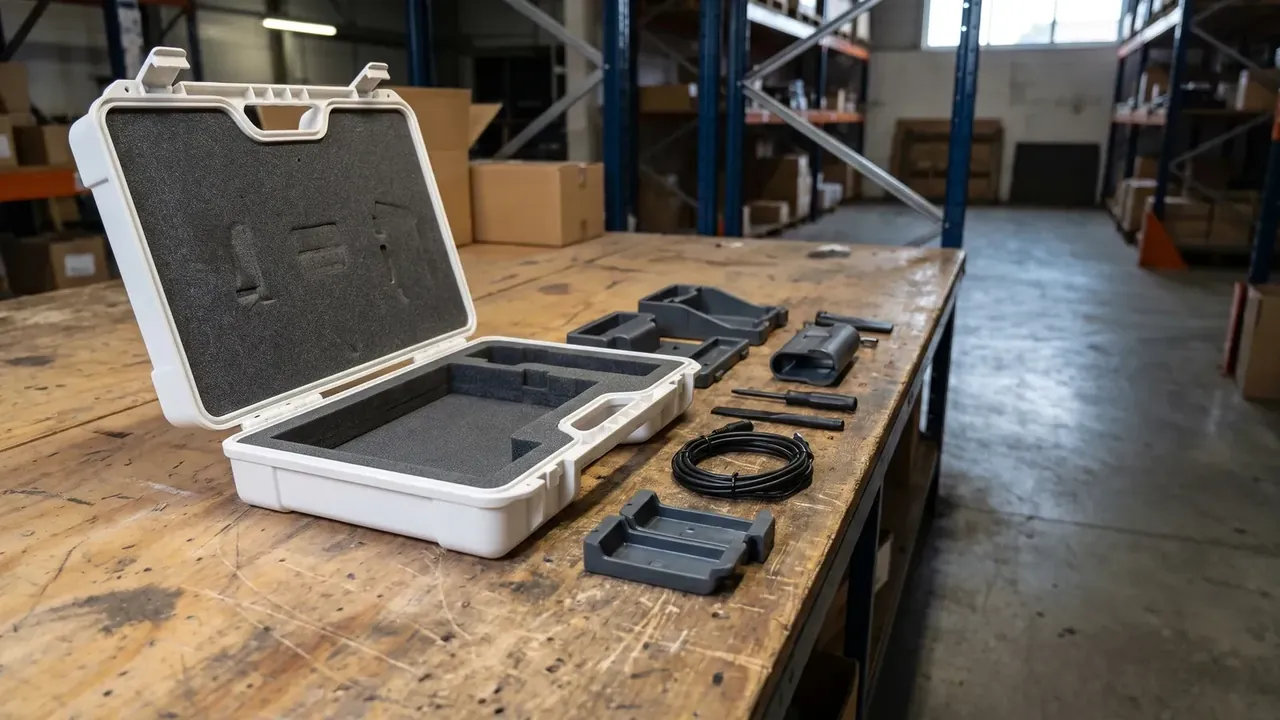
Tolerances run as two sets: plus or minus 2 mm inside for the insert, 3 mm outside for the pallet slot, plus a 3 mm diagonal limit that exposes moulded distortion.
External size is the maximum outline, latches included; a case that jams in a rack usually has 8 mm of hardware outside the drawing. A 1200 x 800 mm pallet takes four 600 x 400 mm footprints, 620 mm only three.
3. Wall Thickness, Tare Weight and Rated Load
Wall thickness sets weight, stiffness and cooling time at once: 3.0 to 4.0 mm on the side adds about 1.8 kg and a dozen seconds of cycle.
| Grade | Wall, side and base | Tare | Rated load | Stacking |
|---|---|---|---|---|
| Light | 3.0 and 4.0 mm | 2.8 kg | 25 kg | 3 high |
| Standard | 4.0 and 5.5 mm | 4.6 kg | 50 kg | 4 high |
| Heavy | 5.5 and 7.0 mm | 7.2 kg | 80 kg | 5 high |
Rated load must state static or concentrated and for how long: 24 hours at a safety factor of 3, tested at triple the rating with no set past 2 mm.
Stack height comes back from the bottom case: four high at 15 kg loads 45 kg, inside the 50 kg grade. Polypropylene softens at 60 degrees Celsius, so open-yard stacking rates at seventy percent.
4. How to Write the Sealing and Dust Rating
A rating is two digits, solids then liquids: dust 5 with water 4, dust 6 with water 5, dust 6 with water 7.
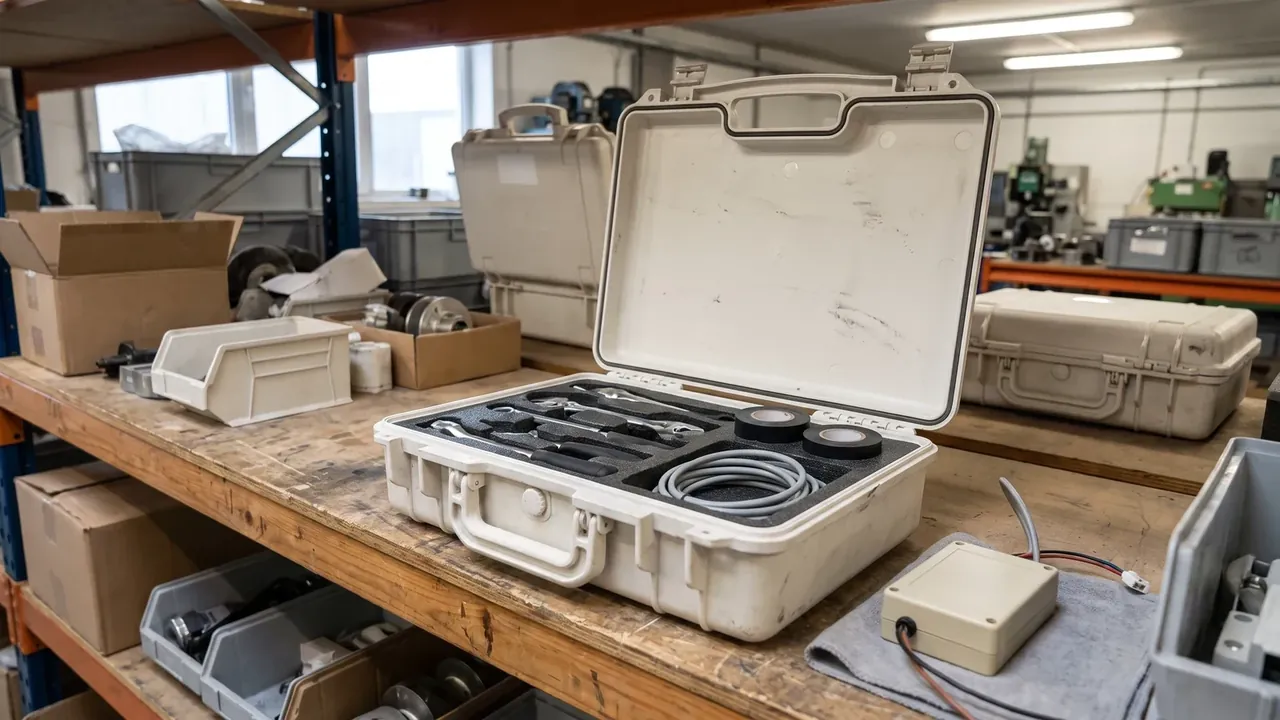
Quoting a rating without test conditions hides the risk: dust 6 is eight hours in a talcum chamber, water 5 is 12.5 litres per minute at 3 metres for 3 minutes, water 7 is immersion at 1 metre for 30 minutes.
Only two features deliver the rating: gasket compression of at least 25 percent and latch spacing no wider than 200 mm. Widen the spacing and the rim lifts between latches.
5. Stacking Pads, Fork Entry and Marking Zones
A lid groove meets a base rib, tight enough to hold, loose enough not to bind in cold.
| Interface | Size | Tolerance | Check |
|---|---|---|---|
| Stacking groove | 12 x 8 mm | 0.5 to 1 mm | Three-high offset stack |
| Fork entry | 200 x 100 mm | Height plus or minus 3 mm | Forks two thirds deep |
| Marking zone | 120 x 80 mm | 30 mm below top | Clears parting line |
The 100 mm entry covers a 45 mm blade plus clearance; the roof carries the load, so fork cases are checked at 1.25 times the rating.
Marking zones stay clear of the parting line, since a label across it splits. Keep two faces, so a turned transit case still shows one.
Conclusion
A specification is ordered constraints: contents set internal size, the pallet external size, load the wall, and the stacking case checks both.
Tolerances and test conditions are the least visible lines and the first tested. Write the datum, the diagonal and the pass criterion, and a transit case becomes deliverable.
This article discusses only the container (case body) side of specifications and design intent, and does not cover any handling, loading or use of the contents.
Related Reading
- Transit case role in a logistics chain
- Transit case configurations by site
- Stacking design: load, interlock and stability
- Protective case size ranges from small to large
Related Products
- 8 Series — Gun Cases; Military Equipment Cases; Camera Equipment Cases; Drone Cases; Watch Cases; Knife Cases; First Aid Cases; Electronics Equipment Cases
- WL8-2812 PP Gun Case — model WL8-2812
- All protective cases and toolboxes: 7 series, 158 models