

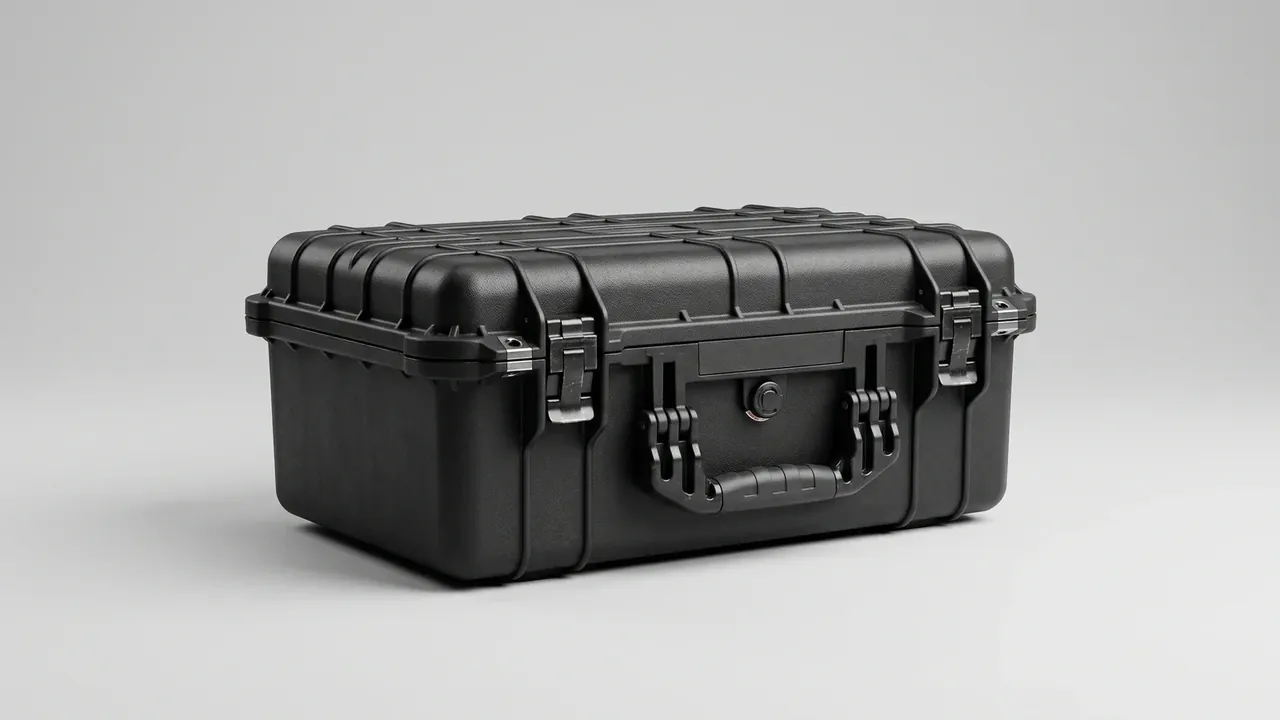
Quick answer: Secondary Protection in Transit pairs film with corners: 20–23 μm LLDPE at 150–250% pre-stretch, and EPE corners that cut a 0.8 m drop from 120 g to 65 g.
Table of contents
- What secondary protection has to stop
- Stretch film: thickness and pre-stretch
- Corner protectors and strapping
- Pallets, stacking and moisture
- FAQ
1. What secondary protection has to stop
Factory packing keeps a case from falling apart; secondary protection keeps other freight from damaging it inside the trailer. Three mechanisms do harm: corner impact in handling, vibration rubbing in transit, and condensation from day-night temperature swings. Each needs a different material.
Corners are the weakest point on a moulded case. In a 0.8 m corner drop a bare case records 120 g of impact acceleration; with EPE corners fitted it records 65 g, close to half. The gain comes from turning point contact into area contact, not from foam thickness.
Rubbing comes second. Trailer floors are checker plate, and a base at 80 km/h shifts 2–5 mm back and forth; over 600 km in a day the ribs polish 0.3 mm deep. That thins the rib section, and the next drop deforms from there.
Condensation is third and most overlooked: a 15 °C interior swing condenses moisture on the lid, which runs down the gasket line. Damage splits about 60% corners, 20% rubbing and under 10% whitening, so spend in that order.
2. Stretch film: thickness and pre-stretch
Secondary Protection in Transit begins with film: 20–23 μm LLDPE at 150–250% pre-stretch, 50% overlap, two to three layers on the body and four at each corner. Below 20 μm the film whitens once stretched, and the next pull tears along it.
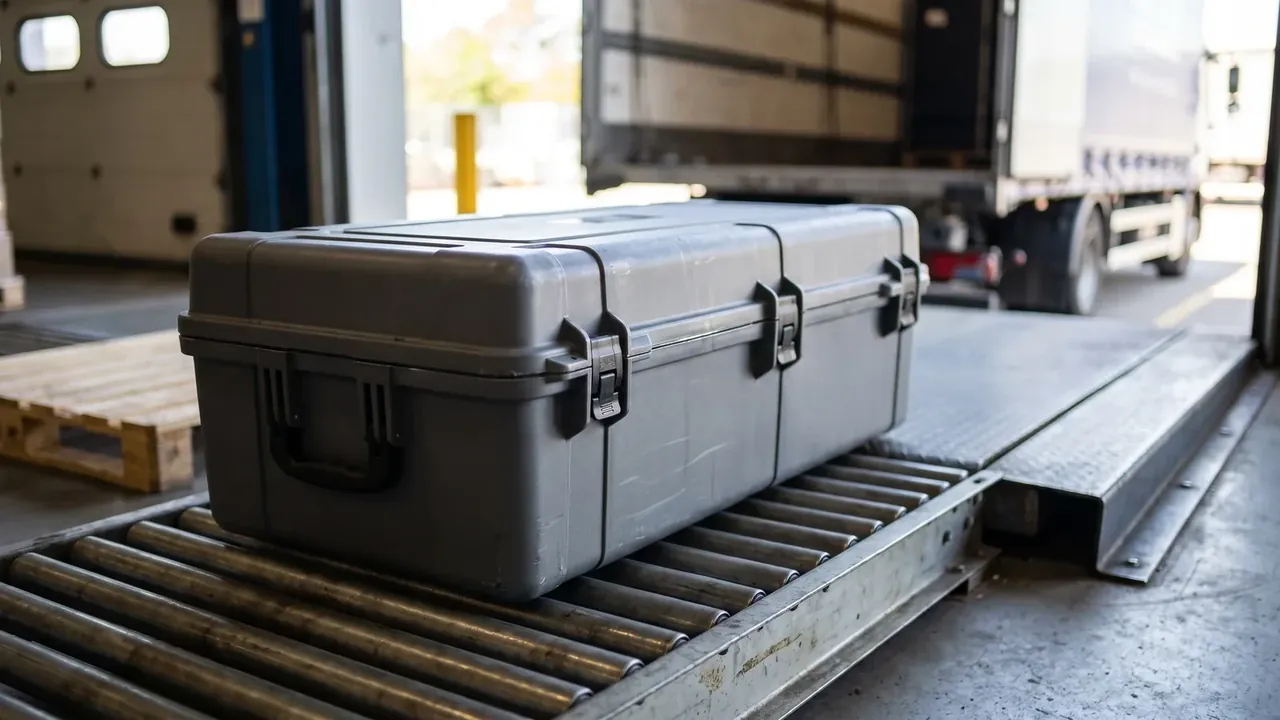
Pre-stretch belongs on a machine. Hand wrapping reaches 40–60% elongation, which halves the clamp force of the same layer and lets the wrap slide down in transit. Without a wrapper, add a layer instead.
Layer count follows distance: two under 300 km, three above 800 km, four at corners every time. Film forms a continuous restraint only at 50% overlap; under 30% the layers slip, and one slip costs half the clamp force. Below 5 °C, LLDPE loses about 30% of its elongation and snaps at 250%, so winter work drops to 150%.
| Material | Specification | Per case | Acceptance |
|---|---|---|---|
| Stretch film | 20–23 μm, 500 mm wide | 2–3 layers, 4 at corners | No whitening or tear |
| Corner | EPE 20 mm or 5-ply board 5 mm | 4 off, 60×60×50 mm | Dent ≤3 mm |
| Strapping | 16 mm PET, break ≥800 N | 2 bands | Tension 250–350 N |
| Pallet | 1200×800 mm | 1 per 6 cases | No broken deck board |
| Desiccant | 50 g/m³ | By internal volume | Sachet intact |
3. Corner protectors and strapping
Secondary Protection in Transit then adds corners and bands. EPE at 20 mm recovers well and suits cases handled repeatedly; five-ply corrugated at 5 mm is cheap and fine one-way, but loses half its strength when damp. Take 60×60×50 mm, which covers three faces of a corner.
Strapping is 16 mm PET at 800 N minimum, two bands per case, laid over the reinforcing ribs 40–60 mm from the edge. A band across a flat wall dents it; a band over a rib passes load into the structure.
Put a 1 mm fibreboard pad under each band. Set tension with a gauge at 250–350 N; above 400 N a plastic case creeps at 60 °C in a summer trailer, and the dent is where the next crack starts.
Direction follows shape: above a 1.5 length-to-width ratio run both bands across the main ribs; on a near-square case run one each way, crossing 30 mm either side of the handle. A palletised stack also takes two girth bands at 1200 N, 300 mm and 900 mm above the deck.
| Method | Main job | Typical failure |
|---|---|---|
| Stretch film | Unitising, dust and moisture | Overlap under 30%, wrap slides |
| Corner | Flattening corner impact | Damp board, dent over 3 mm |
| Strapping | Stopping lid movement | Band on flat wall, dents shell |
| Pallet | Fork handling, ground moisture | Broken deck board, fork through base |
| Desiccant | Condensation control | Sachet under the base, no airflow |
4. Pallets, stacking and moisture
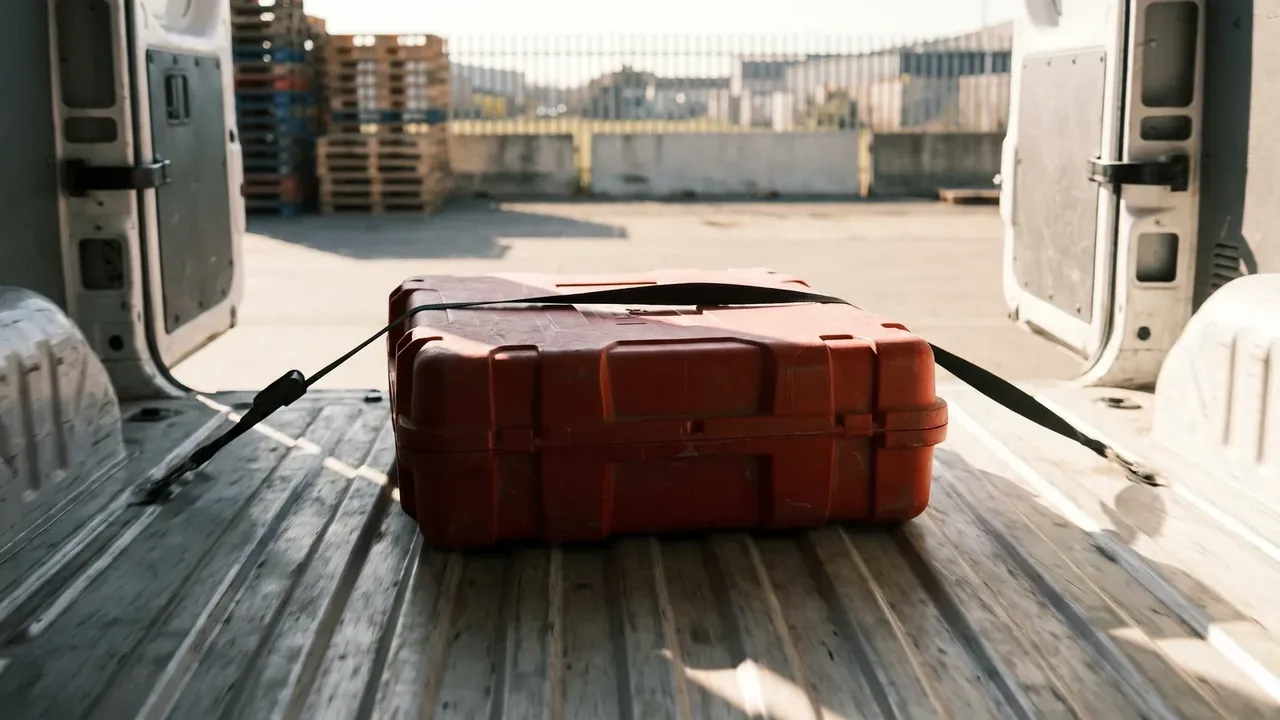
Secondary Protection in Transit finishes on the pallet: 1200×800 mm, six cases each, no more than three high, total height including the pallet under 1.8 m. Above that, the centre of gravity passes the pallet edge under 0.3 g braking, and a sharp stop brings the stack down on a corner.
Dose desiccant at 50 g/m³, or line the case with VCI film. Hang the sachet inside the lid; a sachet under the load blocks its own airflow. Beyond 30 days at sea, raise it to 80 g/m³.
A 3 mm corrugated sheet between layers spreads rib load and absorbs vibration. Replace it once damp; wet board leaves a watermark on the lid, and nobody can then tell whether the moisture came off the road or out of the warehouse.
Two forklift rules: forks at least two thirds of pallet length, and travel with the load under 100 mm off the floor. Half-engaged forks double the bending moment on the centre deck board. Unpacking reverses the order — cut bands, remove film, take off corners — with two photos per step for six archive shots, each showing the case number and a timestamp.
Conclusion
What secondary protection buys is coverage of three separate failures, not thickness: corners bring a 120 g peak down to 65 g, 20–23 μm film at 50% overlap unitises the body, and 50 g/m³ of desiccant holds condensation in check. Doing all three adds roughly 3–5% to packaging cost and takes the damage rate down with it. The quickest test of a wrap is the six unpacking photos: if every layer is in them, nothing was skipped.
This article discusses only the container (case body) side of specifications and design intent, and does not cover any handling, loading or use of the contents.
Related Reading
- Loading rules for full truckload and LTL
- How packing and stacking move the damage rate
- Wheels and trolley handles matched to load
- Stacking tests behind warehouse height limits
Related Products
- 8 Series — Gun Cases; Military Equipment Cases; Camera Equipment Cases; Drone Cases; Watch Cases; Knife Cases; First Aid Cases; Electronics Equipment Cases
- WL8-2812 PP Gun Case — model WL8-2812
- All protective cases and toolboxes: 7 series, 158 models