

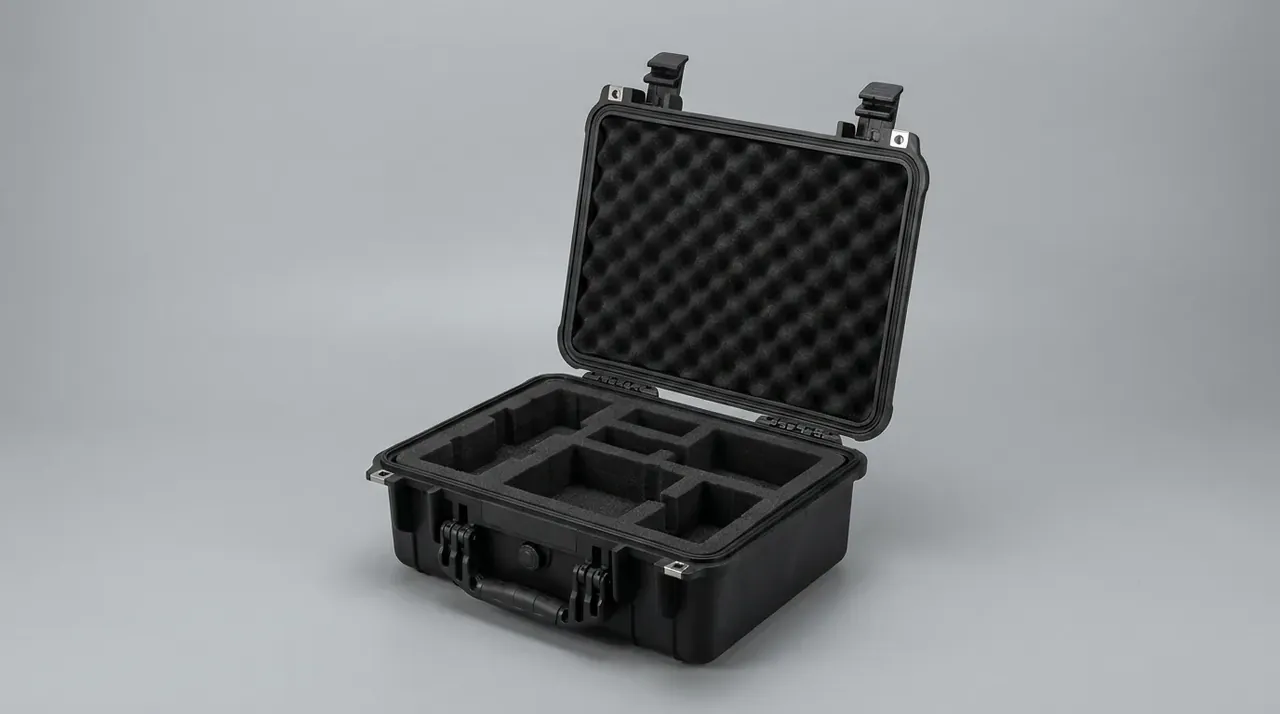
Quick answer: A trolley vs backpack case test over 800 m and three flights: the trolley wins the first 700 m by 1.5 min, then loses the last 100 m by 2.1 min.
Table of contents
- How transfer time adds up
- 800 m and three flights
- Kerbs, 80 mm wheels and 15 kg
- Six hours on the shoulders
- FAQ
1. How transfer time adds up
Transfer time has three sources: walking, stairs and picking the case up. Load 15 kg into two cases of the same size and the trolley rolls at 90 m/min against 75 m/min, climbs a floor in 2.5 min against 1.8 min, and opens in 20 s against 75 s.
In one line: total minutes = distance ÷ speed + floors × minutes per floor + pick-ups × seconds per pick-up. Distance and floors are fixed by the route; only the pick-up count moves, and in a working day it can triple.
On a 200 m walk from the van to the bench, the trolley covers the ground in 2.2 min plus 1.7 min of five pick-ups, so 3.9 min; the backpack walks 2.7 min plus 6.3 min, so 9.0 min. The 4 min against 9 min gap is four fifths pick-up, not wheels.
| Stage | Trolley | Backpack | Hybrid |
|---|---|---|---|
| Flat push, per 100 m | 1.1 min | 1.3 min | 1.2 min |
| One floor, 15 steps | 2.5 min | 1.8 min | 2.0 min |
| One pick-up | 20 s | 75 s | 45 s |
| Kerb it can clear | 12 mm | no limit | 12 mm |
The last row is the one quotes skip: the 12 mm kerb limit comes straight from an 80 mm wheel, and a backpack has no wheel, so it has no limit.
Fifty-five seconds per pick-up explains the rest. A backpack comes off the shoulders, opens, unloads, closes and goes back on: six moves of 7 to 9 s. A trolley needs a bend, an open lid and a close: three. Five pick-ups turn 55 s into 4.6 min, six trips a day into 27 min and 250 working days into 112 h.
2. 800 m and three flights
Split the route into 700 m of flat ground and a final 100 m up three floors. On the flat the trolley takes 7.8 min against 9.3 min. On the stairs it must be carried at 15 kg, 2.5 min a floor, so 7.5 min against 5.4 min. Across the whole route the backpack leads by 0.6 min.
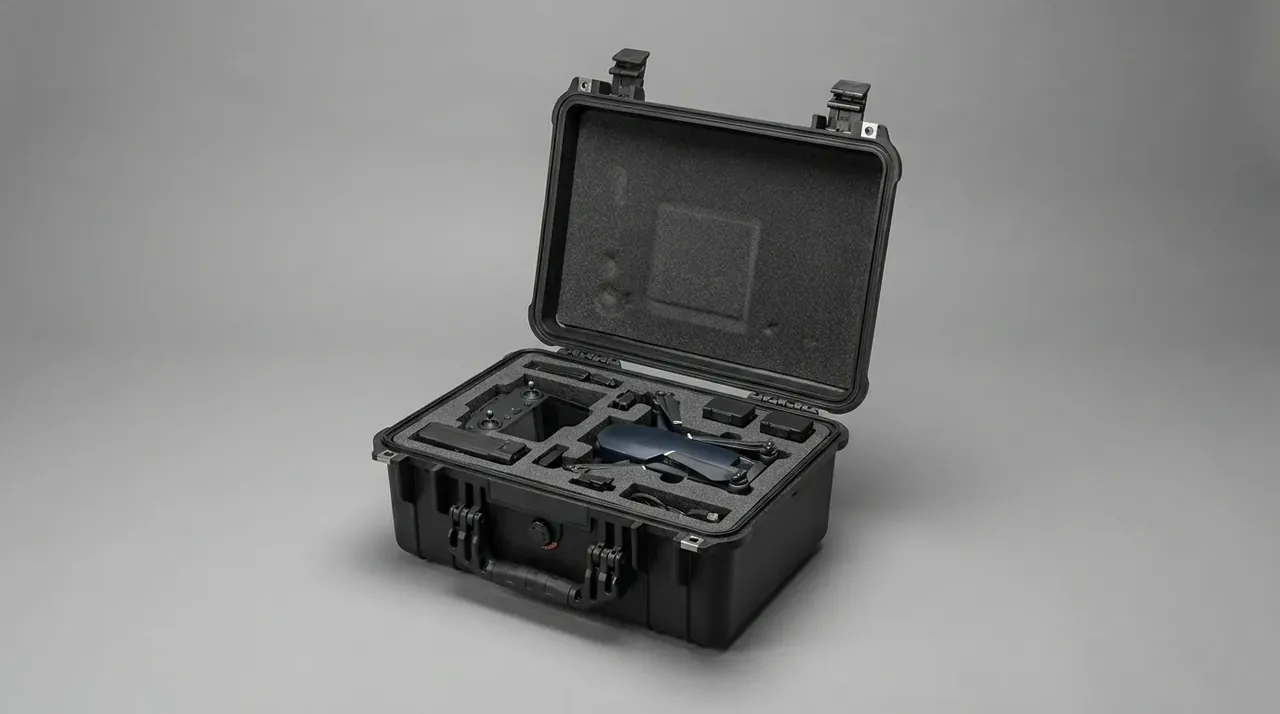
One trip is not a verdict. A single drop puts the backpack at 14.7 min against 15.3 min. Three pick-ups add 1.0 min to the trolley and 3.75 min to the backpack, flipping it to 16.3 against 18.5 min.
The line sits at two pick-ups. At one the trolley needs 15.6 min and the backpack 16.0 min, so the backpack leads by 0.4 min. At two the trolley needs 15.9 min and the backpack 17.2 min, a 1.3 min reversal. At three the gap reaches 2.2 min.
Floors change the starting point, not the slope: three floors give the backpack 2.1 min, six give 4.2 min, but each extra pick-up returns 0.9 min to the trolley, and eight floors with five pick-ups bring them level.
A working day shows it: six trips with three pick-ups cost the trolley 98 min and the backpack 111 min, while one pick-up per trip puts the backpack two minutes ahead.
3. Kerbs, 80 mm wheels and 15 kg
An 80 mm wheel clears a step of about one seventh of its diameter, so 11 to 12 mm. A 20 mm platform gap, a 30 mm speed bump and a 40 mm gravel seam all need a lift. The backpack has no wheels, so the limit disappears and the weight moves to the shoulders.
Pulling 15 kg one-handed is the real load: a straight arm keeps wrist load lowest, while leaning past 20° makes 15 kg behave like 21 kg. Two hands drop palm pressure from 6 kPa to 3.5 kPa for 200 m.
The three-stage handle is about height: 840 mm, 930 mm and 1020 mm. At 170 cm to 185 cm the top stop keeps the wrist level; under 160 cm the lowest stop avoids shrugged shoulders.
A 100 mm wheel lifts the kerb limit from 12 mm to 15 mm but adds 0.6 kg and costs 3 m/min, 0.3 min over 800 m, which three millimetres of step does not repay.
Stairs are the blind spot of any wheel. A 160 mm riser is twice the diameter, so the case must be carried, and every 90° landing adds 12 s by hand, 72 s over three floors.
4. Six hours on the shoulders
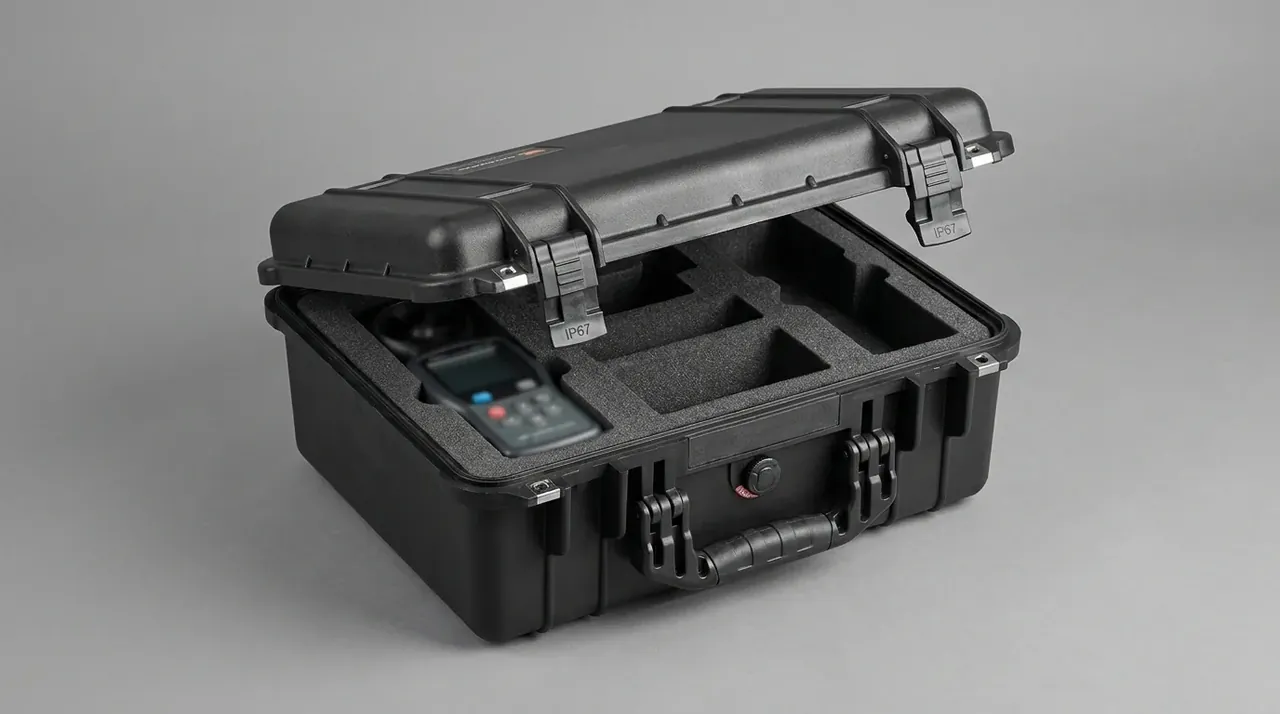
The backpack wins on distance and bad ground. With 15 kg on two 45 mm straps, peak shoulder pressure is about 9.6 kPa, and after 6 h the discomfort score climbs from 2 to 6 on a ten-point scale; a waist belt moves load to the hips and drops it to 6.8 kPa. The curve is not linear: 2 h stay flat, marks appear in the third hour, and by the fourth the marked area reaches 12 cm². Six hours is the ceiling.
On 1.5 km of track the 80 mm wheels sink into seams over 20 mm and speed falls to 55 m/min, 27.3 min against 21.4 min on the backpack; wet ground halves that speed again.
A site is trolley country: over 300 m of hard standing, two floors of scaffold and six pick-ups, the trolley needs 3.3 + 5.0 + 2.0 min, or 10.3 min, against 4.0 + 3.6 + 7.5 min, or 15.1 min.
A hybrid build joins the two. Two 40 mm webbing straps and four D-rings spread load across four points for 28 CNY a set and 0.4 kg extra; roll it on the flat, carry it upstairs, and the three-floor leg falls from 7.5 to 4.6 min while a pick-up grows from 20 s to 45 s. Four-point straps take 20 kg static, so the back panel needs four 8 mm inserts. Airports are decided by flat distance, sites by pick-up count, field work by surface grade.
Conclusion
Choosing between a trolley and a backpack case needs no discussion of shells or latches. Split the route into distance, floors and pick-ups, then use the formula in section 1. The deciding term is the pick-up count: 55 s looks trivial, five pick-ups make it 4.6 min and six trips a day make it 27 min. The 80 mm wheel, the 15 kg single-hand pull and the three-stage handle are levers on the flat leg, not verdicts on the route. Above two pick-ups with over 300 m of flat ground, buy the trolley; one pick-up or fewer with three floors or more, buy the backpack; where both appear, fit the hybrid kit at 28 CNY a case.
| Setting | One leg | Floors | Pick-ups | Trolley | Backpack | Call |
|---|---|---|---|---|---|---|
| Airport and hall | 600 m | 0 | 2 | 7.3 min | 10.5 min | Trolley saves 3.2 min |
| Site | 300 m | 2 | 6 | 10.3 min | 15.1 min | Trolley saves 4.8 min |
| Field track | 1500 m | 0 | 3 | 28.3 min | 25.2 min | Backpack saves 3.1 min |
| Office delivery | 800 m | 3 | 1 | 15.6 min | 16.0 min | Backpack saves 0.4 min |
| All three in a day | 800 m | 3 | 3 | 16.3 min | 18.5 min | Hybrid kit at 16.7 min |
This article discusses container-side specifications and design implications only, and does not cover any handling, loading or use of the contents.
Related Reading
- Wheels and telescopic handles on cases
- How a carry case is built
- Static and dynamic handle load
- Choosing a wheeled protective case
Related Products
- 8 Series — Gun Cases; Military Equipment Cases; Camera Equipment Cases; Drone Cases; Watch Cases; Knife Cases; First Aid Cases; Electronics Equipment Cases
- WL8-2812 PP Gun Case — model WL8-2812
- All protective cases and toolboxes: 7 series, 158 models