

Quick answer: A ukca case mark is governed by two numbers: a 5 mm minimum height and a 2:1 width-to-height ratio that every other dimension follows.
Table of contents
- The Mark Itself: Two Numbers That Set Everything Else
- Three Surfaces and Their Order of Preference
- What Indefinite CE Recognition Does Not Change
- Northern Ireland: Where UKCA Stops
- Legibility at One Metre and the Importer Block
- FAQ
1. The Mark Itself: Two Numbers That Set Everything Else
Take a moulded case with a 120 mm front label area. At the 5 mm floor the mark occupies 10 mm by 5 mm, and clear space must be twice the height on all four sides, so the clean zone is 30 mm by 25 mm. No pad print, parting-line step or ejector-pin bloom may intrude.
The 2:1 figure describes the whole block of letterforms, not each glyph. Double the height to 10 mm and the width goes to 20 mm, stroke weight scaling with it; stretch height alone and the letters flatten under an inspector's eye.
There is a floor but no ceiling: below 5 mm the mark fails, so a small shell is solved by moving the mark.
Where resolution is marginal, protect height first. Laser marking on black polypropylene lands near 3:1 contrast; dark grey on light grey sits at 1.6:1 and smears at arm's length, while a white label at 8:1 reads cleanly at the same 5 mm.
| Mark | Territory | Minimum height | Companion element |
|---|---|---|---|
| UKCA | England, Scotland, Wales | 5 mm | UK importer name and address |
| CE | EU 27; recognised with no sunset date in GB | 5 mm | EU manufacturer or importer |
| UKNI | Northern Ireland, only beside CE | 5 mm | UK approved body number |
| UKCA beside CE | Both markets at once | 5 mm each, 10 mm apart | Two address blocks |
Side-by-side marks stay 10 mm apart at 2:1; a clipped device scraps the label.
2. Three Surfaces and Their Order of Preference
A mark may sit on the shell, the shipper or the paperwork, and the three are not equal.
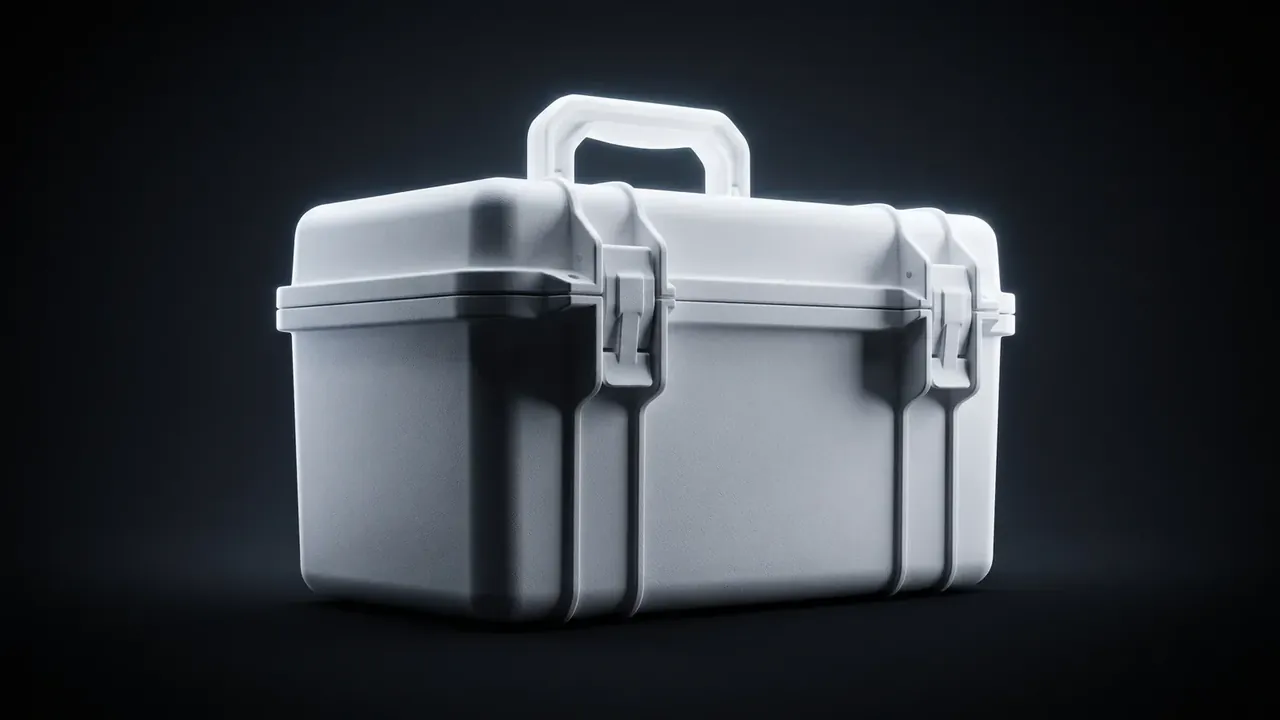
On the shell, choose the face that still points outward once the lid opens; inside the lid does not count. Stay 15 mm clear of the catch mounts, where a loaded latch grinds the surface. On a curved corner allow 0.3 mm for development, or the label lifts at one edge.
Shipper placement suits shells too curved for a 30 mm by 25 mm flat patch; the floor still applies at 5 mm.
Paperwork placement suits single units and rented fleets; the mark ties back to the case serial, one folder per unit.
| Surface | Reading distance | Where it fits | Floor check |
|---|---|---|---|
| Front label zone | 1 m | Volume runs with a flat face | Compare to a 5 mm template |
| Shipper side panel | 1.5 m | Highly curved shells | Match to the case serial |
| Accompanying document | 0.4 m | Single units, returnable fleets | One sheet per case, signed |
| Shell plus shipper | 1 m and 1.5 m | Repeated transhipment | Both copies identical |
3. What Indefinite CE Recognition Does Not Change
The UK government has announced that CE marking stays recognised in Great Britain with no sunset date. Many buyers read that as permission to drop UKCA entirely.
That reading overshoots. Recognising CE keeps a route open; it does not retire the UKCA route, and both remain valid on their own terms. Which one a shipment needs is settled by the purchase order, not by the regulation.
Each configuration fails differently. CE only is the cheapest document set and loses any tender naming UKCA. UKCA only needs re-labelling before the case enters the EU, and pad print cannot be removed, so a sticker goes over it. Dual marking crowds the layout: the clean zone doubles to 65 mm by 25 mm, which small shells cannot give, pushing the pair onto the lid exterior. Asking for the destination port before the tool is cut costs less than reworking a run.
Technical documentation is retained for 10 years and the signatory answers for it. The file holds wall sections, resin grades, test records and production-size artwork.
4. Northern Ireland: Where UKCA Stops
Northern Ireland follows EU rules and does not recognise UKCA. A case bound for Belfast carries CE alone, or CE with UKNI beside it.
UKNI never travels alone. It appears only when a UK approved body carried out the assessment; if an EU notified body did the work, the case carries CE and nothing else. An extra UKNI invites the receiver to question the paperwork.
A case shipping to both Liverpool and Belfast needs three devices. Lay them in one row at 2:1, 10 mm apart, row height set by the smallest at 5 mm, strip cut to 90 mm by 15 mm and placed 20 mm up from the bottom edge.
5. Legibility at One Metre and the Importer Block
One metre is an inspector's distance to a case on a bench, and it sets the practical floor. At 1 m a 5 mm character subtends 17 arc minutes, inside normal acuity; at 3 mm it falls to 10 arc minutes and stops being a glance.
The importer block shares the zone: line height 3 mm or more, addresses written out, postcode mandatory, company name matching the contracting party character for character. Stamp-filled entries are rejected because they rub away.
Four checks cover the requirement:
- Height against 5 mm and 10 mm templates, tolerance 0.2 mm
- Ratio on a go gauge, deviation beyond 3% fails
- Clean zone rubbed with a paper transfer, no print inside 30 mm by 25 mm
- Full read at 1 m within 5 seconds
The third check fails most often. A parting line lands on the edge of the clean zone, nobody notices at tool trial, and every unit ships with a 0.4 mm ridge through the white space.
Conclusion
The mark reduces to a height, a ratio and a surface. Set 5 mm as the floor, hold 2:1 through every scale change, and reserve 30 mm by 25 mm of clean shell before the tool is cut. Because CE is recognised in Great Britain without a sunset date, dual marking is routine rather than transitional.
This article covers case-side specifications only and does not address any handling, loading or use of the contents.
Related Reading
- UKCA and CE document sets for the same case
- Laying out a label zone and nameplate
- General rules for export packaging labels
- Compliance route into the EU market
Related Products
- 8 Series — Gun Cases; Military Equipment Cases; Camera Equipment Cases; Drone Cases; Watch Cases; Knife Cases; First Aid Cases; Electronics Equipment Cases
- WL8-2812 PP Gun Case — model WL8-2812
- All protective cases and toolboxes: 7 series, 158 models