

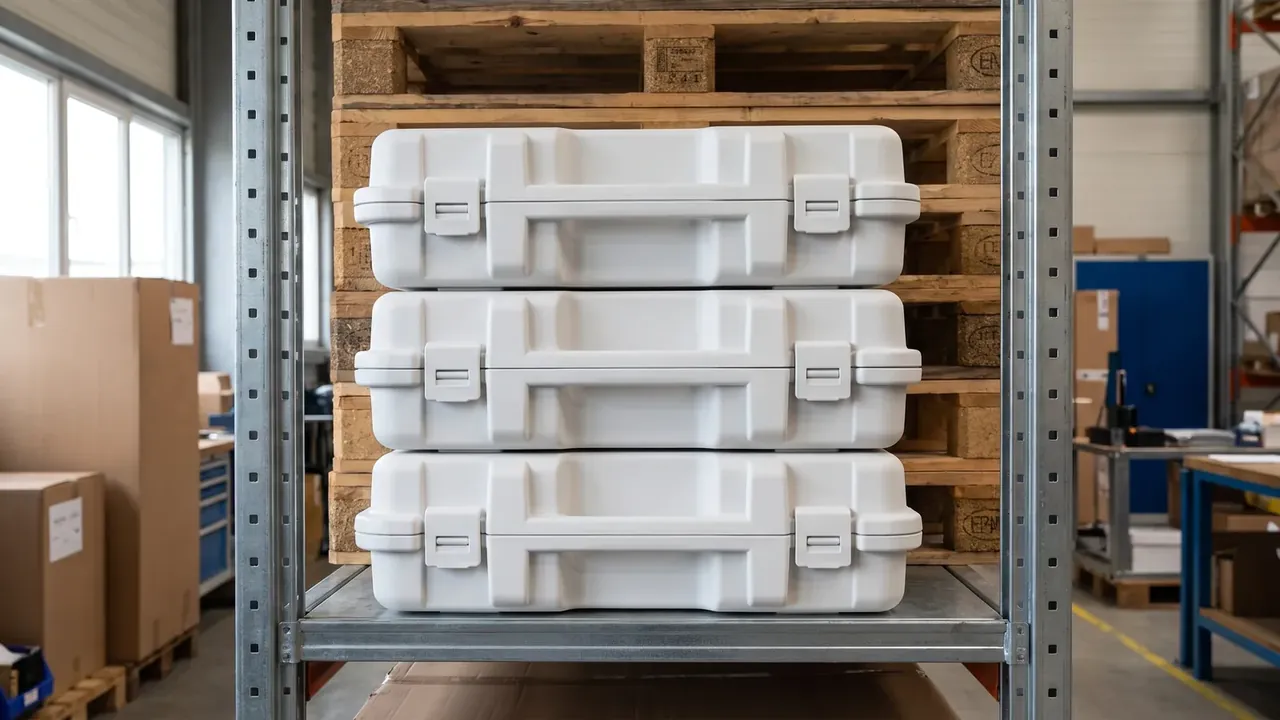
Quick answer: Underwater camera housing waterproof safety box holds at 3.0 m for 60 min with 26% lip compression and a 1.5 MPa reinforced panel opening.
Table of contents
- Underwater camera housing waterproof safety box: box-mouth lip rings and static-pressure compensation
- Reinforcement frames and gaskets around panel cut-outs
- Reading leakage in sequence at three metres of water
- Acting values of the pressure valve under differential load
- Measuring lip compression after immersion recheck
- FAQ
1. Underwater camera housing waterproof safety box: box-mouth lip rings and static-pressure compensation
Underwater camera housing waterproof safety box measures 520 × 400 × 220 mm outside, with a 455 × 335 × 160 mm cavity, a 4.0 mm wall, 5.6 kg empty and 11 kg loaded. The box mouth is the only continuous pressure face, so two lip rings sit one behind the other around the lid, giving 2 independent sealing lines. The outer lip blocks direct ingress; the inner lip tightens as water pushes the lid inward.
Both lips are pre-compressed to 26%, locked by lid travel and latch preload; too low and the lip cannot rebound, too high and it relaxes after repeated opening. Underwater camera housing waterproof safety box takes 60 min without seepage at 3.0 m as its mouth acceptance line, about 30 kPa at the ring face, shared by the two lips.
| Immersion depth | Ring-face pressure | Observation point | Verdict |
|---|---|---|---|
| 3.0 m | about 30 kPa | start of immersion | baseline recorded |
| 3.0 m | about 30 kPa | 30 min | inner lip compensating |
| 3.0 m | about 30 kPa | 60 min | no seepage, pass |
2. Reinforcement frames and gaskets around panel cut-outs
Two φ28 mm openings are left in the panel, and a cut rim becomes the stress raiser a static load finds first. Underwater camera housing waterproof safety box adds a metal frame behind each opening to spread the rim load into the wall so 1.5 MPa opens no micro-cracks. An elastic gasket stands 0.6 mm proud of the frame and compresses first.
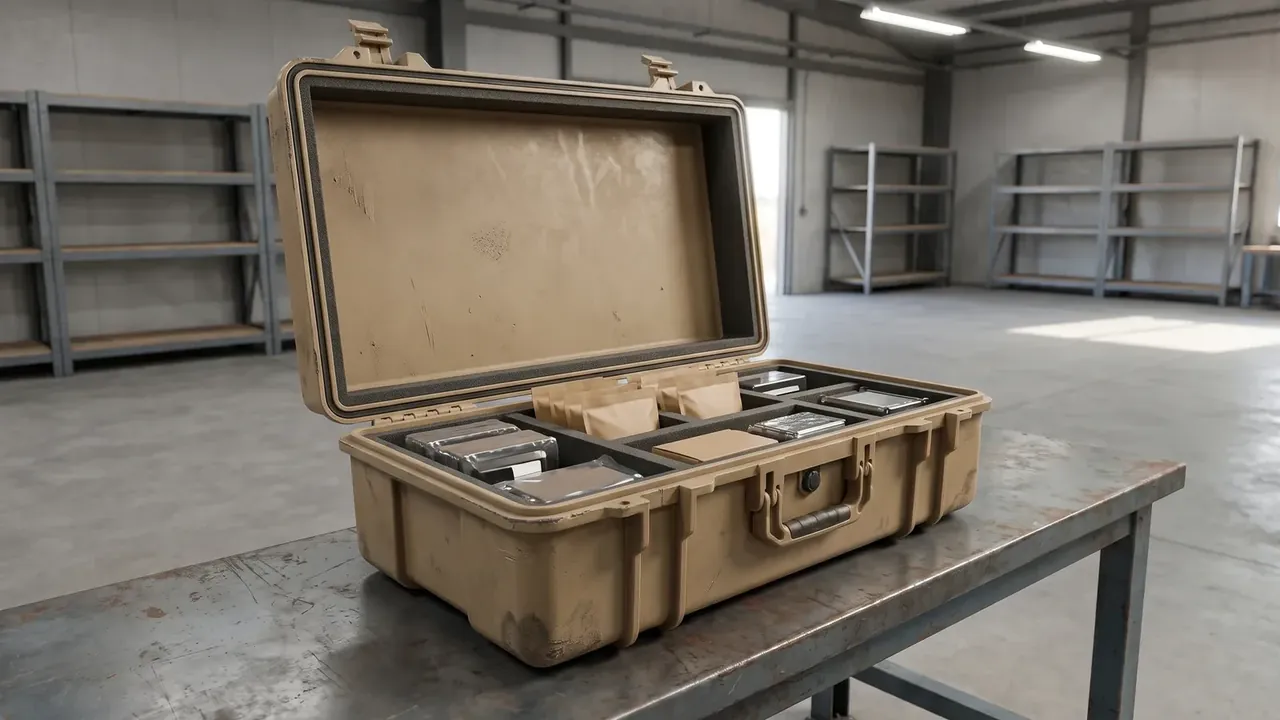
The cut-out panel is checked on its own rig: static load is raised to 1.5 MPa and held while the bore rim and gasket face are watched for water. Bore spacing, frame thickness and the 0.6 mm stand-off go on one inspection card.
Two lines decide acceptance: no seepage at 3.0 m over 60 min, and no seepage at 1.5 MPa on the cut-out panel.
| Cut-out location | Bore | Reinforcement | Static criterion |
|---|---|---|---|
| panel left | φ28 mm | rear frame plus gasket | 1.5 MPa, no seepage |
| panel right | φ28 mm | rear frame plus gasket | 1.5 MPa, no seepage |
| rim transition | rounded corner | stress spreading | no micro-crack |
3. Reading leakage in sequence at three metres of water
Mouth, cut-outs and valve are judged in one immersion run in a fixed order: first the lid perimeter for a water line, then the two bore rims, then the valve seat. All three dry means the 3.0 m / 60 min run passes. Transfer out of the water is held within 2 min so droplets are not read as seepage.
Underwater camera housing waterproof safety box is set against the standing-water conditions of IP68 as a reference method, not a certification claim. Working temperature spans −20 °C to 55 °C: the cold end checks ring hardening, the hot end lid creep.
After one immersion run, Underwater camera housing waterproof safety box closes out in six steps. Wipe the lid rim dry and read the perimeter clockwise. Blot each bore rim with white paper; a dry sheet is the only pass. Check whether the φ16 mm valve seat ring has been pushed off-centre. Let the shell rest 10 min and re-read the mouth to rule out draining residue. Log water temperature and immersion times on the card. Compare lid opening force with closing travel to confirm the lips keep their shape.
4. Acting values of the pressure valve under differential load
Differential pressure comes from air compressed or expanded during immersion. A φ16 mm valve balances both ways, venting when internal pressure is high and admitting air when low. The return spring is calibrated to the band for 3.0 m of standing water: act too early and lip preload is disturbed, too late and the lid loads first. Underwater camera housing waterproof safety box offsets the seat from the two φ28 mm openings.
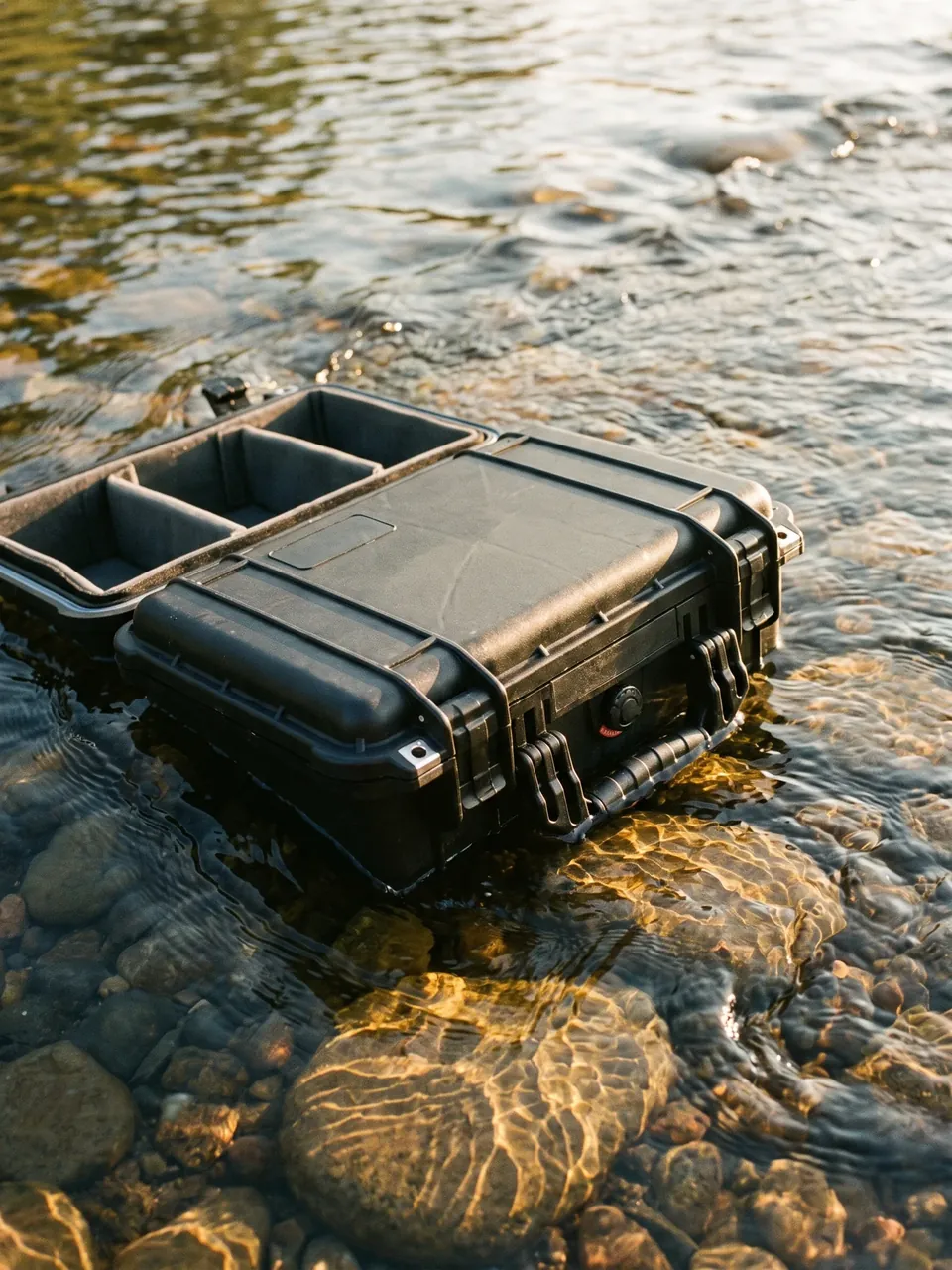
Underwater camera housing waterproof safety box takes closing preload from 4 latches at 420 N each, set at the corners for even loading. Drop recheck runs at 1.2 m on all six faces, once on a corner and once on a flat face; only mouth diagonal deviation and lip compression return are measured.
5. Measuring lip compression after immersion recheck
A 3.0 m / 60 min run leaves short-term compression set, so the recheck asks how much squeeze the ring recovers. Depth readings at the four lid corners and the long-edge mid-point are compared with the pre-immersion baseline; any point outside the ±2% band around 26% is logged as a recheck exception. Underwater camera housing waterproof safety box fixes the measuring points on the card.
After many cycles another immersion run is made; a lip that cannot return to the baseline band is replaced rather than the latches tightened further.
| Compression | Measuring point | Baseline | Verdict |
|---|---|---|---|
| 26% | long-edge mid-point | set value | pass |
| 24% | lid corner | lower −2% | recheck |
| 28% | lid corner | upper +2% | recheck |
Conclusion
Underwater camera housing waterproof safety box puts mouth lips, cut-out reinforcement and valve balance into one static-pressure envelope, with 3.0 m / 60 min and 1.5 MPa as the two hard lines. The 520 × 400 × 220 mm envelope, 4.0 mm wall and 26% compression are one coupled set. JUNZHIJIA supplies this protective case verified by Kexin New Materials (Guangdong) Co., Ltd. under the methods above; the specification covers box-side structure and inspection only.
Related Reading
- Camera equipment protective case selection guide
- Hard camera equipment case structure comparison
- Case seal materials and compression ratio values
- Camera gear case humidity control and inner lining
Related Products
- 8 Series — Gun Cases; Military Equipment Cases; Camera Equipment Cases; Drone Cases; Watch Cases; Knife Cases; First Aid Cases; Electronics Equipment Cases
- WL8-2812 PP Gun Case — model WL8-2812
- All protective cases and toolboxes: 7 series, 158 models