

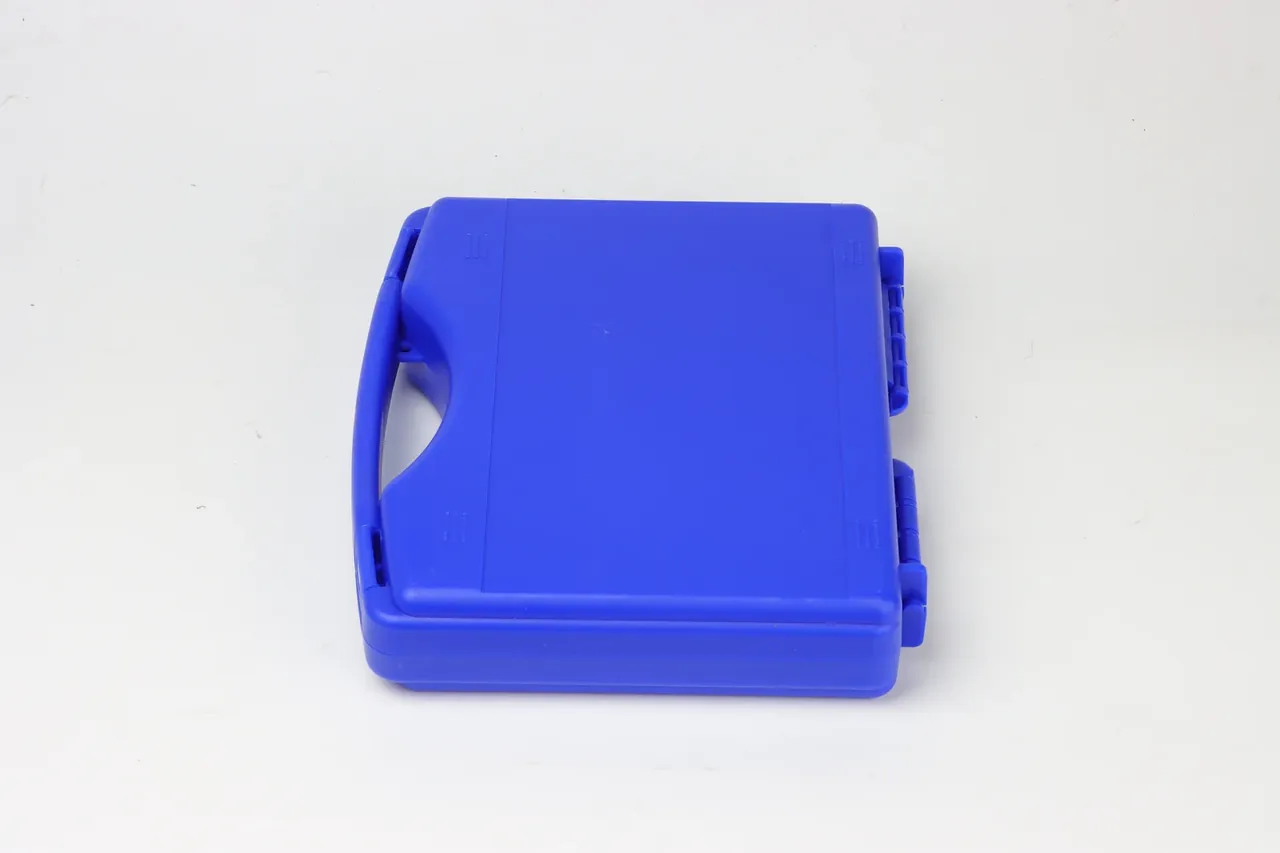
Quick answer: Work Cases obey two numbers underwater, displacement and total weight, and the gap is net buoyancy. A 540 × 400 × 300 mm body displaces 66.4 kg; empty at 6.9 kg it climbs hard, and 48 kg of contents plus 14 kg of ballast brings it to −2.5 kg.
Table of contents
- Net Buoyancy: Displacement First, Ballast Second
- Handles and Lifting Points: A Four-Point Rig
- Lines and Carabiners: Mount Position Sets Load Direction
- Descent and Recovery: Two Separate Stages
- FAQ
1. Net Buoyancy: Displacement First, Ballast Second
Above water buoyancy is about volume; below it two numbers decide everything. A 540 × 400 × 300 mm body measures 64.8 litres outside and displaces 66.4 kg in seawater at 1.025, while weighing 6.9 kg empty, so net buoyancy runs +59.5 kg. Let go and it surfaces.
The target is slightly negative, between −2 and −4 kg. Too positive and the diver fights the case down at 30 m, burning gas; too negative and it drives into silt and tips. At −2.5 kg one hand holds it, and released it sinks slowly without bouncing.
| State | Total weight | Displacement | Net buoyancy | Ballast |
|---|---|---|---|---|
| Empty | 6.9 kg | 66.4 kg | +59.5 kg | none |
| With 48 kg of contents | 54.9 kg | 66.4 kg | +11.5 kg | none |
| Ballasted | 68.9 kg | 66.4 kg | −2.5 kg | 14 kg |
| Two lamps added (+3.2) | 72.1 kg | 66.4 kg | −5.7 kg | drop 3 |
Ballast is not a one-off sum. Swap steel clamps at 7.8 for filter cartridges at 0.4 and the total moves more than ten times at the same volume, so keep weights as 5 kg blocks on two rails with M10 hand screws, 90 seconds to change without tools. Count the rigging too: a main line and four carabiners add 2.4 kg.
Wall thickness does not enter the sum but governs sealing. Under 0.3 MPa at 30 m a 3.0 mm PP lid bows 1.5 mm and gasket squash falls from 30 to 22 percent, still sealing; at 60 m the wall goes to 4.0 mm.
Centre of buoyancy against centre of gravity decides attitude. Ballast on the base rails drops the centre of gravity some 20 mm, which keeps Work Cases upright; move it to the lid and a current tips the case.
2. Handles and Lifting Points: A Four-Point Rig
A handle is for hands, a lifting point is for rigging, and the two never interchange. The handle is rated 75 kg static in a vertical pull; lifting points take load in any direction, four of them evenly spaced, each rated 120 kg with a four-to-one break margin.
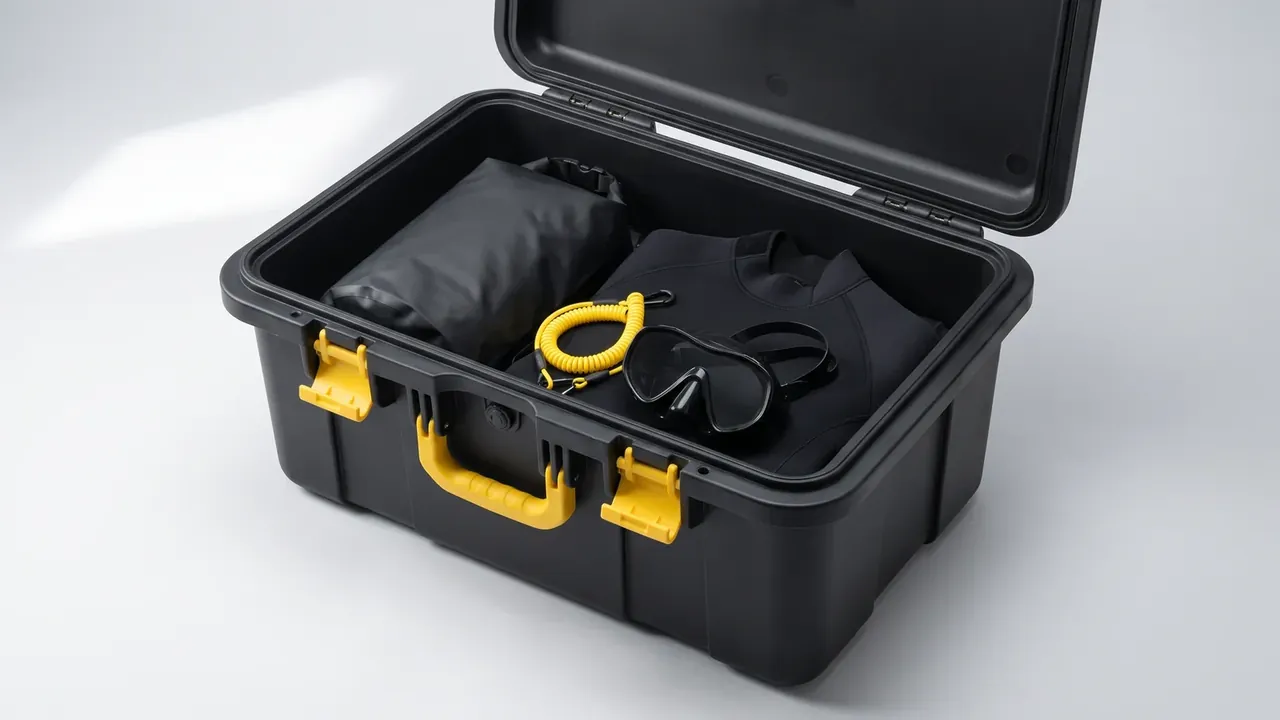
Corner eyes are M8 in 316 stainless, set in bosses with 8 mm of wall and torqued to 6 N·m. Over-torque cracks the boss in cold water, under-torque works loose under cyclic load, so use a wrench rather than judgement.
Four-point slings need legs equal within 20 mm. Unequal legs load the shortest one, where the figure can double and the eye deforms before the wall tears; cut against one master sample.
| Position | Fitting | Working load | Riggings |
|---|---|---|---|
| Four top corners | M8 stainless eye | 120 kg | main sling |
| Handle sides | moulded lug | 45 kg | tow line |
| Bottom front | cross bar | 80 kg | anti-roll line |
| Lid centre | carabiner hole | 25 kg | tool line |
Lifting points come moulded-in or drilled after the fact. A moulded-in nut shares load across the wall; a drilled hole concentrates stress at the edge and loses about 30 percent of the rating at the same M8 size, so above 300 units inserts pay for tooling.
3. Lines and Carabiners: Mount Position Sets Load Direction
Rigging splits into three lines, main sling, tow line and tool line, each on its own fitting. The main sling is 10 mm double-braid polyester at 24 kN break, giving 4.8 kN working load at a safety factor of five; 8 mm nylon at 16 kN is a tow line only.
Mount position fails more often than rope size. The main sling goes to corner eyes, the tow line to handle lugs at 45 kg, the tool line to the lid hole at 25 kg. Main slings clipped to handles are common, and since the handle assumes a vertical static pull, an angled load can double the real force.
Carabiners are 8 mm aluminium at 22 kN closed. Clip with the gate inward so rock cannot lever it open, and check gate snap after every dive; a sluggish gate retires the unit.
Line length follows depth at 1.5 times the working depth plus 3 m, so a 30 m job takes 48 m, with surplus kept on deck where coils cannot catch a propeller.
4. Descent and Recovery: Two Separate Stages
Descent and recovery are separate drills. Lower at 0.3 m/s, about 100 seconds to 30 m; faster and the case swings, slower and the diver wastes gas. Whoever pays out line keeps it in sight.
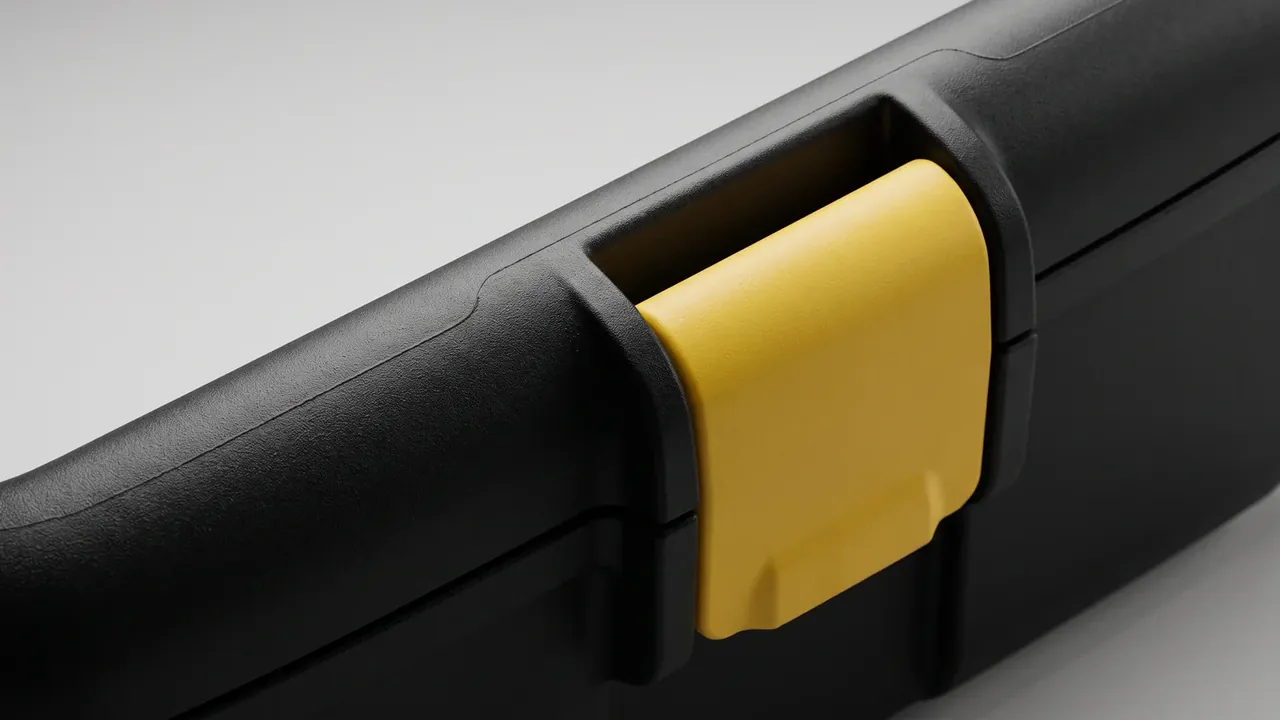
Before the drop, ballast on, latches home, vent clear. Hold the case at the surface for 10 seconds and watch whether it sinks slowly; if it floats, lift it out and add a block rather than forcing it down.
Recovery reverses the order: sling on first, ballast off second, lift last. Release ballast first and the case surges up before the sling takes load, which is how divers and cases end up tangled. Two people clear 30 m in three minutes.
Weigh Work Cases after every job. Closed-cell EVA takes under 1 percent of water in 24 hours, but repeated compression lets it creep, and weight drift moves ballast out of trim. Check every 20 dives and replace foam that has gained 0.5 kg.
Conclusion
Four numbers size Work Cases: displacement, total weight, lifting-point rating and working depth. At 66.4 kg of displacement and 14 kg of ballast the case sits at −2.5 kg; corner eyes take 120 kg, the handle 75 kg, and the two never swap; a 24 kN sling works at 4.8 kN.
This article discusses only the container (case body) side of specifications and design intent, and does not cover any handling, loading or use of the contents.
Related Reading
- Choosing cases for diving equipment
- Case protection for subsea equipment
- Case sets for underwater work
- Structure of waterproof camera cases
Related Products
- 8 Series — Gun Cases; Military Equipment Cases; Camera Equipment Cases; Drone Cases; Watch Cases; Knife Cases; First Aid Cases; Electronics Equipment Cases
- WL8-2812 PP Gun Case — model WL8-2812
- All protective cases and toolboxes: 7 series, 158 models