


The job of a subsea equipment and vehicle parts case is not to "wrap things up" but to keep pressure-rated components at their original geometry, seal-face condition and electrical performance across the three stages that are most often ignored: inland transport, quayside transfer, and deck lifting. Pressure housings, pressure transducers, acoustic transducers, oil-filled compensators, thruster motors and hydraulic valve packs can run for years at several thousand metres of water depth without a single anomaly, yet they routinely fail during a short move from the factory to the shipyard, from the quay to the platform, or from the platform to the work vessel, because of one knock, one night of condensation, one round of salt spray, and continuous vibration. Three design threads therefore govern case selection: the shell and seal system (with the IP rating defined against IEC 60529 and GB/T 4208), the insert and cushioning strategy (a graded cushion design driven by component mass and fragility), and marine environmental resistance (referencing ISO 9227 neutral salt spray testing and the general awareness of ISO 13628 for subsea production systems). One boundary must be stated plainly at the outset: a transit case does not perform a pressure-retaining function, it does not replace hydrostatic testing of a pressure housing, and it confers no subsea certification of any kind. What it delivers is a dry, clean, shock-managed landside and deck-side environment. The sections below follow the sequence: components and hazards, the pressure misconception, IP rating selection, shell materials and corrosion, insert cushioning, pressure equalisation, sensor-specific protection, standards and testing, lifting and stacking, a six-step selection process, and acceptance and maintenance.
Procurement and logistics teams on subsea projects face a recurring dilemma. The component itself is designed and built by a specialist manufacturer, but the transport leg is often arranged by a third-party logistics provider as an afterthought. The result is that the most expensive items receive the most casual packaging. A seal groove gets burred by a pallet corner, an acoustic window is contaminated by label adhesive, connector pins grow a film of rust in a damp trailer. These defects are frequently discovered only just before the equipment is lifted into the water, at which point rework is measured in weeks and vessel downtime is measured in days. This article converts that field experience into executable parameters and workflows so that procurement, logistics, warehouse staff and site engineers are working from the same specification. It also outlines where JUNZHJIA can take on work in custom insert engineering, seal part configuration by component model, and the provision of inspection documents.
Table of Contents
- What a subsea equipment and vehicle parts case has to protect: from pressure housings to sensors
- The four real hazards of subsea transport: salt spray, condensation, vibration and thermal cycling
- Why pressure-rated parts are different: sealing cannot solve a pressure problem
- Choosing the IP rating: IP65, IP67, IP68 against IEC 60529 and GB/T 4208
- Shell materials and corrosion control: ISO 9227 salt spray and common marine practice
- Insert cushioning design: EVA, EPE, PU and the graded cushion strategy
- Pressure equalisation valves: why a case must never be fully sealed
- Dedicated protection for sensors, acoustic transducers and electronic housings
- Standards and testing: MIL-STD-810H (not a military certification), ISTA, GB/T 4857, ASTM D4169
- Transport, lifting and stacking: classification-society transport awareness
- A six-step selection process from component list to case specification
- Incoming acceptance and whole-life maintenance
- Frequently Asked Questions
- Conclusion & Related Reading
What a subsea equipment and vehicle parts case has to protect: from pressure housings to sensors
Subsea equipment is a component-dense field: high unit value, low volume. A spare parts kit for a single remotely operated vehicle or submersible may contain titanium pressure housings, anodised aluminium frame connectors, polyurethane oil-filled compensators, piezoelectric ceramic transducers, deep-water motors and a large number of electrical connectors. Their physical characteristics differ enormously, and applying a single packaging logic to all of them guarantees problems.
| Component class | Typical items | Dominant failure mode | Key packaging requirement |
|---|---|---|---|
| --- | --- | --- | --- |
| Pressure housings | Electronic canisters, end caps, viewport flanges, pressure-rated junction boxes | Seal groove scoring, end-face deformation, O-ring compression set | Independent end-face support, no face contact, clean and dust-free |
| Pressure and temperature sensors | Pressure transmitters, temperature-depth loggers, CTD probes | Diaphragm denting, calibration drift, pressure port blockage | Diaphragm face left free, vibration control, desiccant |
| Acoustic components | Transducers, hydrophones, acoustic releases | Acoustic window scratching, ceramic cracking, matching layer debonding | Soft facing protection, extremely low shock input |
| Oil-filled and compensation parts | Compensators, oil bladders, hydraulic hose assemblies | Bladder puncture, over-bending of hose, oil leakage | No sharp edges, large bend radius support |
| Drive components | Thruster motors, servo actuators, hydraulic valve packs | False brinelling of bearings, valve spool sticking | Axial restraint, resistance to sustained vibration |
| Electrical and connectors | Subsea connectors, penetrators, umbilical terminations | Pin corrosion, insulation resistance loss, seal face contamination | Individual wrapping per item, moisture and salt spray control |
| Structural parts | Aluminium frame sections, buoyancy modules, lifting lugs | Anodised layer scratching, thread damage, distortion | Thread protection, interlayer separation |
The table points to one governing principle: the overwhelming majority of failures in subsea components are not fractures but gradual degradation of surfaces and interfaces. A 0.1 mm score in a seal groove, a fingerprint of grease on an acoustic window, a thin film of rust on a connector pin — none of these are visible on land, yet under water each can produce leakage, signal attenuation or a short circuit. The design emphasis of a subsea case should therefore shift away from pure impact resistance and towards interface protection plus environmental isolation.
The four real hazards of subsea transport: salt spray, condensation, vibration and thermal cycling
The intuitive assumption is that because subsea equipment is designed to operate in water, it is not harmed by moisture. That is the most dangerous misconception in this field. What damages subsea components is not water as such, but water that carries salt, oxygen and particulates, combined with repeated wet-dry cycling at the interfaces.
- Salt spray corrosion. In marine shipping or coastal laydown yards, airborne chloride particles settle on component surfaces and, once they absorb moisture, form a thin electrolyte film. On aluminium alloys, carbon steel fasteners and copper alloy connectors, this film drives far higher corrosion rates than in an inland environment. ISO 9227 neutral salt spray testing is the common method for quantifying this resistance, and marine engineering components are frequently specified against a reference threshold of several hundred hours without base metal corrosion.
- Condensation. This is the most insidious hazard. A component packed in a temperature-controlled workshop cools overnight in a road trailer or an air cargo hold, then enters a warmer, more humid quayside environment the next day. Water vapour inside the case condenses on the cooler metal surfaces. The consequences are reduced insulation resistance, tracking across electrical connectors and fogging of optical windows, and by the time the case is opened the evidence has usually evaporated and cannot be traced.
- Vibration and cumulative damage. Road transport is dominated by random vibration in the 2 to 200 Hz band, while sea transport is dominated by low-frequency roll and occasional shock. For thruster motors, hydraulic valve packs and precision gearboxes, sustained vibration produces bearing raceway brinelling, relaxation of threaded preload and solder joint fatigue. This damage accumulates silently while the component still turns freely, and only becomes apparent under subsea load.
- Thermal and pressure differentials. Large day-night temperature swings make seals breathe. Reduced cabin pressure in air freight and low atmospheric pressure on high-altitude roads create a positive internal pressure differential. If the case is completely sealed, that differential acts continuously on the seal, accelerating permanent deformation and making the case difficult to open.
A practical ranking rule: for coastal and ocean shipping scenarios the usual hazard priority is salt spray, then condensation, then vibration, then impact. For an air-plus-road combination from an inland factory to a coastal shipyard, the order becomes condensation, vibration, impact, salt spray. Establish this order first, then decide where the budget goes.
Why pressure-rated parts are different: sealing cannot solve a pressure problem
The question most frequently asked about subsea cases is whether a case rated to IP68 can be taken into the water with the component inside. The answer is no, and the misconception leads directly to serious consequences.
- The IP rating of a transit case describes short-term immersion performance. Its test conditions, in terms of duration, depth and whether the item is energised, are on a completely different scale from the design envelope of a pressure housing. IP68 is normally executed at a depth and duration agreed between manufacturer and user, commonly on the order of one to three metres for thirty minutes. A subsea pressure housing designed along the lines of the ISO 13628 series must withstand hundreds or thousands of metres of hydrostatic pressure, a difference of several orders of magnitude.
- Pressure housing safety depends on pressure boundary design. Wall thickness, material yield strength, stress concentration at end caps and flanges, seal groove dimensional tolerance, O-ring compression ratio and extrusion gap — every one of these requires calculation, finite element analysis and hydrostatic verification. A transit case shell has none of these design inputs.
- What a case can do is protect the pressure boundary. It keeps seal grooves from being scored, preserves end-face flatness, prevents O-rings from taking a compression set, protects threads and preserves coatings. These are precisely the most common causes of hydrostatic test failure.
The correct role for a subsea equipment case is therefore that of landside guardian of the pressure boundary. When JUNZHJIA engineers an insert for pressure-rated components, every seal end face is left floating or non-load-bearing, and load is taken only by the cylindrical shell section or the handling lugs. That single principle matters more than any thickness figure.
Choosing the IP rating: IP65, IP67, IP68 against IEC 60529 and GB/T 4208
IEC 60529, and its national counterpart GB/T 4208, describe the ability of an enclosure to resist solid foreign objects and water using two digits. Selection should match genuine exposure rather than defaulting to the highest number.
| IP rating | Dust protection | Water protection | Suitable scenario |
|---|---|---|---|
| --- | --- | --- | --- |
| IP65 | Dust protected (5) | 6: protection against water jets | Indoor storage, workshop transfer, covered container transport |
| IP66 | Dust protected | 6: protection against powerful water jets | Short-term open deck exposure, washdown impact |
| IP67 | Dust tight (6) | 7: temporary immersion (typically 1 m for 30 min) | Coastal laydown yards, wet loading and unloading, temporary quay storage |
| IP68 | Dust tight | 8: continuous immersion (depth and duration agreed between supplier and user) | Extreme exposure, scenarios with a drop-into-water recovery risk |
| IP69K | Dust tight | 9K: high-temperature high-pressure spray | Process areas requiring pressure washdown, rarely relevant to subsea parts |
The practical recommendation for subsea equipment is straightforward: use a case with IP67 capability for general export packaging and move to IP68 capability where cases will be stored long term in open yards or on vessel decks. For a detailed treatment of how IP ratings are verified and commonly misread, see sealing and testing points for IP67 protective cases. For a clause-by-clause comparison of dust and water boundaries, see the relationship between waterproof cases and IP ratings.
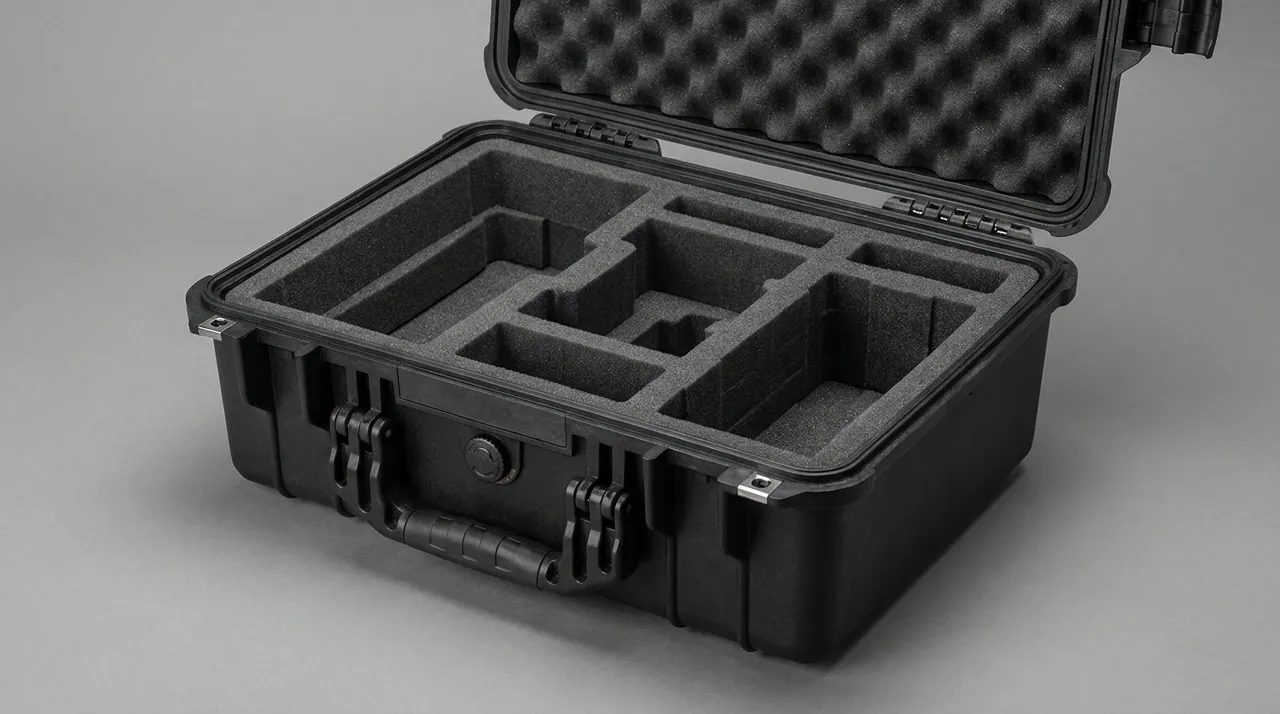
It is important to remember that an IP rating only holds when the case shell is intact, the gasket is clean, the latches are correctly closed and the pressure equalisation device is functioning as designed. In the field, the vast majority of so-called water ingress events trace back not to an insufficient rating but to a fibre trapped in the seal groove, an aged and deformed gasket, or a case closed with only two of its latches engaged.
Shell materials and corrosion control: ISO 9227 salt spray and common marine practice
Case shell materials must balance strength, weight, corrosion resistance and manufacturability. In marine engineering applications, the salt spray performance of the shell and hardware often determines service life more than impact performance does.
- Engineering plastic shells. Copolymer polypropylene is representative: low density, good chemical resistance, non-conductive, and free from metal rust problems. It suits medium and light components and applications where electrical insulation is valued. The limitation is limited flexural stiffness, so large cases depend on ribs and case mouth geometry for reinforcement, and long-term ultraviolet exposure requires a UV-stabilised compound.
- Metal shells (aluminium alloy or stainless steel). These offer the best load capacity and stiffness and suit heavy pressure housing sections and hydraulic valve packs. However, aluminium alloy must be anodised or painted for marine shipping, and fasteners should be stainless steel or receive a suitable conversion coating, otherwise the outcome is a perfectly sound case with seized screws.
- Hardware is the weak link. Hinges, latches, telescopic handles and castors are often made from different materials, creating galvanic couples. Marine applications benefit from standardising on stainless steel or heavily plated hardware, with insulating washers at assembly interfaces.
ISO 9227 neutral salt spray testing is the usual method for evaluating corrosion performance. As a rule of thumb, plain carbon steel fasteners show visible red rust within tens of hours in a salt spray chamber, whereas properly finished stainless steel components can remain free of red rust on the order of several hundred hours. When supplying marine engineering customers, JUNZHJIA can provide, on request, technical documentation covering shell material grade, hardware surface treatment and structural strength notes, so that transport packaging can be brought within the project documentation system rather than left outside it.
Insert cushioning design: EVA, EPE, PU and the graded cushion strategy
The insert is the layer most often improvised and the layer that best demonstrates engineering capability. It must simultaneously deliver three functions: location, so the component cannot move inside the case; cushioning, so shock acceleration stays below the fragility limit of the component; and isolation, so components cannot scratch each other or form galvanic contacts.
| Insert material | Typical density band | Cushioning behaviour | Suitable components | Cautions |
|---|---|---|---|---|
| --- | --- | --- | --- | --- |
| EVA (ethylene vinyl acetate) | Medium to high | Good rebound, precisely machined, dimensionally stable | Sensors, connectors, small electronic housing sections | Higher cost than EPE, low-temperature stiffening |
| EPE (expanded polyethylene) | Low | Light, long cushioning stroke, low cost | Large light components, buoyancy modules, frame parts | Rebound decays after repeated compression |
| PU (polyurethane foam) | Wide adjustable range | Firmness tailored by density, strong energy absorption | Heavy pressure housings, hydraulic valve packs | Relatively higher moisture uptake, benefits from sealing |
| Cross-linked PE foam | Medium to high | Tear resistant, good weather resistance | Long-life returnable cases | Slightly harder to machine |
| Air cushion or suspended design | Not applicable | Extremely low transmitted force | Very high value, very sensitive components such as inertial-grade sensors | Occupies significant internal volume |
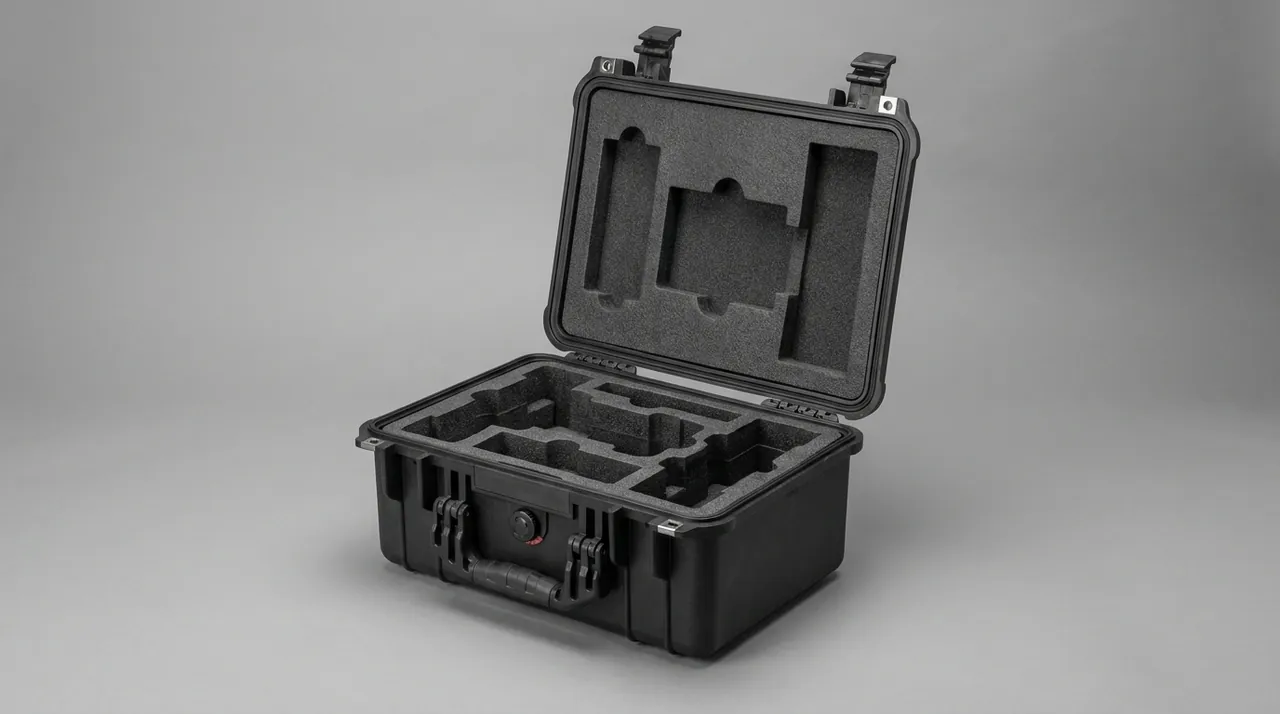
The engineering approach to graded cushioning is to use a soft first layer contoured to the component as the intimate contact layer, a medium-firmness second layer as the energy absorption layer, and the case shell with its ribs as the rigid boundary. For cylindrical bodies of revolution such as pressure housings, the usual practice is to place ring supports along the axis at 300 to 500 mm intervals, so that the barrel is radially constrained but can extend and contract slightly in the axial direction. This avoids the local stress concentration that occurs when a component is over-constrained and then dropped. For diaphragm-type pressure sensors, the diaphragm face must not touch any material at all, which is normally achieved by machining a relief groove in the insert.
For more detail on foam selection and structural design, compare the custom foam insert design guide and the EVA foam insert custom process. Where a trade-off must be made between several foams, the case foam material comparison provides a side-by-side table.
Pressure equalisation valves: why a case must never be fully sealed
This is another high-frequency misconception in subsea equipment transport. If water and moisture are the enemy, would a perfectly sealed case not be better? The answer is the opposite: a case with high air-tightness must be fitted with pressure equalisation.
There are three reasons.
- Pressure differential and altitude. Air cargo holds are typically depressurised to the equivalent of 2,000 to 2,500 metres of altitude, and high-altitude road transport produces a similar differential. If the interior is completely isolated, a continuous positive internal pressure presses on the gasket, driving its compression ratio away from the design value; over time its rebound capacity declines.
- Thermal cycling. Day-night temperature swings and trailer temperature changes make the internal air expand and contract repeatedly, creating a breathing load that concentrates on the gasket and latches.
- Difficult and damaging opening. With a significant pressure differential, a large initial force is needed to open the case, and the moment it releases can eject components or damage the case mouth.
The conventional pressure equalisation valve design uses a hydrophobic and oleophobic microporous membrane, commonly expanded PTFE, which allows gas to pass while blocking liquid water and oil mist, together with a protective cap that prevents mud and water from blocking the membrane surface. The valve is normally positioned on the upper part of the case side wall so that it is not submerged in standing water. For the mechanical details, see the function and selection of pressure equalisation valves for protective cases and the integrated design of hinges, latches and seals.
Dedicated protection for sensors, acoustic transducers and electronic housings
These three component groups represent the three extremes of requirement in subsea packaging and deserve separate treatment.
Pressure, temperature and depth sensors. The objects to protect are the diaphragm and the pressure port. A diaphragm is an extremely thin metal or ceramic structure, and any point contact can produce irreversible denting and zero-point drift. Packaging requirements are a floating diaphragm face, a dust-free interior, a desiccant, and avoidance of severe thermal cycling. For sensors that have already been calibrated, a separate pocket for the calibration certificate should be provided so the certificate is not crushed along with the component.
Acoustic transducers and hydrophones. The objects to protect are the acoustic window, usually a polyurethane or rubber matching layer, and the internal piezoelectric ceramic stack. The acoustic window is soft and easily scratched, and surface contamination alters acoustic impedance matching. Piezoelectric ceramic is brittle and highly sensitive to transient shock. A full-contact soft facing of low-hardness EVA or PE foam is recommended, and once the component is in the case there should be no perceptible free movement.
Electronic housings and pressure-rated junction boxes. The objects to protect are the seal faces, penetrator connectors and internal electronics. These components have usually already completed electrical testing and insulation resistance measurement, and if insulation resistance falls during transport they must be retested or reworked. Packaging should include ESD measures, either antistatic insert material or antistatic bags, together with a humidity indicator card inside the case so that moisture exposure can be assessed immediately on opening. For packaging practice on static-sensitive components, see design points for ESD shielding cases.
A field observation worth repeating: for a component that has already passed hydrostatic and electrical testing, the most valuable asset is not the component itself but its verified condition. Every packaging decision should serve the goal of no re-verification being required after the case is opened.
Standards and testing: MIL-STD-810H (not a military certification), ISTA, GB/T 4857, ASTM D4169
For a subsea equipment case to pass a customer packaging acceptance review, it normally needs to cite a set of public standards that define test methods. These standards serve as methodological references for environmental and transport testing and do not constitute product certification. MIL-STD-810H in particular is used here purely as a reference for environmental test methodology; it is not a military certification, and no claim of military qualification is made or implied.
| Standard | Main content | Relevance to subsea equipment cases |
|---|---|---|
| --- | --- | --- |
| IEC 60529 / GB/T 4208 | Enclosure protection ratings (IP code) | Defines dust and water ratings and their test methods |
| MIL-STD-810H | Environmental test methods (vibration, shock, temperature, humidity, salt fog and more) | Provides general reference for test profile design (not a military certification) |
| ISTA series | Performance testing of transport packages (drop, vibration, compression and more) | Verifies that the packaged case survives a real logistics chain |
| GB/T 4857 series | Basic tests for transport packages | Common basis for domestic transport package testing and reporting |
| ASTM D4169 | Performance testing of shipping containers and systems | Basis for distribution cycle simulation for North American customers |
| ISO 9227 | Corrosion tests in artificial atmospheres: salt spray tests | Evaluates salt spray resistance of the shell and hardware |
| UL94 | Flammability testing of plastic materials | Classifies flame retardance of foams and plastics where required |
| ISO 13628 series | Design and operation of subsea production systems | Clarifies the design boundary of pressure-rated parts and confirms that a case has no pressure duty |
In practice a project rarely needs every test. A common sequence is: type verification of the IP rating to IEC 60529, then drop and vibration testing of the fully packed case to ISTA or GB/T 4857, then salt spray testing of the shell and hardware to ISO 9227, then UL94 classification of foam if flame retardance is required. For how these tests combine, the ISTA transport testing procedure, GB/T 4857 transport packaging testing and ASTM D4169 distribution cycle simulation provide directly citable procedures, while the general logic of environmental test profile design is covered in interpreting MIL-STD-810H environmental test compliance.
Transport, lifting and stacking: classification-society transport awareness
The real journey of a subsea equipment case on a marine project is far more complex than ordinary industrial packaging: factory, road, port warehouse, container or breakbulk sea freight, port of destination, quay, supply vessel, platform or work vessel, temporary deck storage, final installation. Each leg has a different dominant hazard.
- Container sea freight. The dominant hazards are sustained high humidity, salt spray and internal temperature cycling. Place sufficient desiccant and a humidity indicator card inside the case, avoid direct contact with the container wall where condensation droplets can act on the case, and follow the manufacturer's stacking limit.
- Quay and supply vessel transfer. The dominant hazards are rough handling and occasional drops. Cases should carry clear lifting and centre-of-gravity markings, and heavy cases should have lifting points or a palletised base. Sling selection on this leg is directly related to the strength of the case lifting points.
- Temporary deck storage on a platform. The dominant hazards are salt spray, ultraviolet radiation and wave splash. Select UV-stabilised shell compounds, stainless or fully plated hardware, and keep the case bottom clear of the deck so it is not standing in pooled water.
Classification societies including DNV and ABS have published extensive rules and recommended practice for offshore transport and lifting operations, and project documentation commonly cites them to specify slings, sea fastening and stacking arrangements. It should be clear that a transit case is not itself a classification society certified item, but citing general principles on sea fastening and stacking is normal when preparing a project transport plan, and it makes the packaging documentation easier for an owner to approve. For how this lands in practice, see how to choose a protective case OEM factory; the sections on batch consistency and technical documentation are particularly relevant to marine projects.
A six-step selection process from component list to case specification
Condensing the analysis above into an executable process is what procurement and engineering teams need most.
- Build the component list with critical dimensions. Record for each item the component name, maximum envelope including protrusions such as connectors and lifting lugs, net mass, fragility or allowable acceleration where known, the location and orientation of seal faces, and the sensitive surface areas such as diaphragms, acoustic windows and threads. The output of this step should be a table, not a paragraph of description.
- Define the transport route and exposure conditions. Establish the split between sea, air and road, whether open storage occurs, whether the case goes on deck, whether high-altitude roads are used, and the climate of the destination port. From this, set the IP target, normally IP67 as a baseline and IP68 capability for open deck use, and decide whether a pressure equalisation valve is mandatory.
- Define the insert concept and load paths. Provide relief around sensitive faces, select foam density and thickness from mass and fragility, use ring supports for cylindrical bodies of revolution, and add intermediate supports for long cantilevered items.
- Define case type, volume and handling method. Choose between hand-carry, shoulder-carry, wheeled trolley or vehicle-stacked formats based on unit mass, check compressive load capacity against the stacking requirement, and decide latch type and whether a tamper-evident seal position is needed based on how often the case is opened.
- Define accessories and markings. Lifting markings, centre-of-gravity marking, orientation marking, humidity indicator card, desiccant, calibration certificate pocket, spare parts compartments and tool positions. Where rapid inventory on site matters, consider engraving component names and sequence numbers into the insert.
- Define the acceptance method and documentation. Agree incoming inspection items, covering appearance, dimensions, gasket condition, IP sampling and insert fit, along with sampling level and acceptance rules, and require the supplier to provide shell material notes, hardware surface treatment notes and optional test reports. For sampling scheme design, custom case acceptance and AQL sampling offers criteria that can be adopted directly.
Incoming acceptance and whole-life maintenance
A subsea equipment case is a long-life returnable asset, and its condition directly affects the safety of every component that travels in it. Acceptance and routine maintenance should be fixed routines rather than ad hoc checks.
Incoming acceptance checklist
- Shell free of through cracks, distortion or impact dents; case mouth visually flat and true.
- Gasket complete, not twisted, no trapped foreign matter; seal groove clean and free of particles.
- Latches fully engaged with consistent effort; hinges free of play or noise.
- Pressure equalisation membrane clean with the protective cap in place.
- Insert fit matches the drawing and relief grooves align with sensitive faces.
- Desiccant and humidity indicator card present in the agreed quantity.
- Accompanying documents, including material notes, test reports and calibration certificates, complete.
Routine maintenance recommendations
- Clean the seal groove and case mouth after each use with a mild detergent and a soft cloth; never use solvent-based or strongly alkaline cleaners. See correct cleaning and care for protective cases for detailed methods.
- Inspect the gasket every 6 to 12 months and replace immediately on hardening, cracking or permanent flattening; shorten to 3 to 6 months in marine environments or high-turnover service.
- During long storage, leave latches slightly open or ventilate periodically so the gasket is not under permanent compression; keep desiccant inside and replace it on schedule.
- Avoid prolonged direct sunlight and rain exposure in storage; check castors and telescopic handles periodically on wheeled cases.
- Maintain a case number to component to transport history log so the shipping record of high-value pressure-rated components remains traceable. On judging case condition and replacement timing, see protective case service life and replacement criteria.
Frequently Asked Questions
Q: Subsea equipment is designed to work in water, so why does transport packaging focus so heavily on moisture and sealing?
A: Because the transport environment and the operating environment involve two entirely different failure mechanisms. When a component operates subsea, the external load is hydrostatic pressure and the interior electronics cavity stays dry; the metal and electronic parts never contact seawater directly, and corrosion and pressure resistance are handled by the pressure housing, the seal system and the cathodic protection system. During transport, by contrast, the component is exposed to humid salt-laden air, condensation driven by day-night temperature swings, quay dust and deck water. Condensation forms a continuous water film on component surfaces, directly reducing insulation resistance, contaminating connector pins and rusting seal groove hardware, while salt spray initiates pitting on aluminium and carbon steel parts. More critically, this degradation is usually invisible before the equipment enters the water, and a leak can follow shortly after the lift. The focus of transport protection is therefore preserving an already-verified dry and clean condition, which is a completely different objective from subsea pressure and corrosion resistance.
Q: If a case is rated IP68, can it simply be taken into the water together with the component?
A: This is not recommended, and a transit case should never be treated as subsea protective equipment. The test depth and duration behind an IP68 rating are agreed between supplier and user, commonly on the order of a few metres for thirty minutes to a few hours, and neither the structure nor the sealing design targets long-term hydrostatic loading. Subsea pressure housings are designed along the lines of the ISO 13628 series, with wall thickness calculated for the operating depth, stress verified at end caps and flanges, O-ring compression ratio and extrusion gap established, and the result confirmed by hydrostatic testing. A transit case has none of these design inputs or verification steps, and prolonged immersion will eventually fail it through permanent gasket deformation, shell creep or latch instability. The correct approach is to treat the transit case as the landside guardian of the pressure boundary: preventing seal groove scoring, end face impact damage and O-ring compression set, so that the component arrives on site in the condition in which it left the factory for professional installation and pressure testing.
Q: How should IP65, IP67 and IP68 be selected, and is a higher number always better?
A: A higher number is not automatically better; the rating should match genuine exposure. IP65 provides full dust protection and resistance to water jets, suits workshop transfer, covered container transport and indoor storage, and is the best balance of cost and weight. IP67 provides full dust protection and temporary immersion resistance, suits coastal laydown yards, wet loading and unloading and temporary open storage at a quay, and is the common choice for subsea equipment export packaging. IP68 provides continuous immersion resistance and suits long-term open or deck storage where there is a risk of the case going overboard, but it usually comes with heavier latches and thicker sealing structure and is less convenient to open. Two points deserve emphasis. First, an IP rating only holds when the gasket is clean and intact, the latches are correctly closed and the pressure equalisation device works as designed; most field water ingress is a usage issue rather than a rating issue. Second, higher ratings mean heavier and more expensive cases, so specifying IP68 for a workshop transfer task that only needs IP65 actually reduces handling efficiency.
Q: Why must a highly sealed case be fitted with a pressure equalisation valve, and will that not simply let water in?
A: A pressure equalisation valve uses a hydrophobic and oleophobic microporous membrane that allows air to pass while blocking liquid water and oil mist, so its function is to eliminate the pressure differential rather than to open an ingress path. Reduced cabin pressure in air freight, low atmospheric pressure on high-altitude roads, and day-night temperature swings all create positive or negative internal pressure. If the case were completely sealed, that differential would act continuously on the gasket and latches, driving the gasket compression ratio away from its design value; over time the rebound capacity declines, opening becomes difficult, and components can be damaged the moment the case releases. The valve relieves that differential so the gasket can remain stable at its design compression, which actually lowers the risk of leakage. When specifying, check membrane hydrophobic rating, air flow rate, protective cap design and installation height; the valve is normally placed on the upper part of the case side wall so it cannot be submerged in pooled water.
Q: What is the most common packaging mistake with long cylindrical pressure housings?
A: Over-constraining them. In an effort to control vibration, many packers wrap the barrel completely in foam, which fully restrains it along its entire length. On impact, the shock energy travels through the foam into the barrel surface and, because the barrel cannot release it, local stress concentration forms near the seal grooves, producing ovalisation or slight end-face distortion. This kind of distortion is invisible to the eye and hard to detect with calipers, yet it misaligns O-ring compression. A sounder approach is to place ring supports along the axis at 300 to 500 mm intervals, radially constraining the barrel while allowing slight axial movement, and to leave the end-face seal groove region entirely free. All support rings should be of consistent hardness so that load is evenly distributed. Where end caps are already fitted, the caps should not carry the load, and relief positions should be provided for lifting lugs or process flanges where necessary.
Q: Why do case hardware components cause so much trouble on marine engineering projects?
A: Because hardware is usually the weakest link in the corrosion chain. Hinges, latches, telescopic handles, castors and rivets are often made from different materials, and once assembled in a marine salt spray environment they form galvanic couples, producing the classic outcome of a sound shell with seized screws and a latch that will not open. Hardware also has many crevices and poor coating coverage, so coatings tend to be thin at edges and corners and corrosion starts there. Workable measures include preferring stainless steel or appropriately finished hardware, adding insulating washers or coatings at dissimilar metal interfaces, selecting screw grades compatible with the case material, and verifying by sampling with ISO 9227 neutral salt spray testing before shipment. These requirements should be written as explicit clauses in project documentation rather than left to supplier default, otherwise batch-to-batch variation will be large. It is worth specifying the acceptance evidence as well: a salt spray test report referring to ISO 9227, even as a short screening test, settles far more arguments than a verbal assurance that the hardware is corrosion resistant.
Q: Does referencing MIL-STD-810H mean the case has a military certification?
A: No. MIL-STD-810H is an environmental test method standard. It defines how to conduct vibration, shock, temperature, humidity and salt fog testing along with approaches to profile design; it issues no certification and confers no military qualification. In the protective case context, citing it means adopting a public, reproducible methodology so that both parties share a common language for vibration resistance, temperature tolerance and salt spray resistance. A genuine compliance statement should read along the lines of "environmental testing conducted in accordance with the relevant methods of MIL-STD-810H", accompanied by the specific conditions such as level, frequency range, duration and number of cycles, rather than a general claim of compliance with a military standard. For subsea equipment customers, aligning the test profile with the actual transport route is far more valuable than pursuing a standard's name. Project specifications are therefore best written around the real exposure profile, the transport route and the storage duration, with the standard named only as the method reference.
Q: Should the insert foam be EVA, EPE or PU, and how is that decided?
A: It depends on component mass, fragility and contact face sensitivity. EPE has low density, a long cushioning stroke and low cost, and suits buoyancy modules and aluminium frame parts that are large, light and not surface-critical. EVA has higher density, good rebound, and can be precisely machined into complex cavities with stable dimensions, making it suitable for sensors, connectors and small electronic housing sections that need accurate relief and long-term dimensional stability. PU foam can be tailored in firmness by density and absorbs energy well, which suits heavy pressure housings and hydraulic valve packs, but it takes up relatively more moisture and benefits from sealing or desiccant. In practice, combinations are most common: a low-hardness layer against the sensitive face, a medium-hardness energy absorption layer in the middle, and a high-density outer layer for location and load bearing. On real projects, JUNZHJIA provides a material recommendation for each line of the component list and verifies fit and ease of removal during the sampling stage.
Q: How often should the gasket in a subsea equipment case be replaced?
A: There is no single answer, since it depends on material, opening frequency and environmental severity, but an operational decision logic can be given. Nitrile or silicone gaskets used indoors with a few openings per month typically last two to three years on the basis of field experience. In coastal or high-turnover shipping service, inspect every 6 to 12 months and replace immediately on hardening, cracking, permanent flattening, surface tackiness or obvious loss of elasticity. Inspection methods include visual checking for cracks and embedded foreign matter, pressing with a finger to observe rebound speed, measuring critical cross-section dimensions against the original value, and performing a simple water spray or immersion check with the case closed. Replacement should always be full-perimeter rather than a spliced repair, with the seal groove cleaned at the same time and inspected for damage or distortion along its base; where necessary, order gasket parts from the same production batch to preserve consistency.
Conclusion & Related Reading
Subsea equipment and vehicle parts cases look simple but are in fact a demanding packaging discipline. Its logic reduces to three statements. A transit case performs no pressure duty, yet it guards the pressure boundary. It does not chase absolute sealing, but a controlled microclimate. It does not win by using the thickest foam, but by graded cushioning and precise relief. Putting these into practice means setting the IP rating against IEC 60529 and GB/T 4208, defining corrosion requirements against ISO 9227, selecting transport tests against ISTA, GB/T 4857 and ASTM D4169, and designing the insert around the sensitive faces of each component, all held together by an explicit acceptance and maintenance routine. JUNZHJIA supplies custom protective cases, EVA, EPE and PU insert design, seal part configuration by component model, and OEM and ODM support with volume supply for marine engineering and subsea equipment customers, and can provide shell material and structural documentation as projects require so that transport packaging can be brought within the project quality management system.
Related Reading