

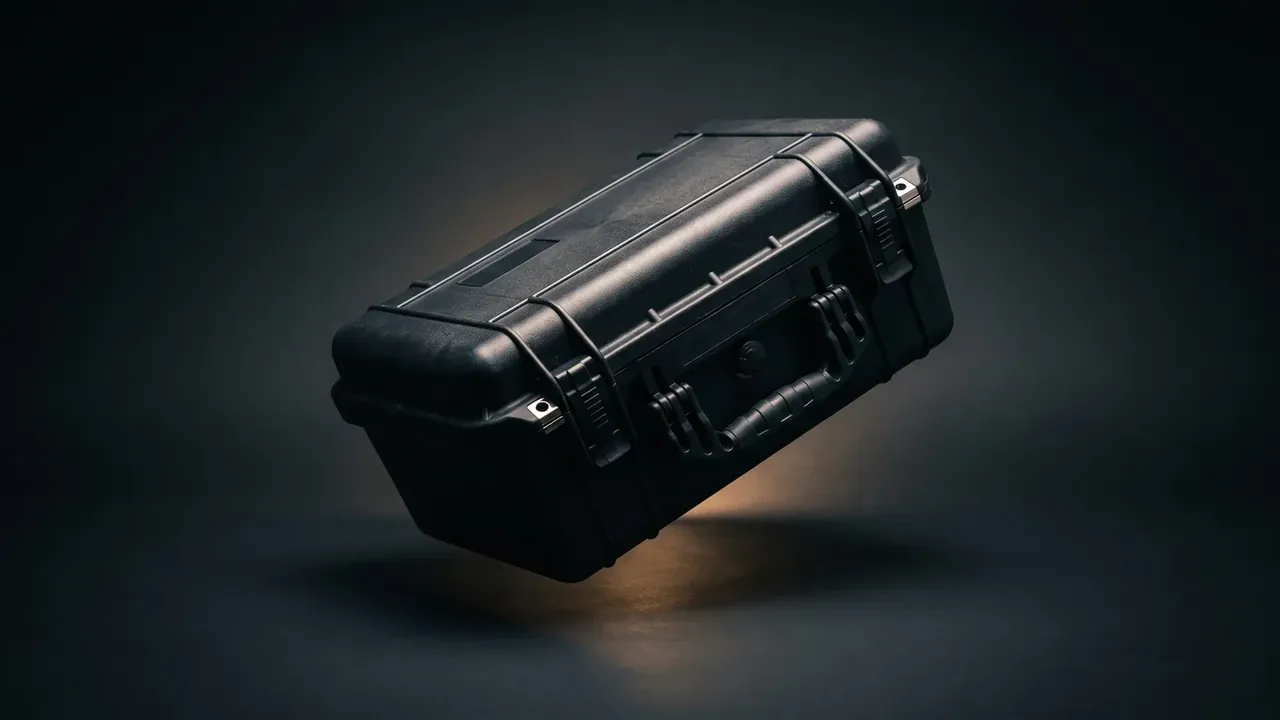
Quick answer: A used flight case is worth buying when five measurements pass: board moisture below 12%, extrusion wall above 1.8 mm, rivet hole ovality under 0.5 mm, hinge pin thicker than 4.6 mm, and foam rebounding within 8 seconds of a 5-second press. Pass all five and a 480 CNY box still has three years left.
Table of contents
- Board First: 9 mm Against 12 mm
- Extrusion and Corner Caps: The Rivet Hole Test
- Latches and Hinges: Preload with a Feeler Gauge
- Foam: Compression Set and Rebound
- Wheels, Handle and Hardware: Wear Limits
- The Money: 480 Against 1,400 CNY
- FAQ
1. Board First: 9 mm Against 12 mm
Check the board before the hardware. A flight case body is 9 mm birch plywood, 13 plies at about 0.7 mm each, with a 12 mm base for forklift point loads. Second-hand boards fail two ways — water and delamination — and a 30 CNY pin meter reads both in 20 seconds.
Twelve percent is the line. Below 12% the board is recoverable; 12% to 16% needs seven days upright at 25 °C and 50% RH before a second reading; above 16% the glue has begun to hydrolyse and the case gains 1.2 kg of water weight. A dull knuckle tap usually marks a patch over 30 mm × 30 mm.
| Board | 9 mm birch ply | 12 mm birch ply | 9 mm PP honeycomb |
|---|---|---|---|
| Build | 13 plies | 17 plies | Honeycomb core, two skins |
| Area density, kg/m² | 6.3 | 8.4 | 4.1 |
| Bending stiffness, relative | 1.0 | 2.4 | 0.7 |
| After water | Edge swell 1.5 mm | Edge swell 1.2 mm | No uptake, skins debond |
| Repair | Epoxy and dowel | Epoxy and dowel | Replace the panel |
One hidden defect is common: a pale ring within 20 mm of the corner-cap screws, where alkali bloom has already halved pull-out strength.
2. Extrusion and Corner Caps: The Rivet Hole Test
The frame is 30×30 mm aluminium tube, 2 mm wall when new, fixed with 4.8 mm blind rivets at 75 mm centres. What gets missed is ovality: after two rebuilds a 4.8 mm hole measures 5.2 mm and the rivet turns in place.
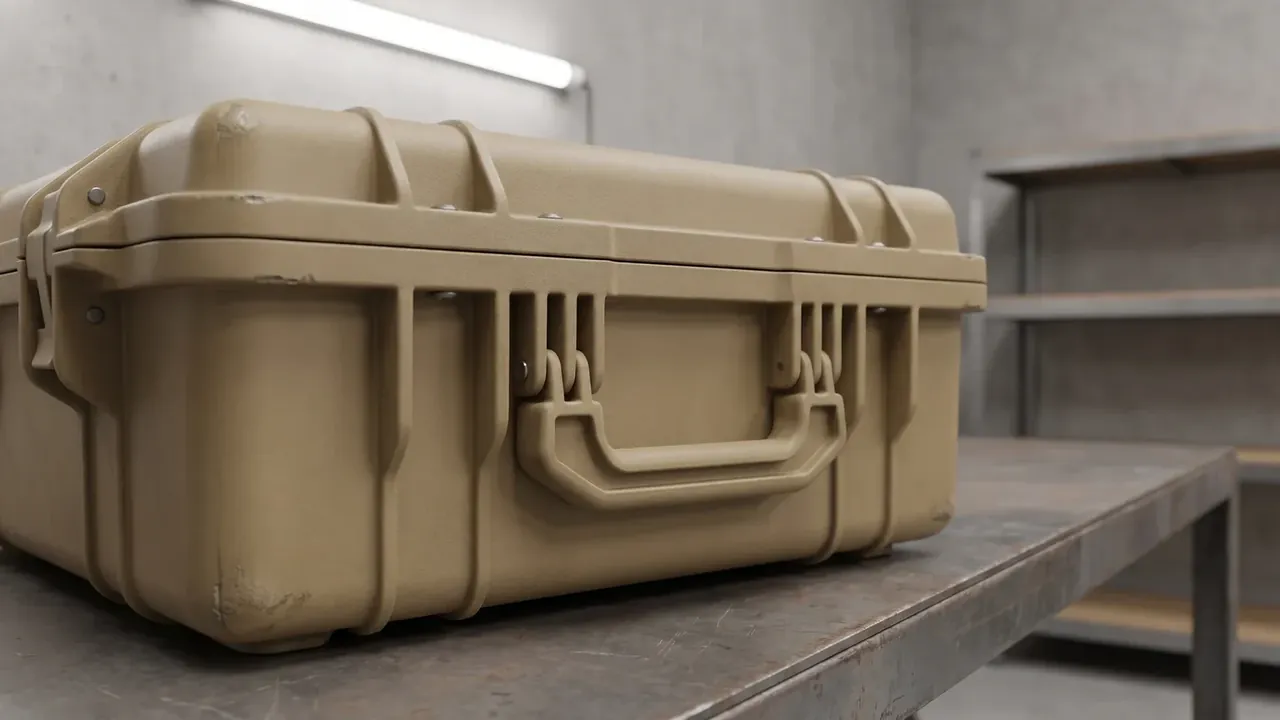
Pull one rivet and try a 5 mm plug gauge. Under 0.2 mm of play passes; 0.2 to 0.5 mm needs 6 mm rivets with a backing washer; past 0.5 mm the hole needs a patch plate.
Corner caps are 2 mm stamped aluminium: check for weld cracks over 10 mm, a gap above 1 mm at the extrusion, and four rivets present. Lose one and the cap lifts 3 mm in a drop, taking the extrusion run with it.
3. Latches and Hinges: Preload with a Feeler Gauge
A butterfly latch is rated at 200 N of preload, which fingers cannot judge but a 0.3 mm feeler gauge can. Push the blade between tongue and seat: no entry means intact preload; 0.3 mm means clamping has fallen to about 120 N and the lid will chatter; 0.5 mm means it is finished.
Hinges are simpler — read the pin. A 5 mm pin is replaced at 4.6 mm, because 0.4 mm of clearance lets the lid shift 2 mm side to side as it drops. A re-welded leaf is a walk-away: the heat-affected zone anneals 1.5 mm sheet to 60% of its strength.
The part everyone forgets is the 1 mm plastic spacer under the latch seat. Without it the latch travels 1.5 mm further and no preload closes the gap.
4. Foam: Compression Set and Rebound
The foam is 45 kg/m³ EVA cut into compartments. Age shows in rebound, not colour. Press a thumb flat for 5 seconds and release: full thickness back within 8 seconds passes; a 2 mm crater after 8 seconds means compression set above 15%.
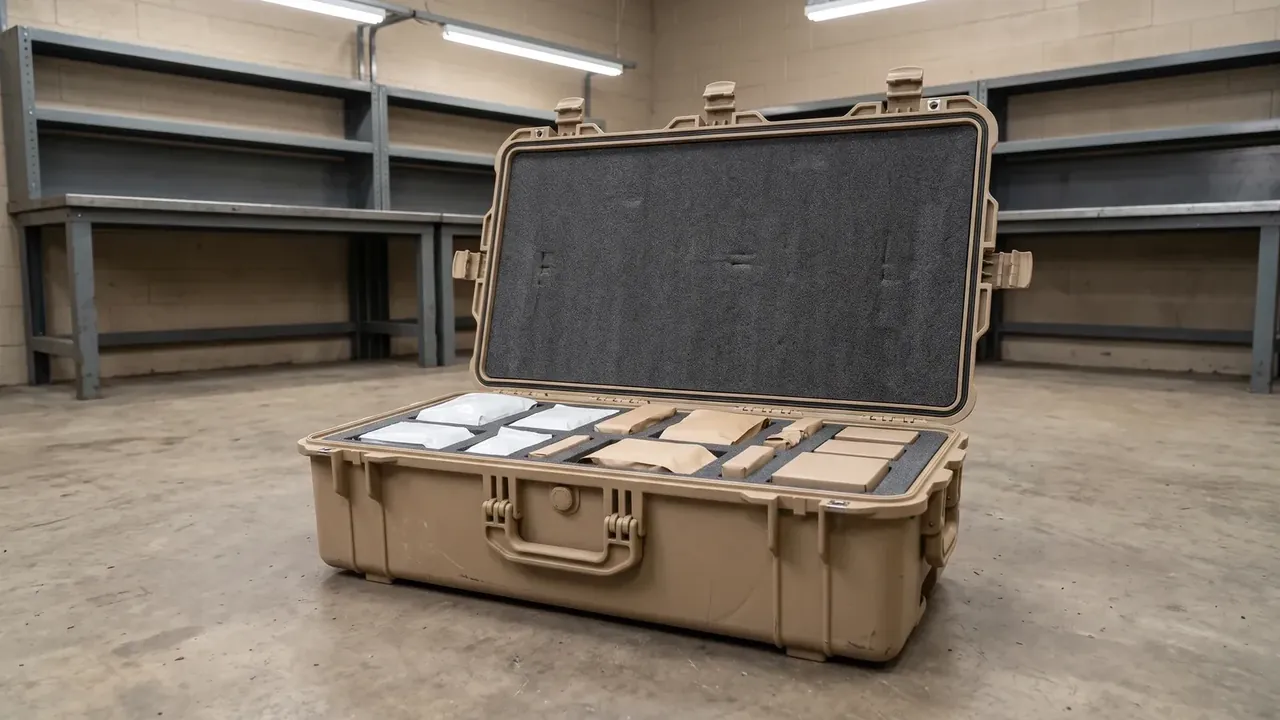
A replacement runs 90 CNY for a 1200×600 mm cavity in three layers, 15% to 19% of a used box price — a cost buyers routinely leave out. Press the four corners, under the handle and the centre of the base, whatever the listing says.
A 3 mm gap between foam and wall means the box took a side squeeze. Measure the diagonals: a difference over 4 mm means the body is out of square.
5. Wheels, Handle and Hardware: Wear Limits
- Wheel diameter 75 mm; replace at 2 mm of tread loss, all four together, 15 CNY each.
- Wheel bearing play 0.4 mm; visible rocking means replacement before it chews the floor.
- Handle wobble under 3 mm is fine; past 5 mm the inner bush is through.
- Latch spring free length 18 mm; below 15 mm it no longer returns the tongue.
All four take five minutes with a tape and a caliper. Hardware is the only part replaceable item by item, so its limits sit wider: wheels, handle and latches are consumables; plywood and extrusion are not.
6. The Money: 480 Against 1,400 CNY
| Item | New flight case | Used flight case |
|---|---|---|
| Purchase, CNY | 1,400 | 480–650 |
| Refurbishment, CNY | 0 | 90–180 |
| Remaining life | 8 years | 3–5 years |
| Annual amortisation, CNY | 175 | 120–160 |
| Single repair, CNY | 20 (rivets) | 45 (patch and rivets) |
On a 1200×600×600 mm cavity, a new box at 1,400 CNY over 8 years amortises at 175 CNY a year; a used one at 480 CNY plus 180 CNY of refurbishment over 4 years lands at 165 CNY. The saving is in optionality: a six-month project writes off six years of depreciation at once, and a used box still resells for 200 CNY.
Past 900 CNY after refurbishment the arithmetic flips: another 300 CNY reaches 85% of a new price, with eight years and a warranty attached. A refurbished unit listed above 950 CNY deserves a new quote first.
Conclusion
Five rulers decide a used flight case: 12% moisture, 1.8 mm wall, 0.5 mm ovality, 4.6 mm pin, 8-second rebound — all readable on site in 20 minutes with a meter, feeler gauge, caliper and tape. The price advantage needs a short project and five passes; past 900 CNY of refurbishment, price a new box.
This article discusses only the container (case body) side of specifications and design intent, and does not cover any handling, loading or use of the contents.
Related Reading
- Flight case boards: birch ply and aluminium frames
- Hinge life on cases: cycles and pin wear
- Replacing flight case latches: butterfly preload and selection
- Case castors: material and load at 75 mm and 100 mm
Related Products
- 8 Series — Gun Cases; Military Equipment Cases; Camera Equipment Cases; Drone Cases; Watch Cases; Knife Cases; First Aid Cases; Electronics Equipment Cases
- WL8-2812 PP Gun Case — model WL8-2812
- All protective cases and toolboxes: 7 series, 158 models