

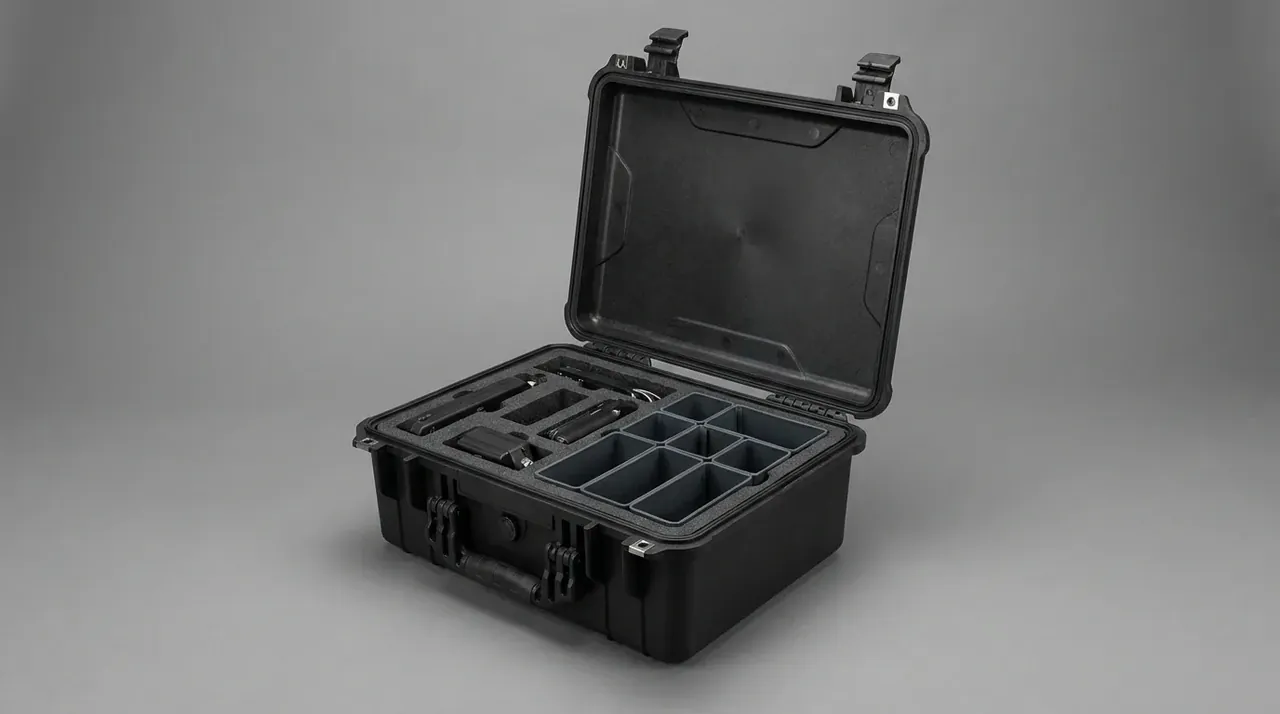
Quick answer: Case winter use at -20 °C starts with a palm pressed on the lid for 5 s, because the seal gains 15 Shore A and opening force doubles to 96 N.
Table of contents
- Case Winter Use: Why the Seal Comes First
- How Closing Force Tracks Temperature
- Why 1.2 m Becomes the Dividing Line
- Warming Up Before the Lid Opens
- Limits and Three Forbidden Moves
- FAQ
1. Case Winter Use: Why the Seal Comes First
Case winter use starts at the gasket ring, not the wall. One EPDM profile reads 62 Shore A at 20 °C and 77 at -20 °C, a 15-point gain that turns a springy strip into hardwood and doubles the force for 30% compression.
Hard rubber does not spring back on its own. The lid presses it flat, and when the lid lifts the seal is still returning; pry the edge then and the shell corner cuts a crease. It reads 0.8 mm, about 22% of section thickness, and compression set there jumps from 8% to 22%.
The order that works has three steps: press the palm on the lid centre for 5 s, press the release end of each catch until it clicks, then lift both edges at a third of normal speed.
Above -10 °C none of this matters. Polypropylene sits near its brittle point there, so corners stop bending and start cracking while the gasket stiffens in the same band. Pressed first, the seal is released rather than torn, and a gasket treated that way passes 90 cycles where the old method leaves a crease at 40.
2. How Closing Force Tracks Temperature
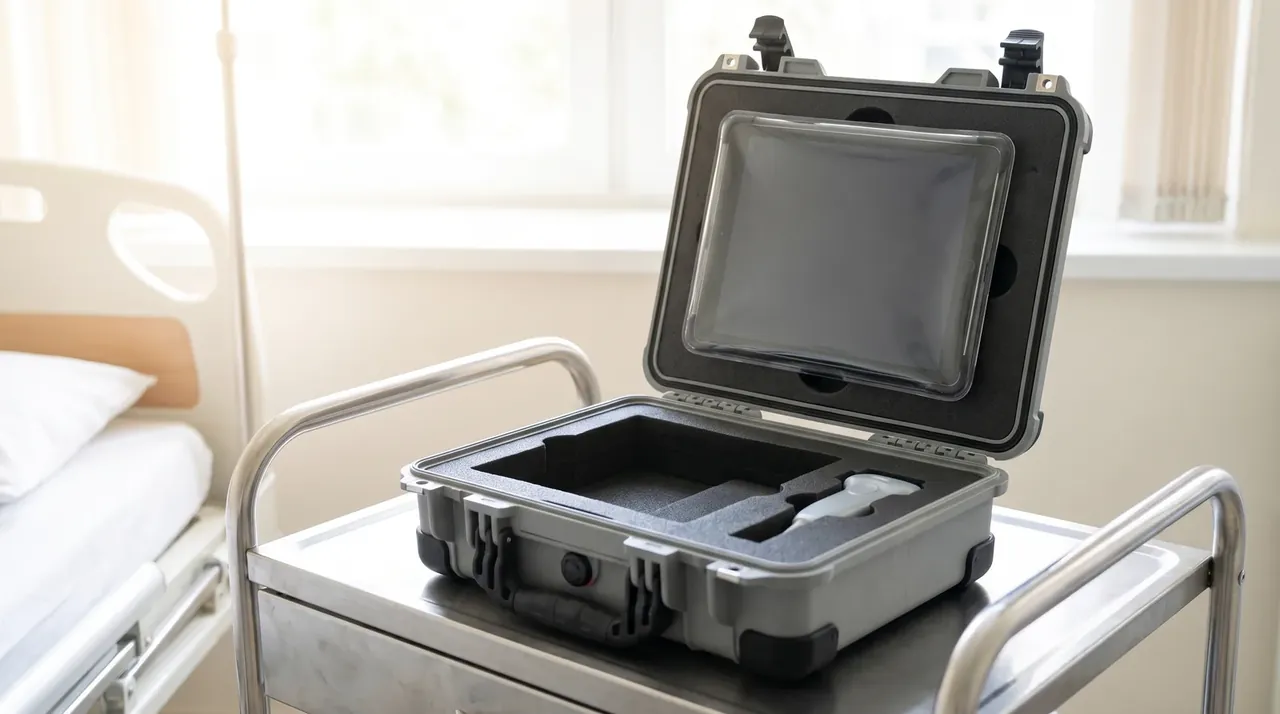
Every 10 °C drop raises opening force by roughly 12%: 45 N at 20 °C, 58 N at 0 °C, 74 N at -10 °C, 96 N at -20 °C. At 96 N one hand is near its limit, and a glove costs another 30%.
| Temp | Seal (Shore A) | Force | Feel |
|---|---|---|---|
| 20 °C | 62 | 45 N | normal |
| 0 °C | 68 | 58 N | firm |
| -10 °C | 73 | 74 N | stiff |
| -20 °C | 77 | 96 N | prying |
| -25 °C | 80 | 110 N | over limit |
The extra force is compression set joining the load path: cold rubber needs more force for the same deflection, and the extra 51 N lands on the catches.
The two catches never share evenly. At -20 °C on one case the first catch carried 62 N and the second 34 N, a ratio of 1.8 to 1. Opening the same side every time halves that catch's life.
The catches shrink as well. Between 20 °C and -20 °C the shell contracts about 0.6%, so clearance grows from 0.3 mm to 0.45 mm and each catch needs 0.15 mm more travel to latch.
3. Why 1.2 m Becomes the Dividing Line
An 8 kg case dropped from 1.2 m arrives with 94 J. At room temperature the corners turn about 70% of that into elastic deflection and give it back; at -20 °C the same corners absorb 28%, leaving 68 J for the shell.
Polypropylene enters its brittle range near -10 °C, and notched impact strength falls from 25 kJ/m² at 23 °C to 6 kJ/m² at -20 °C, a retention of 24%. On the floor that is a white mark in summer and a 12 mm corner crack in winter.
| Temp | 1.2 m drop | Shell | Action |
|---|---|---|---|
| 20 °C | none | rebounds | keep |
| 0 °C | none | whitening | keep |
| -10 °C | 3 mm | surface split | downgrade |
| -20 °C | 12 mm | to rib root | inspect |
| -25 °C | through | delamination | scrap |
So 1.2 m is a room-temperature acceptance height, not a winter one. At -20 °C the equivalent safe height is 0.4 m, and applying the summer figure in winter loosens the criterion threefold. A corner-first landing also concentrates all 94 J into a 30 mm × 30 mm footprint, so keep corners off the ground.
4. Warming Up Before the Lid Opens
A case moved from -20 °C into a 5 °C room does not equalise at once. With 3 mm walls the surface reaches 5 °C in 10 min while the core needs 2 h, and the surface-to-core gap stays above 3 °C for the first 40 min.
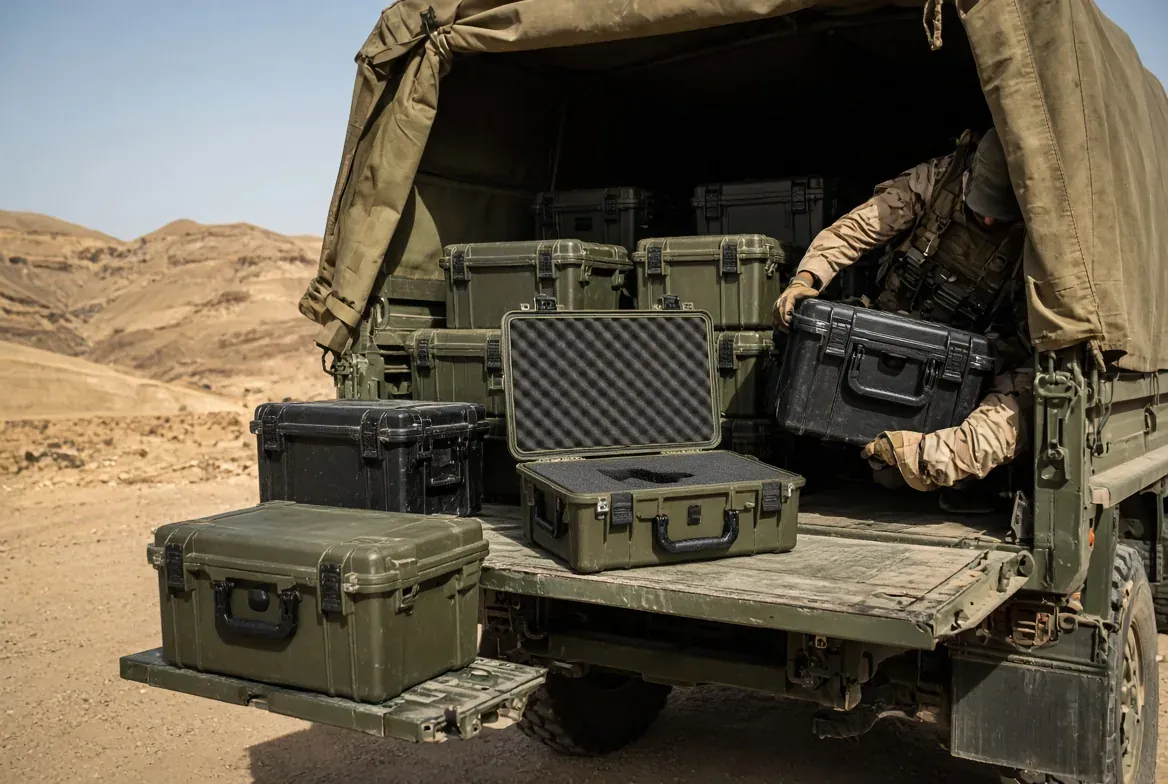
Opening before the gradient clears costs twice: the seal is still hard, so the pull exceeds 90 N, and indoor moisture condenses on the cold surface within 5 min and runs into the sealing groove.
The 2 h figure has a basis. For 3 mm polypropylene at a thermal diffusivity near 0.1 mm²/s, equalising from -20 °C to 5 °C takes about 100 min, so 2 h carries the margin. A heat gun is the wrong tool, since local heating pushes the wall stress difference past 15 MPa.
During warm-up, do not cycle the case and do not lean it on a radiator. Laying it on its side cuts warm-up to 1.5 h, but the lid then loads one side of the gasket at 40% compression.
5. Limits and Three Forbidden Moves
The service limit for case winter use is -25 °C: not where the shell cracks, but where the seal reaches 80 Shore A and opening force reaches 110 N, past what a hand can manage.
The first forbidden move is prying. A screwdriver in the lid gap gives a 15 mm lever arm, and 100 N there puts over 40 MPa on the fulcrum. The rim takes a notch, and a notch past 1 mm destroys the flatness of the sealing face.
The second is dropping. At -20 °C a 0.8 m fall onto concrete delivers 63 J, beyond the 28% the corners absorb. One drop may only leave a 0.2 mm craze line, and the next one breaks along it.
The third is forcing. Bracing a frozen lid with a knee pushes deflection past 6 mm and hinge boss stress concentration to 3.2, bending the pin first; a bent pin stops the lid closing squarely.
Two substitutes: wait, or press. A 5 s palm press cuts contact stress by 20%, and 2 h of warm-up brings the seal under 70 Shore A.
Conclusion
Case winter use reduces to one limits table: opening force at or under 100 N, each cycle inside 10 s, drop height at or under 0.5 m, warm-up of at least 2 h, no more than 15 cycles in a row, and ambient temperature no lower than -25 °C. Cross any line and the method has to change, not the effort. A case at -20 °C has not simply become fragile: the seal is 15 Shore A harder, the corners absorb 28% of the impact energy instead of 70%, and catch wear runs 3.6 times faster, all at once.
| Item | 20 °C | -20 °C | Limit |
|---|---|---|---|
| Opening force | 45 N | 96 N | ≤100 N |
| Cycle time | 3 s | 8 s | ≤10 s |
| Drop height | 1.2 m | 0.4 m | ≤0.5 m |
| Warm-up | 0 h | 2 h | ≥2 h |
| Cycles | 30 | 10 | ≤15 |
| Service temp. | — | -20 °C | ≥-25 °C |
This article discusses container-side specifications and design implications only, and does not cover any handling, loading or use of the contents.
Related Reading
- How cold-temperature brittleness shows up in cases
- Cases in Nordic cold conditions
- Running a cold drop test on cases
- Case handling in cold weather
Related Products
- 8 Series — Gun Cases; Military Equipment Cases; Camera Equipment Cases; Drone Cases; Watch Cases; Knife Cases; First Aid Cases; Electronics Equipment Cases
- WL8-2812 PP Gun Case — model WL8-2812
- All protective cases and toolboxes: 7 series, 158 models