

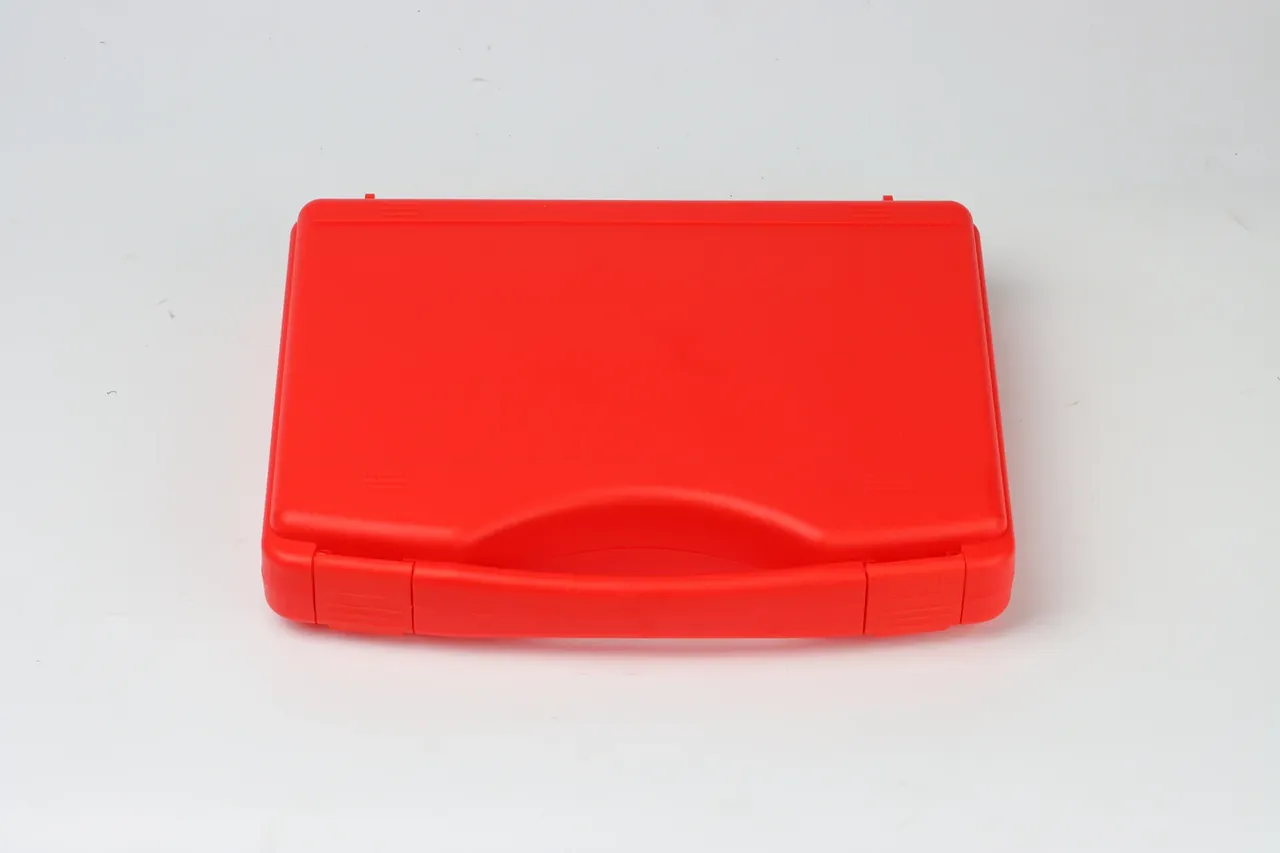
Quick answer: Case colour and UV life are decided by three numbers after 2000 hours of xenon testing: colour shift ΔE, notched impact retention and chalking grade. At 0.3% HALS plus 2% rutile TiO2, ΔE falls from 12.4 to 3.2 and impact retention rises from 38% to 76%.
Table of contents
- Three Bands and Two Years of Irradiance
- Colour Sets Surface Temperature: 78 °C vs 52 °C
- Fading and Chalking: ΔE 4 Is the Line
- Embrittlement: Impact and Elongation Over Time
- Writing UV Into the Drawing
- FAQ
1. Three Bands and Two Years of Irradiance
A horizontal surface in southern China collects 4600 to 5000 MJ/m² a year. Ultraviolet is about 5% of that, or 65 kWh/m², so two years outdoors means 130 kWh/m² of UV energy on the same shell. That figure is what a UV package has to answer.
UV-B runs 280 to 315 nm and carries more energy per photon but is under 1% of ground-level UV. UV-A runs 315 to 400 nm, is about 5% of it, and penetrates 0.2 mm into the wall. The tertiary carbon on a PP chain is the weak point: once abstracted, the chain breaks, carbonyl groups form, and the surface chalks, lightens and loses impact strength.
Heat works alongside it. Every 10 °C of surface temperature roughly doubles the rate of thermo-oxidative degradation, so one compound can differ by a factor of two between Hainan and Heilongjiang.
We screen with a xenon arc to ISO 4892-2: 0.51 W/m² at 340 nm, 102 minutes of light plus 18 minutes of spray, black panel at 65 °C. Two thousand hours ranks against two years in Guangdong; it is not presented as an equal sign.
| Package | Stabiliser system | ΔE at 2000 h | Impact retention | Cost per kg |
|---|---|---|---|---|
| Natural, unstabilised | none | 12.4 | 38% | 0 |
| Standard | HALS 0.15% + UV absorber 0.1% | 6.8 | 58% | 0.6 |
| Light-colour outdoor | HALS 0.3% + rutile TiO2 2% | 3.2 | 76% | 1.4 |
| Dark outdoor | HALS 0.15% + carbon black 2% | 2.6 | 81% | 0.9 |
2. Colour Sets Surface Temperature: 78 °C vs 52 °C
At 35 °C ambient, 1000 W/m² at noon and 1 m/s of wind, a black shell at L* 24 reaches 78 °C, a dark grey at L* 45 reaches 68 °C, and an off-white at L* 82 stays at 52 °C. The inside follows: 61 °C against 44 °C, a 17 °C gap that matters more to the payload than to the wall.
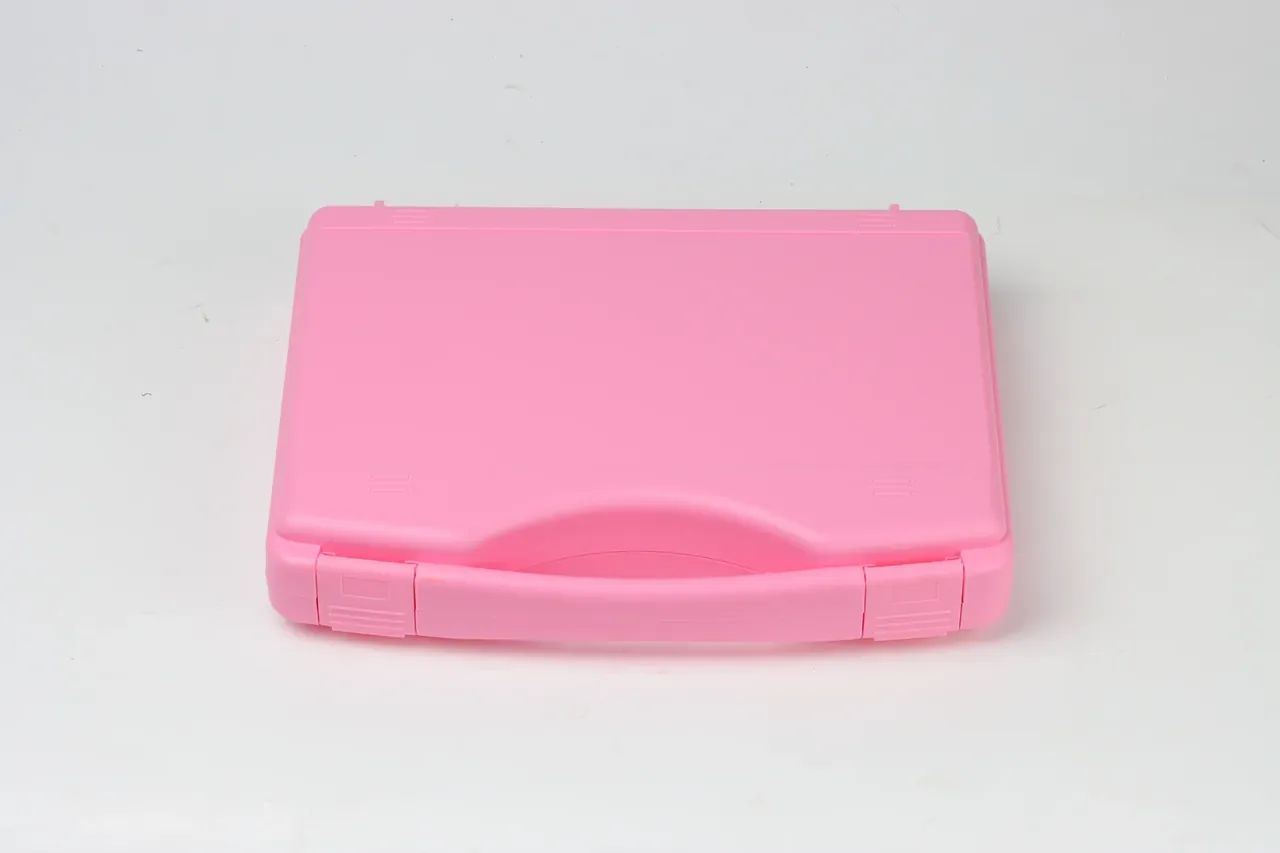
Dark does not mean forbidden. Carbon black at 2% is the most effective UV screen there is, so UV never reaches the inner wall and the degraded layer stays thin: ΔE 2.6 at 2000 hours. Light colours reflect UV with rutile TiO2 and scavenge radicals with hindered amine light stabilisers instead.
The crystal form belongs on the drawing. Anatase saves 1.8 per kg and its photocatalytic activity accelerates chalking; at 2000 hours an anatase compound chalks to grade 2 while rutile stays at grade 0.
3. Fading and Chalking: ΔE 4 Is the Line
ΔE 1.5 is where the eye just notices, 4 is where anyone notices, and 12 is scrap. Those three numbers do more work on an inspection sheet than the phrase "colour fast".
Measured at 500, 1000, 1500 and 2000 hours, the unstabilised natural compound reads 4.2, 7.8, 10.6 and 12.4, while the light-colour outdoor grade reads 1.0, 1.8, 2.5 and 3.2. The curve is steepest in the first 500 hours because the degraded layer then starts shielding the fresh material beneath it.
| Exposure | Unstabilised ΔE | Outdoor grade ΔE | Unstabilised chalk | Outdoor chalk |
|---|---|---|---|---|
| 500 h | 4.2 | 1.0 | 0 | 0 |
| 1000 h | 7.8 | 1.8 | 1 | 0 |
| 1500 h | 10.6 | 2.5 | 1 | 1 |
| 2000 h | 12.4 | 3.2 | 2 | 1 |
Chalking is graded to GB/T 1766, where 0 shows nothing and 2 leaves white powder on a finger. Surface roughness on an unstabilised shell climbs from 0.8 to 2.6 µm after two years, with a chalk layer 20 to 40 µm thick, enough to bury screen printing under a fog.
Cleaning slows it and cannot reverse it: a neutral cleaner lifts the powder and leaves the colour lighter, while a solvent opens the degraded layer and cracks follow the wipe.
4. Embrittlement: Impact and Elongation Over Time
Fading is the face, embrittlement is the structure. Notched Charpy impact at 25 °C reads 8.0 kJ/m² new, 5.4 at one year, 3.1 at two and 2.2 at three. Elongation at break warns earlier, falling from 320% to 90%.
Infrared shows why. The carbonyl index at 1715 cm⁻¹ is 0.08 new, 0.42 after two years and 0.86 after five. More carbonyl means shorter chains, and the material swings from ductile to brittle: a drop no longer deforms the wall, it splits it.
Failures cluster at corners and latch seats, where the wall transitions from 3 to 5 mm and the radius has the worst molecular orientation. Four hours at -5 °C, then a 1.2 m corner drop: a two-year-old shell cracks 18 mm, a new one shows a 3 mm white mark.
| Age | Impact | Elongation | Carbonyl index | Verdict |
|---|---|---|---|---|
| 0 years | 8.0 kJ/m² | 320% | 0.08 | normal |
| 1 year | 5.4 kJ/m² | 210% | 0.21 | normal |
| 2 years | 3.1 kJ/m² | 130% | 0.42 | watch |
| 3 years | 2.2 kJ/m² | 90% | 0.63 | replace |
5. Writing UV Into the Drawing
Five lines belong on the drawing; leave one out and the supplier picks a value:
- Resin and additives: PP grade stated, HALS ≥0.3%, UV absorber 0.2%
- Pigment: rutile TiO2 ≥2% for light colours, carbon black ≥2% for dark, anatase excluded
- Colour: ΔE ≤4 after 2000 hours xenon, recorded every 500 hours
- Strength: notched impact retention ≥70%, elongation ≥120%
- Chalk: GB/T 1766 grade ≤1, no lifting at the print
The cost spreads. The outdoor grade adds 1.4 per kg, or 6.3 on a 4.5 kg case; stretching life from two years to five works out at 1.3 a year.
Screen the compound first. A 500-hour run answers in two weeks, and any formula already past ΔE 5 at that point does not deserve the full 2000 hours.
Conclusion
Case colour and UV performance reduce to three moves: turn two years of exposure into 130 kWh/m², work out surface temperature from colour, and put ΔE, impact retention and chalking on the inspection sheet. The 0.3% HALS plus 2% rutile recipe lands at ΔE 3.2 with 76% retention.
This article discusses only the specification and design intent on the container (case) side, and does not cover any handling, loading or use of the contents.
Related Reading
- Colour standards for coloured protective cases
- How colour is compounded into a protective case
- Outdoor waterproof equipment case: 7 gates and 300 mm/h rain
- Hard-shell case material comparison
Related Products
- 8 Series — Gun Cases; Military Equipment Cases; Camera Equipment Cases; Drone Cases; Watch Cases; Knife Cases; First Aid Cases; Electronics Equipment Cases
- WL8-2812 PP Gun Case — model WL8-2812
- All protective cases and toolboxes: 7 series, 158 models