

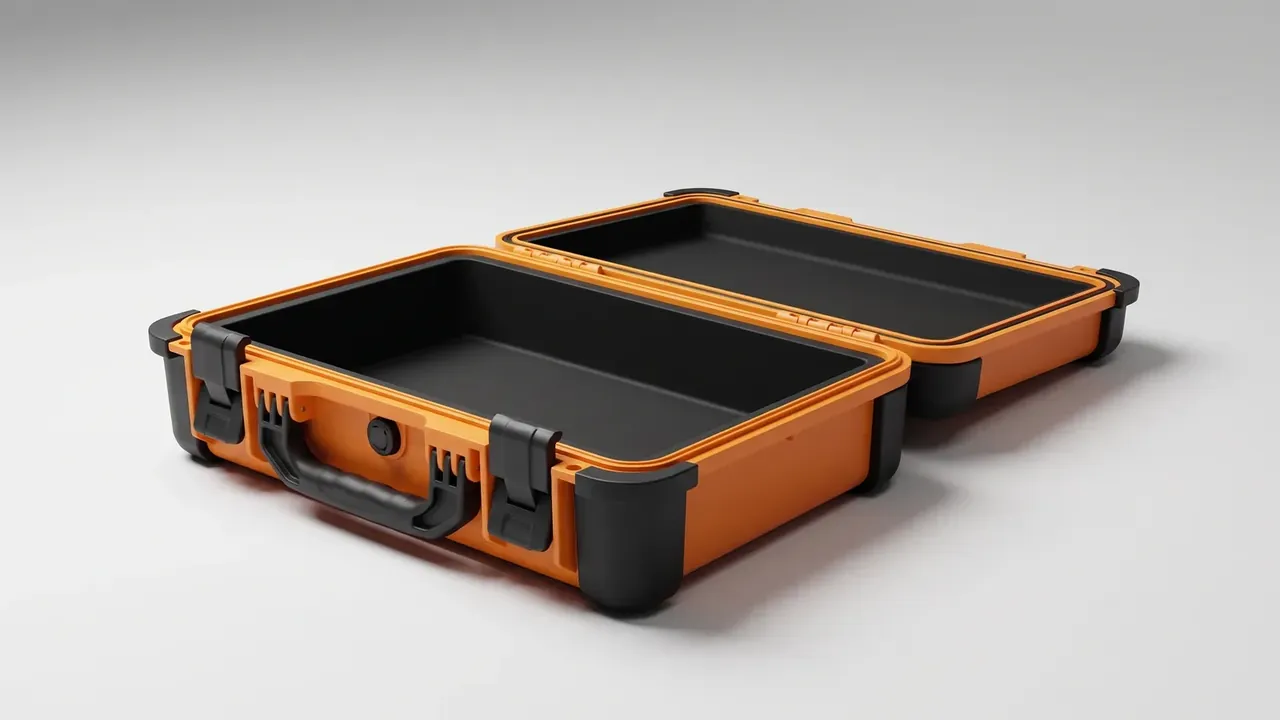
Quick answer: A vehicle-mounted equipment transport case holds only when the fixing method, the 5 to 500 Hz sweep and the 70 C cab are answered together.
Table of contents
- Three Ways to Fix a Case in a Vehicle
- 5 to 500 Hz and 1.5 g
- What 70 C in a Cab Does to Foam
- Four Feet and a 25 mm Anti-Slip Pad
- Three High Under 180 kg
- FAQ
1. Three Ways to Fix a Case in a Vehicle
A vehicle-mounted equipment transport case leaves the warehouse as one object and reaches the chassis as another. Strap a 25 kg shell to a stake bed, bolt it through its feet, or drop it on a rail, and the shaker response differs threefold.
Strapping is quickest: two 25 mm polyester straps through four rings, 90 seconds, 2 to 3 percent stretch. A 200 kg case under 0.8 g slides 8 to 12 mm before they catch; a 25 mm pad cuts that to 3 mm.
Clamp plates bolt the four feet to a 3 mm floor plate at 20 Nm each and hold all six freedoms; a rail with a latch locks in 30 seconds but needs a base flat within 2 mm.
| Fixing method | Degrees held | Point rating | Swap time | Cost |
|---|---|---|---|---|
| Strap and ring | Two horizontal | 400 kg | 90 s | 8 to 12 mm slide |
| Clamp plate | All six | 600 kg | 6 min | Tools, floor holes |
| Floor rail | All six | 350 kg | 30 s | Rail moulded in place |
What cannot be skipped on a vehicle-mounted equipment transport case is the load path: 3 mm of boss around each strap ring, or 200 kg under 0.8 g pulls 5 mm of hollow into the wall.
2. 5 to 500 Hz and 1.5 g
A vehicle-mounted equipment transport case is qualified on a sine sweep from 5 to 500 Hz at 0.5 to 1 octave per minute, three axes. Body-mounted random levels run 0.5 to 2 g with 1.5 g near the top; that g is RMS, not peak.
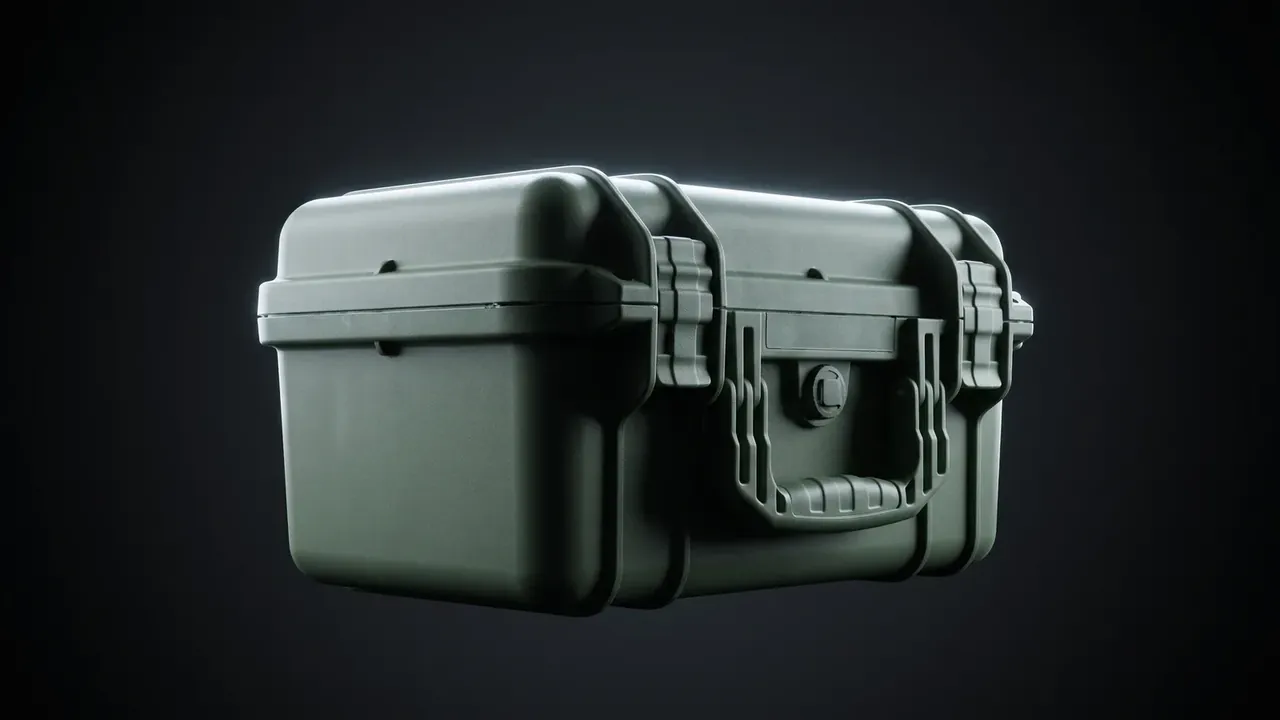
Resonance is where a vehicle-mounted equipment transport case fails first: a mode at 60 to 120 Hz with a Q of 5 to 8 turns 1.5 g into 7.5 to 12 g, and ribs at 90 mm pitch push the mode past 130 Hz.
| Band | Where it comes from | What the case does | Countermeasure |
|---|---|---|---|
| 5 to 20 Hz | Suspension travel, kerbs | 3 to 8 mm of body motion | Tension, not thickness |
| 20 to 200 Hz | Road input, base resonance | Lid flutter, latches opening | Closer ribs, two latches |
| 200 to 500 Hz | Panel resonance, loose parts | Insert wear, screws backing out | Tight insert, threadlocker |
Below 20 Hz a vehicle-mounted equipment transport case is judged on clamp load: under 150 N of strap tension the case beats several times a second, 300 N stops it, and the wall then carries 300 N extra, so anything under 3.5 mm wrinkles. Above 200 Hz fasteners fail first - dwell ten minutes at the peak over two sweeps, then reject any fastener turned past 15 degrees.
3. What 70 C in a Cab Does to Foam
Heat is the quieter enemy of a vehicle-mounted equipment transport case. A dark van passes 70 C inside after four hours and the lid runs 10 to 15 C above that; the shell copes, since PP deflects near 100 C at 0.45 MPa and ABS between 80 and 95 C.
The insert does not: cross-linked PE holds to about 90 C, EVA softens from 70 C, and 30 kg/m³ EVA at 30 percent compression for 30 days recovers 75 to 85 percent, so the pocket opens 2 to 3 mm and the load moves.
Every 10 C multiplies compression set by 2 to 2.5, so 12 months in a 40 C store equals 2 to 3 months in a cab. Fixes, in rising cost: 45 kg/m³ density, a 1.5 mm relief groove, or 3 mm foil worth 8 to 10 C.
4. Four Feet and a 25 mm Anti-Slip Pad
Four feet on a vehicle-mounted equipment transport case carry load and supply friction: 18 mm high, 900 mm² each, holding the base clear of wash water while leaving a 400 mm span that sags 0.8 to 1.2 mm.
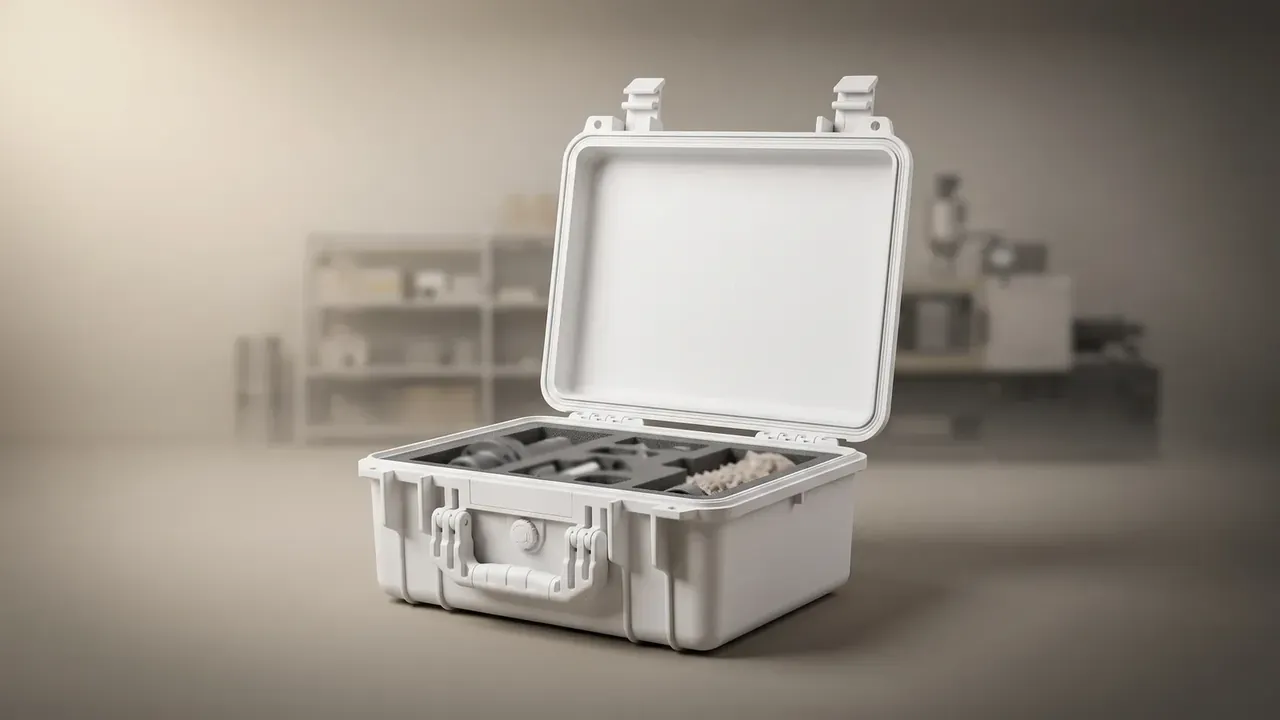
The 25 mm EPDM pad is about friction. Ten percent compression at 0.3 MPa settles 2.5 mm and lifts friction from 0.3 to 0.9: a 200 kg case under 0.8 g needs 1570 N, the pad supplies 1760 N, bare plastic 590 N.
Keep the pad 10 mm proud at each corner and stop at 40 mm, where float reaches 3 mm under 0.8 g.
Feet are never level: 0.8 mm of base flatness and 0.3 mm of foot height put 60 percent of the load on two feet, which a pad brings to 55/45 and 0.52 MPa.
5. Three High Under 180 kg
A 1.9 m cargo box takes three 400 mm tiers at 1.2 m and leaves 700 mm for hands; under 600 mm the middle case becomes a knuckle scraper.
On a vehicle-mounted equipment transport case the bottom tier carries 180 kg, from two 90 kg cases above. Four feet at 45 kg give 0.49 MPa on 900 mm² against 0.8 MPa allowable for PP at 60 C, a margin of 1.6.
Heat takes that back. The allowable is 1.1 MPa at 23 C, 0.8 MPa at 60 C and 0.65 MPa at 70 C, so at 180 kg in a cab the margin falls to 1.3 and a fourth tier at 60 kg per foot ends it.
| Tier | Load above | Foot pressure at 70 C | Allowable | Verdict |
|---|---|---|---|---|
| One | 180 kg | 0.49 MPa | 0.65 MPa | Usable, 1.3 margin |
| Two | 90 kg | 0.25 MPa | 0.65 MPa | Usable, 2.6 margin |
| Three | none | none | 0.65 MPa | Self weight only |
Stack feet over feet. Offset past 20 mm puts the load on the lid panel, where deflection goes from 1.2 mm to over 4 mm.
Conclusion
Fix the mounting points, then the vibration margin, then the temperature; reverse that order and every later step is a patch. Hold the mode above 130 Hz and foot pressure at 0.49 MPa at 70 C, and a vehicle-mounted equipment transport case needs no extra reinforcement at three tiers.
This article covers only the container side of the specification, not anything done with the contents.
Related Reading
- Feet and stacking load
- Cartons and cases in transit
- Cases for vehicle mount rigs
- Handle static load and two-person lift
JUNZHIJIA
Related Products
- 8 Series — Gun Cases; Military Equipment Cases; Camera Equipment Cases; Drone Cases; Watch Cases; Knife Cases; First Aid Cases; Electronics Equipment Cases
- WL8-2812 PP Gun Case — model WL8-2812
- All protective cases and toolboxes: 7 series, 158 models