

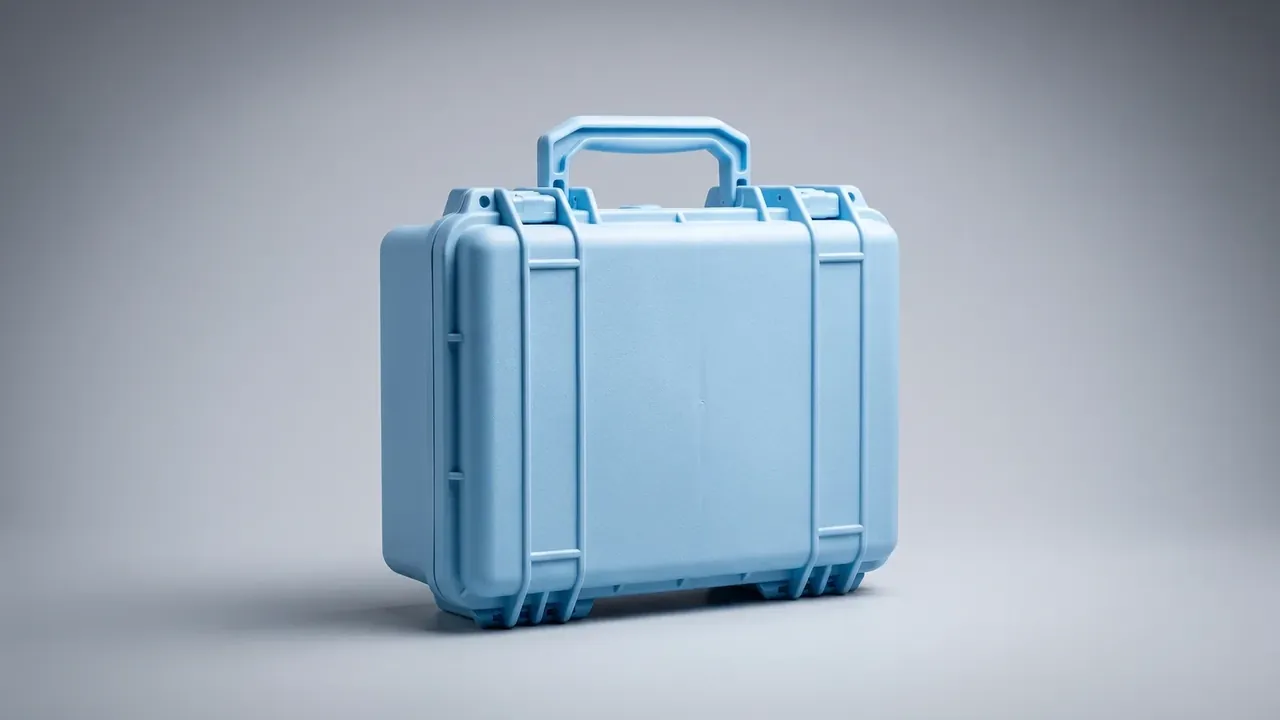
Quick answer: Judge a waterproof plastic box with lid at the lid first. Flatness, groove depth and clamp force decide whether it leaks; spray and stacking only confirm.
Table of contents
- Seven Checks for a Waterproof Plastic Box With Lid
- Lid Flatness and Groove Depth
- Latch Count and Clamp Force
- Spray Before Immersion
- Stacking Sink and Opening Force
- Rejects, Sampling and Records
- FAQ
1. Seven Checks for a Waterproof Plastic Box With Lid
Inspection starts with the removable half. On a waterproof plastic box with lid, the lid carries the gasket, latches and hinge, and water usually gets in there.
| Item | Threshold | Sample |
|---|---|---|
| Flatness | 0.8 mm max on a 300 mm plate | 5 per batch |
| Groove | 6.2 mm, plus or minus 0.2 | 5 per batch |
| Clamp force | 900 N total, four corners | 3 per batch |
| Spray | No ingress under IPX5 | 2 per batch |
| Immersion | 0.5 g gain max | First article |
| Stacking | 1.5 mm sink max | First article |
| Opening | 60 to 120 N | 3 per batch |
Three items are measured open, four closed. Reverse the order and the numbers mean nothing.
Keep two units per batch out of every test as controls. They never enter the spray booth or stacking frame, so in a dispute they are the only untouched evidence.
2. Lid Flatness and Groove Depth
Flatness is most often waved through. Clamp the lid onto a 300 mm plate and work a feeler gauge around the rim; the widest gap may not exceed 0.8 mm. Past that, latch force only moves the warp from one side to the other.

Groove depth must match cord diameter. A 6.2 mm groove with an 8.0 mm cord gives 1.8 mm of compression, or 22.5 percent. Cut it 0.5 mm deeper and compression falls to 16 percent, which reads fine on day one and seeps by month three.
| Groove | Compression | Ratio | Verdict |
|---|---|---|---|
| 6.2 mm | 1.8 mm | 22.5% | Pass |
| 6.7 mm | 1.3 mm | 16.3% | Low |
| 5.7 mm | 2.3 mm | 28.8% | High |
Read the groove at eight points. A spread above 0.3 mm means uneven venting in the tool.
3. Latch Count and Clamp Force
Latch count on a waterproof plastic box with lid follows volume. Two suit anything under 40 litres, four cover 40 to 80 litres, and above 80 litres you need six plus a centre seam rib.
A single latch should hold at least 320 N, and four together at least 900 N of clamp force. Check the balance with pressure-sensitive paper: close the box, wait 24 hours, then read the impressions. A spread above 15 percent between corners means the lid is twisted, and it opens at the shallow corner first under stack load.
4. Spray Before Immersion
Spray and immersion are two stages, not two options. Spray removes assembly faults; immersion confirms the seal design. A waterproof plastic box with lid runs spray on every batch and keeps immersion for the first article.
IPX5 uses a 6.3 mm nozzle at 12.5 litres per minute from 2.5 to 3 metres, three minutes per direction. Stop the water while the fixture turns, or the seam misses the jet.
| Grade | Method | Duration | Use |
|---|---|---|---|
| IPX4 | Oscillating tube | 10 minutes | Indoor transit |
| IPX5 | 6.3 mm nozzle | 3 minutes per side | Batch release |
| IPX7 | 500 mm depth | 30 minutes | First article |
Immersion runs at 500 mm for 30 minutes. Hold the water-to-case difference within 8 °C, or trapped air contracts and pulls water through pores. Read the absorbent paper first, weigh second, require both to pass.
5. Stacking Sink and Opening Force
- Stacking: 3 high, 18 kg each, 45 °C, 48 hours, sink 1.5 mm max
- Opening: 60 to 120 N unladen; under 60 N the latches run loose
- Hinge: pin clearance 0.25 mm max after 8000 cycles
- Cold: 4 hours at minus 25 °C, then a 1 kg ball from 300 mm
- Handle: twice the rated 20 kg for 10 minutes
- Marking: cavity, material and week in one base area
Stacking and opening force pull against each other. More compression raises the pull and reduces the sink. Cold testing gets deleted on the grounds that the goods never enter a freezer, yet a winter loading dock is a freezer. Hinges and handles also get merged, though the first is a wear test and the second a single-event strength test. Write these pairs separately, and a waterproof plastic box with lid stops being a coin toss.
6. Rejects, Sampling and Records
Sampling follows GB/T 2828.1, level II. A lot of 281 to 500 takes 50 units, AQL 2.5 for appearance and 1.0 for function. One functional failure rejects the lot, with no concession on sealing.
Rejection is not the end of the file. Freeze the records from the same tool, shift and material lot, re-test 100 percent for air tightness after rework, and keep that lot apart at re-inspection.
Conclusion
Flatness, groove depth and clamp force are the root; spray, stacking and immersion only prove the root holds. Put thresholds in the purchase file and sample sizes on the sheet, and the verdict stops depending on who is on shift. That is when acceptance of a waterproof plastic box with lid becomes repeatable.> This article discusses only the container (case body) side of specifications and design intent, and does not cover any handling, loading or use of the contents.
Related Reading
- Waterproof hard case grades and tests
- Storing and maintaining case moulds
- Batch marking rules for ammunition boxes
- Pallet marking and stacking rules
- Standard work documents for case production
Related Products
- 8 Series — Gun Cases; Military Equipment Cases; Camera Equipment Cases; Drone Cases; Watch Cases; Knife Cases; First Aid Cases; Electronics Equipment Cases
- WL8-2812 PP Gun Case — model WL8-2812
- All protective cases and toolboxes: 7 series, 158 models