

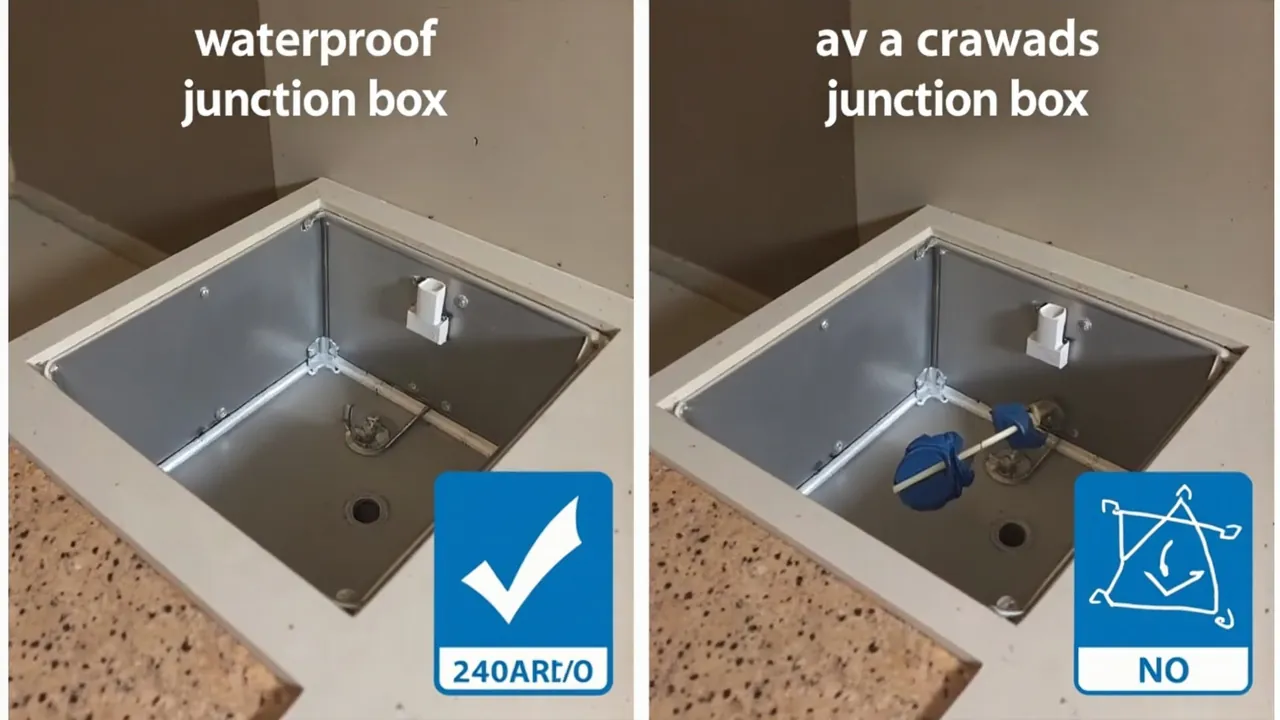
In a building materials market an ordinary recessed junction box sells for a few yuan while an IP67 enclosure two hundred millimetres square costs over a hundred. What exactly does the difference buy? If the answer is merely an extra sealing strip, can you not simply buy a strip and stick one on? You cannot, and here is why. Protection is never delivered by a single component. It comes from a whole set of interlocking design decisions: seal cross-section, clamping method, clamping density, housing stiffness, opening detail and the rating of every accessory. Missing any one of them invalidates the rest.
This article lays the two product families side by side across seven dimensions, working mainly from IEC 60529, adopted in China as GB/T 4208-2017, with reference to UL 50E and NEMA 250 for North American work. One clarification up front: waterproofing has no direct relationship with material quality. Plastic reaches IP68. Stainless steel sometimes stops at IP54.
Contents
- The Difference in One Sentence
- Establishing Which Standard Applies
- IP Code Reference Tables
- Seven-Dimension Comparison Table
- Dust: The First Numeral Everyone Forgets
- Sealing Structure: From Covering to Compressing
- Where the Real Weakness Lies: Glands
- Material, Wall Thickness and Stiffness
- Where the Extra Money Goes
- Where a Standard Box Is Enough
- Three Traps When Retrofitting to Waterproof
- Three Levels of Site Verification
- Writing the Purchase Enquiry
- Frequently Asked Questions (FAQ)
- Closing Notes and Further Reading
The Difference in One Sentence
Compressed to a single line: a standard junction box exists to hold; a waterproof junction box exists to hold and exclude.
The functional brief of a standard box is containment and protection of connections. It gathers terminations in one place so they cannot be pulled apart, prevents people touching live parts, and provides a base for a cover plate. Its protective target is therefore people and conductors rather than environment. Typical ratings run IP20 to IP40, meaning resistance to solid objects above 12.5 millimetres, such as a finger, or above 1.0 millimetre, such as a tool wire. Water is effectively not addressed at all.
A waterproof enclosure adds a further layer: alongside containment it establishes a controlled barrier against external solids and water. That barrier is a system. It defines what may enter, how large a particle, in what attitude, for how long, under what pressure, and all of it verified by third-party testing. Once that requirement is imposed, the housing can no longer be shaped first and sealed afterwards; sealing must drive the design from the outset.
A useful way to remember it is to ask what each product has been tested for. A standard box is tested, if at all, only for whether a probe can reach live metal. A waterproof enclosure is tested for whether water under a defined condition finds its way in, which means somebody had to build a pressure boundary, then prove it held. That proof is the deliverable you are buying, and it is why two boxes that look superficially similar can differ by a factor of ten in price while differing by very little in appearance.
One detail reveals the whole difference. A standard box offers knockouts without any compression structure. A waterproof enclosure treats every opening as requiring a matched sealing element, and that element must carry a rating no lower than the enclosure it sits in.
Establishing Which Standard Applies
Every discussion of IP eventually returns to IEC 60529, Degrees of protection provided by enclosures (IP Code), adopted nationally as GB/T 4208-2017. It defines two things: how the code is assembled and what each grade means in terms of test method and acceptance criteria.
The code consists of IP followed by two characteristic numerals, optionally extended by an additional letter covering protection of persons, as in IPXXB, and a supplementary letter carrying extra information, as in IP67M indicating the equipment was moving during the water test. The numerals mean this:
- First numeral: protection against solid foreign objects, implicitly including protection of persons against access to hazardous parts, taking values 0 to 6.
- Second numeral: protection against harmful ingress of water, taking values 0 to 9, including 9K.
Two rules must be remembered.
Rule one, grades cannot be inferred from one another. IEC 60529 states plainly that compliance with a given grade does not imply automatic compliance with all lower ones. The reason is intuitive: second numeral 5 examines resistance to a jet from a 6.3 millimetre nozzle, whereas 7 examines thirty minutes at one metre of static head, and the two impose almost opposite structural demands. Where a box must face both driving rain and possible ponding, the enquiry has to list both codes and demand data for both.
Rule two, the IP code is not a statement of environmental durability. It is a one-off determination made in a laboratory on a new sample in a standard attitude. It excludes ultraviolet ageing, salt spray corrosion, low-temperature embrittlement and seal degradation over time. Whether an IP67 product still meets IP67 after eight years outdoors is not a question this standard answers; that belongs to ISO 4892 and ISO 9227.
Export work to North America brings UL 50E and NEMA 250 into play. There is no exact mathematical correspondence between NEMA types and IP codes. The usual approximations run: Type 1 near IP20; Type 3R near IP24 to IP34, meaning rain resistant; Type 4 and 4X near IP66 and generally treated as approaching IP67 behaviour, though the tests differ; Type 6P near IP67 to IP68. On international orders those relationships must be written as approximate, never as equals.
IP Code Reference Tables
Both numerals in full, worth keeping next to the office printer for review meetings.
| First numeral | Protection against solids | Brief test description |
|---|---|---|
| --- | --- | --- |
| 0 | None | No test |
| 1 | Objects of 50 millimetres and above | Back of hand probe |
| 2 | Objects of 12.5 millimetres and above | Finger probe, 12 millimetre sphere must not pass |
| 3 | Objects of 2.5 millimetres and above | 2.5 millimetre probe must not pass |
| 4 | Objects of 1.0 millimetre and above | 1.0 millimetre probe must not pass |
| 5 | Dust protected, limited ingress | Talcum chamber, trace entry permitted if operation unaffected |
| 6 | Dust-tight | Same test with no visible dust |
| Second numeral | Protection against water | Brief test description |
|---|---|---|
| --- | --- | --- |
| 0 | None | No test |
| 1 | Vertically dripping water | Ten minutes of dripping |
| 2 | Dripping water tilted 15 degrees | 2.5 minutes in each of four positions |
| 3 | Spraying water | Oscillating tube at plus or minus 60 degrees, ten minutes |
| 4 | Splashing water | Splashing from all directions, ten minutes |
| 5 | Water jets | 6.3 millimetre nozzle, 12.5 litres per minute |
| 6 | Powerful water jets | 12.5 millimetre nozzle, 100 litres per minute |
| 7 | Temporary immersion | One metre depth, thirty minutes |
| 8 | Continuous immersion | Conditions agreed between manufacturer and user, more severe than 7 |
| 9 | High temperature and pressure water | Close range from several angles, 80 degrees Celsius at 8 to 10 megapascals |
Ordinary indoor junction boxes commonly sit between IP20 and IP44; outdoor rain-resistant types between IP44 and IP54; genuinely waterproof products start at IP65, with IP67 and IP68 reserved for ponding, temporary submersion and permanent submersion duty.
Seven-Dimension Comparison Table
This is the working table at the centre of the article. Print it and fill it in row by row when appraising a candidate product.
| Dimension | Standard junction box | Waterproof enclosure, IP65 and above |
|---|---|---|
| --- | --- | --- |
| Typical rating | IP20 to IP44 | IP65 to IP68 |
| First numeral | 2 to 4, finger or tool | 6, dust-tight |
| Second numeral | 0 to 4, none or splash only | 5 to 8, jets through continuous immersion |
| Sealing element | None, or decorative cover contact | Solid silicone or EPDM, 3 to 8 millimetre section, 25 to 35 percent compression |
| Clamping | Snap fit or self-tapping screws, no torque figure | Stainless screws with metal inserts, specified torque, 100 to 200 millimetre spacing |
| Wall thickness | 1.2 to 2.0 millimetres | 2.5 to 5 millimetres with ribs |
| Opening treatment | Knockouts, unsealed | Threaded holes taking glands or sealed plugs |
| Governing standard | General wiring practice only | IEC 60529 or GB/T 4208 type test with third-party report |
| Typical price | A few yuan to tens | Tens to hundreds |
| Application | Dry interiors, flush boxes | Outdoors, damp, dusty and wash-down areas |
The row most often undervalued is clamping. Most improvised solutions fail exactly here: take a standard box, add a strip of rubber, and drive in self-tapping screws. The arrangement looks equivalent, but self-tapping screws hold poorly in plastic, metal inserts are absent so repeated opening is impossible, and there is no torque control, so compression across the four corners can vary by more than half. Uneven compression is the single most common proximal cause of seal failure.
Dust: The First Numeral Everyone Forgets
Discussions about water focus on the second numeral, yet across much of industry the first numeral comes into play sooner.
IP6X dust-tight requires placing the sample in a chamber with talcum powder at two kilograms per cubic metre, drawing internal pressure down by no more than 2 kilopascals, holding for eight hours, then finding no visible dust on opening. IP5X permits limited ingress, accepting any quantity that does not impair operation or safety.
Why insist on it? Two practical reasons.
First, dust enters along cables where these move or vibrate, and becomes conductive mud once damp. In metallurgical, cement, timber and textile plants, a dust layer on terminals absorbs moisture in the wet season and initiates tracking.
Second, dust arrives before water, and dust on a sealing face changes the compression state. Fine particles trapped between gasket and housing act like a layer of sandpaper along the sealing line, converting continuous compression into point contact. Many boxes that begin leaking after two years look clean on the outside yet carry a thin film of dust in the seal groove. That is the mechanism.
So where dust loading is high, specify the first numeral as 6 rather than writing something vague such as "waterproof to IP65". Note carefully that IP65 already carries a 6 in the first position; writing IPX5 would abandon any dust assessment altogether.
Write IP66 or IP67, settling dust-tightness first and then the water numeral. Never write IPX7, since that means no dust testing was performed, which in a dusty plant amounts to no protection at all.
Sealing Structure: From Covering to Compressing
Section drawings of the two families make the difference immediately visible.
A standard box usually has a flat rim around the housing with the lid bearing directly on it, held by two to four self-tapping screws or sometimes only snap fits. A thin foam strip may lie between lid and body, or nothing at all. The structure has exactly one purpose: stop the lid falling off.
A waterproof enclosure is a quantitative system of five elements.
- A seal groove or sealing land: a continuous channel or raised lip moulded into housing or lid, locating the seal and preventing it extruding inward or outward under sustained compression.
- The seal itself: a solid-section silicone or EPDM profile, appearing as O, D, tongue or a moulded one-piece gasket. Its section is designed so that compression lands between 25 and 35 percent when clamped. Below 20 percent it cannot fill micro-scale roughness; above 40 percent it accelerates compression set and can distort the housing.
- The clamping mechanism: stainless screws running into metal inserts or threaded sleeves, at a specified torque, tightened in a diagonal sequence.
- Clamping density: spacing between adjacent points runs from 100 to 200 millimetres, closer as the rating rises. Deflection of the housing between two points under load must stay within what the seal can absorb.
- A stop and water deflector: beyond the sealing line sits a drip edge or labyrinth so that incoming water does not reach the seal line in the first place.
Absence of any one of these degrades all the rest. That is the technical reason why adding a gasket to a standard box always fails: it supplies element two while elements one, three, four and five remain missing.
For reference, 25 to 35 percent compression means that a seal whose free height is 6 millimetres should end up between about 3.9 and 4.5 millimetres thick once the lid is tightened to specification. Below that band the two surfaces meet only at isolated high spots; above it the rubber is being asked to absorb movement it no longer has, and permanent set follows quickly. It also explains why replacing a seal with one of a larger section is dangerous. A thicker profile changes the designed compression ratio, often bending plastic housings outward at the rim, and the joint that results can be worse than the worn seal it replaced.
One more note on compression ratio, because it can be checked on site very simply. Place a short length of soft modelling clay between two clamping points, close the lid to the specified torque, remove it and compare its flattened thickness with the original. The ratio falls out in five minutes and immediately shows whether selection and installation are correct.
Where the Real Weakness Lies: Glands
It bears repeating, because it is overlooked with remarkable frequency.
The IP type test on a box normally addresses the enclosure body, meaning base, lid and the joint between them. The delivered product must then be drilled for glands, sometimes for vents and windows too. If any accessory carries a lower rating than the housing, the assembly performs at the rating of the weakest part.
| Component | Typical marking | Comment |
|---|---|---|
| --- | --- | --- |
| Enclosure body | IP65 to IP68 | The part covered by type testing |
| Cable gland | IP68, depth and duration to be stated | Bodies commonly achieve it, provided the size suits the cable diameter |
| Sealing plug | IP66 to IP68 | Cheap items may be only IP54; always confirm |
| Breather vent | IP66 to IP68 | Hydrophobic membranes typically quote IP68 plus an air flow figure |
| Sight glass | Same as housing | Require a report covering the windowed build |
| Mounting face | Unrated | Seepage behind the mounting face is a hidden entry route |
One low-cost, high-return action at procurement stage is to demand test evidence for a fully configured sample, meaning gland, plugs and options fitted, rather than a report for an empty shell. As set out in Why Do Outdoor Waterproof Boxes Leak: Five Seal Failure Causes and Fixes, most genuine seepage originates at this level.
Material, Wall Thickness and Stiffness
The wall thickness gap between the two families often exceeds a factor of two, and that gap is not about toughness. It is the stiffness precondition of the whole sealing system.
The reason: sealing depends on clamping force being distributed evenly along the entire joint line. As the corner screws are tightened, the housing deflects slightly between them. If the wall is too thin and lacks stiffness, the midpoint lifts, and once lift exceeds the margin left in the compressed seal, that section leaks. This is why plastic waterproof enclosures run above 2.5 millimetres thick and always carry ribs; ribs raise second moment of area and directly reduce deformation under a given load.
Metal versions follow the same principle by another route, relying on sheet thickness and folded box construction, typically 1.2 to 2.0 millimetres in cold-rolled steel and 2.5 to 4 millimetres in die-cast aluminium. Metal brings one additional problem: flatness at welds and folds is hard to hold, so achieving the rating often needs a machined flange face or a resilient liner. That is also why expensive stainless steel sometimes fails to reach IP67 where a moulded plastic housing succeeds; the forming disadvantage outweighs the material advantage.
Common misconceptions in material choice include assuming metal always seals better than plastic, assuming thicker walls are always better, since excessive thickness causes uneven cooling, moulding defects and higher cost without improving sealing, and ignoring differences in expansion coefficient, where a metal housing carrying a plastic cover plate shifts relative to itself between summer and winter and alters compression.
A worked example makes the last point concrete. Fit a 300 millimetre wide ABS cover, expansion coefficient roughly 90 micrometres per metre kelvin, onto a 304 stainless housing at about 17. Over a 50 kelvin swing the difference in length is 300 millimetres times 73 micrometres per metre kelvin times 50, which is about 1.1 millimetres. Asking a seal to absorb all of that usually exceeds its capability, so such combinations need either matched materials or a compliant fixing detail.
Where the Extra Money Goes
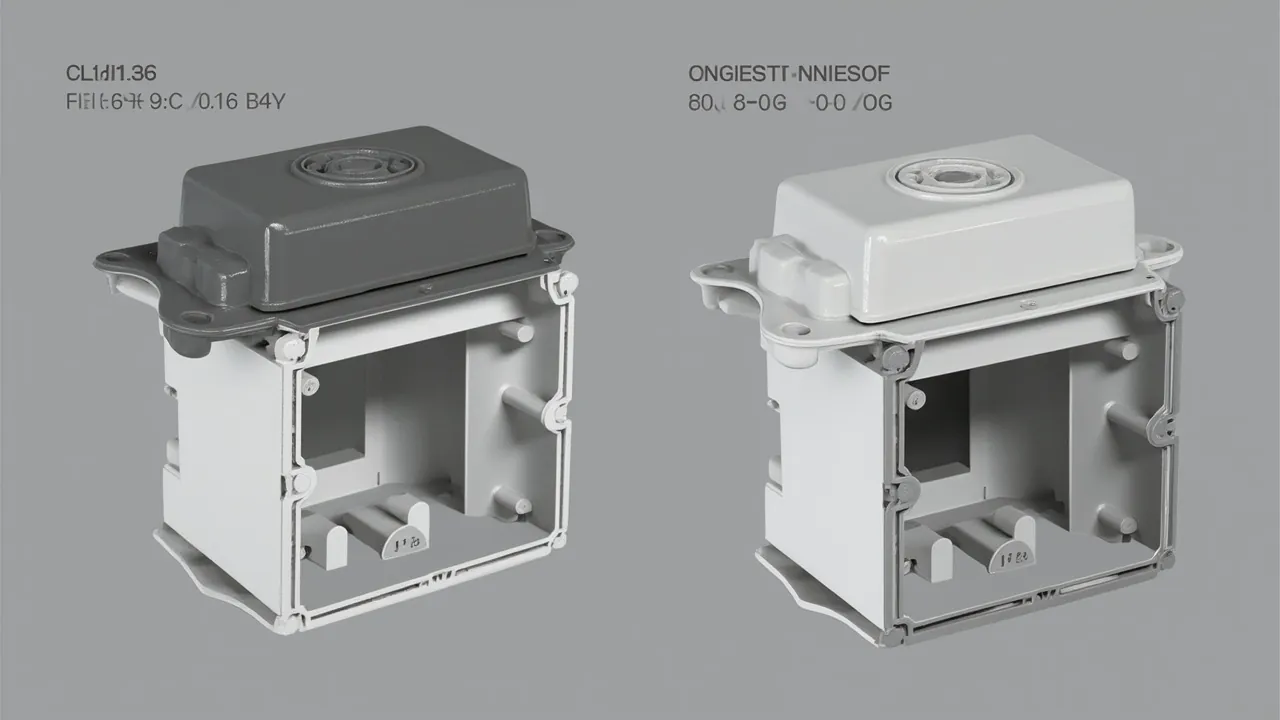
Taking a 200 by 200 millimetre ABS enclosure to IP67 costs roughly five to eight times the equivalent plain box. The money goes here.
| Cost element | Standard box | Waterproof enclosure | Comment |
|---|---|---|---|
| --- | --- | --- | --- |
| Resin | General-purpose ABS, sometimes regrind | Virgin material with UV stabiliser | Regrind gives unpredictable weathering and impact |
| Tooling and process | Simple tool, 0.5 millimetre tolerance | Precision tool, 0.1 to 0.2 millimetres on sealing faces | Accuracy determines whether it can be compressed |
| Seal | None or foam strip | Solid silicone or EPDM, often moulded | Can be 10 to 20 percent of unit cost |
| Metal parts | Self-tapping screws | Stainless screws plus inserts | Allows repeated opening with controlled torque |
| Accessories | None | Glands, plugs, sometimes vent | Often equal to the housing in price |
| Third-party testing | None | Several thousand yuan per type test | Amortised over volume; uneconomic in tiny batches |
| Quality control | Sample inspection | Batch or proportional immersion sampling | A significant hidden cost for real manufacturers |
Two lessons follow. First, extremely low prices cannot genuinely deliver IP67, because type testing alone is a hard threshold that few small batches can amortise. Second, do not load the whole budget into the housing. Glands and plugs account for 30 to 40 percent of the cost in many configurations, and fitting cheap ones drags the whole assembly down to their level.
Where a Standard Box Is Enough
More protection is not automatically better, and specifying it in the wrong place wastes money.
Standard boxes suit flush mounting in dry interiors, involving recessed wall boxes and pull boxes; component and terminal enclosures installed inside a distribution or control cabinet; anything already inside a protected equipment shell; and surface trunking systems in dry rooms, provided humidity stays low.
The test is simple: can water in any form reach the outside, and is there dust? If both answers are no, spend the money elsewhere. Beware two traps. No water today does not mean none ever: a semi-external corridor about to be refurbished is a classic case. And a process that makes no dust today frequently does within six months.
Another recurring mistake is wrapping an already IP67 product in a standard box or tape for extra safety. This usually backfires, because the outer box is not dust-tight and creates an interspace that collects dust and water, leaving the inner IP67 item permanently wrapped in damp.
Three Traps When Retrofitting to Waterproof
Three errors dominate retrofit work.
Trap one, compromising on size. Existing apertures were cut for the old box, and a thicker waterproof replacement will not fit. The tempting answer is to find one that fits and accept IP54. The correct answer is to enlarge the opening or change to surface mounting. If the aperture genuinely cannot move, specify a product that reaches IP67 in a slimmer industrial design rather than relaxing the requirement.
Trap two, assuming the box alone delivers the upgrade. A new IP67 housing still using its old knockouts with tape, or reusing plugs without seals, performs at the level of its weakest accessory. Retrofits must replace glands, plugs and screws together and be tightened to the manufacturer's torque.
Trap three, skipping verification. Energising straight after retrofit means that when trouble appears three months later nobody can tell whether the new enclosure or the existing conduit was responsible. Always perform at least a low-pressure spray screen when retrofitting, ideally a simplified immersion check, and record the outcome in the register.
Three Levels of Site Verification
Site conditions cannot replicate a laboratory, but three descending levels of verification are available.
Level one, visual and tactile inspection: every unit, two minutes. Confirm the seal is complete and free of twists and cuts, the groove is clean, all screws are present and identical, spare openings are closed with sealed plugs, and no gland O-ring is missing. This level screens out assembly defects, which account for well over half of real problems.
Level two, spray screening: every critical position, ten minutes. Rinse from all directions for five minutes at low pressure using a garden sprayer or a hose on a gentle setting, concentrating on the four corners, around the glands and along the upper edge of the mounting face, then open and wipe the interior with tissue. This catches uneven compression, debris trapped in the joint and most gland assembly faults. Do not use a pressure washer close up, since that exceeds what most products are tested against and will soak even sound units.
Level three, immersion screening: sampling high-risk positions, thirty minutes to two hours. Submerge the box unenergised and without expensive modules, ensuring the lowest point sits at least a metre below the surface, or falling back to at least 0.3 metres for thirty minutes where that is impractical. Where conditions allow, follow IPX7 to IEC 60529 in full. Confirm the interior is dry beforehand, add a humidity indicator card if useful, dry the outside carefully before opening. Parameters and common pitfalls appear in Can an IP67 Box Really Be Submerged: The 1-Metre 30-Minute Immersion Test.
Two points apply across all three levels. Test in the actual condition existing after installation rather than testing an empty box, because installation changes compression. And record every test, with date, operator, method and result, ideally logging the serial numbers of units that were sprayed or immersed for future traceability.
Writing the Purchase Enquiry
The preceding content reduces to nine clauses that belong in every enquiry. Leaving any one out invites disagreement later.
- Standard and edition. Name IEC 60529 or GB/T 4208-2017 and state which clauses were actually used.
- Complete rating. Write IP66 or IP67, never IPX7 unless dust testing genuinely is not required. Where both powerful jets and immersion apply, write "test data required for both IPX6 and IPX7."
- Scope. State whether glands, plugs, vents and windows are included, and require a report covering the configured product.
- Material and colour. Identify ABS, polycarbonate, steel or stainless, and whether UV stabilisation is needed, which is mandatory outdoors.
- Dimensions and openings. Provide overall size, usable internal dimensions, an opening layout drawing and thread system, PG or metric.
- Accessory schedule. Gland types and quantities, plug types, whether a vent is required, and whether DIN rail or mounting plate is needed.
- Documentation. Third-party report number and validity, material certificates, stated tightening torques and any required conformity markings.
- Packing and transport. State whether stacking is permitted and whether individual protection is needed, to avoid seals sitting compressed during transit.
- Acceptance basis. Agree sampling rate on delivery and which of the three verification levels applies.
Writing those nine clauses brings a side benefit: the list becomes the basis for comparing quotations. Where two prices differ widely, checking line by line usually reveals either missing third-party documentation or substituted low-grade glands.
Frequently Asked Questions (FAQ)
Q: Can a standard box with a bead of sealant reach IP67? A: No. Sealing comes from a system rather than a part. It requires a locating seal groove, a solid profile of correct section and hardness, stainless clamping with stated torque, adequate clamping density and a deflector outside the sealing line. Adhesive supplies a fraction of that and introduces problems of its own: it bonds lid to body so the unit cannot be opened again for maintenance, uneven bead thickness lifts the lid and makes compression worse, and over time it yellows, hardens and cracks. Where protection is genuinely needed, replace the product with a type-tested one.
Q: Can an IP67 enclosure be mounted upside down with the lid facing up? A: Not recommended, and it is the attitude most often overlooked. Testing is performed in the attitude the manufacturer declares as normal service, which rarely includes lid-upwards. With the lid facing the sky, rainwater ponds against the sealing line, ultraviolet concentrates on the top face, and the gasket ages several times faster under the combination of standing water and direct sun. If the wiring demands it, mount sideways and add a rain cover, or choose a model validated for that attitude.
Q: Where both dust and water matter, how should the rating be written? A: Write both numerals, for instance IP66 or IP67. The first numeral 6 means dust-tight and the second covers water. Never reduce it to IPX7, because X literally means that digit was not tested, leaving no dust assurance at all. If the location sees both pressure washing and ponding, write "third-party data required for both IPX6 and IPX7," since IEC 60529 does not allow compliance with a higher code to infer compliance with lower ones.
Q: What separates a cheap waterproof box from an expensive one, and can it be judged by appearance? A: Three checks. Look at the clamping: are stainless screws running into metal inserts, and are the points evenly spaced, typically 100 to 150 millimetres for IP67? Self-tapping screws driven straight into plastic usually indicate low-grade construction. Look at the seal: solid silicone or EPDM with a regular section and a mitred joint rather than a butt joint, since foam strip or thin sheet will not reach IP67. And test the paperwork: can the supplier produce a third-party report immediately, complete with number, sample configuration and test parameters, rather than a self-declaration saying compliant with IP67? Paintwork and thickness tell you nothing.
Q: Is a metal waterproof enclosure always better than plastic? A: No. Metal's strengths are heat dissipation, electromagnetic shielding and impact resistance; plastic's are insulation, low weight, salt spray resistance and the ability to mould complex sealing geometry. Two counterexamples are common. Folded and welded metal shells struggle with flatness and often cannot reach IP67. And on the coast an aluminium housing with damaged coating pits and develops white rust quickly, while UV-stabilised ABS lasts eight to ten years. Judge on the actual requirement, meaning heat, shielding, corrosion and weight, rather than on the price of the raw material.
Q: Can a standard box be used outdoors under cover? A: Yes, provided "under cover" is defined properly. Beneath eaves, inside balconies and on sheltered plant decks, IP44 to IP54 suits the duty and IP67 would be waste. Watch three exceptions: positions reached by traffic spray or wind-driven rain, which count as exposed even with a roof; spots that drain badly and splash the base of the box during rain; and locations attracting web-building insects or birds, whose activity cancels the benefit of shelter. When in doubt take the higher grade, since the difference is small beside one repair visit.
Q: The contract said IP67 and the delivered units still gave trouble. Why? A: Usually because three things went unwritten. The standard edition and test parameters, since "complies with IP67" carries nothing verifiable. The scope, because the report covered the enclosure body while the failure occurred at a gland. And the delivery and acceptance basis, so nobody knows whether type testing, sampling or immersion checks were actually performed. The remedy is to copy the nine clauses from the enquiry section into the contract annex and agree both sampling on delivery and a post-installation spray screen.
Q: The old waterproof enclosure still looks usable. Should it stay alongside the new one? A: Replacing is normally the better course. Almost all the value sits in the seal and clamping, and both are hard to judge after several openings: the seal may have taken a permanent set, threads may be stripping, and the housing may have embrittled under ultraviolet. Old units make acceptable temporary spares but should not remain the active installation in a formal project. Where reuse is unavoidable, renew seal, screws and glands as a complete set and prove it with the three-level verification before returning it to service.
Closing Notes and Further Reading
To return to the opening question, what does the price difference buy? It buys an assurance that can be verified. A standard box guarantees that joints are not left hanging in the open. A waterproof enclosure guarantees that under defined conditions, defined forms of water and dust will not get in, and that assurance can be checked against a third-party report, rechecked by spray and immersion testing, and used afterwards to establish where responsibility lies.
Three sentences cover the essentials for purchasing. Write both numerals in full and never use X. Extend the rating to the glands, not just the housing. And verify after installation rather than before. Those three habits prevent the great majority of problems.
JUNZHJIA builds its waterproof junction box and sealed enclosure range at its Zhongshan plant covering IP65 through IP68, supplying glands, plugs and vents rated to match the housing, with OEM and ODM service, wholesale volumes and worldwide delivery.
Further reading