

Quick answer: A weather station case has to hold for 90 days alone: a 20 W panel brings 70 Wh a day, a 1.8 W load takes 43 Wh, and 288 Wh empties in 6.7 days.
Table of contents
- What ninety unattended days ask of a weather station case
- A 20 W panel against a 1.8 W load
- When the rain runs seven days
- Where 0.4 mL of condensate goes
- Splitting the moisture work
- FAQ
1. What ninety unattended days ask of a weather station case
Two visits a year is the rhythm at a ridge-top site. Between them nobody opens the lid and no mains cable arrives. The weather station case stays shut for 90 days with three budgets to protect: energy in, vapour in, and the afternoon-to-dawn swing.
None looks serious alone: a tenth of a day of charge, 0.4 mL of water, a 25 ℃ drop after sunset. Over a quarter they compound.
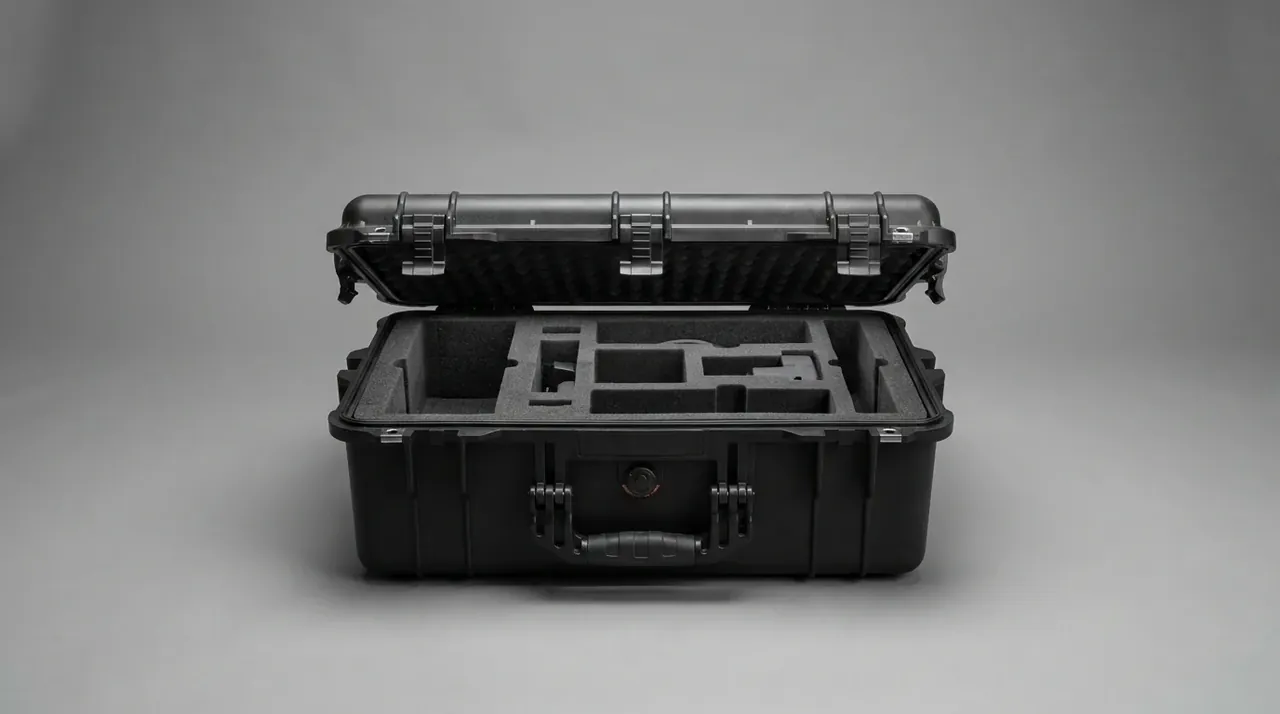
The weather station case makes no power and dries no air. Its job is to hold the margins of panel, battery and desiccant in a small volume so outside change arrives slowly. Wall thickness says very little about that.
Energy is the budget that runs out first.
2. A 20 W panel against a 1.8 W load
A 20 W panel at 3.5 peak-sun hours yields 70 Wh. Controller losses at 12% leave 61.6 Wh at the terminals; a 1.8 W load around the clock takes 43 Wh. The 18.6 Wh left over is not free storage: round-trip losses, self-discharge and overcast debt come out of it.
| Load W | Daily Wh | Days to empty |
|---|---|---|
| 2.6 | 62 | 4.6 |
| 1.8 | 43 | 6.7 |
| 1.2 | 29 | 9.9 |
288 Wh is 12 V times 24 Ah. Divide by 43 Wh and 6.70 days appears, just under the seven-day window most specs assume. Three tenths of a day is not rounding: seven sunless days at full load take the battery to zero.
So seven days is not pass or fail: it is a condition that caps depth of discharge at 70%: 202 Wh usable, 4.7 days. A larger panel or a second battery closes the gap expensively; the cheap fix is to stop drawing 1.8 W after dark. At 1.2 W the average falls to 29 Wh and 9.9 days, 2.9 days spare. The price is a longer logging interval and a battery bay held within 5 ℃.
3. When the rain runs seven days
The storage and working range for a weather station case of this class is -20 ℃ to 50 ℃, and temperature moves autonomy in a curve, not a line. At -20 ℃ usable capacity falls to 80%, so 288 Wh behaves like 230 Wh and 43 Wh a day gives 5.4 days. Heat bites differently: at 50 ℃ inside, charge current is limited to 70% of rating.
| Days of autonomy | Usable Wh | Precondition |
|---|---|---|
| 9.9 | 288 | Night load held at 1.2 W |
| 6.7 | 288 | 20 ℃, full discharge |
| 5.4 | 230 | -20 ℃, capacity at 80% |
| 4.7 | 202 | Depth of discharge capped |
Four rows, four ways to run one box: a row fixes panel, battery and load together, and choosing the shell first lands designs at the bottom.
What matters is not how many days the weather station case survived but how long it takes to recover: at 61.6 Wh in and 43 Wh out, a 202 Wh debt needs 11 days, and a second wet spell inside them ends the site.
4. Where 0.4 mL of condensate goes
Take the weather station case at 20 L of internal volume, 35 ℃ at 70% RH in the afternoon, 10 ℃ before dawn. Each cubic metre gives up about 18 g of water across that swing; at 20 L it is 0.37 mL, rounded to 0.4 mL a day. No rain, no immersion — the temperature swing alone does it.
Ninety days is 36 mL. Spread over the floor it is a film, yet it does not stay: vapour by day, liquid on the lid's inner face and the lowest corner by night. A compressed gasket cannot stop it: the source sits inside.
Holding internal humidity at or below 60% RH is the working limit. Above it, condensate on the lid merges into sheets and runs down the ribs; far below it, rubber parts harden. The 60% line is 13.8 g per cubic metre at 25 ℃, a band the daily warm-up can flush.
5. Splitting the moisture work
100 g of silica gel holds about 20% of its mass at 60% RH, so 20 mL of water. Against 36 mL a quarter it saturates halfway, and the rest of the term is spent watching water reach the floor.
The vent covers the remainder. An ePTFE membrane passing 0.8 L/min at 10 kPa pushes warmed, pressurised air out by day and draws drier air back at night. At 40% net retention, 90 days leaves about 14 mL — within the 20 mL capacity, with 6 mL spare.
A vent does not break IP66: the membrane stops liquid and passes gas, and a 1 m, 30 min immersion test still forbids a continuous bubble stream. The real risk is a membrane fouled with mud: below 0.2 L/min the gasket takes the difference and the joint weeps.
At the 90-day visit, weigh the desiccant. A gain above 15 g means the quarter's moisture budget is spent.
Conclusion
For a weather station case the real test is a 90-day balance sheet. A 20 W panel brings 70 Wh, a 1.8 W load takes 43 Wh, and 288 Wh empties in 6.7 days, so the seven-day rain window stays short by three tenths of a day until the night load drops. Moisture runs the other column: 0.4 mL a night becomes 36 mL a quarter, the vent carries off six tenths and 100 g of silica covers the rest. Settle both columns at drawing stage and nobody drives up the hill twice.
Related Reading
- Case materials at low temperature
- UV ageing and colour choice outdoors
- Pressure equalisation valve versus breather vent
- Where an outdoor pressure valve stops being useful
Related Products
- 8 Series — Gun Cases; Military Equipment Cases; Camera Equipment Cases; Drone Cases; Watch Cases; Knife Cases; First Aid Cases; Electronics Equipment Cases
- WL8-2812 PP Gun Case — model WL8-2812
- All protective cases and toolboxes: 7 series, 158 models