

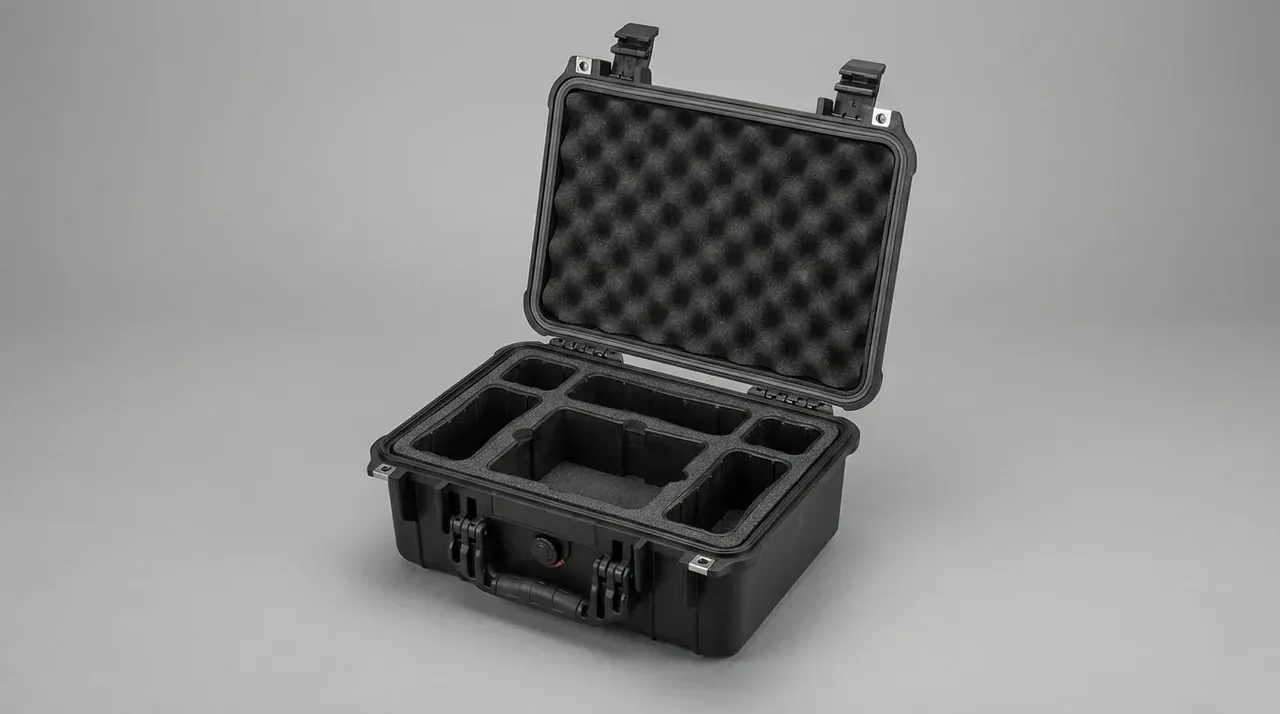
Quick answer: Case foam replacement hinges on one test: press 3 s, and if the dent lasts 5 min with set above 15%, the insert is spent. Replace it.
Table of contents
- The first test: 3 s press and 15% set
- Checking the EVA 45 kg/m³ baseline
- Measuring 2 mm wall collapse
- Mould, odour and the 24-month cycle
- Post-fit checks and old foam recovery
- FAQ
1. The first test: 3 s press and 15% set
Foam that still looks fine may already have stopped working. Press a thumb into the most loaded spot for 3 s and let go: a surface that comes back within 5 s still has life, a dent still visible at 5 min means it has lost the argument.
Numbers settle a case foam replacement decision. Cut a 10 mm sample, compress it to 25% of thickness, leave it 24 h, release and measure after 30 min: above 7.5 mm means set is inside 15%, below that the fit is over.
Why 15% and not 25%? Foam must hold 0.5 mm to 1 mm of interference between load and wall. Set eats 15% of the thickness, that interference disappears and the load floats 3 mm, hitting foam, then wall, then floor.
Sampling position beats caliper precision. The loaded zone dishes, so a centre-only reading overstates ageing; take 5 points across centre and corners, and a point 1 mm off the mean means the sheet was cut unevenly.
| Criterion | Tool | Fail line | Recheck |
|---|---|---|---|
| Recovery | Thumb, 3 s | Dent at 5 min | Monthly |
| Compression set | 0.02 mm caliper, 5 points | Above 15% | 12 months |
| Thickness | Caliper vs original | One point 1 mm low | With set test |
| Collapse | Depth gauge | Above 2 mm | 6 months |
| Mould | Eye, torch | 3 spots over 5 mm | Monthly, humid season |
2. Checking the EVA 45 kg/m³ baseline
The nominal density of EVA inserts here is 45 kg/m³, and that number decides whether the sheet survives 40 kg of equipment and a 1.2 m drop. Verifying it is crude work: cut 100 mm × 100 mm × 50 mm, which is 500 cm³, expect 22.5 g, and accept 21.4 g to 23.6 g, a ±5% window, on a 0.1 g scale.
Density 10% under baseline means thinner cell walls and collapse within 3 months; 10% over means slower recovery and worse shock absorption. If a new insert for a case foam replacement weighs 19 g instead of 22.5 g, ask which batch it came from.

| Sample | Volume | Expected | Acceptable |
|---|---|---|---|
| 100 × 100 × 50 mm | 500 cm³ | 22.5 g | 21.4–23.6 g |
| 50 × 50 × 50 mm | 125 cm³ | 5.6 g | 5.3–5.9 g |
| 100 × 100 × 50 mm | 500 cm³ | 19.0 g | Reject, near 38 kg/m³ |
Density inside one batch should stay within ±3%. A spread above 1.5 g across three samples means regrind, whose cells age about twice as fast as virgin sheet, and the check takes 10 min against three months of rework.
3. Measuring 2 mm wall collapse
Collapse is about the walls, not the floor. Lay a steel rule across the cavity mouth as a bridge, drop a depth gauge vertically to the deepest point of the wall, and subtract from the original depth: anything over 2 mm is collapse. Read 4 corners and the centre of every cavity, and the deepest point decides.
The consequence is loss of grip. With wall squareness off by 0.5 mm the load shifts 3 mm sideways and transport vibration turns into impact, while the foam surface still looks untouched, which is why case foam replacement cannot run on appearance.
Collapse has three sources: long compression, moisture uptake then shrinkage, and cut-edge fatigue. EVA held at 40 ℃ and 80% RH for 72 h takes up about 8% of its mass in water and never returns to full thickness, and a batch that waited three weeks at a wet-season dock came back 2.5 mm shallow.
Record direction too. Collapse at the handle side means one-sided carrying, even collapse at four corners is the load's weight, and a single bad cell means an oversized item has been pushing the wall out.
Chart it as you go: sketch a plan view, write the readings in place and remeasure in three months. Anything above 1 mm of collapse per 6 months means the cavity was oversized.
4. Mould, odour and the 24-month cycle
Mould is the one criterion never to postpone. Three grey-green spots over 5 mm, or a sour smell within 10 s of opening, means the insert is saturated, and wiping will not fix hyphae grown into the open cells.
Environment sets the cycle. A dry shop opening twice a day schedules case foam replacement at 24 months; coastal sites and shipping move to 18; cold storage inspects at 12.
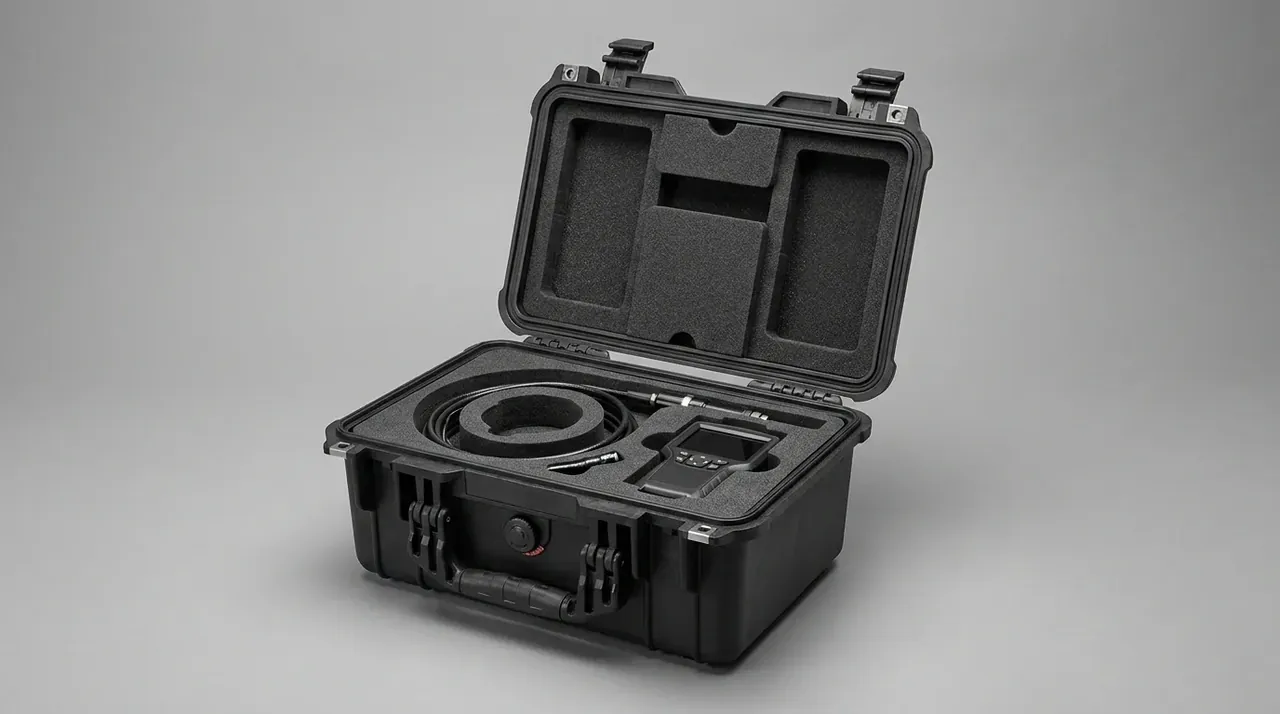
The clock starts at first wetting, not at the production date: from one batch, cases in a conditioned store lasted 5 years while cases under an open shed failed in 2, so log both dates.
Grade the smell. A faint adhesive note clears within 7 days; a sharp sour or musty smell means anaerobic growth, and that case needs 48 h open before new foam goes in.
Storage can stretch the interval. Leave the case open when empty, since a closed lid keeps the foam under load and set accumulates while it sits idle; hold the store under 60% RH so EVA takes up moisture half as fast. Stacked against an outside wall, the reverse happens and mould starts on the hidden back face.
5. Post-fit checks and old foam recovery
Measure before latching. Cavities should leave 0.5 mm to 1 mm to the item outline and 2 mm of compression in depth. Lid closed, the seam stays under 1 mm and a thumb on the centre sinks no more than 1 mm.
Material cost runs about 38 per set, one 30 mm cut sheet plus a 10 mm pad, and refitting takes 40 min for strip-out, cleaning, fitting and checking. Labour is more than half the cost, so one correct case foam replacement beats two experiments.
Old inserts split two ways. Clean EVA offcuts hot-press into pallet blocks at roughly 3 per 1.2 kg set, while adhesive or flocked foam has no recovery value and leaves as general waste. Shake the crumbs out first.
| Condition | Action | Interval | Cost |
|---|---|---|---|
| Set under 10% | Keep, check | 6 months | 0 |
| Set 10–15% | Patch or shim | 3 months | 6 |
| Set above 15% or 2 mm collapse | Replace | Now | 38 |
| Mould or odour | Replace, air 48 h | Now | 38 plus 2 h |
| Squareness over 0.5 mm | Replace, remeasure | Now | 38 plus 30 min |
Conclusion
Case foam replacement runs off one table: keep the insert while set stays under 10%, patch between 10% and 15% and recheck in 3 months, replace the sheet above 15% or at 2 mm of wall collapse, replace and air the case for 48 h at three or more mould spots, and remeasure the cavity when wall squareness passes 0.5 mm. Start the clock at first wetting, then plan 24 months in dry shops, 18 on the coast and 12 in cold storage, since at 38 per set plus 40 min of labour a second attempt always costs more.
This article discusses container-side specifications and design implications only, and does not cover any handling, loading or use of the contents.
Related Reading
- Three ways to replace a foam insert
- Foam lining structure and thickness
- Building cavities with pick-and-pluck foam
- Relining and recutting foam inserts
Related Products
- 8 Series — Gun Cases; Military Equipment Cases; Camera Equipment Cases; Drone Cases; Watch Cases; Knife Cases; First Aid Cases; Electronics Equipment Cases
- WL8-2812 PP Gun Case — model WL8-2812
- All protective cases and toolboxes: 7 series, 158 models