

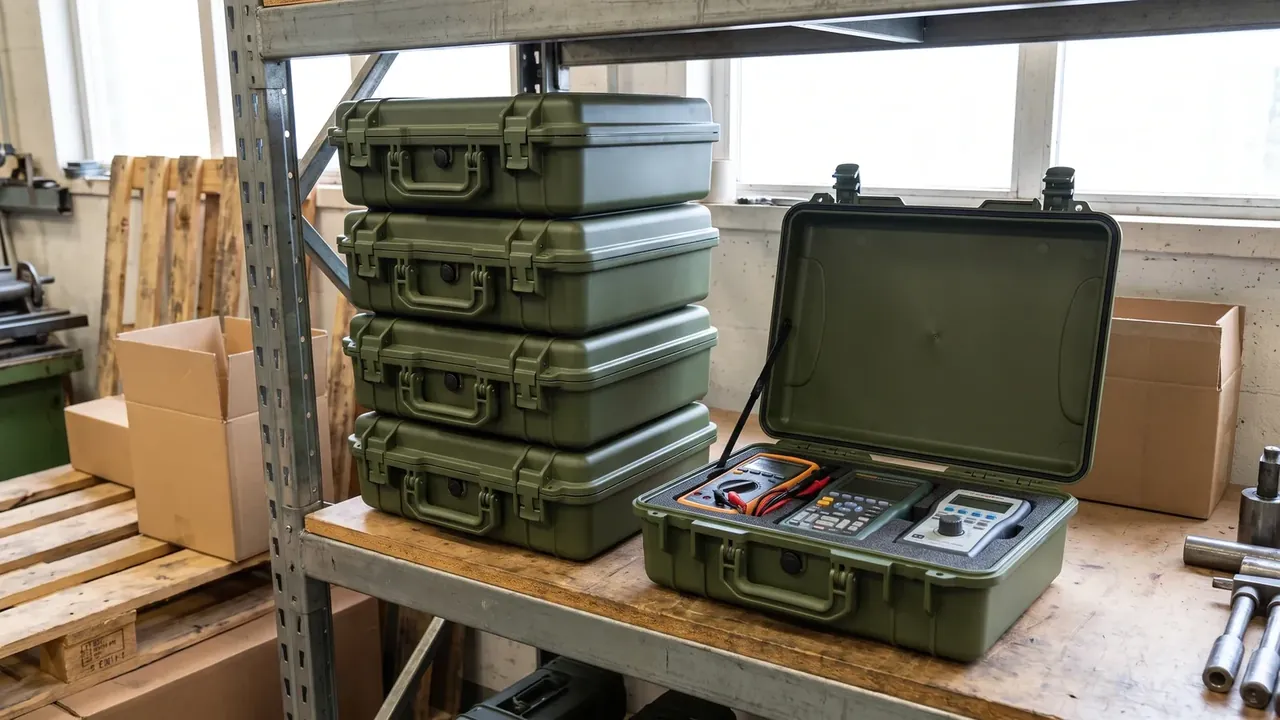
Quick answer: Wireless microphone & soundcard moisture-proof case: 420×320×180 mm outside, 370×270×140 mm inside, an 8 mm seal squeezed 22 percent, 100 g of desiccant.
Table of contents
- Three parts in series, not one rating
- An 8 mm seal at 22 percent
- 100 g of desiccant, counted in openings
- Three dots on the humidity card
- A 6 kPa valve, a 1.0 m drop and −10 °C to 55 °C
- FAQ
1. Three parts in series, not one rating
Moisture control in a wireless microphone & soundcard moisture-proof case is three parts in series: seal, desiccant, indicator card. They fail in a fixed order: seal first, desiccant second, card last, so a card at 60 percent means the other two have been failing for a while.
The wireless microphone & soundcard moisture-proof case is 420×320×180 mm outside with a 3.0 mm wall, 370×270×140 mm inside, 3.0 kg empty, 6.5 kg loaded, 9.5 kg in total. The cavity takes three grey foam pockets; the lid carries 20 mm egg-crate foam.
Table 1: what each barrier does
| Barrier stage | Job | Key figure |
|---|---|---|
| Seal | keeps vapour and splash out | 8 mm wide, 22 percent squeeze |
| Desiccant | absorbs what openings admit | 100 g, 12 g usable |
| Indicator card | reports internal humidity | 3 dots, 10 / 40 / 60 percent |
| Pressure valve | equalises temperature differential | opens at 6 kPa |
Only the seal wears; the other three are spent by count.
2. An 8 mm seal at 22 percent
In the wireless microphone & soundcard moisture-proof case the seal is an 8 mm EPDM lip in a lid groove. Closed, it is squeezed 22 percent, 1.76 mm, leaving 6.24 mm. The line runs 2×(370+270)=1 280 mm and reacts at about 200 N; two latches at 280 N give 560 N, a factor of 2.8.
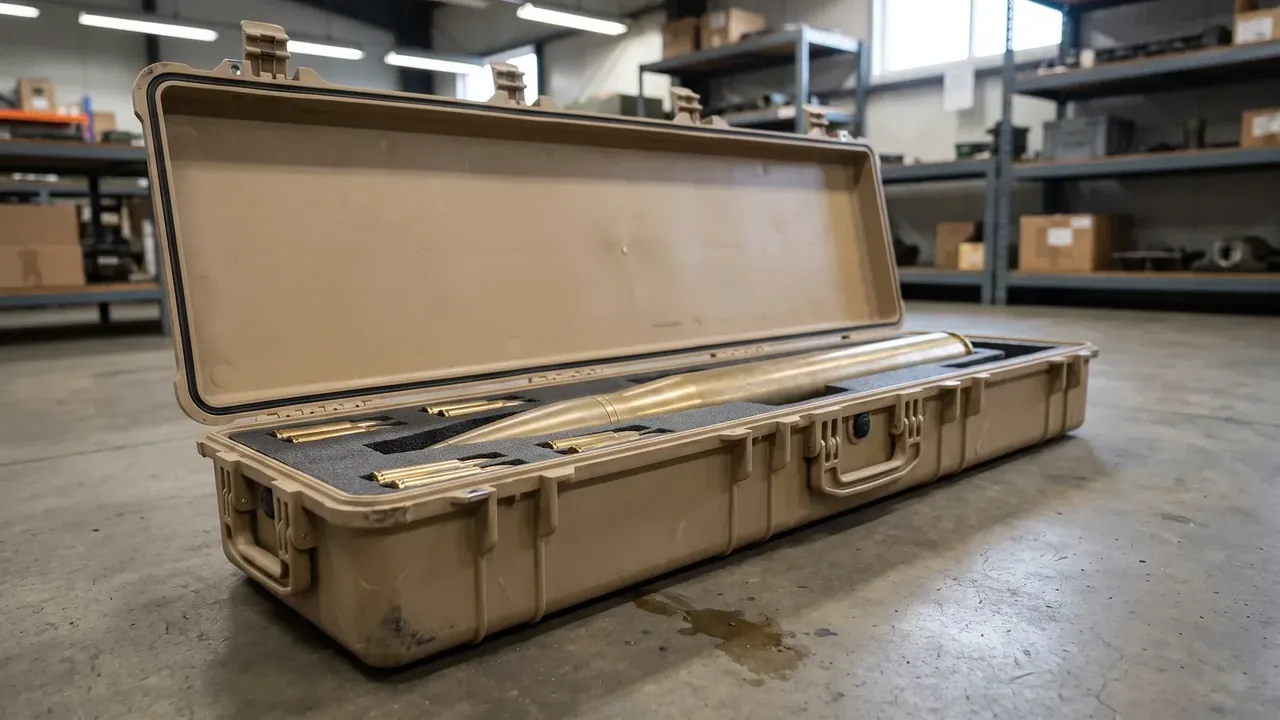
The squeeze falls: EPDM takes a permanent set, and after 3 000 openings the same latch closes on 18 percent, 1.44 mm, 0.32 mm below new. Under 10 kPa of a 1 m water column that gap is a continuous path, which is what IP67 at 1 m for 30 min tests.
Starting at 25 percent lifts the reaction to 240 N; the latches still hold, but the lid is harder to break open, so 22 percent sits between a 3 000-cycle life and one-hand opening.
3. 100 g of desiccant, counted in openings
The wireless microphone & soundcard moisture-proof case cavity is 0.014 m³. Air at 30 °C and 80 percent RH carries about 24 g/m³, so one opening exchanges roughly 0.3 g of water. Openings, not days, are the real budget.
At 40 percent RH 100 g of silica gel holds about 12 g, not half its weight. Twelve grams over 0.3 g gives 40 openings: ten days at four a day, three at twelve. Same shell, same sachet, a threefold spread the opening count explains.
Table 2: three ways the barrier fails
| Failure mode | Early sign | When it appears |
|---|---|---|
| Seal takes a set | groove looks shallow, lid closes light | 3 000 openings |
| Desiccant saturates | card turns at the 40 percent dot | about 40 openings |
| Lip scratched | local leak, card jumps to 60 | grit left in the groove |
The second is the one people miss: nothing moves, only the card knows.
4. Three dots on the humidity card
In the wireless microphone & soundcard moisture-proof case the card carries three patches: 10 percent dry, 40 percent ceiling, 60 percent replace. Three rather than five is about reading cost: large patches read through the lid, five-dot cards need the eye close enough to separate neighbours.
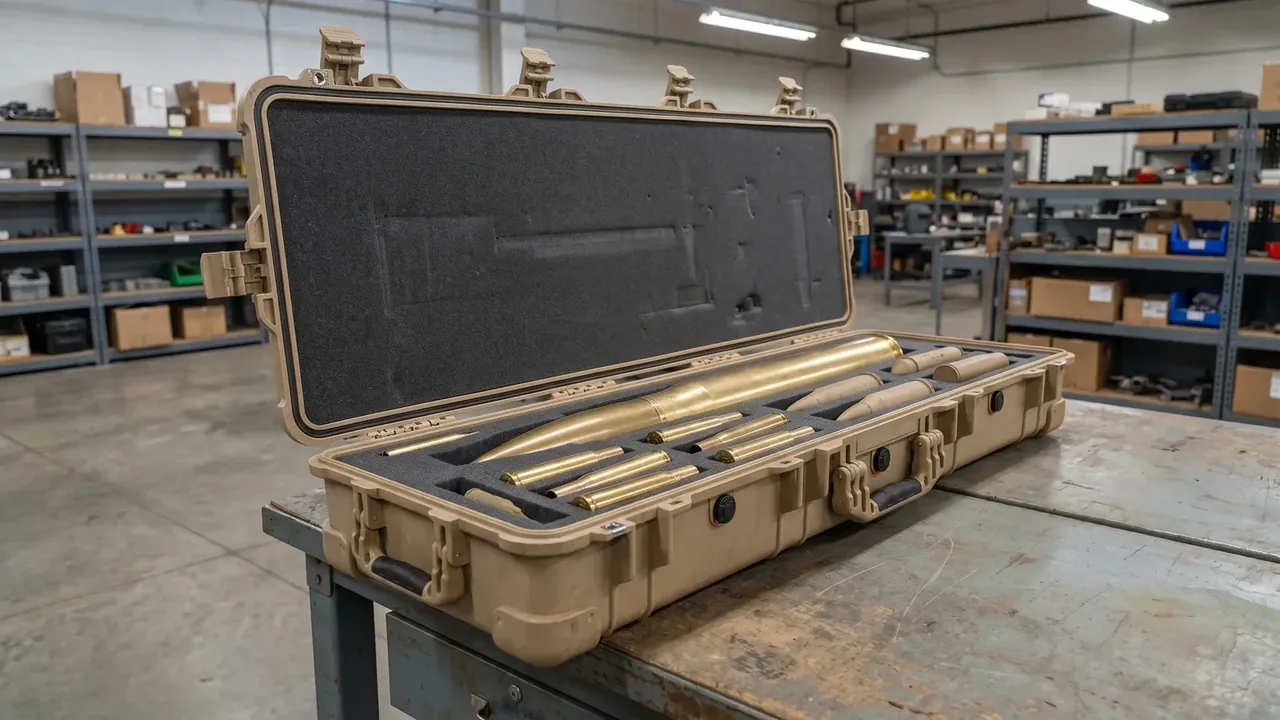
Forty percent RH is a band, not a floor to chase. Below 10 percent the foam and seal stiffen and the lid keeps a permanent groove. The card also drifts with heat, reading about 5 points drier near 55 °C; read it two minutes after opening.
5. A 6 kPa valve, a 1.0 m drop and −10 °C to 55 °C
The wireless microphone & soundcard moisture-proof case valve opens at 6 kPa, a figure about temperature rather than altitude. A sealed box moving from 20 °C to −10 °C crosses 30 K, roughly 10 kPa across a 3.0 mm wall, and past 6 kPa it vents; without that the lid is sucked down and the latches release without lifting it. The membrane is expanded PTFE, so air passes and 10 kPa of 1 m head does not, which is how IP67 and a valve coexist.
Drop tests run at 1.0 m with 9.5 kg aboard, once per face: no latch opens, no pocket collapses, no lid gap beyond 1.5 mm.
IP67 at 1 m for 30 min rests on the seal plus 0.3 mm of lid flatness. The −10 °C to 55 °C range is what PP and EPDM take: at −10 °C the seal needs a moment to seat, at 55 °C compression set accelerates and the 3 000-cycle life is discounted.
Table 3: control values and how to check them
| Control value | Pass condition | Check method |
|---|---|---|
| 22 percent squeeze | 1.76 mm closed, 6.24 mm left | feeler gauge at the lid line, quarterly |
| 40 percent RH inside | 40 percent dot unchanged | look each time the lid opens |
| 12 g usable absorption | replace after 40 openings | count openings, not calendar |
| IP67 at 1 m / 30 min | lid flatness 0.3 mm | 3 units per batch |
Conclusion
A wireless microphone & soundcard moisture-proof case holds 40 percent RH through three parts that fail in order, not a water rating alone. The 8 mm seal closes at 22 percent and falls to 18 percent after 3 000 openings, and the 0.32 mm difference is where the leak starts. Desiccant capacity of 12 g against 0.3 g per opening sets a 40-opening change, and the three card dots watch the band from 10 to 60 percent. Keep the three in sequence and the 6 kPa valve keeps its meaning.
Related Reading
- Seal, desiccant and indicator: the three parts of a moisture-proof case
- Sealing grades and desiccant change intervals
- Microphone case storage and transport choices
- Moisture control when cases are stacked in a warehouse
Related Products
- 8 Series — Gun Cases; Military Equipment Cases; Camera Equipment Cases; Drone Cases; Watch Cases; Knife Cases; First Aid Cases; Electronics Equipment Cases
- WL8-2812 PP Gun Case — model WL8-2812
- All protective cases and toolboxes: 7 series, 158 models